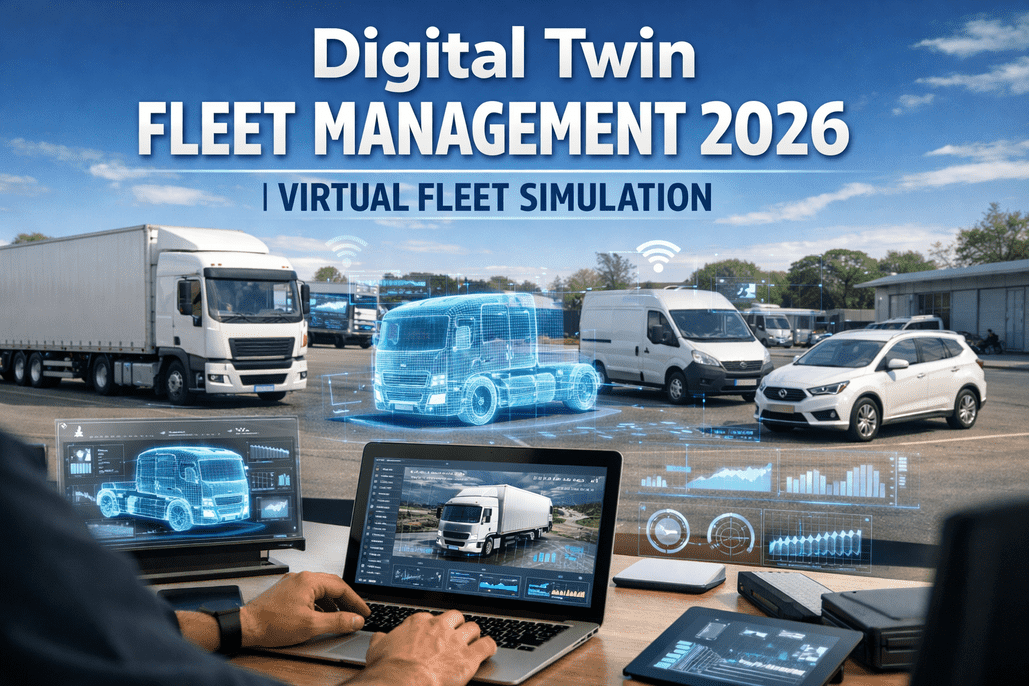
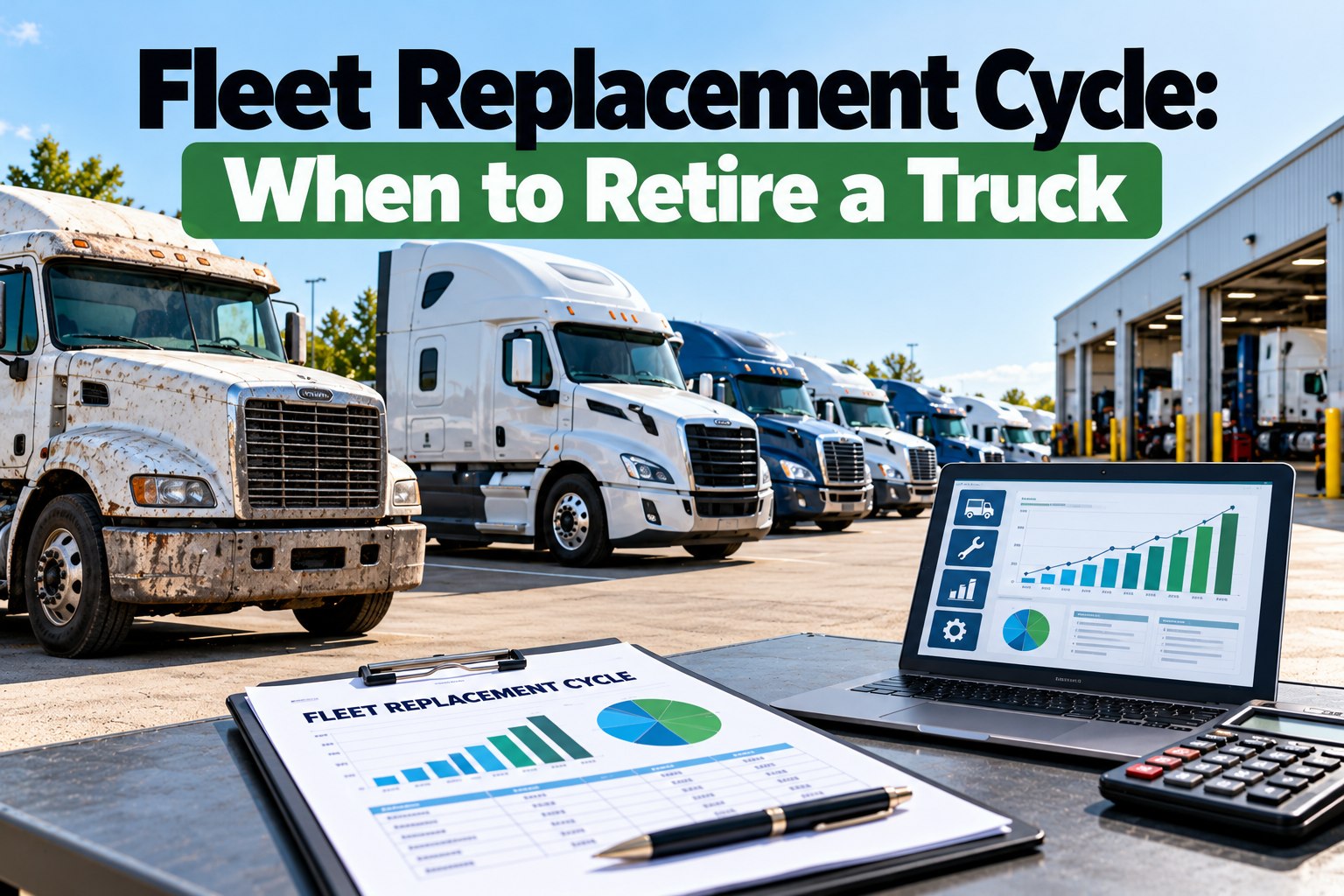
A digital twin is a continuously updated virtual replica of a physical asset — in fleet management, that means a software model of every truck, trailer, and engine in your operation that mirrors real-time condition, performance, and behavior. Not a static dashboard. Not a GPS dot on a map. A living simulation that predicts what will fail, when it will fail, and what to do about it before it happens. The global digital twin market hit $36 billion in 2025 and is projected to reach $49 billion in 2026, growing at 35%+ CAGR. Automotive and transportation already account for over 22% of all digital twin spending. The shift from reactive monitoring to predictive simulation is reshaping how fleets manage maintenance, fuel, routes, compliance, and total cost of ownership. Book a demo to see digital twin fleet management in action.
How a Vehicle Digital Twin Actually Works
A digital twin is more than sensor data on a screen. It's a four-layer system where each layer builds on the one below it to turn raw data into automated decisions.
Layer 4: Autonomous Action
The twin doesn't just recommend — it acts. Automated work orders triggered when component health drops below threshold. Dynamic route adjustments when the model predicts a breakdown risk. Maintenance parts pre-ordered before the driver reports a problem. The system closes the loop between prediction and execution without human bottleneck.
Layer 3: Predictive Simulation
AI models simulate future states. Given current turbocharger efficiency trends, when will this engine need service? If this driver continues current braking patterns, when will brake pads reach replacement threshold? The twin runs thousands of "what-if" scenarios against your fleet's actual operating conditions — not generic manufacturer estimates. This is where digital twins separate from telematics.
Layer 2: Virtual Model
Software replicates the truck's mechanical, electrical, and operational characteristics. Engine behavior models, transmission wear curves, aftertreatment system health, tire degradation patterns, and brake system performance — all calibrated to each specific vehicle's history and operating environment. Modern Class 8 trucks have dozens of sensors feeding this model continuously.
Layer 1: Physical Asset + Sensors
The foundation: the actual truck with its embedded sensors, ECMs, telematics devices, and communication modules. GPS position, engine parameters, transmission behavior, aftertreatment conditions, brake health, tire pressures, fuel consumption, and driver inputs — streaming continuously via cellular or satellite connection. OEM platforms like Detroit Connect, Cummins Connected Diagnostics, and PACCAR Solutions already provide this data layer.
See Your Fleet's Digital Twin
In a 30-minute demo, we'll show you how FleetRabbit creates a virtual replica of every vehicle in your fleet — with predictive maintenance alerts, component health scores, and automated work orders that prevent breakdowns before they happen.
6 Ways Digital Twins Transform Fleet Operations
Digital twins don't just monitor — they simulate, predict, and optimize. Here are the six highest-value applications for commercial fleets.
Predictive Maintenance
The twin tracks component degradation curves for every engine, transmission, brake system, and aftertreatment unit in the fleet. When turbocharger efficiency drops 12% over 3 weeks, the twin predicts failure 2-4 weeks out and triggers a work order while the truck is still operational. Emergency repairs cost 3-5x more than planned maintenance; digital twins eliminate them.
Impact: Unplanned downtime reduced by up to 65%. Tire lifespan extended by nearly 50% with optimized rotation scheduling.
Fuel Efficiency Optimization
The twin models fuel consumption against engine load, route terrain, driver behavior, tire pressure, and ambient conditions. It identifies fuel-draining patterns invisible to traditional monitoring: a 2 PSI tire pressure drop that costs $400/year per truck, an engine running 3% rich due to a degrading sensor, a driver idle pattern that burns 0.8 gallons/hour unnecessarily.
Impact: Fleets using AI-powered digital twins report 15-20% reduction in operating costs through fuel and efficiency optimization.
Vehicle Lifecycle Management
When should you rebuild vs. replace an engine? When does a truck's total cost of ownership cross the threshold where replacement is cheaper than continued maintenance? The digital twin tracks cumulative wear, repair history, depreciation, and projected maintenance costs to generate data-backed keep/replace recommendations for every asset in the fleet.
Impact: Optimized replacement cycles reduce fleet TCO by 10-15%. Capital expenditure decisions backed by simulation, not spreadsheets.
Driver Behavior Analysis
The twin correlates driving patterns with vehicle wear and fuel consumption at the individual driver level. Hard braking events mapped to brake pad degradation rates. Aggressive acceleration correlated with transmission wear curves. Speeding patterns linked to tire wear acceleration. Coaching becomes specific and data-backed: "Your braking pattern on Route 45 is reducing brake pad life by 30%."
Impact: Targeted coaching from digital twin data improves safety scores and reduces component wear simultaneously.
Route and Load Simulation
Before dispatching, the twin simulates how a specific truck will perform on a specific route with a specific load. Will this 2019 Freightliner with 420K miles handle a mountain pass at full load without overheating? What fuel consumption should we expect from this truck on this lane given current engine health? The simulation runs before the wheels turn.
Impact: Route-vehicle matching optimization reduces breakdowns on demanding routes and improves fuel cost accuracy for quoting.
Compliance and Inspection Readiness
The twin continuously assesses each vehicle against DVIR requirements, DOT inspection criteria, and emissions standards. DPF regeneration issues, DEF quality problems, sensor failures, and brake system degradation are flagged weeks before they'd become a violation. The fleet is always inspection-ready because the twin knows what an inspector would find before they arrive.
Impact: Aftertreatment system failures — a top source of costly downtime — become predictable and preventable.
Want to see predictive maintenance, fuel optimization, and lifecycle management working together in a single platform? Book a 30-minute demo and we'll show you how FleetRabbit's digital twin capabilities work on real fleet data — from component health scores to automated work orders.
Digital Twin vs. Traditional Telematics: The Real Difference
Standard telematics tells you what happened. A digital twin tells you what will happen and what to do about it. The distinction matters for every maintenance, routing, and capital decision your fleet makes.
Tracks location, speed, fault codes — descriptive data
Alerts when thresholds are exceeded (reactive)
Data points displayed independently — no system interaction modeling
Same alert regardless of context (ambient temp, load, terrain)
Historical reporting — tells you what already happened
Maintenance scheduled by mileage or calendar intervals
Result: You know where your trucks are and what broke. You don't know what's about to break.
Models entire vehicle systems — how components interact and degrade together
Predicts failures weeks before they occur (proactive)
Contextual intelligence — factors in load, terrain, weather, driver behavior
Simulates future states — "what will happen if we keep running this truck?"
Prescriptive analytics — recommends specific actions with timing
Maintenance scheduled by actual component condition and predicted failure
Result: You know what will break, when, and what to do about it — before it costs you downtime.
2026 Trending: Cognitive Twins, Edge AI, and Fleet-Wide Simulation
Digital twin technology for fleets is advancing rapidly. These three trends are defining the next generation of fleet intelligence.
Cognitive Digital Twins with Self-Learning AI
Next-generation twins don't just simulate — they reason. Cognitive digital twins integrate machine learning that improves prediction accuracy with every mile driven. Companies using digital twins report 65% reduction in unplanned downtime, 62% improvement in asset utilization, and 90% faster decision-making cycles. Over 90% of IoT platforms are projected to support digital twin capabilities by 2027, making this technology accessible at fleet scale.
Impact: Prediction models that get smarter every week without manual recalibration. The twin learns your fleet's unique patterns.
Edge AI Processing On-Vehicle
Instead of sending all data to the cloud for processing, edge AI runs lightweight digital twin models directly on the truck's telematics hardware. Critical predictions happen at the vehicle level with sub-second latency — no cellular connection required. The cloud model synchronizes when connectivity is available, but safety-critical alerts don't wait for a network signal. Global IoT spending is expected to reach $1 trillion by 2026.
Impact: Breakdown predictions and safety alerts work even in dead zones. Real-time response without cloud dependency.
Fleet-Wide Digital Twin Orchestration
Individual vehicle twins are powerful. Fleet-wide twins are transformational. When every vehicle has a digital replica, the fleet itself becomes a simulation environment. Run "what-if" scenarios across the entire operation: what happens if diesel prices spike 20%? What if we add 15 trucks to the Southeast region? What if we extend replacement cycles by 6 months? The fleet twin simulates outcomes before you commit capital.
Impact: Strategic decisions — fleet sizing, regional expansion, replacement timing — tested in simulation before real-world execution.
From Telematics to Digital Twin
Already have GPS tracking and basic telematics? FleetRabbit builds a predictive digital twin layer on top of your existing data — adding component health modeling, failure prediction, and automated work orders without replacing your current hardware.
Digital Twin Maturity: Where Is Your Fleet?
Most fleets are at Level 1 or 2. The competitive advantage belongs to fleets reaching Level 3 and 4. Each level builds on the data foundation of the level below it.
Level 4
Autonomous Twin
Self-learning models that automatically trigger work orders, adjust routes, rebalance assets, and optimize replacement schedules without human intervention. The twin manages routine decisions; humans handle exceptions and strategy. Fewer than 5% of fleets operate at this level today.
Level 3
Predictive Twin
AI models predict component failures, fuel consumption anomalies, and optimal maintenance windows. Recommendations are specific, actionable, and time-bound: "Replace DPF on Unit 47 within 12 days." The twin simulates future states and prescribes actions. About 15% of fleets are reaching this level with modern platforms.
Level 2
Connected Twin
Real-time data streaming from vehicles into a centralized platform. Fault codes, GPS, fuel consumption, and driver events visible on dashboards. Threshold-based alerts trigger when values exceed limits. This is where most modern telematics-equipped fleets operate — useful, but not predictive.
Level 1
Static Model
Vehicle specs, maintenance history, and inspection records stored in a database. No real-time data connection. Maintenance scheduled by mileage or calendar. Decisions based on averages and manufacturer recommendations, not actual condition. Many small and mid-size fleets still operate here.
Implementation: Getting Started With Fleet Digital Twins
You don't need a massive infrastructure investment to start. Most fleets already have the data foundation — they just need the intelligence layer on top.
1
Assess Your Data Foundation
What data do you already have? OEM telematics (Detroit Connect, Cummins, PACCAR), aftermarket ELDs, GPS tracking, maintenance records, fuel card data, and inspection history. Most modern fleets have 80% of the data they need — it's just not connected or analyzed predictively.
2
Pilot on 50-100 Vehicles
Start focused. Select a subset of vehicles — ideally a mix of high-mileage units and newer trucks. Connect data streams, calibrate models, and establish baseline performance metrics. Initial accuracy reaches 75-80% in months 1-3 as the twin learns your fleet's specific patterns.
3
Measure and Validate Predictions
Track the twin's predictions against actual outcomes. Did the predicted brake pad replacement window match reality? Was the fuel consumption forecast accurate within 5%? Validation builds confidence and identifies where models need calibration. Payback typically reaches 18-30 months through reduced unplanned downtime and extended component life.
4
Scale Fleet-Wide and Automate
Once validated, extend the twin across the entire fleet. Connect maintenance scheduling, parts procurement, and dispatch systems so predictions automatically trigger actions. The goal: every vehicle has a living digital replica that drives maintenance, routing, and lifecycle decisions without manual intervention.
Ready to move from telematics to digital twin intelligence? Book a demo and we'll assess your fleet's data foundation and show you exactly how FleetRabbit builds predictive vehicle models from your existing telematics, maintenance records, and inspection data. Or start a free trial and connect your first vehicles in minutes.
Frequently Asked Questions
QDo I need to install new hardware for digital twin fleet management?
Usually not. Most modern fleets already have the sensor infrastructure through OEM telematics platforms (Detroit Connect, Cummins Connected Diagnostics, PACCAR Solutions) and aftermarket ELD/GPS devices. Digital twin platforms like FleetRabbit build the intelligence layer on top of data you're already collecting. Additional sensors may be beneficial for specific use cases like tire pressure monitoring or aftertreatment health, but the core data foundation is typically already in place.
QWhat size fleet benefits from digital twin technology?
Any fleet where unplanned downtime costs real money — which is essentially every fleet. A 20-truck operation losing $500-$1,000/day per sidelined truck benefits enormously from predicting failures 2-4 weeks early. Cloud-based platforms have made digital twin technology accessible without massive upfront infrastructure investment. Start with a pilot on your highest-value or highest-mileage units and scale based on results. Book a demo to see how it works for your fleet size.
QHow accurate are digital twin failure predictions?
Initial accuracy is typically 75-80% in the first 1-3 months as the model learns your fleet's specific operating patterns. By months 4-6, calibration improves accuracy to 85-90%. Mature models consistently reach 90%+ accuracy for known failure modes like DPF regeneration issues, brake wear, and turbocharger degradation. One ASME research study showed a digital twin framework extending tire lifespan by nearly 50% through optimized maintenance scheduling.
QWhat's the ROI timeline for fleet digital twin implementation?
Typical payback is 18-30 months. The fastest ROI comes from eliminating emergency repairs (which cost 3-5x planned maintenance), reducing unplanned downtime ($500-$1,000+ per truck per day), and extending component life through condition-based maintenance instead of calendar-based replacement. Companies using digital twins report 79% cost savings through predictive maintenance and a 65% reduction in unplanned downtime. For a 50-truck fleet, even modest improvements translate to six-figure annual savings.
QHow does a digital twin differ from a fleet management dashboard?
A dashboard displays current and historical data — it shows you what is and what was. A digital twin simulates what will be. It models how vehicle systems interact, predicts future component states, and recommends actions with specific timing. A dashboard tells you the coolant temperature is 215F. A digital twin analyzes that reading alongside ambient conditions, engine load, recent maintenance, and thousands of similar events across the fleet to determine whether it indicates a developing problem or a normal operating condition. The twin adds prediction and context to raw data.
Every Truck Has a Story. The Digital Twin Reads It Before It's Written.
FleetRabbit creates a virtual replica of every vehicle in your fleet — predicting failures, optimizing maintenance, and extending asset life through AI-powered simulation. Stop reacting. Start predicting.
February 23, 2026
By James Henderson
All Articles