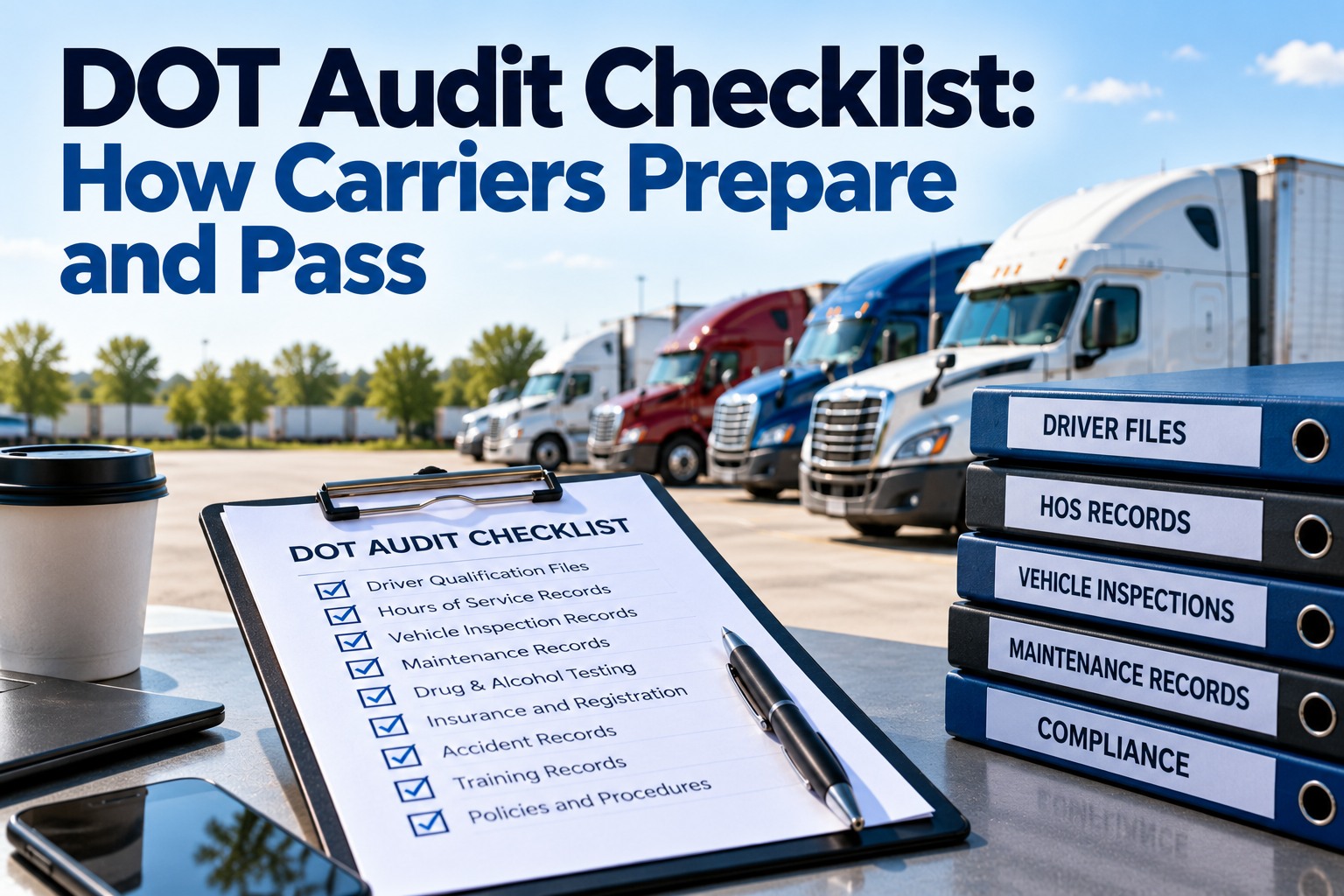
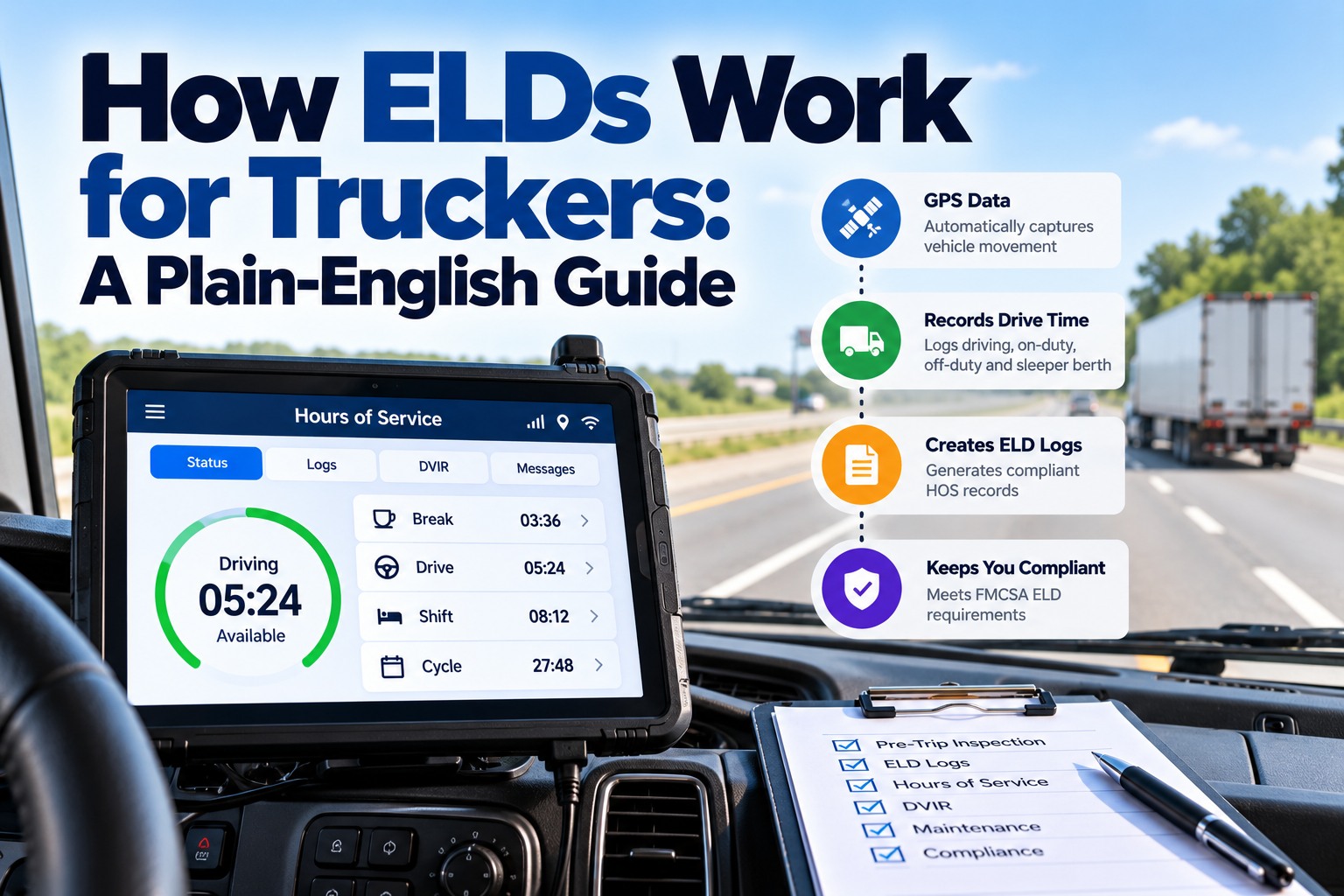
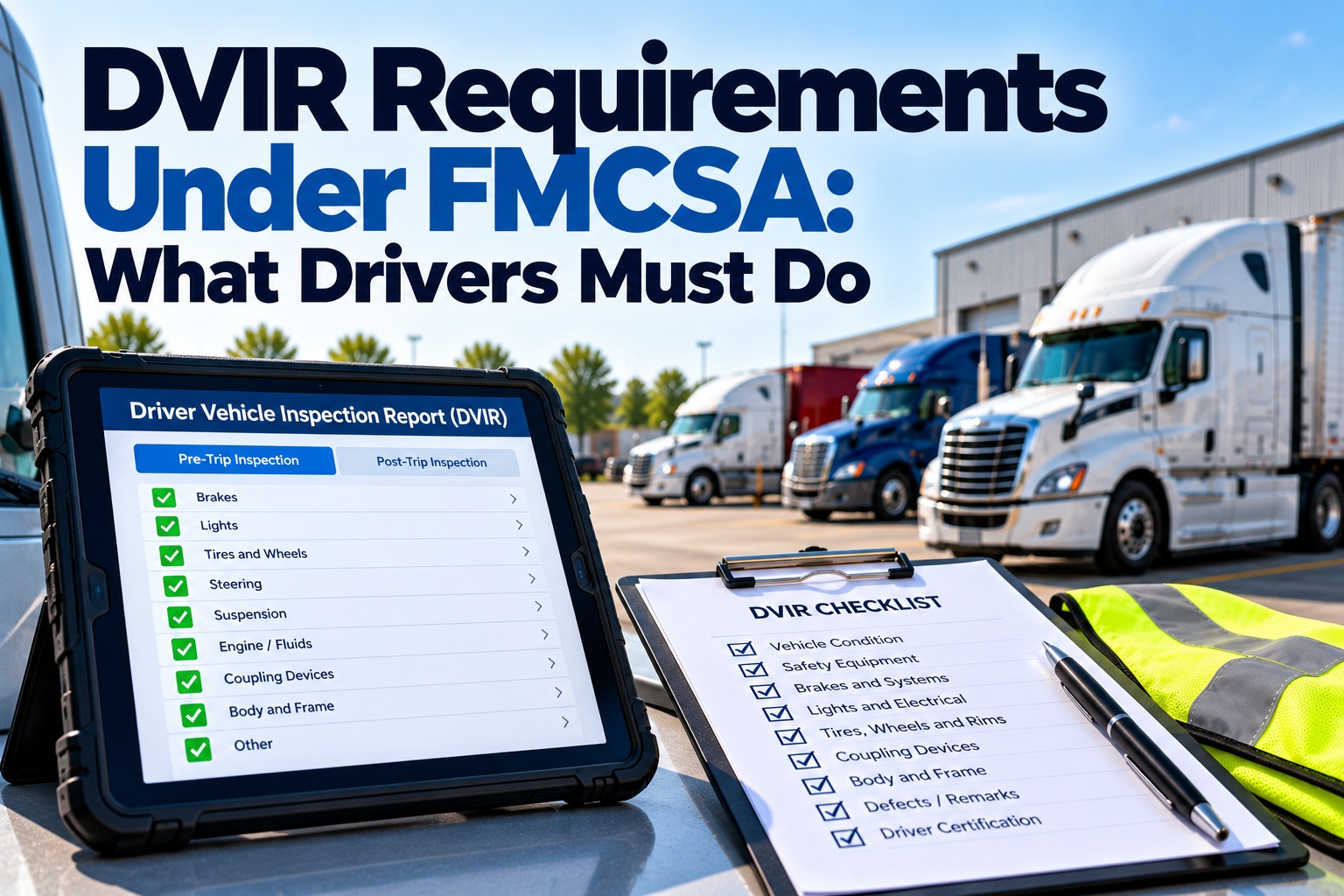
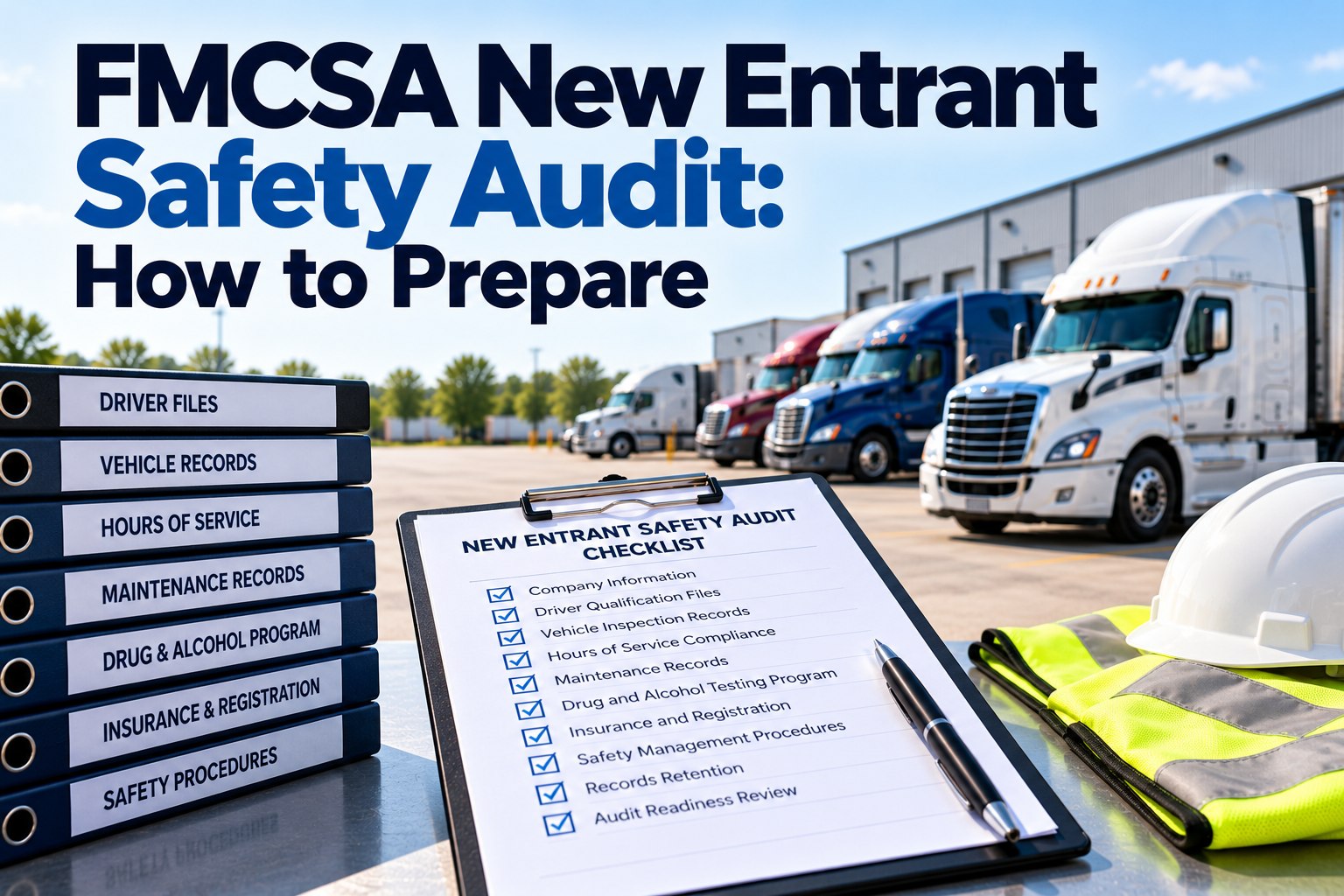
A DOT audit isn’t a test of whether a carrier is safe. It’s a test of whether the records show it. Investigators pull a sample of driver files, hours-of-service logs, inspection reports and maintenance files, score what they find against six factors, and turn the result into a rating. Most failures come from missing paper, not missing safety. This guide covers the types of audit, how the six rating factors and points work, the 16 violations that fail a new entrant audit on their own, the records and retention periods, a 20-day plan for when the notice arrives, and a checklist you can use as a template. To see how FleetRabbit keeps the vehicle side ready, book a short demo with our team.
DOT audit checklist · motor carriers
Six file drawers decide your safety rating. Here is what goes in each one.
Investigators rate carriers on six factors. Every finding in a drawer is scored, and the scores become a Satisfactory, Conditional or Unsatisfactory rating.
Factor 4 · Vehicle
Annual inspections
DVIRs and repairs
Maintenance files
Representative · sample file
Three kinds of DOT audit, and why most now happen offsite
Every interstate carrier with a USDOT number can be audited. The type depends on why FMCSA is looking.
New entrant safety audit
Within the first 12 months of a new USDOT number, during an 18-month new entrant period. Pass or fail, with 16 automatic-failure violations.
Compliance review
A full review that can result in a safety rating. Often triggered by poor scores, a serious crash or a complaint.
Focused investigation
Looks at one or two problem areas, such as hours of service or vehicle maintenance, flagged by roadside data.
Offsite reviews, where carriers upload records through their FMCSA account, have become more common than visits, according to Trucksafe Consulting. That makes organised digital files more important, not less.
The six rating factors, and which regulations each one checks
Factor 1
General
Parts 387, 390
Insurance, registration, accident register
Factor 2
Driver
Parts 382, 383, 391
Drug and alcohol, CDLs, qualification files
Factor 3
Operational
Parts 392, 395
Driving rules and hours of service
Factor 4
Vehicle
Parts 393, 396
Inspections, repairs, maintenance files
Factor 5
Hazardous materials
Parts 171, 177, 180, 397
Shipping papers, placards, training
Factor 6
Accident
Accident rate
Recordable accidents per million miles
How points become a rating: acute violations, critical patterns and the rating table
Under Appendix B to Part 385, an acute violation is one so serious it needs immediate correction, and each one scores a point. A critical violation scores only when it forms a pattern: more than one violation, and at least 10% of the records examined. A pattern of hours-of-service violations scores two points. Each factor is then rated: no points is Satisfactory, one is Conditional, two or more is Unsatisfactory.
Combining the six factor ratings into the overall safety rating
0 Unsatisfactory, 2 or fewer Conditional
=
Satisfactory
0 Unsatisfactory, more than 2 Conditional
=
Conditional
1 Unsatisfactory, 2 or fewer Conditional
=
Conditional
1 Unsatisfactory, more than 2 Conditional
=
Unsatisfactory
2 or more Unsatisfactory
=
Unsatisfactory
Two factors also use data. The vehicle factor can start at Conditional if 34% or more of a carrier’s roadside vehicle inspections end in an out-of-service order, when there are at least three inspections. The accident factor is Unsatisfactory if a carrier with two or more recordable crashes exceeds 1.5 per million miles, or 1.7 for carriers operating entirely within 100 air miles.
Vehicle out-of-service rate
At or above 34% of roadside inspections: vehicle factor starts at Conditional
Recordable accident rate per million miles
Above 1.5, or above 1.7 for urban carriers: accident factor Unsatisfactory
Sixteen violations that fail a new entrant audit on their own
For a new carrier, one of these is enough to fail the audit, whatever the rest of the file looks like. The last three are vehicle records.
01
No drug and alcohol testing program
02
Using a driver known to have tested positive for alcohol
03
Using a driver who refused a required test
04
Using a driver known to have tested positive for drugs
05
No random testing program
06
Using a driver without a valid CDL
07
Using a driver with a suspended or revoked license
08
Using a disqualified driver
09
No required minimum liability insurance
10
No required passenger liability insurance
11
Knowingly using a disqualified driver
12
Using a physically unqualified driver
13
Not requiring a driver to keep hours-of-service records
14
Operating a vehicle placed out of service before repair
15
Not fixing out-of-service defects reported on a DVIR
16
Operating a vehicle with no periodic inspection
A failed carrier gets a list of violations and must submit a corrective action plan. If it isn’t accepted, FMCSA revokes the registration, and the carrier can’t reapply for 30 days.
Three of the sixteen are about the truck. Make sure your vehicle file is complete.
A 20-minute demo of DVIRs, repair certifications and maintenance records for every tractor, trailer and chassis.
The records auditors ask for, and how long you must keep each one
| Record | 49 CFR | Keep for | What it includes |
|---|
| Driver qualification files | 391.51 | Employment plus 3 years | License, medical status, driving records, road test |
| Drug and alcohol records | 382.401 | 1 to 5 years by record type | Results, Clearinghouse queries, random selection |
| Hours-of-service records | 395.8 | 6 months | ELD records and supporting documents |
| Driver vehicle inspection reports | 396.11 | 3 months | Defects, repair certifications, driver review |
| Annual periodic inspections | 396.17, 396.21 | 14 months | Report or decal for every tractor, trailer and chassis |
| Vehicle maintenance files | 396.3 | 1 year, plus 6 months after the unit leaves | Inspection, repair and maintenance records per unit |
| Accident register | 390.15 | 3 years | Every DOT-recordable crash |
| Insurance | 387 | On file | Evidence of minimum financial responsibility |
The vehicle rows are where a digital system saves the most time. Daily DVIRs with repair sign-off, preventive maintenance schedules and each unit’s maintenance history become one file per truck, trailer and chassis.
The notice has arrived: a 20-day plan
Day 0
Notice arrives
Read the request. Note the review period and the due date, and name one person to own the response.
Days 1–3
Pull the sample
Auditors review samples of drivers, trips and units. Gather files for every driver and unit, not just the ones you expect.
Days 4–10
Close the gaps
Missing annual inspection? Unsigned DVIR repair? Fix what can be fixed now, and document why the rest is missing.
Days 11–19
Organise and check
One folder per area, named the way the request names them. Have someone else check it against this list.
Day 20
Submit
New entrant audits generally ask for documents within 20 days. Upload or hand over exactly what was asked for.
Vehicle file gaps auditors find on tractors, trailers and chassis
The vehicle factor is where many carriers lose points without realising it, because trailers and chassis get less attention than tractors.
Trailer
Annual inspection lapsed on trailers that sit in the yard and only run now and then
Tractor
DVIR defect noted, but no repair certification before the next trip
Chassis
No inspection record for leased or pool chassis the carrier controlled for 30 days or more
All units
Maintenance file missing for units sold or returned less than six months ago
After the audit: corrective action plans and asking for a better rating
A Conditional or Unsatisfactory finding isn’t the end. For a compliance review, a carrier with a proposed Unsatisfactory rating has a set window to fix the problems before the rating takes effect: 45 days for passenger and hazmat carriers, 60 days for others, under Part 385. A carrier with a Conditional rating can ask FMCSA for an upgrade once the problems are fixed. In both cases, the request rests on evidence: a written corrective action plan that names each violation, what changed, who is responsible, and the records that prove it. Vague promises don’t move a rating. Dated inspection reports, repair certifications and a working maintenance schedule do, because they show the fix is a routine, not a one-off clean-up.
A DOT audit checklist you can use as a template
General and insurance
Have
Gap
USDOT registration and MCS-150 update current
Proof of minimum insurance on file
Accident register for the last 3 years
Process agent designation, if required
Qualification file for every driver, including medical status
Annual driving record reviews signed
Pre-employment and annual Clearinghouse queries
Drug and alcohol program, random pool and results
Hours-of-service records for 6 months
Supporting documents kept with them
Unassigned ELD driving time reviewed
Speeding and false-log follow-up documented
Annual inspection for every tractor, trailer and chassis
DVIRs for 3 months, with repair certifications
Maintenance file for each unit
Out-of-service repairs completed before reuse
Where FleetRabbit fits audit preparation
Documented
Digital DVIRs with photos, signatures and mechanic sign-off; preventive maintenance and work order history; HOS data from ELD providers
Described
FleetRabbit’s audit-preparation page describes centralised records that can be pulled quickly when a request arrives
Confirm in a demo
How driver files, Clearinghouse queries and medical status are tracked for your fleet, and how exports are produced
FleetRabbit for audit-ready fleets
One file per truck, trailer and chassis, ready before the auditor asks
01
Daily DVIRs, signed and photographed
02
Repairs certified before the unit runs
03
Annual inspections and PM on a schedule
04
Driver hours from your ELD provider
What the 20-minute demo covers
Pulling a unit’s full inspection and repair history
How defects move to repair and sign-off
The free plan for three vehicles
Walk Through Your Audit File
DOT audit questions from carriers
What happens in a DOT audit?
An FMCSA or state investigator reviews a sample of the carrier’s records against the safety regulations, often offsite through document uploads. Findings feed the six rating factors and, for compliance reviews, the carrier’s safety rating.
How is a DOT safety rating calculated?
Each of six factors is rated from acute and critical violations: no points is Satisfactory, one is Conditional, two or more Unsatisfactory. The factor ratings then combine into an overall Satisfactory, Conditional or Unsatisfactory rating.
What fails a new entrant safety audit automatically?
Any one of 16 violations, such as having no drug and alcohol testing program, using a driver without a valid CDL, or operating a vehicle with no periodic inspection.
How long do carriers have to submit documents?
New entrant audits generally ask for documents within 20 days of the request. Other investigations set their own deadlines in the notice.
Which vehicle records do auditors check?
Annual inspection reports, driver vehicle inspection reports with repair certifications, and the maintenance file for each tractor, trailer and chassis.
Is there a DOT audit checklist template or PDF?
Yes. The four-section checklist on this page can be printed and used to mark what you have and where the gaps are.
Does FleetRabbit prepare audit files?
FleetRabbit’s audit-preparation page describes centralised digital records that can be pulled quickly for a request. Its DVIR, maintenance and ELD hours features are documented on the product pages. See it with your own records in a demo.
Pass the audit by keeping the records every day, not the week before
Start with the vehicle file, and keep each truck, trailer and chassis ready.
October 21, 2026
By Sam Parker
All Articles