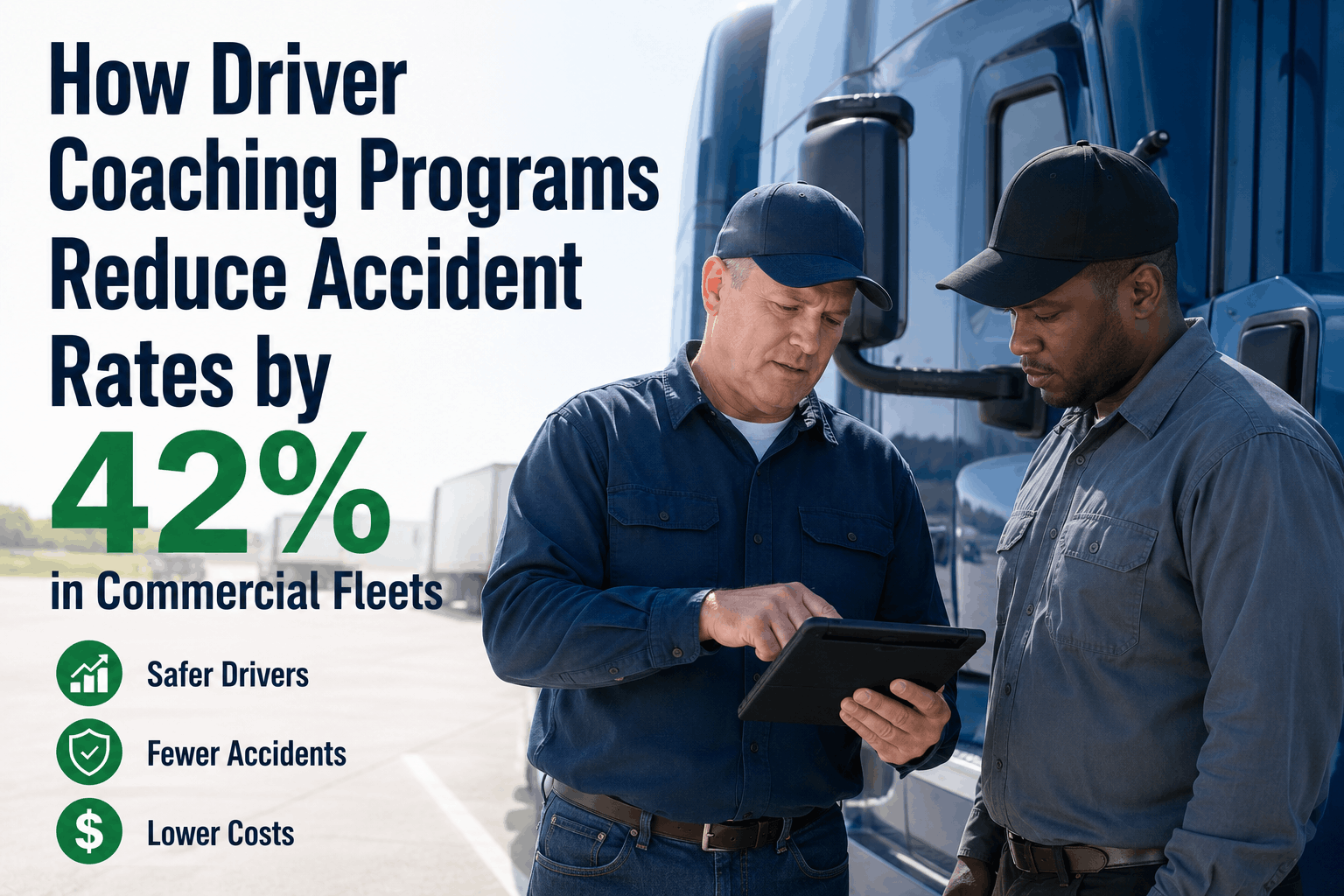
Every fleet manager knows the sinking feeling: a phone call reporting a collision, a damaged vehicle, an injured driver, and a cascade of costs that follow — insurance claims, repair bills, lost productivity, and reputational damage. For years, safety training was a box-ticking exercise — a video watched, a form signed, and back to business as usual. But that approach is failing, and the data proves it. A new generation of driver coaching programs, powered by telematics and behavioral science, is achieving something remarkable: accident rate reductions of up to 42% in commercial fleets. This isn't just about safety anymore. It's about survival.
Driver Coaching Programs: How Fleet Operators Are Cutting Accident Rates by 42%
The Hard Truth About Traditional Safety Training
Traditional driver training is fundamentally flawed. It treats safety as an event rather than a process. A driver attends a classroom session once a year, watches a safety video, and then returns to the same driving habits that existed before. There is no feedback loop, no personalized coaching, and no reinforcement of good behavior. The result is predictable: accident rates remain stubbornly high, and fleets continue to lose millions to preventable collisions.
Research from the National Highway Traffic Safety Administration (NHTSA) indicates that human error is a contributing factor in over 90% of commercial vehicle accidents. The problem isn't that drivers don't know how to drive safely — it's that they don't receive real-time feedback on their specific behaviors. They don't know they're braking too hard, following too closely, or taking corners too fast until an incident occurs. And by then, it's too late. To see how a modern coaching framework can transform your fleet's safety culture, sign up with FleetRabbit and access real-time driver performance data that powers effective coaching.
Generic safety videos don't address individual driver behaviors. Each driver has unique risk patterns that require personalized coaching to effectively reduce accident exposure.
Without immediate data on driving behavior, drivers have no way of knowing when they're operating outside safe parameters — until a near-miss or accident occurs.
Most fleets address safety only after an accident happens. A proactive coaching program identifies high-risk behaviors before they lead to a collision, not after.
Traditional programs lack data on driving habits. Without measurable behavioral metrics, fleet managers can't track improvement or identify high-risk drivers in their teams.
How Modern Driver Coaching Actually Works
Modern driver coaching programs are fundamentally different from the training of the past. They are data-driven, continuous, and highly personalized. Telematics systems track dozens of driving behaviors — acceleration patterns, braking force, cornering speed, following distance, lane deviation, and idle time. That data is then fed into analytics platforms that score each driver on safety metrics and identify specific risk patterns that need attention.
The coaching itself is targeted and specific. Instead of a generic "drive safely" message, coaches focus on observable behaviors that can be measured and improved. For example, a driver with a pattern of hard braking receives coaching on following distance and traffic anticipation. A driver with aggressive cornering receives guidance on speed management in turns. This precision is what makes the difference between a program that works and one that doesn't. The data shows that fleets using personalized, data-driven coaching see accident reductions of 30% to 42% within the first year of implementation. To experience this approach firsthand, book a demo with FleetRabbit and see how our coaching framework can be deployed across your fleet.
Telematics devices capture every driving event — braking, acceleration, cornering, speeding, and following distance — across your entire fleet.
AI-powered algorithms analyze driving data, scoring each driver on safety metrics and identifying specific behaviors that present elevated risk.
Drivers receive targeted coaching sessions focused on their specific risk behaviors, with clear goals for improvement over defined time periods.
Ongoing monitoring tracks improvement, identifies new risk patterns, and provides reinforcement to ensure safe behaviors become permanent habits.
This continuous feedback loop is what separates effective coaching from traditional training. It transforms safety from an annual event into an ongoing conversation between fleet managers and drivers. And the results speak for themselves: fleets with active coaching programs consistently outperform those that rely on reactive training methods alone. The safety gains are measurable, sustainable, and directly tied to the bottom line. Sign up with FleetRabbit and start building a coaching program that delivers measurable safety improvements from day one.
Protect Your Drivers and Your Bottom Line
FleetRabbit's driver coaching platform combines telematics data with personalized coaching programs to reduce accidents, lower insurance costs, and create a safer fleet culture.
The Real-World Financial Impact
The cost of fleet accidents is staggering. The average commercial vehicle accident costs between $70,000 and $100,000 when all factors are considered — vehicle repairs, medical expenses, insurance premium increases, legal fees, and the indirect costs of downtime and lost productivity. For a fleet of 100 vehicles, even a 10% reduction in accident rates can translate to over $700,000 in annual savings. At 42% reduction, the financial impact is transformative.
Beyond direct cost savings, fleets with strong safety records benefit from lower insurance premiums, better driver retention, and improved public reputation. Insurance providers increasingly factor telematics-based safety programs into their underwriting decisions, offering meaningful discounts to fleets that can demonstrate proactive safety management. This creates a virtuous cycle: safer driving leads to lower premiums, which frees up budget for additional safety investments, which further improves safety outcomes. To understand exactly what your fleet could save with a coaching program, book a demo with FleetRabbit and let our team model your accident data against coaching benchmarks.
Why Behavioral Coaching Is Different
Most safety programs focus on rules: don't speed, don't tailgate, don't brake hard. But rules without feedback are rarely effective. Behavioral coaching targets the underlying habits that produce unsafe driving. It asks: why is this driver braking hard? The answer might be following too closely, or misjudging traffic flow, or a tendency to wait too long before reacting to slowing vehicles. By addressing the root behavioral cause, coaching creates lasting improvement rather than temporary compliance.
This approach is grounded in behavioral science. Research shows that habit formation requires repeated reinforcement over time. A single training session creates awareness, but it doesn't create habit. Coaching sessions that occur weekly or monthly, based on actual driving data, reinforce safe behaviors until they become automatic. The result is sustained improvement that persists even when the driver is not being actively monitored. Fleets that understand this dynamic have shifted from annual training to continuous coaching programs that deliver measurable, lasting safety gains. To see how behavioral coaching can work for your fleet, sign up with FleetRabbit and start analyzing driver behavior patterns today.
Drivers respond better to coaching than to disciplinary measures. When drivers receive constructive feedback based on their actual performance, they're more likely to engage with the process and make meaningful changes.
Top-performing drivers can become coaches for their peers. Fleet programs that leverage peer coaching create a culture of shared responsibility for safety that extends far beyond formal training sessions.
Financial incentives tied to safety performance create powerful motivation. Many fleets use safety bonuses or recognition programs to reward drivers who maintain high safety scores and show continuous improvement.
The Market Is Moving Toward Proactive Safety
The global fleet management and driver safety market is projected to exceed $40 billion by 2028, driven in large part by the adoption of telematics-based coaching programs. Regulatory bodies are increasingly requiring documented safety programs, and insurers are rewarding fleets that can demonstrate proactive risk management.
Early adopters are already seeing a competitive advantage. Fleets with strong safety records attract better drivers, command higher rates for freight services, and face fewer disruptions from accidents or regulatory penalties. Those who wait are not just missing out on savings — they're actively falling behind in a market where safety performance increasingly separates winners from losers. The technology is mature, the data is compelling, and the case for adoption is overwhelming. To position your fleet for this shift, book a demo with FleetRabbit and learn how our coaching framework can help you get ahead of the curve.
Build a Safer Fleet Starting Today
FleetRabbit gives you the tools to track driver behavior, deliver personalized coaching, and measure safety improvements — reducing accidents and saving lives and money.
What Driver Coaching Means for Your Operation
Beyond accident reduction, a well-executed coaching program delivers secondary benefits that transform fleet operations. Drivers who feel supported and valued are more likely to stay with the company, reducing costly turnover. Safe driving also translates to better fuel efficiency, lower maintenance costs, and extended vehicle life — the same behaviors that prevent accidents also reduce wear and tear.
And there's a cultural dimension that's often overlooked. When safety becomes a core value of the organization — reinforced daily through coaching and recognition — it permeates every aspect of operations. Drivers take pride in their safety scores, managers have objective metrics to guide coaching conversations, and the entire fleet operates with a shared commitment to getting everyone home safely. This cultural shift is what sustains the 42% accident reduction numbers that the most successful fleets achieve. To build this culture in your own operation, book a demo with FleetRabbit and let us show you how our platform supports continuous safety improvement.