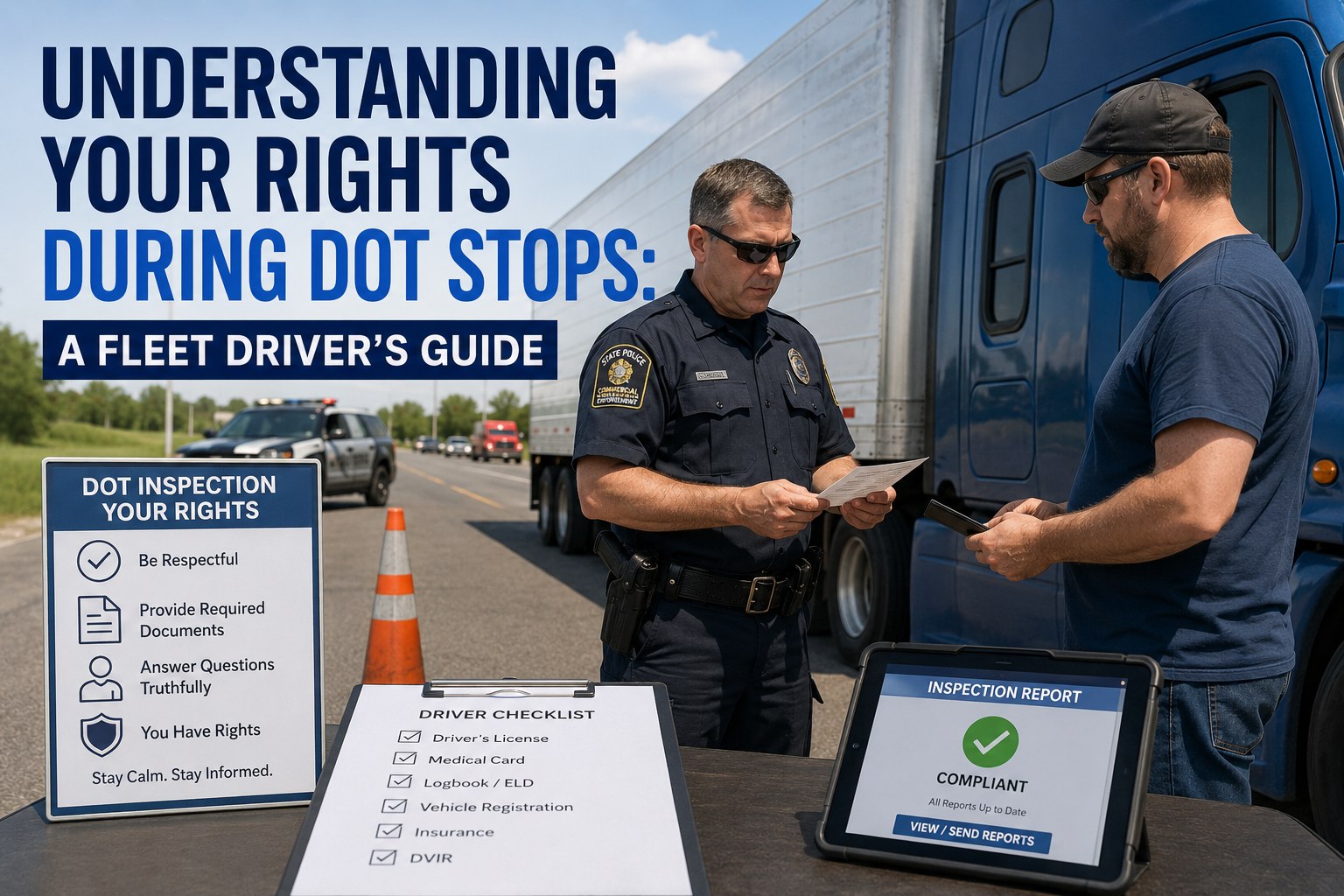
A DOT roadside inspection can feel like a high-stakes interrogation, but it does not have to. Roughly four million commercial vehicles are inspected at roadside every year across North America, and the drivers who move through them smoothly are the ones who understand the process: what inspection level they are facing, exactly what documents they must produce, what officers can and cannot do, and how their conduct shapes the outcome. Knowing your rights is not about being confrontational — professional, prepared, cooperative drivers consistently have smoother stops, while defensive or disorganized ones can turn a minor issue into a major one. This guide walks fleet drivers through the six inspection levels, the documents you must have ready, your rights and obligations at the roadside, and how inspection apps keep every record instantly accessible so a stop stays a formality. Start free trial or book a demo to keep your drivers' documents roadside-ready.
FLEET DRIVER'S GUIDE · ROADSIDE INSPECTIONS
Know the Process, Produce the Documents, Keep It Professional
Inspections protect public safety — but they also protect you when you know how to navigate them. The difference between rolling through and getting parked often comes down to preparation and knowing exactly what happens at each step.
4M
CMV roadside inspections a year in North America
90%+
Of inspections are Level I or Level II
37
Steps in the full Level I North American Standard inspection
The Six CVSA Inspection Levels
Not every roadside stop is the same. The Commercial Vehicle Safety Alliance defines standardized inspection levels used across the United States, Canada, and Mexico, each with a different scope and duration. Knowing which level you are facing tells you exactly what the officer will check. Level I and Level II together account for more than 90% of all inspections — so if you are always Level I-ready, you are ready for anything. Swipe the table horizontally on mobile.
← Swipe to see all columns →
Prepare for Level II and you're ready for anything. Level II inspections are the most common because they are efficient for officers while still catching most violations. A clean Level I inspection can even earn a CVSA decal, signaling to other officers that your vehicle recently passed a thorough exam — which can reduce how often you get pulled in. The habit that gets you there is the same one that keeps your CSA score low: a thorough, documented pre-trip every day.
See how a digital pre-trip keeps you Level I-ready.
What You Must Produce at the Roadside
Having your documents organized and instantly accessible speeds up any inspection and signals professionalism to the officer. Here is what an inspector may ask a driver to produce. The faster and cleaner you hand these over, the shorter and smoother the stop tends to be.
01
Commercial Driver's License
Valid CDL with the correct class and endorsements for the vehicle and cargo you are operating.
02
Medical Examiner's Certificate
Current medical card, now electronically linked to your CDL record under the 2026 registry rules.
03
Hours-of-Service Records
ELD data or the display/printout for the current and prior seven days, ready to transfer to the officer.
04
Vehicle Registration & Insurance
Current registration, proof of insurance, and any required permits for your route and load.
05
Annual Inspection Proof
The current periodic inspection sticker on the vehicle or a copy of the report carried in the cab.
06
Shipping Papers & DVIR
Bill of lading, and your most recent driver vehicle inspection report showing any noted defects.
Scrambling for paperwork is what turns a 10-minute stop into an hour.
Fleet Rabbit keeps DVIRs, inspection records, and compliance documents organized and instantly accessible on the driver's phone — no glovebox archaeology at the roadside.
Your Rights and Your Obligations
A roadside inspection is a two-way street. You have clear rights that officers must respect — and clear obligations you are expected to meet. Understanding both, and where the line falls, is what keeps a stop professional and moving.
Courteous, professional treatment — no harassment, threats, or discriminatory behavior
Officers should be identifiable as law enforcement or authorized inspectors
To ask what inspection level is being conducted and roughly how long it will take
To review the inspection report and note any disagreement before signing
To challenge an inaccurate violation later through the FMCSA DataQs process
Stop when directed and provide the documents the inspector requests
Transfer or display your ELD hours-of-service data on request
Allow the officer to inspect the vehicle to the scope of the level
Comply with an out-of-service order — you cannot move until it clears
Remain professional and cooperative throughout the stop
How you exercise your rights matters as much as knowing them. Officers are required to conduct themselves professionally, and you are entitled to courteous treatment. But being defensive or confrontational rarely helps and can escalate a minor issue into a major one. The drivers with the smoothest inspections are professional and cooperative, hand over organized documents quickly, and let the paperwork speak for itself. If you believe a violation was recorded in error, the place to fight it is the DataQs system afterward — not an argument at the roadside.
See how organized digital records set the right tone.
How a Roadside Inspection Actually Flows
Knowing the sequence removes the surprise. A standard Level I or Level II inspection follows a predictable arc from the moment you are signaled to the final report. Here is what to expect at each stage.
1
The Signal & Pull-In
You are directed into a weigh station, fixed site, or pull-out. Stay calm, pull in safely, and have your window down and documents within reach.
2
Document Review
The officer checks your CDL, medical card, registration, insurance, and hours-of-service. Clean, instantly accessible records make this the fastest part of the stop.
3
Vehicle Inspection
Depending on the level, the officer checks brakes, tires, lights, steering, suspension, coupling, and cargo securement — with or without going under the truck.
4
The Report & Outcome
You receive an inspection report. A clean pass may earn a CVSA decal; violations are noted, and any out-of-service condition must be corrected before you roll.
Make Every Stop a Formality, Not a Fire Drill
Fleet Rabbit keeps every driver's DVIRs, inspection records, and compliance documents organized and instantly accessible on their phone — and the daily pre-trip habit that keeps them Level I-ready keeps violations off the report in the first place. Deploy at $5/vehicle/month, no hardware, live within 72 hours.
Documents accessible on the phone
Level I-ready daily pre-trips
Photo-verified DVIRs
DataQs-ready inspection history
How Inspection Apps Change the Roadside Experience
The single biggest variable in how a stop goes is preparation — and preparation is exactly what software handles. Here is where Fleet Rabbit turns a potentially stressful inspection into a routine one.
01
Documents on the Phone
CDL, medical card, registration, insurance, and current inspection records live in one app — no digging through the glovebox while an officer waits.
02
Level I-Ready Pre-Trips
Guided daily pre-trip checklists catch the brake, tire, and light defects that cause most violations — before an officer ever finds them.
03
Photo-Verified DVIRs
Timestamped, photo-backed inspection reports show an officer exactly the same components they are checking, with proof the walk-around was done.
04
Instant HOS Access
Hours-of-service records and log transfers are ready to hand over the moment they are requested, in the format the officer expects.
05
DataQs-Ready History
A complete, timestamped inspection and maintenance trail gives you the evidence to challenge an inaccurate violation through DataQs after the fact.
06
Fleet-Wide Visibility
Safety managers see every truck's inspection status before any officer does — so a problem gets fixed in the yard, not flagged at the roadside.
Frequently Asked Questions
What is the most common type of DOT inspection?
The Level II walk-around inspection is the most common. It covers the same driver and vehicle elements as a full Level I inspection but does not require the officer to go under the vehicle, making it efficient for officers while still catching most violations. Level I and Level II together account for more than 90% of all roadside inspections — so preparing for Level II means you are effectively prepared for any stop.
Book a demo.
What documents must I have ready at a roadside inspection?
Typically your CDL with proper endorsements, current medical examiner's certificate, hours-of-service records or ELD data, vehicle registration and proof of insurance, proof of current annual inspection, shipping papers, and your most recent DVIR. Having these organized and instantly accessible speeds the inspection and signals professionalism — which tends to make the whole stop go smoother.
Book a demo.
Can I refuse a roadside inspection?
No. When directed to stop for an inspection, drivers are obligated to comply, provide requested documents, transfer or display ELD data, and allow the vehicle inspection to the scope of the level being conducted. You do have rights — to professional treatment, to know what level is being run, and to challenge inaccurate results through DataQs afterward — but refusing the inspection itself is not among them and creates far bigger problems.
Book a demo.
What is a CVSA decal and how do I get one?
A CVSA decal is issued when a vehicle passes a Level I inspection without critical violations. It signals to other enforcement officers that the vehicle recently passed a thorough examination and is valid for up to three months, which can reduce how often you are pulled in for inspection during that window. The path to earning one is a clean, well-maintained vehicle backed by a documented daily pre-trip.
Book a demo.
What should I do if I disagree with a violation?
Do not argue at the roadside — it rarely helps and can escalate the situation. Note your disagreement on the report if given the chance, then challenge the violation formally through the FMCSA DataQs process after the fact. A complete, timestamped inspection and maintenance history is exactly the evidence that makes a DataQs challenge succeed, which is one reason digital records matter beyond the stop itself.
Book a demo.
How does an inspection app help during a stop?
It removes the two things that make stops go badly: disorganized documents and undetected defects. All your compliance documents live on your phone for instant access, and guided daily pre-trips catch the brake, tire, and light issues that cause most violations before an officer finds them. The result is a faster, calmer inspection — and a documented history you can lean on if you ever need to challenge a result.
Book a demo.
Turn Every Roadside Stop Into a Routine You're Ready For.
Fleet Rabbit keeps every driver's documents on their phone, their pre-trips Level I-ready, and their inspection history DataQs-ready — so a DOT stop is a formality, not a fire drill. Integrated with your existing systems in 5–7 working days, at $5/vehicle/month, with no new hardware required.
Free tier for up to 3 vehicles · No credit card required · No hardware installation
July 18, 2026
By Emily Davis
All Articles