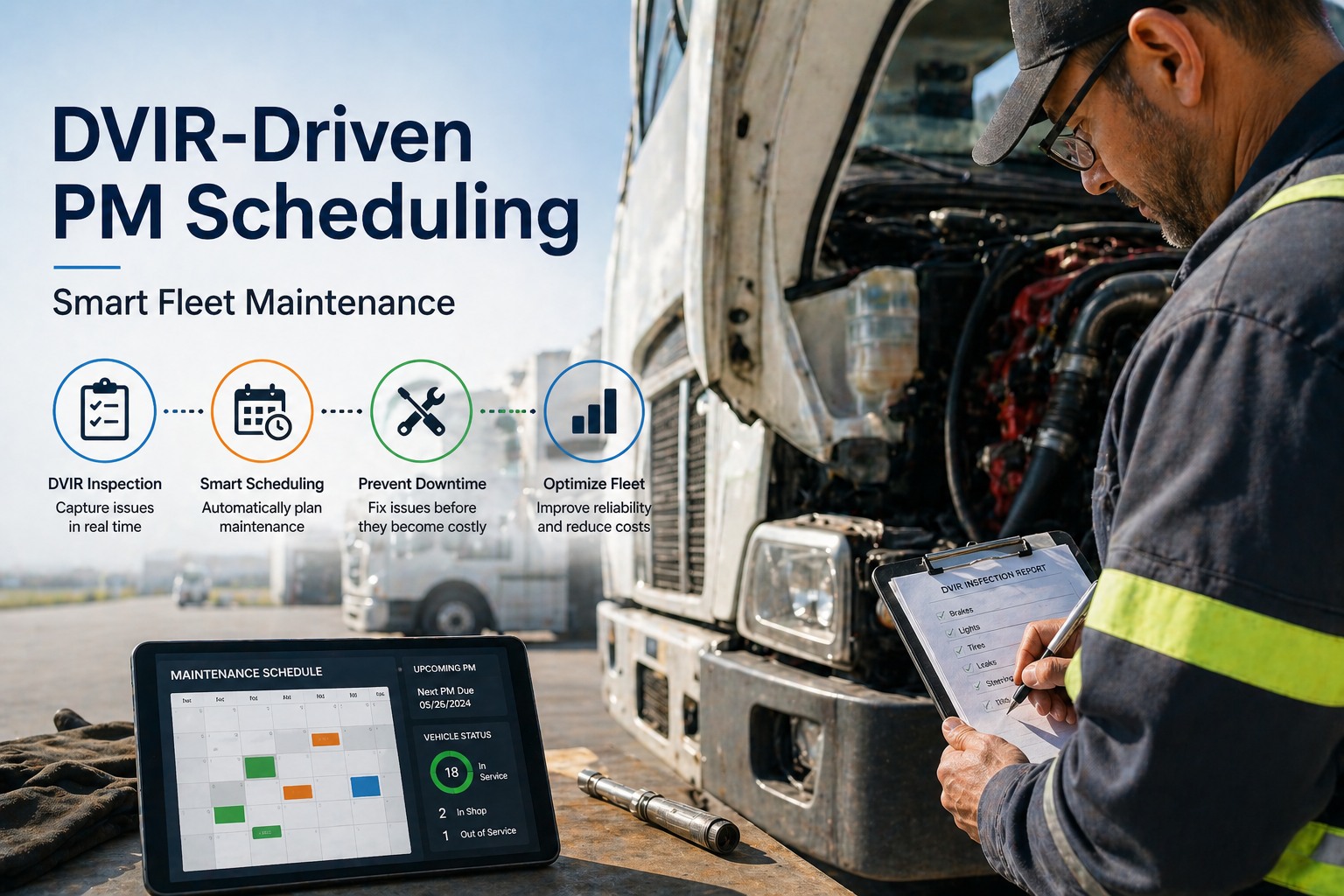
The traditional preventive maintenance schedule is a calendar entry. Truck #47 hits 25,000 miles, oil change is booked, brakes get checked at 50,000, transmission service at 75,000. Same intervals across every truck regardless of how the truck actually got used. But two trucks running the same nominal mileage on different routes wear out at completely different rates. Truck #47 on highway long-haul will have brake pads at 60% life when its sister truck #52 on city stop-and-go is already grinding metal-on-metal. The only thing that knows the difference is the DVIR the daily inspection record where drivers actually flag what's degrading right now. Fleet Rabbit's DVIR-to-PM integration uses that signal: when a defect surfaces, the platform doesn't just create a work order — it recalibrates the affected component's PM interval based on observed wear. Drum brakes flagged at 18,000 mi push next inspection from 25,000 to 21,000. Coolant leak detected pulls cooling-system PM forward by 3 weeks. Twelve component classes, twelve adjustment algorithms, one continuous calibration loop. This guide explains the integration architecture, the defect-to-PM mapping logic, eight real-world adjustment scenarios, the data flow, and the maintenance-cost economics fleets actually recover.
Stop Maintaining on a Calendar. Start Maintaining on Reality.
Every DVIR defect is data. The platform reads it, recalibrates the affected component's PM interval, and the next inspection lands when the truck actually needs it — not when a spreadsheet says so. Reactive becomes adaptive. Calendar becomes condition-based.
The Problem — Calendar PM Burns Money in Both Directions
Fixed-interval PM has been the industry standard for 50 years. It's also the source of two equal-and-opposite waste streams: trucks getting serviced too early (wasted parts, wasted labor, wasted shop time) and trucks getting serviced too late (premature failure, road breakdown, secondary damage). Adaptive PM eliminates both.
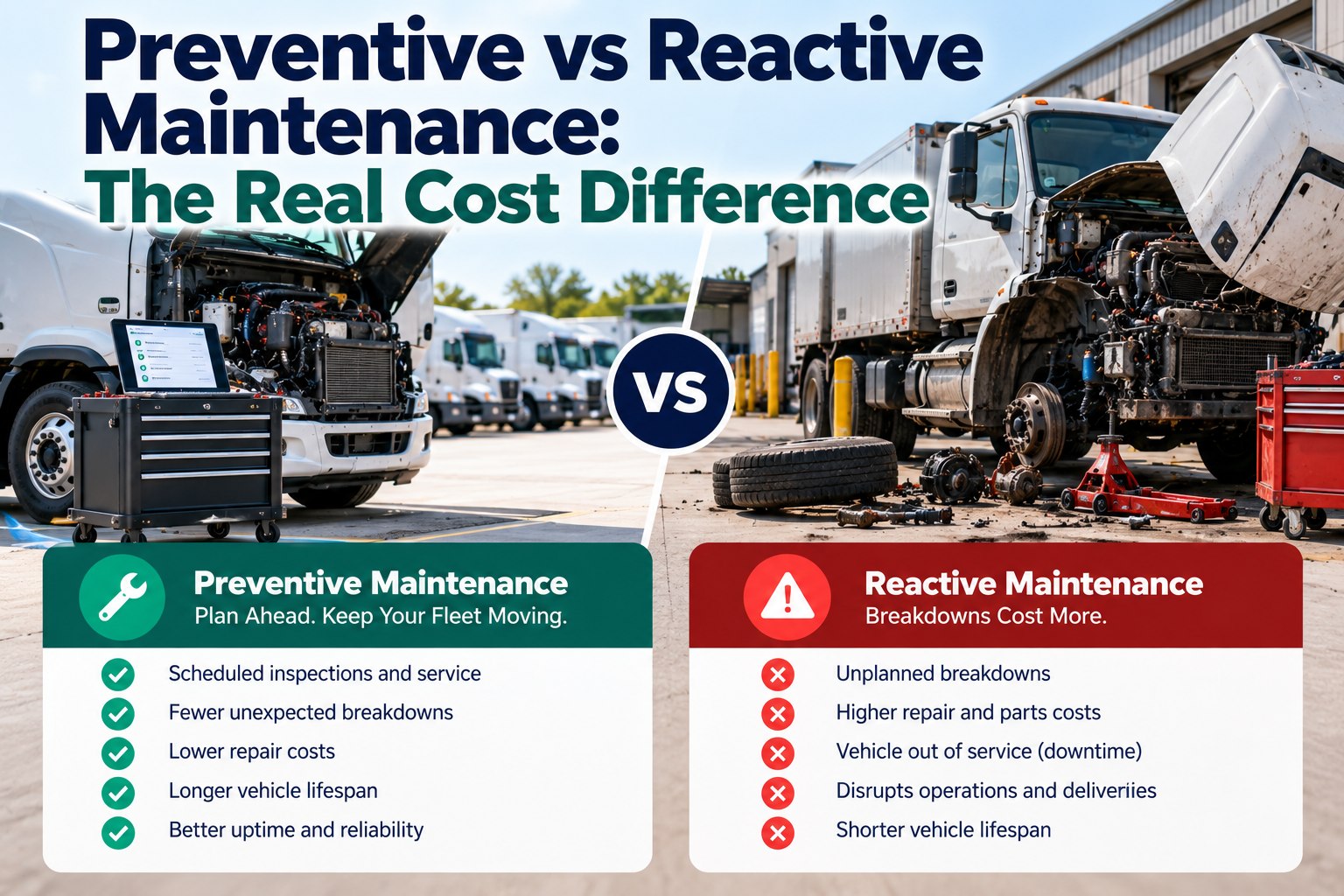
Reactive vs Adaptive Maintenance — The Operational Difference
Both approaches generate work orders. Both retire defects. The difference is what happens after the repair: does the platform learn from the defect, or does it forget and wait for the next breakdown?
How a DVIR Defect Becomes a PM Adjustment — Step by Step
The integration runs in real time. From the moment a driver flags a defect, four sequential calculations run before the next dawn — and the truck's PM calendar is different by morning.
Driver pre-trip flags brake squeal severity-major on truck #47. Photo + GPS + timestamp logged. Mileage at flag: 18,200. Component class: brakes-rear-drum. Severity: 7/10. Webhook fires within 200ms.
WO created · Component=brakes-rear · Severity=7 · Mile=18200Platform pulls component history for truck #47: last brake service at 8,200 mi. Expected interval: 25,000 mi. Defect at 18,200 = 10,000 mi early. Severity 7 + early-occurrence flag = high-confidence wear-acceleration signal.
life_consumed=40% · expected_at=25K · early_by=10K miComponent-specific algorithm applies. For drum brakes: severity-7 + 40%-early = next-interval reduction of 16-20%. New interval: 25,000 → 20,500 mi. Confidence: 87%. Fleet-wide pattern check: similar trucks on similar routes show similar wear.
new_PM_interval=20500 mi · confidence=87% · cluster=urban-stop-goTruck #47 brake-system PM schedule auto-updates. Maintenance manager pinged with rationale. Calendar entry repositioned. Cost-impact estimate generated. Driver sees nothing — the system handles it.
schedule.update() · notify(manager) · estimate_savings=$340The Defect → PM Adjustment Mapping Matrix
Twelve component classes, each with their own adjustment logic. The matrix below shows how different DVIR defects translate to PM-interval changes. All adjustments are explainable, configurable per fleet, and overridable by the maintenance manager.
| Component | DVIR Defect | Severity | PM Adjustment | Rationale |
|---|---|---|---|---|
| Brakes (drum) | Squeal / metal grind | 7-9 | −16-20% interval | Wear acceleration signal |
| Brakes (disc) | Pulsation / vibration | 5-7 | −10-15% interval | Rotor wear or warping |
| Tires | Uneven wear pattern | 4-6 | +rotation cycle | Alignment / pressure issue |
| Cooling system | Coolant leak / temp spike | 7-10 | −25% + immediate | System integrity at risk |
| Engine oil | Dark / metallic / consumption | 5-8 | −15-20% interval | Combustion / wear products |
| Transmission | Slipping / fluid burnt | 7-9 | −20-30% + diag | Major component risk |
| Suspension | Bushing / shock noise | 4-6 | −10% + check-all | Wear cascades to others |
| Steering | Play / pull / vibration | 7-10 | −30% + immediate | Safety-critical system |
| Air system | Pressure drop / leak | 7-9 | −25% interval | Brake-system dependency |
| Electrical | Light flicker / battery | 3-5 | −5-10% interval | Charging / wiring issue |
| HVAC | Insufficient cooling / heat | 3-5 | −10% interval | Refrigerant or component |
| Body / lights | Crack / out / damaged | 2-4 | +spot-check next PM | Cosmetic with regulatory tail |
8 Real-World Adjustment Scenarios
The scenarios below come from anonymized customer data. Each shows the original calendar PM, the triggering DVIR signal, the adjustment the platform applied, and the operational outcome.
The Component Aging Model — How the Algorithm Learns
Each component class has a published wear curve. The algorithm starts with industry-standard expectations and refines per truck based on actual DVIR signals. Visualized below: brake-pad expected vs observed wear on three duty-cycle profiles.
Real-World ROI — What 50-Vehicle Fleets Actually Recover
The dollar impact of adaptive PM compounds across the year. Below is the average annual recovery for a 50-vehicle fleet that activates DVIR-driven PM scheduling — based on customer telemetry and industry benchmarks.
Eliminates 35-45% of unnecessary calendar-driven PMs. Avg PM cost $400 × ~145 prevented annually across a 50-truck fleet.
Catches early-onset failures. ~3 vehicle-days/month recovered per fleet × $700/day revenue × 50 vehicles factor.
Deferred PM costs 4-5× planned. Adaptive PM reduces deferred occurrences ~38% on a $190K annual repair spend.
Earlier intervention on wear preserves brake rotors, transmission internals, suspension components otherwise damaged.
Adaptive scheduling catches DOT-flaggable conditions before inspection. Reduces OOS findings ~42%.
Total adaptive-PM ROI for a 50-vehicle fleet. Fleet Rabbit subscription cost at $3/vehicle/month: $1,800/yr. ROI ratio: ~149×.
What Stays in Your Control — The Override Layer
The platform recommends. The maintenance manager decides. Every adjustment can be reviewed, overridden, or rolled back. No black-box decisions.
Every PM-interval change appears in the manager's review queue with the DVIR trigger, the algorithm's reasoning, the new interval, and the cost impact. One-click approve, modify, or revert.
Lock specific components (e.g. powertrain warranty items) to manufacturer-mandated intervals. Adaptive PM only operates on unlocked components. Useful for OEM warranty preservation.
Adjust how aggressively the algorithm responds. Conservative mode = small adjustments only on high-confidence signals. Aggressive mode = larger adjustments on lower-confidence signals.
Different trucks can run different sensitivity. Brand-new tractors on tight warranty: conservative. Off-warranty older trucks where you want maximum flex: aggressive. Match the algorithm to the asset.
Every adjustment logs to the immutable audit trail with trigger, calculation, decision, manager action. FMCSA-compatible documentation. No "the system did it" gaps.
30-day rollback on any adjustment. If the new interval doesn't work for your operation, revert to the prior schedule with one click. The system learns from the rollback to improve future recommendations.
Frequently Asked Questions
Will adaptive PM void our manufacturer warranty?
No — adaptive PM only shortens intervals (services more often than the calendar) or flags additional inspections. It never extends intervals beyond manufacturer-specified maximums on warranty-protected components. Component-class locks (covered above) ensure powertrain and other OEM-warranty items follow factory schedules exactly. See Warranty-Lock Configuration →
How long until the algorithm learns our specific fleet patterns?
The algorithm uses industry-standard wear curves on day one and refines as DVIR data accumulates. Meaningful per-truck personalization typically emerges after 60-90 days of active DVIR usage. Fleet-wide pattern recognition (e.g. "all your refuse trucks wear brakes 35% faster") emerges within 30 days for fleets with 20+ vehicles.
What if a defect doesn't have a clear PM-adjustment mapping?
Defects outside the 12 mapped component classes still create work orders normally — just without an automatic PM adjustment. The maintenance manager can manually adjust the affected component's PM interval. Custom mappings can be added for specialized fleets (e.g. specific hydraulic systems on refuse trucks, refrigeration units on reefers).
Can we run adaptive PM on some trucks but not others?
Yes — per-truck profiles. New trucks under tight warranty might run pure calendar PM. Older trucks where you want maximum flexibility run aggressive adaptive. Mixed-mode is the most common production deployment. See Mixed-Mode Config →
What about telematics-based predictive signals?
Telematics integration is complementary. DVIR-driven PM uses observed defects (what the driver flagged today). Telematics adds operational signals (engine load, idle time, harsh braking frequency). Both feed the adjustment algorithm. Fleets with both data streams see ~15% better adjustment accuracy than DVIR-only.
Does the platform work with our existing CMMS?
Yes — Fleet Rabbit can run as a standalone CMMS or as the DVIR/PM-intelligence layer feeding adjustments to your existing system (eMaint, Limble, UpKeep, ServiceChannel). API + webhook integrations push the recalculated PM intervals into your incumbent CMMS. See CMMS Integration Demo →
How is DVIR-driven PM priced?
Included in the standard $3/vehicle/month subscription. No separate adaptive-PM module pricing, no per-adjustment fee. Free tier (up to 3 assets) includes the full integration for testing. Book a Demo to See Pricing →
Every DVIR defect recalibrates the affected component's PM interval. 12 component classes. 12 adjustment algorithms. Per-truck personalization within 60-90 days. Component-class warranty locks. Per-adjustment manager review. 30-day rollback. Full audit trail. Plays nicely with your existing CMMS or runs standalone. Free for up to 3 assets indefinitely.