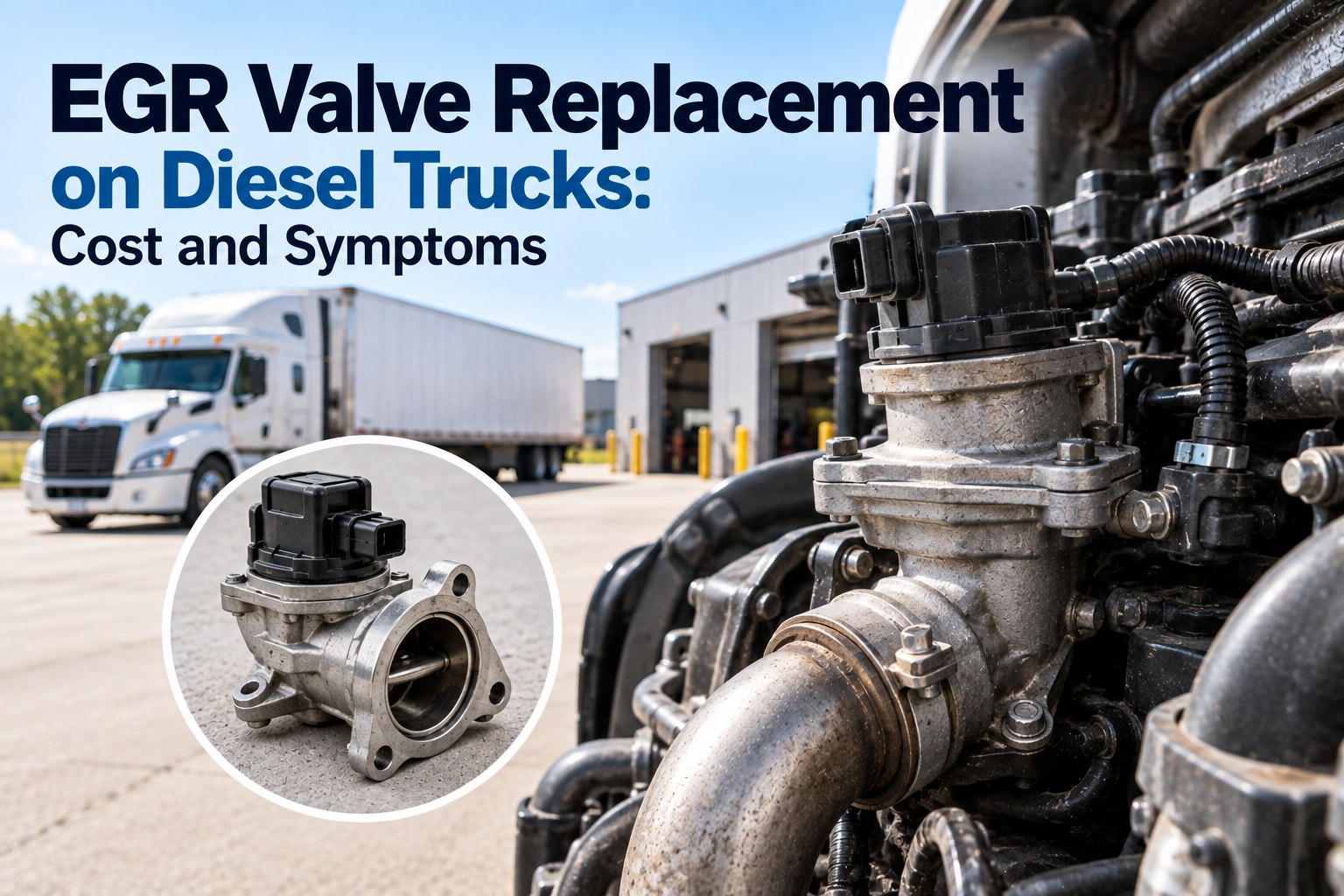
EGR valve replacement on a diesel truck is usually needed when the valve sticks open or closed from soot and carbon buildup, its actuator or wiring fails, or it has been fouled by a leaking EGR cooler — and the signs are EGR position or flow codes, a check engine light, rough idle, black smoke, low power and sometimes a derate. The most important step comes before the new valve goes in: check the EGR cooler, because a cooler leaking coolant into the exhaust turns dry soot into wet sludge that can foul a new valve and damage the intake. This guide explains what the EGR valve does, the symptoms, how to tell a valve problem from a cooler or sensor problem, why the cooler matters, when cleaning is enough, the replacement steps, what drives the cost and how to keep the system clean. Book a demo to see EGR faults tracked to the repair, or create a free account to start with your own trucks.
Emissions system · Exhaust gas recirculation
Replacing the EGR Valve Fixes the Code. Checking the Cooler Keeps It Fixed.
For fleet maintenance managers, technicians and owner-operators: when an EGR valve really needs replacing, how to rule out the cooler and sensors first, and how to stop paying for the same repair twice.
= less NOx
What the EGR Valve Does and Why It Clogs on Heavy-Duty Diesel Engines
Exhaust gas recirculation (EGR) sends a measured share of cooled exhaust back into the intake, which lowers combustion temperature and cuts nitrogen oxide (NOx) emissions. The EGR valve is the gate that meters that flow, and it lives in a stream of hot, soot-laden gas — so carbon builds up on its seat and stem over time, especially on trucks that idle a lot or run light loads. You can log EGR faults and repairs per truck on a free account.
EGR valve
Opens and closes on command from the engine computer to control how much exhaust returns.
Actuator and position sensor
Moves the valve and reports its position; electrical faults here set codes even when the valve is clean.
EGR cooler
A heat exchanger that uses engine coolant to cool the exhaust before it reaches the valve.
Temperature, pressure and flow sensors
Tell the computer whether the right amount of exhaust is flowing.
EGR Valve Failure Symptoms That Point Toward a Replacement
A stuck EGR valve upsets the air and fuel balance in one of two directions: stuck open, too much exhaust reaches the cylinders; stuck closed, combustion runs hotter. Both usually set EGR codes and turn on the check engine light. We can map these symptoms to your trucks' fault history in a demo.
Valve stuck open
- Rough idle and stalling at low speed
- Black smoke and low power
- Higher soot load and more frequent DPF regenerations
- Poor fuel economy
Valve stuck closed
- Higher combustion temperatures
- NOx or SCR-related codes
- Possible knocking under load
- Derate if emissions limits are exceeded
Valve, Cooler or Sensor? Match the Symptom to the Part Before Replacing Anything
EGR codes don't always mean a bad valve. The cooler, the sensors and the actuator wiring produce overlapping symptoms, and some signs — like coolant loss — point away from the valve entirely. Filled dots show where to look first. Record symptoms with every EGR work order free. Swipe the table on mobile.
| What you see | EGR valve sticking | EGR cooler leaking or plugged | EGR sensors | Actuator or wiring |
|---|---|---|---|---|
| EGR position or control codes, no coolant loss | ||||
| Unexplained coolant loss, no external leak | ||||
| White smoke or sweet smell at start-up | ||||
| Air bubbles or pressure in the cooling system | ||||
| Black smoke and low power under load | ||||
| EGR temperature or flow codes |
Typical starting points based on engine-maker service information; confirm with the codes and your engine's procedure.
Why a Leaking EGR Cooler Can Ruin a Brand-New EGR Valve
An internally leaking EGR cooler sends engine coolant into the exhaust stream, where it mixes with soot and coats everything downstream — including the valve. GM and Isuzu service bulletins filed with NHTSA warn that cooler leaks can let coolant reach the combustion chambers and exhaust gas reach the cooling system, and that skipping a cooler pressure test can lead to misdiagnosis. A BMW recall procedure describes the telltale sign clearly: dry black soot is normal, but soot mixed with coolant forms a moist sludge. See cooler checks built into EGR work orders in a demo.
Dry black soot on the valve and cooler outlet
A normal by-product of EGR. Cleaning or replacing the valve is reasonable once other checks pass.
Wet, sticky sludge of soot and coolant
Points to an internal cooler leak. Pressure-test and fix the cooler first, or the new valve will foul the same way.
Also watch for these cooler warnings
Unexplained coolant loss with no external leak, white smoke with a sweet smell on start-up, and air or pressure building in the cooling system. Any of these means the cooler gets tested before the valve is ordered.
Sources: GM bulletin 08-06-04-003C and Isuzu bulletin SB09-J-002 on EGR cooler pressure testing; BMW recall 18V-755 EGR cooler inspection procedure — all filed with NHTSA.
When Cleaning the EGR Valve Is Enough and When It Needs Replacing
A valve that sticks only from dry carbon buildup can often be cleaned and returned to service, but a valve with a failed actuator, a worn stem or a cracked body can't be cleaned back to health. Decide once the valve is out and the cooler has been checked. Review clean-or-replace decisions on your trucks with us.
Dry carbon on the seat and stem, actuator tests OK
Clean with a product approved by the engine maker, replace gaskets and verify operation.
Actuator or position sensor failed, or valve damaged
Electrical faults, a bent or worn stem, or a cracked body mean a new or reman valve.
Wet sludge or coolant in the intake tract
Repair or replace the EGR cooler and clean the intake before fitting any valve.
Make "check the cooler" a required step on every EGR job
In 30 minutes we'll show how FleetRabbit adds a cooler check to EGR work orders and keeps every result on the truck's history, so the next technician sees what was tested.
EGR Valve Replacement Steps a Shop Should Follow on a Diesel Truck
A good EGR valve replacement is more than swapping the part: it includes proving the cooler is sound, cleaning what the old valve contaminated and letting the engine computer relearn the new valve. Log each step on the work order. Add these steps to your EGR template free.
EGR Valve Replacement Cost: What Actually Drives the Bill for a Fleet
The valve price is only one part of an EGR repair; labor access, the condition of the cooler and intake, and downtime often matter more. Benchmarking by FleetNet America and ATA's Technology & Maintenance Council puts unplanned downtime at about $448 to $760 per truck per day before towing and repair, and ATRI puts 2025 average repair and maintenance at $0.215 per mile. Estimate your EGR-related downtime with our team.
Relative cost by repair scope, illustrative — not prices.
Maintenance Habits That Keep the EGR System Clean and Working
Carbon buildup and cooler failures develop slowly, which gives scheduled maintenance time to catch them. Put these checks into your preventive maintenance program and note coolant loss or smoke on the DVIR. Schedule these checks free on 3 vehicles.
Limit long idling and light-load running
Low exhaust temperatures speed up carbon buildup on the valve.
Track coolant top-ups per truck
Unexplained coolant use is the earliest sign of a leaking cooler.
Read EGR codes at every PM
Inactive position or flow codes show a sticking valve early.
Keep the cooling system in spec
Correct coolant and flow help protect the cooler from overheating and cracking.
Fix fueling and air problems promptly
Over-fueling and boost leaks add soot that ends up in the EGR system.
Note smoke and smells on the DVIR
White smoke with a sweet smell at start-up is worth a report.
EGR Valve Replacement Questions Fleet Managers and Technicians Ask
What are the symptoms of a bad EGR valve on a diesel truck?
EGR position or flow codes, a check engine light, rough idle or stalling, black smoke, low power, poor fuel economy and, if emissions limits are exceeded, a derate. See these patterns across your trucks.
Should I check the EGR cooler before replacing the valve?
Yes. A leaking cooler sends coolant into the exhaust, creating sludge that fouls a new valve. Engine-maker bulletins recommend pressure-testing the cooler to avoid misdiagnosis. Add a cooler check to your work orders free.
Can an EGR valve be cleaned instead of replaced?
Often, if the problem is dry carbon and the actuator tests OK. A failed actuator, damaged valve or sludge from a cooler leak needs a replacement or a cooler repair first. Review your EGR repairs with us.
How much does EGR valve replacement cost?
It depends on scope: cleaning costs least, a new valve more, and a cooler replacement with intake cleaning the most. Downtime adds roughly $448 to $760 per truck per day by industry benchmarks. Track EGR repair costs per truck free.
Can I drive with a bad EGR valve?
Usually for a short time, but with reduced power, more soot and a risk of derate. A leaking cooler is more urgent, because coolant loss can lead to overheating. Set up triage rules with our team.
How can I prevent EGR valve problems?
Limit idling, fix fueling and boost problems quickly, keep the cooling system in spec, track coolant use per truck and read EGR codes at every PM. Build that PM schedule free.
Do the EGR job once
Replace the EGR Valve Once, With the Cooler Checked and the Repair on Record
FleetRabbit keeps every EGR code, cooler test and repair on each truck's history, so technicians rule out the cooler first and a repeat fault shows up before it becomes a second replacement.