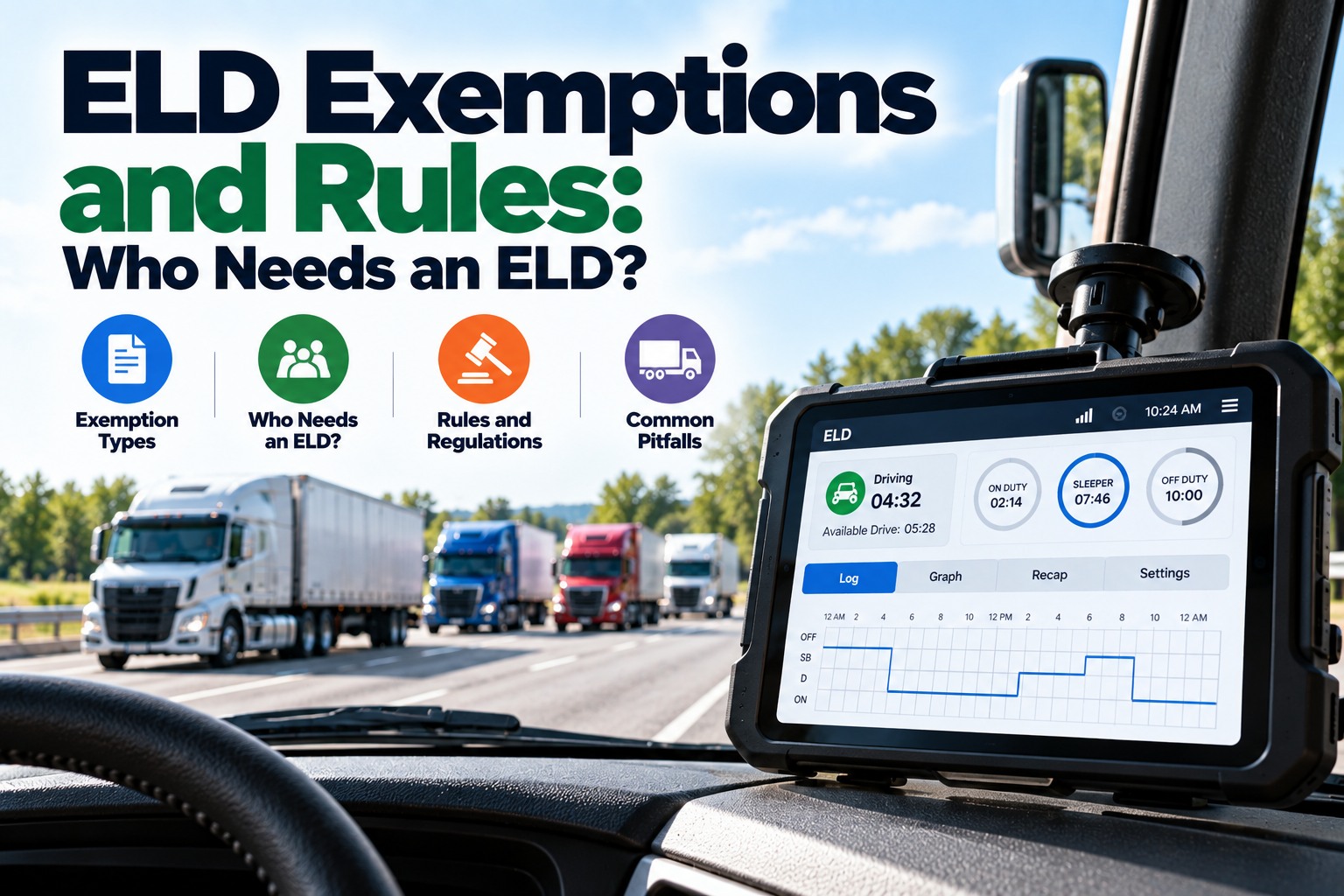
An ELD exemption is a rule that lets certain drivers keep paper records of duty status, or no log at all, instead of using an electronic logging device. Under federal rules the main exemptions are for drivers who need a log on no more than 8 days in any 30-day period, driveaway-towaway operations, vehicles with engines built before model year 2000, and short-haul drivers who stay within 150 air-miles. There is no exemption based on company size, and an exempt driver still has to follow the hours-of-service limits. This guide walks through a four-question check for any truck, compares the exemptions side by side, shows how the 8-in-30 rule counts days and lists the mistakes that turn an exemption into a violation. Run an ELD exemption check on your fleet with us.
ELD EXEMPTIONS · FOR FLEET & COMPLIANCE MANAGERS
Before You Buy an ELD, Find Out Whether You Need One
Most fleets either buy ELDs they don't need or lean on an exemption that doesn't apply. Four questions sort every truck, and a few habits keep the exemption defensible at roadside and in an audit.
THE FIVE EXEMPT PATHS
1Engine before model year 2000
2Driveaway-towaway
3Short-haul, CDL (150 air-miles)
4Short-haul, non-CDL
5Logs on 8 days or fewer in 30
The Four-Question ELD Check
Run each truck or driver through these questions in order. The first question that gets a "yes" settles it. If none do, the answer is that you need an ELD.
1
Does the truck have an engine built before model year 2000?
Check the engine, not just the cab or chassis. Glider kits keep the exemption only if they carry a pre-2000 engine.
YESExempt from the ELD. Drivers keep paper logs, and you keep records of any engine change.
NOGo to question 2.
2
Is the job a driveaway-towaway operation?
The vehicle being driven is the shipment itself, or the load is a motor home or recreational vehicle trailer.
YESExempt from the ELD. Drivers keep paper logs.
NOGo to question 3.
3
Do your drivers stay within the short-haul limits?
CDL drivers: within 150 air-miles of the work reporting location and released within 14 hours, with a time record. Non-CDL drivers: within 150 air-miles, with limits on return time.
YESNo record of duty status needed on those days, so no ELD.
NOGo to question 4.
4
Will a driver need a record of duty status on more than 8 days in any 30-day period?
Count the days a log is actually required, in any rolling 30-day window.
YESELD required. The ninth day triggers it.
NOExempt from the ELD. Paper logs on up to 8 days in any 30.
None apply, or the answer to question 4 is yes: an ELD is required.
The Exemptions Side by Side
Each exemption has its own conditions and its own paperwork. Swipe the table horizontally on mobile.
← Swipe to see all columns →
Other narrow exemptions, such as certain agricultural operations during planting and harvest, sit in the hours-of-service rules at 49 CFR 395.1. The main exemption from the ELD requirement itself is in 49 CFR 395.8(a)(1).
How the 8-in-30 Rule Counts Days
The 8-day exemption is the one fleets misjudge most, because the 30-day window rolls forward every day. If a driver needs a log on a ninth day inside any 30-day window, that day requires an ELD, even if the earlier days were all paper.
Any 30-day window · days that need a log
1
2
3
4
5
6
7
8
9
10
11
12
13
14
15
16
17
18
19
20
21
22
23
24
25
26
27
28
29
30
Paper log days (up to 8)Day 9: ELD required
Count Exempt Days Before an Auditor Does
FleetRabbit keeps compliance and maintenance in one platform: vehicle records with engine details, GPS tracking history you can use to check a short-haul radius and DVIRs stored with each unit. Free for up to three vehicles, then $5 per vehicle per month, with no new hardware to install.
Vehicle and engine records
GPS tracking history
Digital DVIR
Hours-of-service visibility
Five Ways an Exemption Becomes a Violation
Exemptions are narrow, and the mistakes follow the same pattern. Each mistake can be cited for every day it happens, so one misread rule can mean dozens of violations.
Assuming small fleets are exempt
There is no exemption for company size. A two-truck fleet is held to the same rule as a two-hundred-truck fleet.
Treating "no ELD" as "no hours of service"
An exemption changes how you record time, not the driving and on-duty limits. Exempt drivers must still stay within them.
Using short-haul on a day the driver left the radius
If the driver goes beyond 150 air-miles or isn't released in time, a log is required that day, and you need a method to notice it.
Losing count of the 8 days
Without a running count, the ninth day arrives unnoticed. Track paper days per driver, in rolling windows.
Swapping an engine and keeping the exemption
The pre-2000 exemption follows the engine. A newer replacement engine ends it, and glider kits keep it only with a qualifying engine.
The Paperwork That Backs Each Exemption Up
An exemption you can't prove is the same as no exemption. This is what to have ready for each one.
ON THE TRUCK
- Registration showing the vehicle's model year and VIN
- Blank record-of-duty-status grids for paper-log drivers
- Documents for a glider kit or engine swap, where relevant
IN THE OFFICE
- Engine-change records at your principal place of business
- Short-haul time records, kept 6 months
- A running count of paper-log days per driver
IN THE DRIVER'S HEAD
- Which exemption applies and why
- What ends it: radius, hours, ninth day
- How to explain it calmly at a roadside inspection
Frequently Asked Questions
Who is exempt from the ELD mandate?
Drivers who need a record of duty status on no more than 8 days in any 30-day period, drivers in driveaway-towaway operations, drivers of vehicles with engines manufactured before model year 2000, and short-haul drivers who qualify for the 150 air-mile exemptions and so don't need a log at all. There is no exemption based on the size of the company.
Do exempt drivers still need to keep records?
Yes, but a different kind. Drivers under the 8-in-30, driveaway and pre-2000 exemptions keep paper logs. Short-haul drivers keep time records instead of logs, which carriers retain for six months.
What is the 150 air-mile exemption?
A CDL driver who stays within 150 air-miles of the work reporting location and is released from duty within 14 hours doesn't have to complete a record of duty status, provided the carrier keeps time records. Non-CDL drivers have a similar exemption with their own return-time limits.
What happens on the ninth paper-log day?
The exemption no longer covers that day, so the driver needs an ELD. Because the 30-day window moves daily, count paper days on a rolling basis rather than by calendar month.
Does the pre-2000 exemption depend on the truck or the engine?
FMCSA guidance looks at the engine's model year. A truck with a pre-2000 engine can qualify even in a newer chassis, such as a glider kit, but replacing it with a newer engine ends the exemption. Keep records of any engine change at your principal place of business.
Do exempt drivers have to follow hours-of-service rules?
Yes. The exemption affects how time is recorded, not the driving and on-duty limits themselves. A driver on paper logs who exceeds the limits is cited just like one on an ELD.
How can I tell whether a short-haul day stayed in the radius?
Can FleetRabbit help if some of my drivers are exempt?
FleetRabbit keeps vehicle records, GPS tracking history, DVIRs and maintenance in one place, which supports an exemption you can prove. It's free for up to three vehicles, so you can
set up your exempt trucks and count paper days before rolling it out.
Know Your ELD Status for Every Truck
Whether a truck is exempt or not, the records behind that decision should be easy to find. Put vehicle details, GPS history, inspections and maintenance in one platform and answer "do we need an ELD?" with proof.
Free tier for up to 3 vehicles · No credit card required · No hardware installation
October 2, 2026
By Emily Parker
All Articles