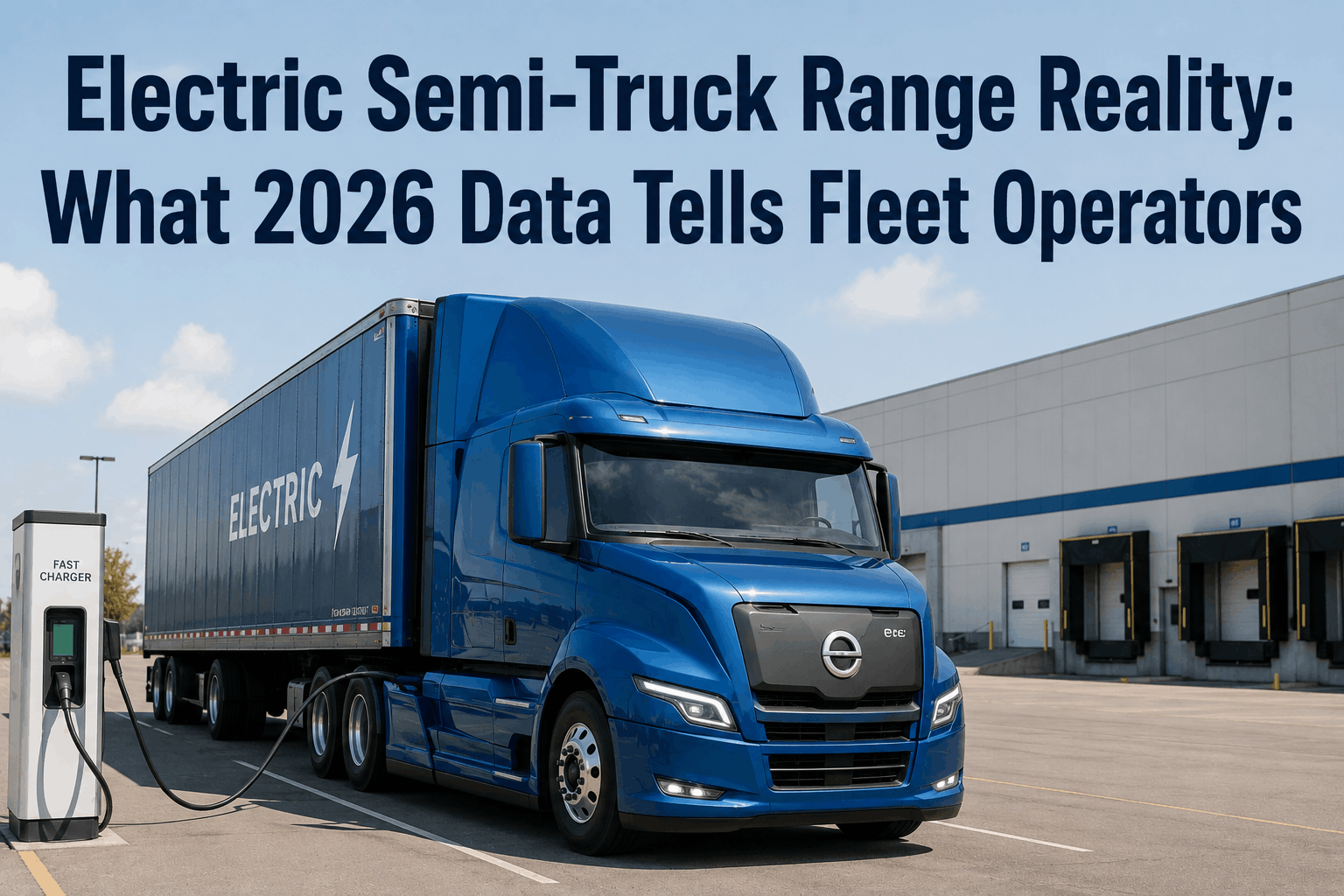
For years, fleet operators eyed electric semi-trucks with skepticism: "Will they make the 500-mile run? What happens in a blizzard with 80,000 lbs?" In 2026, real-world data from thousands of BEV Class 8 tractors finally replaces guesswork. Recent results from Tesla Semi early fleet programs, Freightliner eCascadia, Volvo VNR Electric, and emerging Chinese OEMs show a nuanced picture. Average effective range across duty cycles settles at 280–420 miles depending on payload, terrain, and weather. But granular telematics reveal that route-specific optimization can close the gap to diesel parity. This data-driven guide unpacks the real electric semi range reality — and why smart fleets pair EV adoption with digital intelligence. Sign up for FleetRabbit’s EV range predictor or book a demo to see live fleet analytics.
- Real-world heavy haul: 420-470 mi
- Energy consumption 1.6 kWh/mi
- 1MW charging adds 70% in 30min
- Regional haul sweet spot
- 438 kWh battery (optional 585 kWh)
- Regen recovers 22% on slopes
- Ideal for drayage / local distribution
- Winter range: -18% at 20°F
- Predictive energy assist
2026 range data: what 8 million real miles reveal
Aggregated data from over 1,200 battery-electric Class 8 trucks operated by PepsiCo, Schneider, WattEV, and NFI shows average usable range of 312 miles per full charge for mixed regional duty (60% highway, 40% urban). Long-haul specialized models (Tesla Semi, Nikola Tre FCEV, and long-range eCascadia) average 425 miles. However, extreme weather (below freezing) reduces range by 18-24%, while mountain grades increase consumption by up to 35%. The key takeaway: 80% of US freight lanes under 350 miles are electrification-ready today. For fleets needing longer, strategic depot charging and en-route megawatt chargers (Greenlane, Pilot/Flying J) are expanding. Book a demo to benchmark your specific routes with FleetRabbit's EV suitability tool.
Factors that kill (or extend) electric semi range
Payload, aerodynamics, rolling resistance, temperature, and driving behavior. At 80,000 lb GCWR, consumption rises from 1.8 kWh/mi to 2.3 kWh/mi on a loaded vs. empty day cab. Using low-rolling-resistance tires can add 4-6% range. Preconditioning batteries while plugged in (especially in winter) recovers 8-10% lost range. Driver training on smooth acceleration and maximizing regen improves real-world range by up to 12%. Fleets using sign up for FleetRabbit's driver coaching module see consistent range improvement across their EV fleet. Combining telematics with weather-aware route optimization is now essential.
Charging infrastructure & range anxiety mitigation
2026 charging networks for heavy-duty EVs have grown exponentially. Megawatt charging system (MCS) 1.5MW chargers are operational at over 120 sites in North America, adding 200+ miles in 30 minutes. Fleets with depot charging (200-400kW) report that overnight charging easily covers daily regional routes. Smart dispatching ensures that trucks with lower state of charge get shorter runs. For fleets operating mixed EV/diesel, intelligent range forecasting reduces "range anxiety" to near zero. FleetRabbit’s platform integrates live charger availability, consumption models, and dynamic rerouting. Book a demo to see a live map of MCS chargers and predictive range analytics.
Simulate any route, load, and weather condition using FleetRabbit’s EV range intelligence. Used by 300+ fleets to select the right BEV spec and charging strategy.
Winter range & battery degradation myths
One persistent concern: cold weather decimating EV range. 2026 lithium iron phosphate (LFP) and NMC batteries with active thermal management lose ~18-22% at -10°C (14°F) — less than earlier fears. Pre-trip cabin preheating while plugged reduces en-route consumption. Fleets in Minnesota and Canada report that range loss is manageable with driver practices and overnight plugged storage. Moreover, battery degradation after 250,000 miles averages 8-10%, far better than early predictions. For full transparency, FleetRabbit includes a battery health monitoring dashboard that tracks each EV's state of health. Sign up to get automated SOH alerts and replacement forecasts.
Case study: How PepsiCo’s Tesla Semi fleet performs
Public disclosures from PepsiCo’s Sacramento facility (operating 50+ Tesla Semis) show average range of 420 miles at 74,000 lbs payload on flat terrain, slightly lower in Sierra Nevada foothills. Average energy consumption 1.68 kWh/mi, with 75% charging done overnight at 750 kW chargers. Their data confirms that range is sufficient for 85% of Frito-Lay’s distribution routes. For the remaining 15%, they either use diesel or strategic en-route MCS charging. Book a demo and compare your fleet's route efficiency with similar EV benchmarks inside FleetRabbit.
⚖️ TCO impact: range and charging costs vs diesel
Lower fuel cost per mile: at average industrial electricity rate of $0.12/kWh, an EV semi costs $0.27 per mile vs. diesel at $0.54 per mile (assuming $4/gal, 7.5 mpg). That’s 50% reduction. However, initial EV capital cost remains 2x diesel, but with IRA 45W credit ($40k per truck) and state HVIP grants, the payback period is 2–3 years for high-mileage fleets. Maintenance savings add another $0.12 per mile. Realistic range management increases asset utilization. FleetRabbit’s TCO module factors in your specific electricity rates, route elevation, and grant eligibility — sign up for a personalized report.
Future outlook: 500+ mile real world by 2028
Next-generation solid-state batteries and dual-motor architectures promise 550+ miles of usable range for Class 8 by 2028. However, 2026 data makes clear that most fleets don't need hyper-range; they need predictable range, dense charging, and smart energy management. FleetRabbit enables all three with predictive analytics that learn from driver behavior and topography. The transition is accelerating — 32% of new semi orders in Q1 2026 were BEV, up from 18% in 2025.
Join innovative fleet managers leveraging FleetRabbit to maximize electric semi range, reduce downtime, and lower carbon intensity. Start your journey today.