The 1-million technician shortage meets AI transformation — discover why proactive, AI-augmented maintenance professionals will replace traditional reactive roles and how to prepare your team for the inevitable shift
1 Million
Technician Jobs Needed by 2029
30-40%
Annual Technician Turnover
65%
Teams Planning AI by 2026
90K+
Breakdowns Prevented by AI Yearly
The reactive technician—the mechanic who waits for something to break, diagnoses the problem, and fixes it—is facing extinction. Not because technicians aren't needed, but because the role itself is transforming beyond recognition. With AI copilots now guiding diagnostics, predictive systems identifying failures weeks in advance, and automated workflows generating work orders before problems manifest, the "fix it when it breaks" mindset simply cannot survive in 2026's competitive landscape. The fleets that cling to reactive maintenance culture will hemorrhage talent to proactive operations while watching their best technicians become data analysts, reliability engineers, and AI-augmented maintenance professionals. Assess your team's readiness with our free technician evolution assessment in just 15 minutes, or schedule a workforce transformation consultation to build your upskilling roadmap.
Prepare Your Maintenance Team for the AI Era
Discover where your technicians stand on the reactive-to-proactive spectrum and get a customized training roadmap. Future-proof your workforce before the competition does.
The Perfect Storm: Why Reactive Maintenance Is Dying
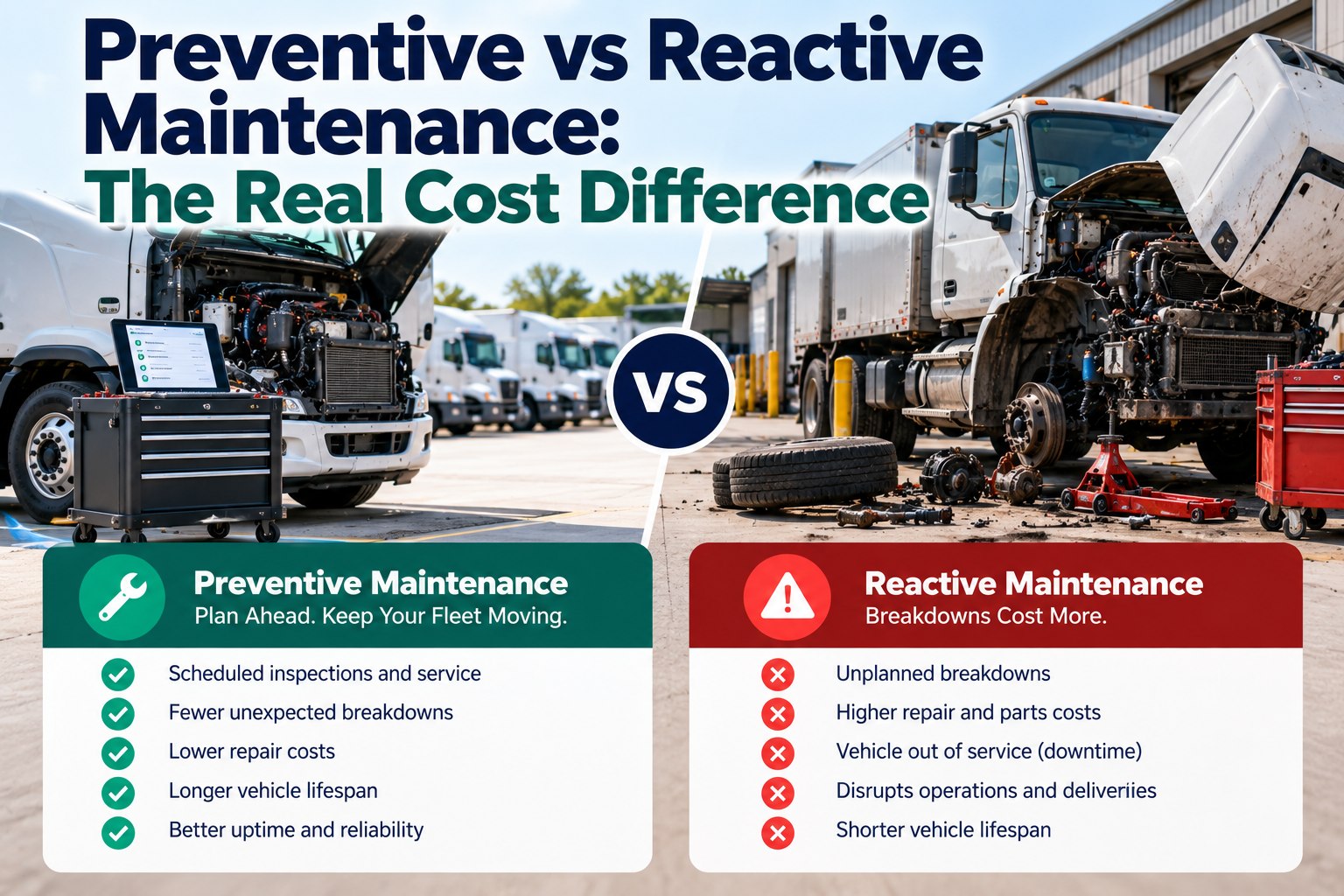
Three converging forces are making reactive maintenance unsustainable: a catastrophic labor shortage, exponentially increasing vehicle complexity, and AI systems that outperform human reactive diagnosis. Understanding these forces is essential for any fleet operator planning their maintenance strategy.
The Technician Shortage Crisis
The US transportation industry needs to fill an estimated 1 million technician jobs over the next five years. Meanwhile, graduates from automotive programs dropped 20% since 2020, with 11.8% declining in just one year. Fleet service organizations face 30-40% annual turnover rates. The math is simple: there aren't enough reactive technicians to go around, and there never will be again.
Why Reactive Maintenance Cannot Scale
| Challenge | Reactive Reality | Proactive Solution | Business Impact |
|---|---|---|---|
| Labor Shortage | Need more techs to handle breakdowns | AI prevents breakdowns, fewer techs needed | 40% efficiency gain per tech |
| Vehicle Complexity | 8,000+ fault codes per vehicle | AI filters to 5-10 actionable items | 99% noise elimination |
| Technician Experience | Requires years of tribal knowledge | AI copilots guide junior techs | 50% faster competency |
| Parts Availability | Emergency orders, rush fees | Predicted needs weeks ahead | 40-60% procurement savings |
| Customer Expectations | Unplanned downtime accepted | Zero tolerance for surprises | Customer retention at stake |
The Complexity Explosion
Modern trucks contain 100+ Electronic Control Units generating thousands of data points per second. The average repairable severity for new model-year vehicles jumped 27% since 2019, while five-year-old vehicles saw a staggering 50% increase. No human can process this complexity reactively—but AI can process it predictively.
From Reactive to Proactive: The Technician Evolution
The technician role isn't disappearing—it's elevating. The future belongs to maintenance professionals who work alongside AI systems, interpreting predictions, executing precision repairs, and continuously improving fleet reliability. Explore the career evolution with our free technician career pathway guide.
Technician Role Evolution: 2020 vs 2026
| Aspect | Reactive Technician (2020) | Proactive Technician (2026) | Key Difference |
|---|---|---|---|
| Primary Trigger | Breakdown or scheduled PM | AI prediction or condition alert | Prevention vs. reaction |
| Diagnostic Method | Fault codes + trial and error | AI-guided root cause analysis | Precision vs. guesswork |
| Knowledge Source | Experience and tribal knowledge | AI copilot + institutional database | Scalable vs. individual |
| Work Planning | Queue of broken vehicles | Optimized schedule of predicted needs | Controlled vs. chaotic |
| Parts Management | Order after diagnosis | Parts staged before arrival | Prepared vs. scrambling |
| Success Metric | Vehicles fixed today | Breakdowns prevented this month | Outcomes vs. activity |
| Career Path | Senior technician → shop foreman | Reliability engineer → data analyst | Strategic vs. tactical |
The Proactive Technician Skill Stack
- Data Interpretation: Reading telematics dashboards, understanding trend analysis, identifying anomalies
- AI Collaboration: Working with diagnostic copilots, validating predictions, providing feedback for model improvement
- Root Cause Analysis: Using 5 Whys, fishbone diagrams, and systematic troubleshooting methodologies
- Predictive System Management: Calibrating sensors, validating prediction accuracy, tuning alert thresholds
- EV/Hybrid Expertise: High-voltage safety, battery diagnostics, electric drivetrain service
- Communication: Explaining technical findings to non-technical stakeholders, documenting procedures
AI Copilots: The Great Equalizer
AI copilots are fundamentally changing what's possible for technicians at every experience level. These systems don't replace human judgment—they amplify it, enabling junior technicians to perform at senior levels and senior technicians to become reliability strategists.
Diagnostic Acceleration
Before: 45-minute diagnosis
After: 5-minute AI triage
Improvement: 89% faster
Result: More wrench time
First-Time Fix Rate
Before: 65% FTFR
After: 85%+ FTFR
Improvement: 31% increase
Result: Fewer comebacks
Junior Tech Capability
Before: 2+ years to competency
After: 12 months with AI guidance
Improvement: 50% faster
Result: Scaled expertise
What AI Copilots Actually Do
- Intelligent Triage: Filter 8,000+ fault codes down to 5-10 actionable priorities ranked by severity and urgency
- Guided Diagnostics: Step-by-step troubleshooting procedures with context-sensitive recommendations
- Root Cause Identification: Analyze symptoms, evidence, and historical patterns to identify the most probable cause
- Repair Time Estimation: Provide accurate labor estimates based on similar repairs across thousands of work orders
- Parts Prediction: Identify likely parts needed before diagnosis complete, enabling pre-staging
- Tribal Knowledge Capture: Learn from successful repairs and surface insights to future technicians
Real-World AI Impact
Penske's fleet of 440,000+ vehicles leverages AI-powered proactive diagnostics that prevented more than 90,000 breakdowns in a single year. Their guided repair solution shaved an average of 15 minutes off repair times across tens of thousands of service instances. AI isn't replacing technicians—it's making them superhuman.
Deploy AI Copilots for Your Technicians
See how AI-guided diagnostics can transform your maintenance team's capabilities. Get a demonstration tailored to your fleet's specific challenges.
The Economics of Proactive vs. Reactive
The financial case for proactive maintenance is overwhelming. Reactive operations cost more in every measurable dimension—labor, parts, downtime, and opportunity cost. Calculate your savings potential with our free proactive maintenance ROI calculator.
Total Cost Comparison: Reactive vs. Proactive Maintenance
| Cost Category | Reactive Operation | Proactive Operation | Savings | 100-Vehicle Annual Impact |
|---|---|---|---|---|
| Emergency Repairs | $2,500/breakdown | $800/scheduled repair | -68% | $170,000 saved |
| Parts Procurement | Rush orders + premium pricing | Standard orders + bulk discounts | -40% | $85,000 saved |
| Downtime Cost | 5+ hours average per event | 2 hours scheduled window | -60% | $250,000 protected revenue |
| Technician Efficiency | 45% wrench time | 75% wrench time | +67% | Equivalent to 3 FTE |
| Diagnostic Time | 45 minutes average | 10 minutes with AI | -78% | 2,000+ hours saved |
| Comeback Repairs | 15% return rate | 5% return rate | -67% | $45,000 saved |
The Hidden Cost of Reactive Culture
Beyond direct costs, reactive maintenance culture drives technician turnover. When skilled professionals spend their days firefighting emergencies in chaotic environments, they leave for proactive operations offering predictable schedules, modern tools, and career development. That 30-40% annual turnover costs $15,000-$25,000 per technician in recruiting, training, and lost productivity.
The Five Stages of Technician Evolution
Transforming from reactive to proactive maintenance doesn't happen overnight. Fleets progress through distinct stages, each requiring different capabilities from their maintenance teams. Identify your current stage with our free maintenance maturity assessment.
Maintenance Evolution Stages and Technician Roles
| Stage | Maintenance Approach | Technician Role | Tools Required | % of Fleets (2026) |
|---|---|---|---|---|
| Stage 1: Reactive | Fix when broken | Emergency responder | Basic diagnostics, hand tools | 25% (declining) |
| Stage 2: Scheduled PM | Calendar/mileage-based service | Procedure follower | PM checklists, CMMS | 35% (stable) |
| Stage 3: Condition-Based | Inspection-triggered service | Inspector + technician | Diagnostic tools, sensors | 25% (growing) |
| Stage 4: Predictive | AI-predicted service | AI-guided specialist | Telematics, AI copilots | 12% (rapid growth) |
| Stage 5: Prescriptive | Automated decision + action | Reliability engineer | Integrated AI platform | 3% (emerging) |
Stage 5: The Prescriptive Technician
- Role Transformation: From "fixer" to "optimizer"—focused on system improvement, not individual repairs
- Work Trigger: AI generates work orders automatically; technician validates and executes
- Decision Making: Collaborates with AI on maintenance strategy, not just repair tactics
- Career Identity: "Reliability Engineer" or "Fleet Health Specialist" rather than "Mechanic"
- Value Creation: Measured by uptime improvement, cost reduction, and breakdown prevention
Upskilling: The Path Forward for Existing Technicians
The good news: 70% of automotive OEMs plan to retrain existing employees rather than hire new talent. The technician shortage makes your current team invaluable—if you invest in their evolution. Build your upskilling program with our free training curriculum template or schedule a workforce development consultation.
Data Literacy Training
Focus: Telematics interpretation
Duration: 40 hours
Outcome: Dashboard proficiency
ROI: Faster diagnosis
AI Tool Certification
Focus: Copilot collaboration
Duration: 24 hours
Outcome: AI-augmented repairs
ROI: Higher FTFR
EV/Hybrid Specialization
Focus: High-voltage systems
Duration: 80 hours
Outcome: EV certification
ROI: Future-proofing
Upskilling Investment ROI
| Training Investment | Cost per Technician | Productivity Gain | Retention Impact | Payback Period |
|---|---|---|---|---|
| AI Diagnostics Certification | $2,500 | +25% efficiency | +35% retention | 3 months |
| Predictive Maintenance Training | $3,500 | +40% prevention rate | +28% retention | 4 months |
| EV Systems Certification | $5,000 | Opens EV market | +45% retention | 6 months |
| ASE Advanced Certification | $3,000 | +15% efficiency | +40% retention | 4 months |
| Data Analytics Basics | $1,500 | +20% diagnostic speed | +22% retention | 2 months |
The Retention Multiplier
Companies that invested in upskilling reported a 71% measurable increase in employee retention rates. In an industry with 30-40% annual turnover, that retention improvement alone justifies training investments—before counting productivity gains.
Attracting the Next Generation
Young people aren't avoiding technical careers—they're avoiding outdated, chaotic work environments. Proactive, technology-forward maintenance operations attract talent that reactive shops cannot.
What Gen Z Technicians Want
- Technology Integration: Modern tools, AI assistants, mobile apps—not clipboards and paper
- Predictable Schedules: Planned work, not emergency chaos and mandatory overtime
- Career Progression: Clear paths from technician to specialist to engineer to management
- Continuous Learning: Training budgets, certification support, skill development opportunities
- Purpose and Impact: Contributing to sustainability, safety, and innovation—not just fixing breakdowns
- Work-Life Balance: Proactive maintenance enables scheduled hours; reactive means unpredictable demands
Recruitment Advantage: Reactive vs. Proactive Operations
| Factor | Reactive Shop | Proactive Operation | Candidate Preference |
|---|---|---|---|
| Work Environment | Chaotic, emergency-driven | Planned, systematic | 87% prefer proactive |
| Tools Provided | Basic scan tools | AI copilots, AR diagnostics | 92% prefer modern tools |
| Training Investment | Minimal, on-the-job | Structured programs, certifications | 78% value training |
| Schedule Predictability | Variable, overtime common | Consistent, planned shifts | 81% prefer predictable |
| Career Path | Senior tech → supervisor | Specialist → analyst → engineer | 73% want growth options |
Build a Technician Recruitment Strategy
Learn how to position your fleet as an employer of choice for the next generation of maintenance professionals. Get insights on compensation, culture, and career development.
Implementation Roadmap: Making the Shift
Transitioning from reactive to proactive maintenance requires systematic change across technology, processes, and culture. This phased approach minimizes disruption while building momentum.
Phase 1: Foundation (Months 1-3)
- Assessment: Evaluate current maintenance maturity, technician skills, and technology gaps
- Quick Wins: Deploy basic telematics if not present; establish baseline metrics
- Communication: Introduce vision to maintenance team; address concerns about job security
- Pilot Selection: Identify 10-20% of fleet for initial predictive maintenance pilot
- Training Launch: Begin data literacy training for maintenance supervisors
Phase 2: Pilot and Learn (Months 4-6)
- Technology Deployment: Implement predictive maintenance on pilot vehicles
- Process Redesign: Create new workflows for AI-generated work orders
- Technician Training: AI copilot certification for pilot team members
- Metric Tracking: Measure MTBF, FTFR, and technician efficiency changes
- Feedback Loop: Gather technician input on tools, processes, and challenges
Phase 3: Scale and Optimize (Months 7-12)
- Expansion: Roll out predictive maintenance to full fleet based on pilot learnings
- Role Evolution: Transition top performers to reliability engineering responsibilities
- Training Scale: Comprehensive upskilling program for all maintenance personnel
- Culture Shift: Recognize and reward proactive behaviors and prevention metrics
- Continuous Improvement: Regular reviews of prediction accuracy and process effectiveness
The New Technician Career Paths
Proactive maintenance creates career opportunities that didn't exist in reactive operations. Technicians who embrace the evolution have paths to higher-paying, more strategic roles.
Fleet Reliability Engineer
Focus: System-wide optimization
Skills: Data analysis, RCM, AI collaboration
Salary Range: $75,000-$110,000
Growth: 45% increase from tech
Predictive Maintenance Specialist
Focus: AI system management
Skills: Telematics, ML basics, calibration
Salary Range: $65,000-$90,000
Growth: 30% increase from tech
EV Systems Specialist
Focus: Electric vehicle maintenance
Skills: High-voltage, battery diagnostics
Salary Range: $70,000-$100,000
Growth: 40% increase from tech
The 400,000 New Jobs
The transition to high-tech trucking will create 400,000 new skilled maintenance jobs by 2030, while eliminating many traditional reactive roles. Technicians who develop proactive, AI-augmented skills will capture these premium positions. Those who resist will find their opportunities—and earning potential—steadily declining.
Leadership's Role in the Transformation
Maintenance transformation succeeds or fails based on leadership commitment. Technology alone doesn't change culture—leaders do.
Critical Leadership Actions
- Communicate Vision: Explain why the change is happening and how technicians benefit
- Invest in Training: Back words with budget—minimum $3,000-$5,000 per technician annually
- Change Metrics: Stop measuring "trucks fixed today"; start measuring "breakdowns prevented"
- Recognize Proactive Behaviors: Celebrate catches before failures, not just heroic emergency repairs
- Address Resistance: Some technicians will resist; provide support, training, and clear expectations
- Lead by Example: Use data dashboards, ask about predictions, demonstrate commitment
The Cultural Pitfall
Many fleets deploy predictive maintenance technology but fail to achieve results because they don't change the underlying culture. If leadership still celebrates the technician who "saved the day" on an emergency breakdown while ignoring the technician who prevented ten breakdowns through proactive intervention, the reactive culture persists regardless of technology investment.
Conclusion: Adapt or Become Obsolete
The reactive technician isn't being replaced by AI—they're being transformed by it. The maintenance professionals who thrive in 2026 and beyond will be those who embrace AI as a partner, develop proactive mindsets, and continuously upskill. The fleets that retain and attract top talent will be those that offer modern tools, career development, and the satisfaction of preventing problems rather than perpetually firefighting them.
Action Steps for Fleet Operators
- Assess your current maintenance maturity stage and set evolution goals
- Invest in AI copilot and predictive maintenance technology
- Create comprehensive upskilling programs with clear career paths
- Change metrics from reactive (repairs completed) to proactive (breakdowns prevented)
- Position your operation as a technology-forward employer of choice
- Develop leadership commitment to cultural transformation
The technician shortage won't be solved by finding more reactive technicians—there aren't enough and never will be. It will be solved by making every technician dramatically more effective through AI augmentation and proactive approaches. The fleets that understand this will thrive; those that don't will struggle to compete. Start your workforce transformation with our free technician evolution assessment or schedule a consultation with our workforce development experts.
Future-Proof Your Maintenance Workforce
Join the fleets transforming reactive technicians into proactive maintenance professionals. Get your personalized workforce evolution roadmap today.