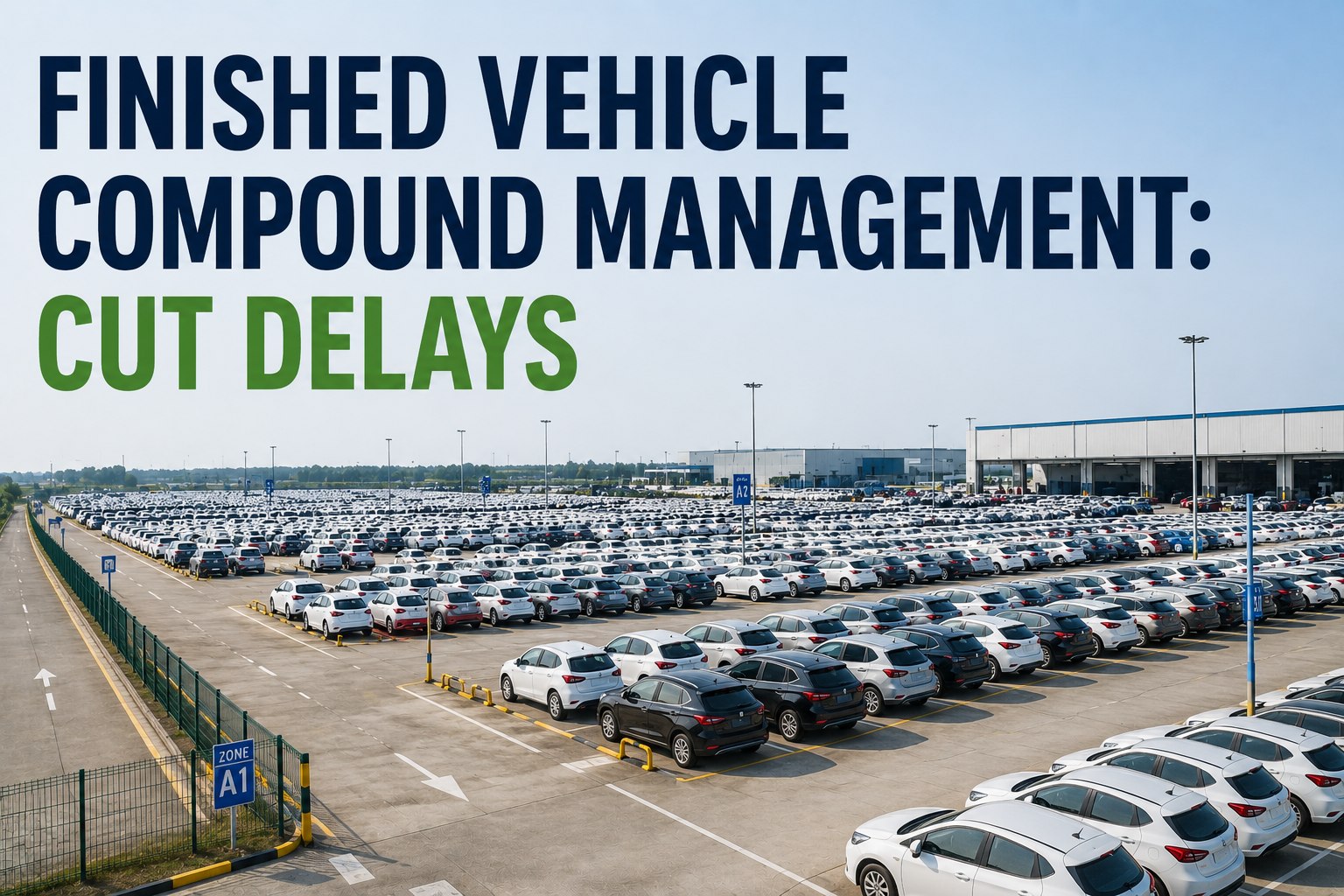
A finished vehicle compound looks like a yard and behaves like nothing else in logistics. The assets are serialised individually by VIN, stored in the open with real damage exposure, handed between carriers repeatedly, and subject to quality holds, release gates and destination sequencing that a trailer yard never has to think about. And the failure that starts most compound problems is small: a driver running behind stashes a car hastily in the wrong place. That single misplacement cascades — search time, a short-shipped load, detention on a waiting car carrier, and a dealership expecting a vehicle that cannot be found on a site spanning hundreds of acres. The system said slot B-14. The car is in D-07. Nobody recorded the difference. Book a 30-minute session and bring one week of your compound's move records — we'll map plan against actual in Fleet Rabbit and show you how much of your search time comes from a handful of repeat locations.
FINISHED VEHICLE LOGISTICS · COMPOUNDS
Finished Vehicle Compound Management
Capacity and slotting that reduces relocations, location accuracy measured rather than assumed, ageing stock surfaced before it is a problem, and retrieval time treated as the operational headline.
Zone B / Zone D
B-14
D-07
Where the plan says it is
Where it actually is
A planned-data-only system uses a static plan generated at gate-in to say where each car should be parked. It does not know when that stopped being true.
A Vehicle Compound Is Not a Trailer Yard
The requirements are more specialised than a typical yard use case, and tools built for trailers miss most of what makes this hard.
Serialised, individuallyEvery unit is a distinct item identified by VIN, not an interchangeable box. Finding the right one matters as much as finding one.
Open-air damage exposureSignificant damage risk across every handover, with standardised damage codes, photographic condition evidence and claims workflows attached.
Frequent carrier handoffsRoad, rail and port coordination, each handover a point where condition responsibility transfers and visibility can be lost.
Release gates and holdsQuality holds and campaign holds block units that are physically present and commercially unavailable — a state a trailer yard has no equivalent of.
Destination sequencingLoading order matters because a car carrier is unloaded in reverse. Slot allocation and load sequence are the same problem.
Charging and readinessElectric units need charging infrastructure and safety areas, and state-of-charge readiness becomes a dispatch condition rather than a nicety.
How a single misplacement becomes a cost
One vehicle out of place is enough to trigger delays that drive up cost. The sequence is consistent: search time absorbs a driver, the load departs short-shipped, the waiting car carrier accrues detention, and a dealership prepares for a vehicle that does not arrive. On a compound spanning hundreds of acres with thousands of units at different readiness stages, the search is the expensive part — and it is entirely invisible in any system that only holds the plan.
Slotting Rules Before Slotting Technology
Allocation decisions determine how many times each unit gets moved, and moves are where cost, damage and misplacement all originate. Six criteria worth setting explicitly.
1Shipping scheduleUnits departing soonest closest to the loading area. The simplest rule and the one that removes the most avoidable movement.
2Destination and route groupingVehicles going to the same place parked together, so a load is assembled from one area rather than from six.
3Customer or brand groupingKeeps related units together for inspection, campaign work and reporting, and simplifies audits considerably.
4Vehicle type and dimensionsSlot sizing by model, because a mixed zone sized for the largest unit wastes space on every smaller one.
5Special handling requirementsElectric units to zones with charging and safety provision. A constraint rather than a preference, and one that is growing.
6Hold statusHeld units segregated so they do not occupy prime dispatch positions while blocked. Their dwell is longer by definition.
Design the physical layout to match — numbered lanes and zones, sized to the traffic they carry. The point of good allocation is reducing unnecessary relocations, because every avoided move removes a search opportunity, a damage opportunity and a labour cost simultaneously.
Move audit
Most compounds have never counted moves per vehicle.
Bring one week of movement records to a short call. We'll count moves per unit in Fleet Rabbit, separate the value-adding moves from the relocations caused by slotting, and show which zones generate the repeat handling. Teams are usually surprised by the ratio — and it is the number that decides whether you have a technology problem or a rules problem.
Location Accuracy: Choose the Tier Deliberately
Real-time visibility of every vehicle is fundamental, but the technology tier should follow the problem rather than lead it.
← Swipe to see all columns →
Technology is not always the answer
Many yards improve substantially by tightening slotting rules, scanning compliance, exception management and carrier scheduling — no new hardware involved. Higher-volume or more complex compounds may justify optical recognition, RFID or real-time location tools, but only when search time, claim exposure and labour waste are material enough to support the investment. Baseline first, then decide. The order matters, because a location system laid over poor slotting rules produces precise visibility of an operation that is still moving cars unnecessarily.
Ageing Stock and Blocked Units
Two distinct problems that look identical on an inventory report and need opposite responses.
Ageing stock
Units sitting beyond expected dwell with nothing preventing dispatch. Consuming prime compound space, accruing damage exposure and tying up working capital while nobody is looking at them.
ResponseSurface by age band and act — dispatch, relocate to lower-value space, or escalate the commercial reason
Blocked units
Physically present and commercially unavailable — quality holds, campaign work, documentation gaps or unreleased status. Their dwell is not a compound failure and treating it as one wastes attention.
ResponseTrack the share of units blocked by unreleased holds as its own metric, and chase the release rather than the vehicle
Report both separately and the compound stops absorbing blame for a commercial delay — and, more usefully, somebody starts working the hold queue. Temporary storage capacity exists precisely to absorb campaigns, quality holds, extended dwell and outbound capacity constraints, so knowing which of the four is filling your yard is the difference between a capacity problem and a release problem.
The Metrics That Matter
Eight figures, and the second one is the one most compounds have never measured.
Dwell timeFrom gate-in to dispatch, split by whether the unit was releasable throughout. Blended dwell hides the distinction that matters.
Locate accuracyShare of units found where the system says they are. The foundational metric, and the one that determines whether any other number can be trusted.
Moves per vehicleTotal handling events per unit. Every move above the necessary minimum is cost, damage risk and a chance to lose the car.
Carrier turn timeArrival to departure for the car carrier. Long turns produce detention and make you a difficult compound to schedule against.
On-time dispatchAgainst the planned load. Short-shipped loads usually trace back to a unit that could not be found in time.
Aged inventoryBy band, excluding held units. Rising bands mean either a demand problem or a compound that has stopped looking.
Damage frequencyPer handling event rather than per unit, so the relationship between moves and damage is visible.
Units blocked by holdsShare of inventory unavailable for release. Capacity you are storing but cannot use, and the fastest route to freeing space.
Where the standards help
Cross-company integration is getting easier. Industry bodies have codified recommendations covering RFID in vehicle distribution, VIN label content, design, location and quality, and a full set of standardised message formats for finished vehicle communication — alongside common event definitions for outbound flows. Adopting the standard message set rather than a bespoke integration per partner is what makes compound data usable beyond your own fence.
Baseline Before You Buy
Four steps, in order. Skipping the first two is how compounds end up with precise visibility of a badly designed operation.
1Measure the current state per yardDwell, locate accuracy, moves per unit, turn times, damage claims, aged inventory and release exceptions — by site, because sites differ more than anyone expects.
2Map where VIN visibility is lostTrace the physical and digital flow together, identifying where vehicles wait and which handoffs create rework. The gaps are usually at handovers rather than in the middle of a process.
3Fix rules, compliance and scheduling firstSlotting rules, scan compliance, exception management and carrier scheduling. Substantial improvement is available here with no hardware at all.
4Then size the technology to the residual problemIf search time, claim exposure and labour waste remain material after the first three, the case for automated identification or real-time location makes itself.
Twenty minutes on your compound's dwell, locate accuracy and hold queue
On the call we'll take one site's records into Fleet Rabbit, produce the eight-metric baseline, split ageing stock from blocked units, and show which of your slotting rules is generating the most avoidable movement. You keep the baseline either way — and it is the document that determines whether your next investment should be in rules or in hardware.
Frequently Asked Questions
Why can't we use a standard yard management system?
Because vehicle yards manage serialised finished goods by VIN in open-air compounds with significant damage exposure and frequent carrier handoffs — and they need workflows for proof of condition, quality holds, rail and port coordination, charging and destination sequencing. Those requirements are more specialised than a typical trailer-yard use case. A trailer-focused tool will handle gate logging and slot assignment and will have nothing to say about a held unit, a damage code or a load sequence.
What does one misplaced vehicle actually cost?
More than the search. The smallest misstep — one vehicle out of place — is enough to trigger delays that drive up costs: search time absorbing a driver, a short-shipped load, detention on the waiting car carrier, and a dealership expecting a vehicle that does not arrive. On a site spanning hundreds of acres holding thousands of units, misplacements have a snowball effect, and the usual cause is mundane — a driver behind schedule stashing a car hastily in the wrong place.
Do we need RFID or real-time location tracking?
Not necessarily, and not first. Many yards improve substantially by tightening slotting rules, scanning compliance, exception management and carrier scheduling alone. Higher-volume or more complex compounds may justify optical recognition, RFID or real-time location tools — but only when search time, claim exposure and labour waste are material enough to support the investment. Baseline the current state first; the numbers will tell you whether you have a rules problem or a visibility problem.
How should vehicles be allocated to slots?
Against shipping schedule, destination and customer or brand grouping, vehicle type, special handling needs and hold status — with the compound laid out in numbered lanes and zones sized to the traffic they carry. Electric vehicles need zones with charging and safety provision. The objective throughout is reducing unnecessary relocations, since each avoided move removes a labour cost, a damage opportunity and a chance to lose the vehicle at the same time.
Which metric should we fix first?
Locate accuracy, because every other number depends on it. If units are not where the system says they are, dwell is understated, moves per vehicle is undercounted and on-time dispatch failures look like scheduling problems rather than search problems. Measure it directly — sample a set of VINs and physically verify — rather than inferring it. The result usually justifies the rest of the programme on its own.
How do we handle ageing stock?
Separate it from blocked units first, because the two look identical on an inventory report and need opposite responses. Genuine ageing stock — releasable but sitting — should be surfaced by age band and acted on through dispatch, relocation to lower-value space, or commercial escalation. Units blocked by unreleased holds are a release problem rather than a compound problem, and tracking the share of inventory in that state is often the fastest route to freeing capacity.
What is changing in compound operations?
The baseline capabilities — slot assignment, gate logging, dwell tracking — are now table stakes, and the shift is toward the intelligence layer above them: yard optimisation, dynamic routing, ETA prediction and capacity reservation based on live demand and disruption data. Infrastructure-led automation is being stress-tested at port scale, and digital twins and computer vision for damage detection are moving from concept toward deployment. None of it substitutes for accurate location data underneath.
Book a session with one site's records and we'll show what your current data supports today.
Know Where It Is, Not Where It Should Be
Locate accuracy measured rather than assumed, slotting rules set before slotting technology, ageing stock separated from blocked units, moves per vehicle counted, and the baseline established before anyone specifies hardware.
Bring one site's move records to the call · Works with standard FVL message formats · Free tier available