A driver flags a brake defect on the mobile DVIR at 7:14 AM. Twelve seconds later, a Slack message lands in the #shop channel with the photo, asset ID, defect severity, and a one-tap link to approve the work order. Two minutes later, the assigned tech gets an SMS with parts staged at bay 3. By 7:30 AM, the dispatcher's spreadsheet auto-updates with the truck's projected return-to-service time. Nobody on the maintenance team typed any of that. n8n did it. Fleet Rabbit's webhook layer fires on every fleet event — DVIR submission, defect creation, work order status change, PM threshold crossed, certificate expiring, audit flagged — and n8n routes those events to email, Slack, SMS, CRMs, ERPs, sheets, dashboards, or any of 400+ connected services with no code. Self-hosted, source-available, your data stays on your infrastructure. This guide shows the architecture, eight production-ready workflow recipes, the trigger and action library, the setup walkthrough, real-world ROI numbers, and the security architecture for connecting Fleet Rabbit to n8n in under 30 minutes.
Why Event-Driven Beats Polling — The Numbers Behind the Architecture
Most fleet integrations still poll APIs every 5-15 minutes asking "anything new?" Webhooks push events the instant they happen. The architectural difference shows up in latency, server load, cost, and operational accuracy.
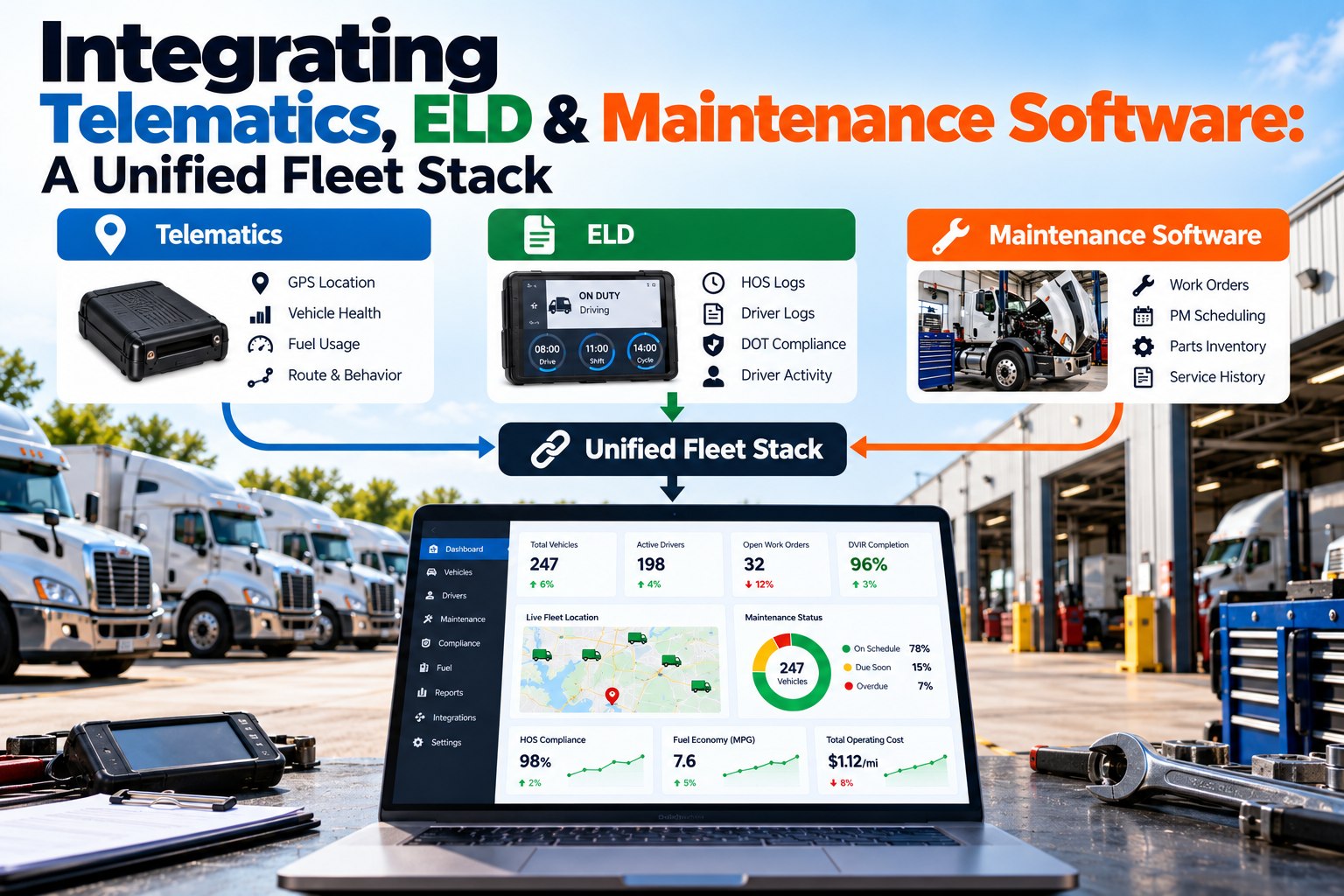
The Architecture — How Fleet Rabbit Talks to n8n
Three layers. Each one transparent. Each one auditable. Fleet Rabbit fires signed webhooks. n8n receives, validates signatures, processes, and routes. Destination services receive the final action. No middleware vendor in between.
Every meaningful fleet event fires a webhook within milliseconds: DVIR submission, defect flag, work order create/update/close, approval action, PM threshold cross, certificate expiration approaching, behavior alert, audit anomaly. Each event includes the full context payload (asset, driver, photos, GPS, timestamps, severity).
Webhook node receives the payload. Optional signature verification ensures origin authenticity. Filter, Switch, Merge, and Set nodes transform the data. Conditional logic decides what happens next. Visual execution log captures every step with success/fail and the data that flowed through.
The action node fires — Slack message, email, SMS, CRM record creation, sheet update, AI agent invocation, ERP push. Multiple actions can run in parallel (notify Slack AND email AND CRM all at once) or in sequence (only fire SMS if Slack delivery confirmed).
8 Production-Ready Workflow Recipes
The following eight workflows are the most-deployed Fleet Rabbit + n8n recipes in 2026. Each one solves a real operational problem most fleets currently handle with manual phone calls, missed emails, and Friday-afternoon panic. Pre-built templates available in the integration library.
Each recipe builds in n8n's visual editor. Templates available in the Fleet Rabbit + n8n integration library — clone, configure credentials, activate. Get the Recipe Templates →
The Building Blocks — Triggers & Actions Available
Mix and match. Any trigger can connect to any action. Any action can have conditional logic between it and the trigger. The list below is non-exhaustive — n8n's 400+ node library plus Fleet Rabbit's webhook coverage means almost any "when X happens, do Y" workflow is constructible.
The 5-Step Setup — Fleet Rabbit Connected to n8n
Total time from zero to first live workflow: typically under 30 minutes. The Fleet Rabbit webhook layer and n8n's visual editor are designed for non-developers to wire up production automations.
Self-host via Docker (single-line install) or use n8n Cloud. Both options free for up to 5 active workflows. Self-host keeps all data on your infrastructure — important for fleets with HIPAA, SOX, or carrier security requirements.
Settings → API → Create webhook key. Set scope (read-only / event-trigger / read-write) and event filters (DVIR, WO, PM, etc.). Key generation includes signing secret for webhook signature verification.
Drag the Webhook node into the canvas. Copy the n8n-generated URL into Fleet Rabbit's webhook destination. Test event fires — n8n receives the payload with full event JSON (asset, defect, severity, photo URLs, user identity).
Drag Slack/SMS/Email/CRM nodes onto the canvas. Connect with credentials (OAuth or API key). Map the Fleet Rabbit event fields onto each destination's required parameters using n8n's drag-and-drop expression builder. No code.
Flip the workflow toggle to active. n8n starts processing live events. Visual execution log shows every run with success/fail status, payload received, and downstream actions completed. Debug any failed runs and re-execute.
For the most-deployed recipes (Recipes 01-08 above), pre-built n8n workflow templates are available in the Fleet Rabbit integration library. Clone, plug in credentials, activate. Walk Through Setup Live →
Real-World ROI — What 50-Vehicle Fleets Actually Recover
The dollar impact of fleet automation isn't theoretical. Below is the average annual recovery for a 50-vehicle fleet running the eight recipes above — based on customer telemetry and industry benchmarks.
Cert expiration SMS reminders eliminate ~95% of expired-credential roadside fines. Avg violation: $3,500 × ~13 prevented annually.
Manual triage, follow-ups, status reports auto-eliminated. ~24 hr/week × 52 weeks × $50/hr loaded labor = saved.
12-second alert-to-action vs 4+ hour email lag. ~2 vehicle-days/month recovered × $700/day revenue × 50 vehicles avg.
Auto-scheduling eliminates missed PMs. Deferred PM costs 4-5× planned. ~35-45% reduction on $90K annual PM spend.
2-3 day billing acceleration improves cash conversion. ~$1.2M annual repair invoicing × WACC interest = recovered.
Total automation ROI for a 50-vehicle fleet running all 8 recipes. Fleet Rabbit subscription cost at $3/vehicle/month: $1,800/yr. ROI ratio: ~141×.
Why Self-Hosted Matters for Fleet Data
Cloud automation tools (Zapier, Make, Workato) route every webhook through their servers. Every DVIR, every defect photo, every driver record passes through a vendor's cloud — and stays in their logs. n8n self-hosted runs on your servers. Fleet event data goes Fleet Rabbit → your n8n instance → your destination, with nothing in between.
Security & Reliability — Production-Grade by Default
Fleet automation routes safety-critical signals. The infrastructure handling those signals needs to be reliable when it matters and secure all the time.
Every webhook from Fleet Rabbit is signed with a shared secret. n8n's verification node rejects any payload that doesn't match — protecting against spoofed requests, replay attacks, and tampered data.
Webhook endpoints enforce TLS 1.2+. n8n self-hosted ships with Let's Encrypt auto-renewal via reverse proxy. No plaintext webhook traffic anywhere in the chain.
Restrict webhook sources to Fleet Rabbit's published IP ranges. Optional but recommended for fleets with strict perimeter security policies.
Failed actions retry automatically with exponential backoff (3 attempts, 30s/5min/30min intervals). Permanent failures route to an error workflow that pings the admin.
Every workflow run logged with input payload, transformation steps, output destinations, success/fail per step, and total runtime. Searchable and exportable for compliance review.
Per-endpoint rate limits prevent runaway loops and abuse. Configurable per workflow (default: 1000 req/min). Excess requests queue gracefully rather than failing.
Frequently Asked Questions
Do I need to be a developer to use n8n with Fleet Rabbit?
No. n8n's visual editor is designed for non-developers — drag-and-drop nodes, click-to-configure credentials, expression builder for mapping fields. The eight recipes above (Critical defect alerts, certificate expiration, WO closed automation, PM scheduling, behavior coaching, AI triage, audit lockdown, driver onboarding) all build in 15-30 minutes without writing code. Developers can drop into JavaScript when they want fine-grained control, but it's optional.
What's the difference between n8n self-hosted vs n8n Cloud?
Self-hosted runs on your infrastructure — Docker container on a $5 VPS handles thousands of executions per day. Source-available, no per-execution fees, full data control. n8n Cloud is hosted by n8n.io with a free tier (5 active workflows, 5K executions/month) and paid tiers thereafter. For fleet data with compliance requirements, self-hosted is the standard choice.
How do webhooks compare to API polling?
Webhooks push events from Fleet Rabbit to n8n in real time when something happens. Polling means n8n asks Fleet Rabbit "anything new?" every 5 minutes and waits for the answer. Webhooks reduce latency by 90%+ and server load by 95%. Use webhooks for real-time alerts (defects, status changes); use scheduled polling for daily summaries and audits. Most production fleets use both. See Webhook + Polling Combined →
What if a workflow fails mid-execution?
n8n's visual log shows every step with success/fail status. Failed runs can be retried automatically (configurable retry count + exponential backoff) or routed to an error workflow that pings the admin via Slack with the failure context. Production workflows typically include error-handler nodes so a Slack failure doesn't block the SMS that follows it.
Can n8n connect to platforms not in its 400+ node list?
Yes — n8n's HTTP Request node connects to any REST or GraphQL API. If a service has an API, n8n can hit it. For platforms without APIs, the Webhook node receives data; you write a transform; the HTTP Request node sends to wherever. The 400+ "native" nodes are convenience wrappers; the underlying capability is universal.
How does n8n handle GDPR / HIPAA / SOC 2 compliance?
Self-hosted n8n means workflow data never leaves your infrastructure — which is the default requirement for HIPAA and most SOC 2 controls. Logs, payloads, and execution history all stay in your environment. For GDPR, the source-available codebase is auditable and the self-host model puts you in control of data retention and deletion. See Compliance Configuration →
Can multiple workflows trigger from the same event?
Yes. Fleet Rabbit fires the webhook once; n8n receives it once; the workflow can branch to as many parallel destinations as needed. A single Critical DVIR event can simultaneously update Slack, send SMS, email a manager, create a Jira ticket, and log to Sheets — all in parallel, all in the same execution.
How is the Fleet Rabbit + n8n integration priced?
Fleet Rabbit's webhook layer is included in the standard $3/vehicle/month subscription — no per-event fee, no integration tier. n8n self-hosted is free; n8n Cloud has a free tier. Total cost for a 50-vehicle fleet running 4-8 production workflows: typically under $10/month for the n8n hosting on top of the Fleet Rabbit subscription. Book a Demo to See Pricing →
Fleet Rabbit + n8n connects every fleet event — DVIR, defect, work order, PM threshold, certificate expiration, audit flag, behavior alert, driver onboarding — to any of 400+ destinations including Slack, SMS, email, CRMs, ERPs, sheets, and AI agents. Visual editor. Self-hosted. Source-available. HMAC-signed webhooks. SOC 2 / HIPAA-compatible architecture. Free for up to 3 assets indefinitely.