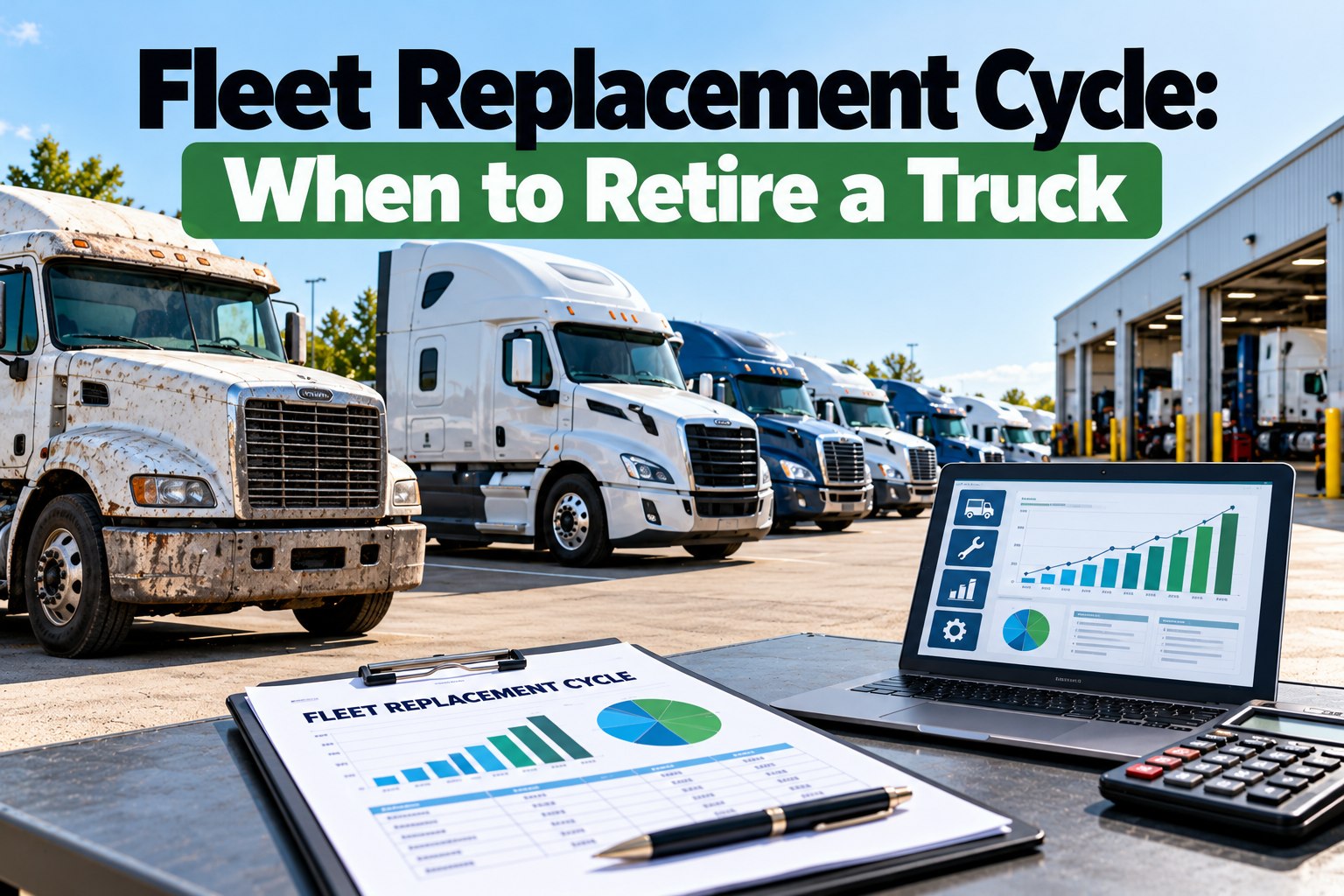
A fleet replacement cycle is the age or mileage at which you retire a truck, and it is a trade between capital cost and operating cost. Keep a truck longer and you spend less on new trucks, but maintenance, downtime and fuel costs eventually climb. This page covers the three ways fleets decide when to replace, the published cost patterns by year and the thresholds experts use to flag a truck for review. Schedule a call to track maintenance cost per truck against its age.
REPLACEMENT CYCLE · TRUCK LIFECYCLE COST
Every Truck Has a Year When Keeping It Costs More Than Replacing It
How fleets find that year, what the published cost patterns show and which numbers to track.
30%maintenance-to-residual-value level one consultant uses to flag a unit for review
Year 4where one fleet financier's data shows maintenance cost first jumping
Three Ways Fleets Decide When to Replace a Truck: Economic Life, Age or Mileage and Repair Cost
Each method trades accuracy against effort, and most fleets combine a simple trigger with a check on each unit
Chatham Consulting's Sal Bibona described the three approaches in a January 2015 Automotive Fleet article on medium-duty trucks. The economic method finds the point where the equivalent annual cost bottoms out, using purchase price, interest, maintenance, mileage, downtime, fuel, depreciation and salvage value. His advice is to treat units that hit an age or mileage trigger as candidates and then check each unit's repair cost against its class average.
| Method | How it works | Weakness |
|---|
| Economic life analysis | Total ownership and operating cost over the life to find where the annual cost bottoms out | Data-heavy and often needs a consultant |
| Age or mileage rule | Review units at a set age or mileage, such as 8 years or 100,000 miles | Ignores condition differences inside a class |
| Repair cost threshold | Replace once repair spend passes a set share of cost or value | Needs clean repair cost records per unit |
The source is more than ten years old and covers medium-duty trucks, so use it for the method, not for any number of years.
When Maintenance Cost Jumps: A Year-by-Year Pattern from Real Fleet Operations
A Fleet Advantage white paper found costs flat through year three, then stepping up in years four and five
Heavy Duty Trucking's Jim Park reported in April 2019 on a 2018 Fleet Advantage white paper covering about five billion miles of fleet operations in food service, grocery distribution and chemical tank hauling. Fleet Advantage finances trucks, so it has an interest in shorter cycles, and the white paper itself was not read here.
YEARS 1 TO 3
Maintenance stays fairly flat
Park notes that some may dispute the figures, though he sees the upward trend as clear. The article tells fleets to use their own data to find when a truck becomes uneconomical in their operation.
MAINTENANCE AND REPAIR COST SAVED BY TRADING EARLIER, PER TRUCK. FLEET ADVANTAGE VIA HEAVY DUTY TRUCKING
Year 4 vs year 7 trade, maintenance saved
$42,830
3-year vs 5-year cycle, maintenance saved
$17,150
$0
$10,000
$20,000
$30,000
$40,000
$50,000
Does your own maintenance cost jump in year four? Schedule a call and we will line up cost per truck by age.
Find your fleet's tipping point from your own records.
Shop Hours, Fuel Economy and Fleet Age: The Costs That Rise as Trucks Get Older
Older trucks take more technician time and, per one lessor, burn more fuel past about 400,000 miles
Fleet Advantage's Matt Hendrix estimates a tractor needs about 2.5 maintenance hours a month in year one and about 4.5 in year three, which matters more with technician shortages. Penske, a lessor, says fuel efficiency starts to degrade around 400,000 miles. It cites the National Private Truck Council's 2025 Benchmarking Survey: leased fleets averaged 7.24 mpg and 3.2 years of equipment age, owned fleets 5.84 mpg and 5.34 years.
MAINTENANCE HOURS PER MONTH
Maintenance hours a month, year 1
2.5 hours
Maintenance hours a month, year 3
4.5 hours
FUEL ECONOMY, NPTC 2025 VIA PENSKE
AVERAGE EQUIPMENT AGE, NPTC 2025 VIA PENSKE
Leased fleets, average age in years
3.2
Owned fleets, average age in years
5.34
Age is not the only difference. Penske credits the mpg gap mainly to shorter trade cycles, but leased and owned fleets also differ in routes and trucks, which the article does not control for.
Replacement Triggers and Rules of Thumb Experts Use to Flag a Truck for Review
Flag at 30 percent of residual value, rebuild only when the numbers pay and reassess units that barely run
Triggers cited by Chatham Consulting
Maintenance at 30% or more of residual value
Age or mileage criteria, such as 8 years or 100,000 miles
Repair spend above the class average
Under 500 gallons or 2,500 miles in 12 months
Rebuild and accident rules
Rebuild only at about 50% of a new unit cost
And only if it adds about 75% of a new unit life
Accident repairs up to about 50% of vehicle value
Use fully burdened labor rates in the math
These come from a 2015 medium-duty article. The 100,000-mile and eight-year trigger is its example, not a Class 8 standard, so set your own.
Replacement Cycle Review Checklist: Build Your Own Retire-or-Keep List
Tick each step so replacement timing rests on your repair records, shop hours and residual values
Find Your Replacement Tipping Point: Track Maintenance Cost and Service History per Truck in FleetRabbit
FleetRabbit keeps PM schedules, work orders and costs for every vehicle in one record, so you can see what each truck costs to keep running as it ages. Free for up to 3 vehicles, then $5 per vehicle per month.
Cost per vehicle
Work orders and PM history
Repeat repairs by truck
Free for 3 vehicles
Fleet Replacement Cycle FAQs: When to Retire a Truck, Thresholds and Lifecycle Cost
Short answers on how to time replacement and what to track
How long should a fleet keep a truck?
No published source gives one answer. Fleet Advantage suggests trading around year three for its customers, while Chatham Consulting says to find the point where annual cost bottoms out for your fleet.
What is economic life?
The point where the equivalent annual cost of owning and operating a vehicle is lowest, found by totalling purchase, interest, maintenance, fuel, downtime, depreciation and salvage.
When should I flag a truck for replacement?
One consultant flags a unit when maintenance reaches 30 percent or more of its residual value. Set your own trigger from your data.
Does maintenance cost really jump in year four?
A Fleet Advantage white paper reported that, via Heavy Duty Trucking. Fleet Advantage finances trucks, so check your own records.
Is leasing the answer to replacement timing?
Lessors such as Penske argue it keeps fleets on regular cycles. It also changes who carries residual risk, so compare total cost.
What does FleetRabbit cost?
Retire Trucks on Evidence, Not on a Calendar Guess
Keep one cost record per vehicle so you can see when keeping a truck stops paying.
Free tier for up to 3 vehicles · No credit card required · Records stored per vehicle
October 17, 2026
By Derek Goes
All Articles