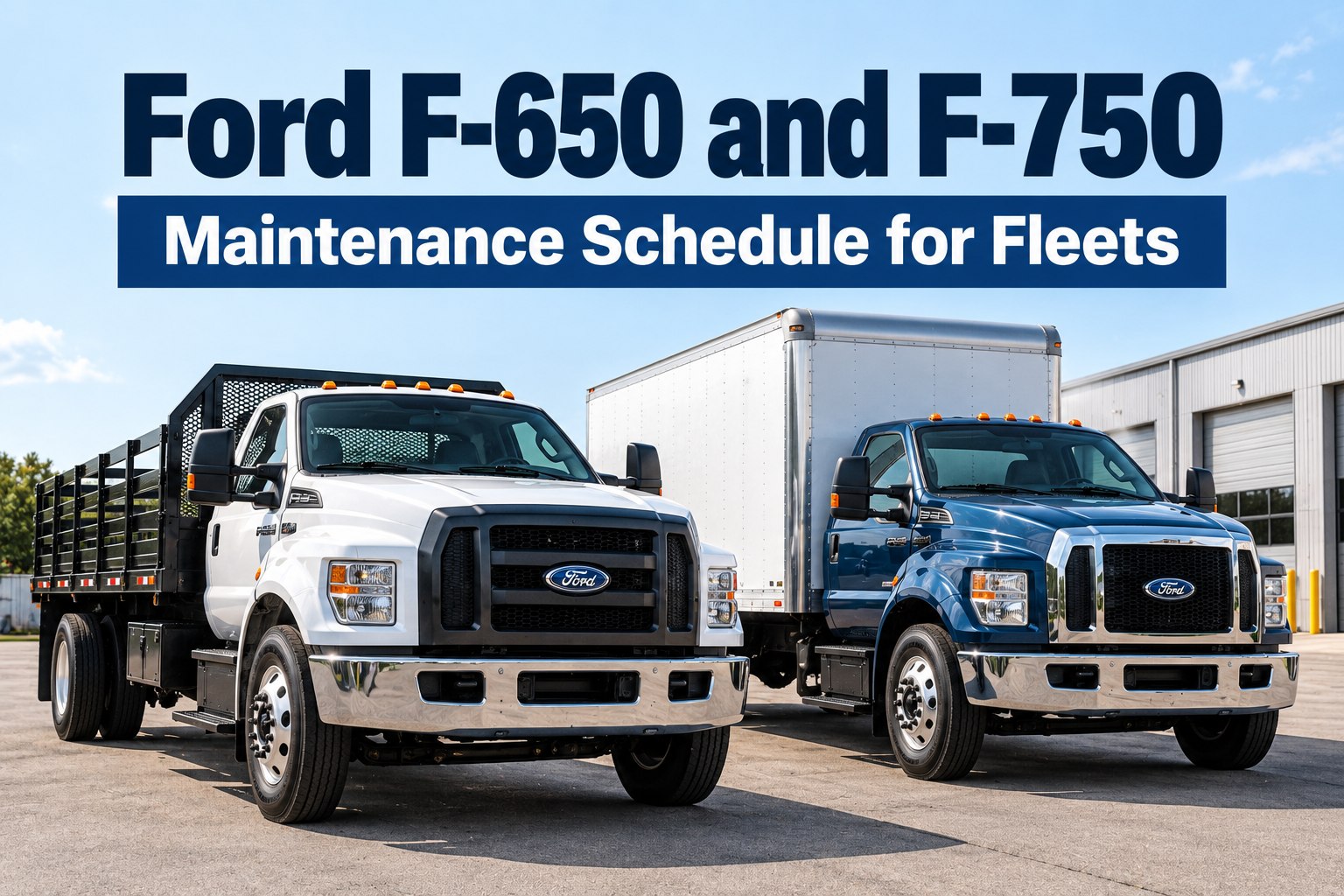
An F-650 or F-750 does not arrive as a truck. It arrives as a chassis cab, and something gets mounted on it — a box, a dump body, a bucket, a tow unit, a tank. That body is what turns it into the vehicle you actually operate, and it decides three things Ford's schedule cannot: whether the chassis runs on the normal or the severe schedule, what second maintenance schedule the vehicle carries from a completely different manufacturer, and in some cases whether an entire regulatory inspection regime attaches to it. Ford publishes half the schedule. The body builder publishes the other half, usually in hours rather than miles, and on most fleets it lives in a folder rather than a system — which is why the body half is the half that goes unserviced. Book an F-650 chassis review.
Ford Publishes Half of This Truck’s Schedule
Why the body on the back decides the chassis duty classification, what second schedule comes with it, and the inspection regime a bucket truck carries that has nothing to do with mileage at all.
The Body Chooses the Chassis Schedule
Ford's severe-duty schedule is not selected by vocation. It is triggered by conditions — and the body is usually what creates them.
Ford's own guidance puts a vehicle on the severe schedule when driving habits frequently include conditions such as towing, operating in dust, extended idling, snowplowing or off-road running. Read that list against a medium-duty body and the overlap is almost total. A dump truck idles while it tips and works unpaved sites. A bucket truck idles for the whole time the boom is up. A tow truck tows by definition. A sweeper runs stationary in dust as its core function.
So the sequence most fleets go through is backwards. The chassis schedule gets set when the truck is delivered, from the normal column, because at that point nobody has watched it work. The body then puts it squarely in the severe column, and nothing in the system notices.
For the specific chassis intervals on your own trucks, Ford's scheduled maintenance information for that model year and engine is the authority, and it differs between the diesel and the gas engine and between model years. What this page is about is the half of the schedule that is not in that document.
Why Hours Stop Matching Miles
This is the mechanism behind it, and it is worth seeing as a curve rather than a claim.
The vertical axis is engine hours accumulated per 1,000 miles driven; the horizontal is the share of engine running time the truck spends stationary. It is pure arithmetic — no assumptions beyond a road average speed. At zero stationary time a truck at 35 mph burns about 29 hours per 1,000 miles. At half its engine time stationary it burns about 57. The curve steepens because the miles stop accumulating while the hours carry on, and past roughly 60% it climbs very fast indeed.
The practical consequence is that any hour-based interval on the vehicle — and body builders use hours far more than mileage — falls due at a mileage that depends entirely on how much of the day the truck spends working rather than driving. A mileage-only schedule has no way to see it coming.
What Each Body Adds
Five common configurations and what each one puts on the maintenance programme beyond the chassis.
Lowest added burden, but a liftgate is a hydraulic system with its own service and a common source of downtime.
PTO use means engine hours with no miles, and the hoist is a lifting system people rarely schedule.
Carries the full ANSI A92.2 regime — four inspection types, one of them triggered by years in service.
Lifting and winching gear with its own inspection expectations, plus heavy PTO and idle time.
Pump time is almost all stationary, so hour limits arrive very early relative to the odometer.
Where does your body builder’s schedule actually live?
On most F-650 and F-750 fleets the answer is a folder, a glovebox, or nowhere — while the Ford intervals sit properly in a system. In thirty minutes we will put both schedules on the same units, with hours running alongside miles so the body items fall due instead of falling off.
The Bucket Truck Case, in Full
Where an aerial device is fitted the vehicle picks up four separate inspections, and the span between them is the problem.
ANSI A92.2 asks the owner for a frequent inspection daily or before first use, carried out by the operator; a periodic inspection every twelve months by a qualified individual or entity specialising in aerial maintenance, which may be required as often as monthly on frequent-use equipment or work near power lines; a major structural inspection after the first fifteen years of service and then every ten years, which adds load testing; and a post-event inspection after an accident or excessive loading. The axis has to be logarithmic because a daily walk-around and a fifteen-year structural test do not share a scale.
Look at what the third one is measured in. Years of service — not miles, not hours, not months since last service. A fifteen-year trigger on a truck that may have had two owners is exactly the kind of obligation that survives in nobody's system, and it is the one that involves load testing a boom that people stand in.
Who Publishes What
The whole schedule, sorted by where the figure actually comes from. Swipe the table sideways on mobile.
| Item | From Ford | From elsewhere | Note |
|---|---|---|---|
| Engine oil and filters | Ford, by model year and schedule | — | Normal or severe, decided by how the body is used |
| Fuel, air and DEF items | Ford | — | Severe schedule shortens several |
| Chassis lubrication and brakes | Ford | — | Plus the federal annual inspection |
| Hydraulic oil and filters | — | Body builder | No Ford figure exists for this |
| Pump, PTO and drive | — | Body builder | Hour-based far more often than mileage-based |
| Boom, outriggers, rotation bearing | — | Body builder | Plus the ANSI regime where an aerial device is fitted |
| Aerial device inspections | — | ANSI A92.2 | Daily, annual, 15-year and post-event |
| Driver vehicle inspection report | Federal, 49 CFR | Covers the body too | Defects on the body are reportable defects |
| Annual federal inspection | Federal, 49 CFR | Covers the body too | The completed vehicle, not the bare chassis |
Two lines are worth reading carefully. The driver vehicle inspection report and the federal annual inspection both apply to the completed vehicle, not to the bare chassis — so a defect on the body is a reportable defect, and the annual inspection covers equipment Ford never supplied. Fleets that treat the body as an accessory rather than part of the vehicle tend to discover this during an inspection rather than before one.
The Body Also Decides the Weight Class
One more consequence of what gets mounted, and it reaches past maintenance into licensing.
The F-650 and F-750 sit in a range where the completed vehicle's rating determines which federal obligations attach. Above 10,001 pounds the vehicle is a commercial motor vehicle for federal purposes, which brings the driver vehicle inspection report, the annual periodic inspection and the associated driver requirements with it. Above 26,001 pounds you are into commercial driver's licence territory. A chassis is ordered with a rating, but the body and the way the truck is loaded are what determine where the finished vehicle actually lands.
That matters for scheduling because the obligations are not optional extras. An inspection programme built around Ford's maintenance intervals alone covers the engine and the chassis and leaves the compliance side unaddressed, which is the part with a roadside consequence.
There is a scheduling consequence too, not just a licensing one. The federal annual periodic inspection and the driver vehicle inspection report are both recurring obligations with records attached, and they belong on the same schedule as the oil changes rather than in a separate compliance process. A fleet running two systems for one truck ends up with two partial pictures of it.
If a unit was specified close to a threshold, it is worth confirming the completed vehicle rating rather than the chassis rating. The two are not the same number, and it is the completed one that governs.
How FleetRabbit Handles This
Four things, built around the fact that this vehicle has two manufacturers and two schedules.
Ford’s chassis intervals and the body builder’s own, held against the same vehicle, so the truck has one due list rather than a schedule and a folder.
Body work is where hours outrun miles. Recording engine and PTO hours is what makes hour-based intervals fall due at all.
Daily, annual and multi-year inspections sit on the schedule with their certificates attached, including the ones measured in years of service.
Make, model and serial of the body and its hydraulics, so the right intervals and the right documents follow that unit when it is reassigned or sold.
Questions F-650 and F-750 Operators Ask
Should our trucks be on Ford’s normal or severe schedule?
Check the conditions rather than the vocation. Ford's severe schedule is triggered by things like towing, dust, extended idling, snowplowing and off-road running — and most medium-duty bodies produce at least one of them as a matter of routine. If the body idles or tows, start from severe. Review your configurations.
Where do we get the body maintenance intervals?
From whoever built the body, not from Ford. Hydraulic oil and filters, pump and PTO service, boom and outrigger work all come from the body builder's own documentation, and they are frequently specified in hours rather than miles. Add the Body Schedule.
Why do we need to track engine hours on a truck?
Because body work accumulates hours without miles. A truck spending half its engine time stationary burns roughly twice the hours per mile that a road-only truck does, so every hour-based interval arrives at an unpredictable odometer reading. Set up hour capture.
What inspections does a bucket truck need?
Four, under ANSI A92.2: a frequent inspection daily or before first use by the operator, a periodic inspection every twelve months by a qualified aerial maintenance specialist, a major structural inspection after fifteen years of service and then every ten, and a post-event inspection after an accident or overload. Set Up Aerial Inspections.
Does the federal annual inspection cover the body?
It covers the completed vehicle, so yes — equipment Ford never supplied is in scope, and a defect on the body is a reportable defect on a driver inspection report. Treating the body as an accessory is how that gets discovered at the roadside. Check your coverage.
Does the body change our licensing requirements?
It can. Above 10,001 pounds the completed vehicle is a commercial motor vehicle federally, and above 26,001 pounds you are into commercial licence territory. The chassis rating and the completed vehicle rating are different numbers, and the completed one governs. Confirm the rating.
What gets missed most often on these trucks?
Hydraulic oil and filter changes, because they have no Ford figure, and anything measured in years of service rather than miles. The fifteen-year aerial structural inspection is the extreme case — it outlives most ownership and lives in nobody's system. Audit an incoming unit.
Can we keep both schedules in one place?
That is the point of doing it properly. Ford's intervals, the body builder's intervals, hours alongside miles and the inspection certificates all belong on one maintenance record held against that unit, so reassigning the truck carries its whole history with it rather than half of it. Start Free on Three Units.
Schedule the Whole Vehicle, Not Just the Chassis
FleetRabbit holds Ford's intervals and the body builder's on the same unit, runs engine and PTO hours beside mileage, and keeps inspection regimes with their certificates attached — including the ones measured in years of service that no odometer will ever raise.
Free for 3 vehicles · no credit card required