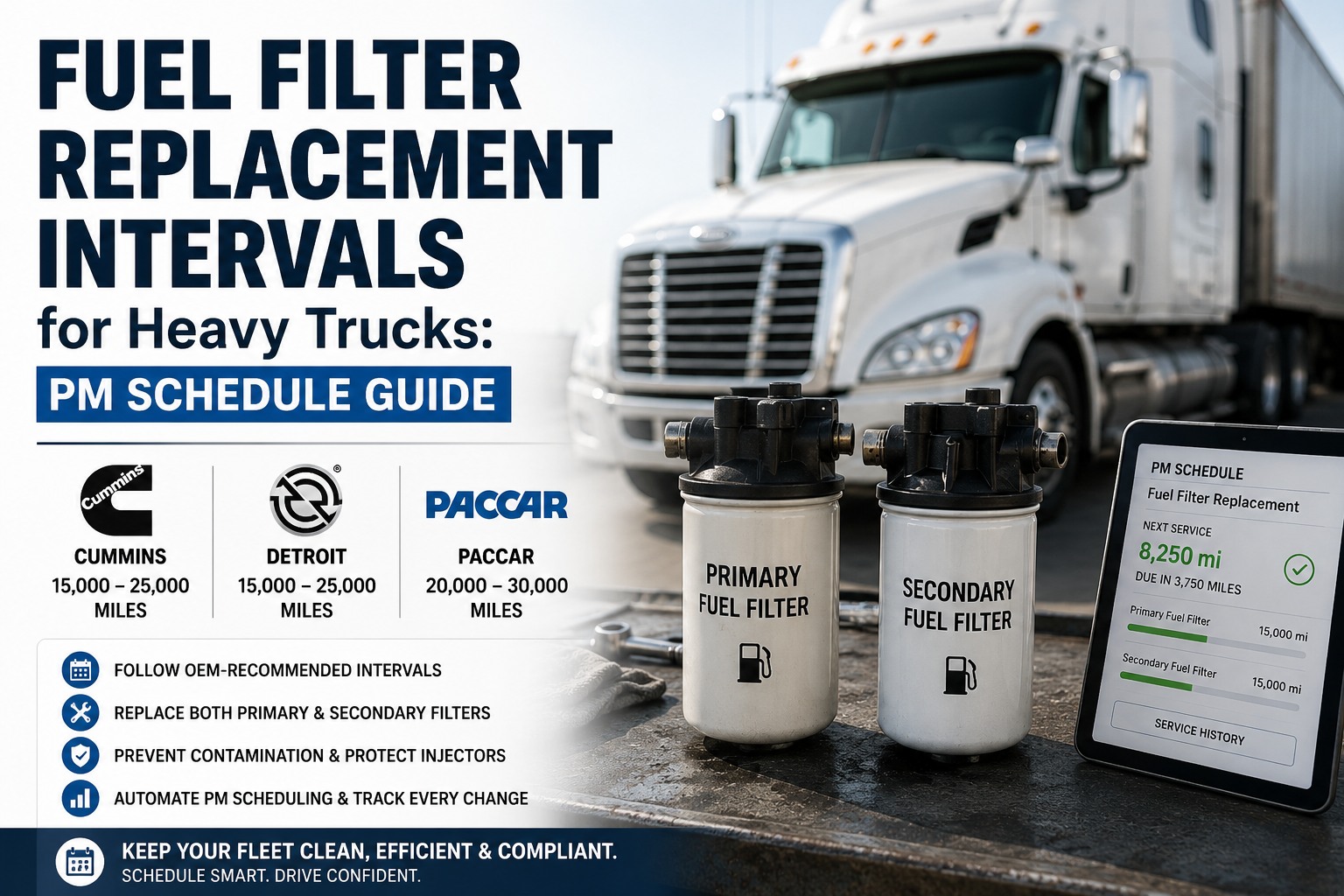
A fuel filter is the cheapest insurance a heavy truck carries — and one of the easiest services to let slip. On a modern common-rail diesel, a neglected filter does not just restrict fuel; it lets contamination reach a high-pressure pump and injectors that cost four figures each to replace, turning a $100 filter into a $10,000 repair. The problem for a fleet is that "when to change it" is not one number: Cummins, Detroit, and PACCAR each publish different intervals, primary and secondary filters run on different clocks, and severe duty cuts every interval short. This guide lays out the manufacturer-recommended fuel filter intervals by engine make, explains the primary-versus-secondary distinction, shows how duty cycle and fuel quality shift the numbers, and details how automated PM scheduling software tracks every filter change by mileage and engine hours across a mixed fleet — so no truck ever runs past its interval by accident. Start free trial or book a demo session with us to put every filter on an automated schedule.
DIAGNOSTICS & REPAIR · PREVENTIVE MAINTENANCE
A $100 Fuel Filter Is the Cheapest Way to Protect a $10,000 Fuel System
Every engine make runs a different interval, primary and secondary filters change on different clocks, and severe duty shortens all of it. Miss the schedule and contamination reaches the pump and injectors — the four-figure components a filter exists to protect.
15K
Typical Cummins 6.7L fuel filter interval, in miles or 12 months
100K
Detroit's hard ceiling — never exceed this on engine fuel filters
3
Separate duty-cycle schedules PACCAR publishes for the MX-13
250 hrs
Inspection rule of thumb for hour-based equipment, regardless of miles
Primary vs. Secondary: Two Filters, Two Jobs
Most modern heavy trucks run a two-stage fuel filtration system, and understanding the split is the key to scheduling correctly. The two filters do different jobs, sit in different places, and can run on different intervals.
STAGE 1
Primary Filter / Water Separator
Mounted between the tank and engine, often on the frame rail. It catches the larger contaminants and, critically, separates water out of the fuel before it reaches the injection system. This is the filter with the drain bowl you check for water and sediment.
Coarser filtration · Water separation · Drain bowl to monitor
STAGE 2
Secondary / Fine Filter
Mounted on the engine, this is the final line of defense before the high-pressure pump and injectors. It captures the fine particles — down to 4–5 microns — that would otherwise score injector internals. On many engines it runs a tighter interval than the primary.
Fine filtration (4–5 micron) · Protects pump & injectors
Fuel Filter Intervals by Engine Make
Here are the manufacturer-recommended baseline intervals for the most common heavy-truck engines. These are starting points for normal-duty operation on clean, branded fuel — severe duty and contaminated fuel shorten them, which the next section covers. Swipe the table horizontally on mobile.
← Swipe to see all columns →
i
The color test that beats any mileage number: a fuel filter that has turned dark brown or black from its original white or yellow has already absorbed a heavy load of contaminants and is due for replacement — regardless of what the odometer says. Fleets running frequent filter cut-opens learn their real interval faster than any manual can tell them. The catch is that this only works if someone is tracking each filter's install mileage and actually inspecting on schedule, which is exactly what falls apart with paper logs.
See how per-filter mileage tracking makes cut-opens actionable.
How Duty Cycle and Fuel Quality Shift the Interval
The manufacturer baseline assumes normal operation on clean fuel. Real fleets rarely run at baseline. These factors move the interval — usually shorter — and a fleet that ignores them is running its filters (and its pumps) on borrowed time.
SHORTEN
Severe / Vocational Duty
Heavy towing, dusty conditions, and high-idle vocational work load filters faster. Cut the baseline to 7,500–10,000 miles for these applications.
SHORTEN
Biodiesel Blends (B20+)
Biodiesel is a strong solvent that cleans tanks and lines, loading filters faster. Most mechanics drop to 10,000 miles on B20 or higher blends.
SHORTEN
Poor Fuel Sources
Low-volume or off-brand stations deliver more contamination and water. Trucks fueling here plug filters faster than the same truck on Tier-1 branded fuel.
EXTEND
Branded Tier-1 Fuel
Fuel from high-volume branded stations generally meets strict standards with fewer contaminants, letting you push toward the upper end of the interval.
Three engine makes, two filters each, four duty adjustments. Who's tracking all that?
Fleet Rabbit stores the right interval for every engine and duty cycle, tracks each filter's install mileage, and fires the reminder before any truck runs past due — across your whole mixed fleet.
Why the Interval Matters: What a Missed Filter Costs
Skipping a fuel filter change does not cause an immediate breakdown — which is exactly why it gets skipped. The damage is cumulative and shows up downstream, in the expensive components the filter was protecting. Swipe the table horizontally on mobile.
← Swipe to see all columns →
Two service details that save injectors: first, prime the system thoroughly after every filter change — on a 6.7L Cummins that means 10–12 key cycles, and Detroit engines need a 70-PSI primer — because running the injection system dry damages it. Second, don't over-torque the filter cap; the 6.7L Cummins spec is 22.5 lb-ft, and a cracked housing from "tight enough" is a lesson you only need to learn once. On 2019+ CP4-equipped engines, inspect the filter and separator for metal remnants that signal a failing pump.
Book a demo session to attach these steps to every work order.
Put Every Filter, on Every Truck, on an Automated Schedule
Fleet Rabbit stores the correct primary and secondary interval for every engine make and duty cycle, tracks each filter's install date and mileage, and fires a reminder before any truck runs past due — with the priming and torque steps attached to the work order. Deploy at $5/vehicle/month, no hardware, live within 72 hours.
Per-engine interval library
Mileage & hour-based triggers
Duty-cycle adjustments
Priming & torque steps on the WO
How PM Scheduling Software Tracks Every Filter
The reason fuel filters get missed is not that fleets don't know the intervals — it's that tracking a different interval for every engine, filter stage, and duty cycle across a mixed fleet is impossible on a spreadsheet. Here is how Fleet Rabbit automates it end to end.
01
Per-Engine Interval Library
Set the correct primary and secondary fuel filter interval for each engine make and model once — Cummins, Detroit, PACCAR, and more — and every truck inherits the right schedule automatically.
02
Mileage & Engine-Hour Triggers
Schedules fire on whichever comes first — miles, engine hours, or the calendar — so an over-the-road truck and a high-idle vocational unit each get serviced on the clock that actually matters for them.
03
Duty-Cycle Adjustments
Tag a truck as severe-duty, biodiesel, or poor-fuel-source and its interval shortens automatically to the 7,500–10,000-mile range, without anyone having to remember the exception.
04
Advance Reminders, Not Overdue Alerts
Reminders fire before the interval hits, so filters get scheduled into planned shop time instead of triggering a roadside restriction code and an emergency service.
05
Complete Per-Filter History
Every change is logged with date, mileage, part number, and technician against the VIN — building the record that makes filter cut-opens meaningful and proves PM compliance in a warranty claim.
06
Procedure Steps on the Work Order
Priming cycles, cap torque specs, and CP4 metal-inspection reminders attach to the filter work order, so the tech does the service right and the injectors survive the swap.
Frequently Asked Questions
How often should I change a heavy-truck fuel filter?
It depends on the engine and duty cycle. A Cummins 6.7L runs a 15,000-mile or 12-month interval; a long-haul Cummins X15 can go up to roughly 75,000 miles; Detroit DD-series engines follow an MPG-based schedule but should never exceed 100,000 miles; and PACCAR's MX-13 publishes three separate schedules by duty cycle. Severe duty, biodiesel, or poor fuel sources cut all of these to the 7,500–10,000-mile range. Always change the filter when the dash service lamp lights, regardless of mileage.
Book a demo session.
What's the difference between the primary and secondary fuel filter?
The primary filter, usually combined with the water separator, sits between the tank and engine and catches larger contaminants while pulling water out of the fuel — it's the one with the drain bowl. The secondary or fine filter mounts on the engine and captures the fine particles, down to 4–5 microns, that would otherwise score the injectors. It's the final defense before the high-pressure pump. The two can run on different intervals, which is a big reason mixed fleets lose track of them on paper.
Book a demo session.
Can I extend my fuel filter interval to save money?
Only carefully, and only with evidence. Some fleets running clean branded fuel and verifying with filter cut-opens push toward the upper end of the manufacturer range. But the math rarely favors extending: a fuel filter is roughly $100, while a clogged one causes low-pressure codes, hard starts, and accelerated wear on a CP3 or CP4 pump — and injector scoring runs four figures per injector. The filter is the cheapest component in the system precisely because it protects the most expensive ones.
Book a demo session.
Does biodiesel change the fuel filter interval?
Yes. Biodiesel is a strong solvent that actively cleans deposits out of tanks and fuel lines, which loads the filter with that loosened material faster than straight ULSD. Most diesel mechanics drop to about 10,000 miles on B20 or higher blends rather than the standard 15,000. If you've just switched a truck to a biodiesel blend, expect the first filter or two to plug up quickly as the fuel system cleans itself out, then stabilize.
Book a demo session.
Why do I need to prime the system after a filter change?
Because running the injection system dry damages it. When you remove a filter, air enters the fuel system, and firing the engine before that air is purged forces the high-pressure pump and injectors to run without adequate fuel lubrication. On a 6.7L Cummins, prime with 10–12 key cycles; Detroit engines typically need a 70-PSI primer. Also mind the cap torque — 22.5 lb-ft on the 6.7L Cummins — because a cracked housing from over-torquing is an avoidable and costly mistake.
Book a demo session.
How does PM software help track filters across a mixed fleet?
It solves the core problem: no human can reliably track a different primary and secondary interval for every engine make, adjusted for each truck's duty cycle, across a mixed fleet on a spreadsheet. Fleet Rabbit stores the right interval per engine, triggers on whichever of miles, hours, or months comes first, shortens automatically for severe-duty or biodiesel trucks, and reminds you in advance so filters get scheduled into planned shop time. Every change is logged against the VIN, building both the cut-open history and the warranty-compliance record.
Book a demo session.
Never Let a $100 Filter Become a $10,000 Repair.
Fleet Rabbit stores the correct fuel filter interval for every engine make and duty cycle, tracks each filter by mileage and engine hours, and reminds you before any truck runs past due — with the priming and torque steps built into the work order. Integrated with your existing systems in 5–7 working days, at $5/vehicle/month, with no new hardware required.
Free tier for up to 3 vehicles · No credit card required · No hardware installation
July 21, 2026
By Derek Goes
All Articles