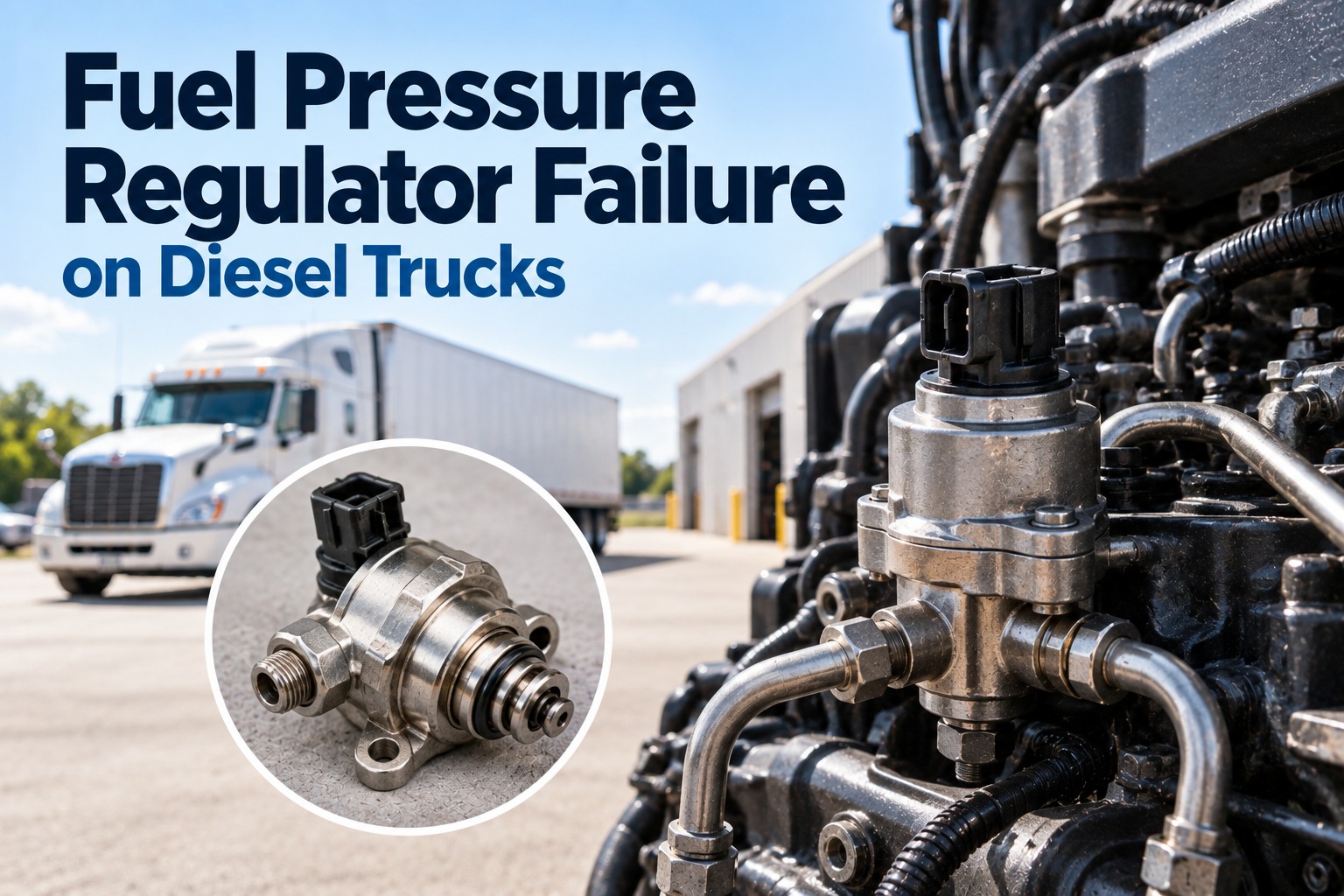
Fuel pressure regulator failure on a diesel truck shows up as low or unstable fuel rail pressure: hard starts or no-starts, loss of power or a derate, rough idle, stalling, misfire and fuel rail pressure fault codes with a check engine light. On modern common-rail engines the "regulator" is really a pair of electronically controlled valves — one metering fuel into the high-pressure pump and one controlling or relieving rail pressure — and the engine computer adjusts them constantly. The regulator is often blamed but rarely guilty first: engine-maker troubleshooting guides list clogged filters, low fuel, air in the fuel, leaks and supply restrictions ahead of the valve itself. This guide explains how rail pressure is controlled, the symptoms, why the regulator is usually not the cause, how to read the codes, a cheapest-first test order, what drives the cost and how to prevent it. Book a demo to see fuel faults turned into scheduled repairs, or start free with 3 vehicles.
Common-rail diesel · Fuel pressure control
Low Rail Pressure Gets Blamed on the Regulator. The Filter Is Usually Guilty First.
For fleet maintenance managers, technicians and owner-operators: what fuel pressure regulator failure looks like, how to confirm it before buying parts, and how to keep it out of the shop.
Order based on Navistar troubleshooting for fuel rail pressure below minimum, filed with NHTSA, which lists a sticking control valve as "not likely."
How Fuel Pressure Is Regulated on a Modern Common-Rail Diesel Truck
Fuel pressure on a common-rail diesel is controlled in two stages. A lift pump pushes fuel through the filters at low pressure; a high-pressure pump then raises it to injection pressure in the rail, and the engine computer sets rail pressure by adjusting a metering or quantity control valve at the pump and, on many engines, a pressure control or relief valve on the rail. You can log fuel system faults and repairs per truck on a free account.
Sources: Detroit Diesel GHG17 troubleshooting for SPN 157 FMI 16 and 17, and Navistar fuel rail pressure diagnostics, both filed with NHTSA.
Fuel Pressure Regulator Failure Symptoms Drivers and Technicians Report
Low or erratic rail pressure affects every injection event, so the symptoms show up in starting, power and smoothness. Engine-maker diagnostics list the same customer complaints across brands. We can match these symptoms to your trucks' fault history in a demo.
Hard start or crank-no-start
The rail can't reach minimum pressure while cranking, so the engine won't fire.
Loss of power or an engine derate
The engine computer limits power when rail pressure falls short of its target.
Rough idle, surging or stalling
Pressure swings upset fueling, especially under changing load.
Misfire and smoke
Poor atomization at low pressure can cause misfires and visible exhaust smoke.
Noise from the high-pressure pump
Listed by Navistar as a customer concern alongside rail pressure codes.
Check engine light with rail pressure codes
The clearest sign; read the failure type before replacing anything.
Why the Pressure Regulator Usually Isn't the Real Cause of Low Rail Pressure
When rail pressure is low, the pressure control valve is the obvious suspect, but engine makers point elsewhere first. Navistar's troubleshooting for fuel rail pressure below minimum lists nine possible causes and marks a stuck or sticking pressure control valve as "not likely"; Detroit's list for low cranking rail pressure starts with filter integrity and fuel supply. Record the confirmed cause on every fuel repair for free.
Supply side: check these first
- Restricted fuel supply
- Restricted engine-mounted secondary filter
- Aerated fuel delivery
- Fuel leaks
- Low fuel level
High-pressure side and sensing
- Rail pressure sensor or circuit fault
- Internal leak in the high-pressure system
- Leaking rail pressure relief valve
- Failed high-pressure pump
The regulator valve
- Stuck or sticking pressure control valve
Why this matters for your parts bill
A new regulator or pump fitted to a truck with a plugged filter or an air leak sets the same code again. Fixing supply-side causes first is cheaper and usually faster — and Detroit notes that its low cranking pressure code can set right after filter maintenance or running out of fuel, when the system simply needs priming.
Reading Fuel Rail Pressure Codes: Sensor Fault, Pressure Too Low or Too High
Most rail pressure faults share one parameter — SPN 157, fuel rail pressure — and the failure mode identifier (FMI) tells you whether the problem is real pressure or the sensor reading it. Related codes point at the control valves directly. We can read your trucks' fuel codes with you in a demo. Swipe the table on mobile.
| Code | What it means | Where to start |
|---|---|---|
| SPN 157 FMI 0 | Rail pressure above normal range, most severe | Pressure control or relief valve, return circuit |
| SPN 157 FMI 1 | Rail pressure below normal range, most severe | Supply side first, then high-pressure leaks |
| SPN 157 FMI 3 / 4 | Rail pressure sensor circuit voltage high or low | Sensor, connector and wiring — not pressure |
| SPN 157 FMI 16 | Rail pressure too low versus desired (Detroit) | Supply, filters, then pump and valves |
| SPN 157 FMI 17 | Minimum rail pressure not reached while cranking (Detroit) | Priming, filters, supply, then pump |
| SPN 633 | Fuel pressure control valve circuit (Navistar) | Valve connector, wiring and coil |
| SPN 1077 | Quantity control valve current or high-pressure leakage (Detroit) | Metering valve circuit, internal leaks |
Code descriptions from Detroit Diesel and Navistar troubleshooting documents filed with NHTSA and the SAE J1939 FMI definitions. Meanings vary by engine; always confirm in the maker's service information.
A Cheapest-First Test Order for Low Fuel Rail Pressure
The engine makers' own procedures work from the tank toward the rail, and that order keeps expensive parts on the shelf until they're proven bad. Record each result on the work order so a repeat fault starts where the last diagnosis ended. Add this test order to your templates free.
Steps and pass values from Navistar fuel rail pressure troubleshooting filed with NHTSA; your engine's procedure may differ.
Build the test order into every fuel pressure work order
In 30 minutes we'll show how FleetRabbit keeps each fuel code, test result and repair on the truck's history, so the next technician doesn't start from step one.
What Fuel Pressure Regulator Failure Costs a Fleet, From Filters to Pumps
The cost of a rail pressure fault depends almost entirely on where the cause turns out to be — and on how long the truck is down while you find it. Benchmarking by FleetNet America and ATA's Technology & Maintenance Council puts unplanned downtime at about $448 to $760 per truck per day before towing and repair, and ATRI's latest data puts average repair and maintenance at $0.215 per mile in 2025. Estimate your fuel-related downtime with our team.
Relative cost by repair type, illustrative — not prices. A failed high-pressure pump can send debris through the rail and injectors, which is why it sits at the top.
Preventive Maintenance That Protects the Diesel Fuel Pressure System
Most rail pressure faults start on the low-pressure side, which makes them the easiest to prevent with routine work. Put these tasks into your preventive maintenance schedule and note fuel concerns on every DVIR. See these tasks scheduled automatically in a demo.
Drain the water separator and watch for leaks
Water and air are two of the most common causes of low rail pressure.
Change fuel filters on the maker's interval
Use the specified filters and prime the system fully afterwards.
Read stored fuel pressure codes
Inactive rail pressure codes show a developing problem before a no-start.
Buy fuel from clean, high-volume sources
Contaminated fuel damages pumps and valves faster than wear does.
Don't run tanks near empty
Low fuel level can draw air and debris into the system.
Verify rail pressure under load
Confirm actual pressure tracks desired before closing the job.
Fuel Pressure Regulator Failure Questions Fleet Managers and Technicians Ask
What are the symptoms of a bad fuel pressure regulator on a diesel truck?
Hard starting or no-start, loss of power or a derate, rough idle or stalling, misfire, smoke, and fuel rail pressure codes with a check engine light. See these patterns across your trucks.
Is the regulator usually the cause of low rail pressure?
Usually not first. Engine-maker troubleshooting lists filters, fuel supply, air, leaks and low fuel level ahead of the valve, and Navistar marks a sticking control valve as "not likely." Track confirmed causes free.
What does SPN 157 mean?
SPN 157 is fuel rail pressure. The FMI tells you whether pressure is truly too high or too low, or whether the sensor circuit has a fault. Read your fuel codes with us.
Can you drive with a failing fuel pressure regulator?
Often only with reduced power, and the engine may stall or fail to restart. Low rail pressure can leave a truck stranded, so book the repair promptly. Log fuel faults on the DVIR free.
How much does fuel pressure regulator failure cost to fix?
It ranges from filters and priming to a control valve or a high-pressure pump with contamination cleanup. Downtime adds roughly $448 to $760 per truck per day by industry benchmarks. Estimate your exposure with our team.
How do I prevent fuel pressure problems?
Drain the water separator, change filters on schedule and prime properly, use clean fuel, avoid running near empty and read stored codes at every PM. Build that PM schedule free.
Find the Real Cause of Low Fuel Pressure Before You Replace the Pump
FleetRabbit keeps every fuel code, test result and repair on the truck's record, so technicians work down the suspect list instead of guessing — and a repeat fault points straight to what was missed.