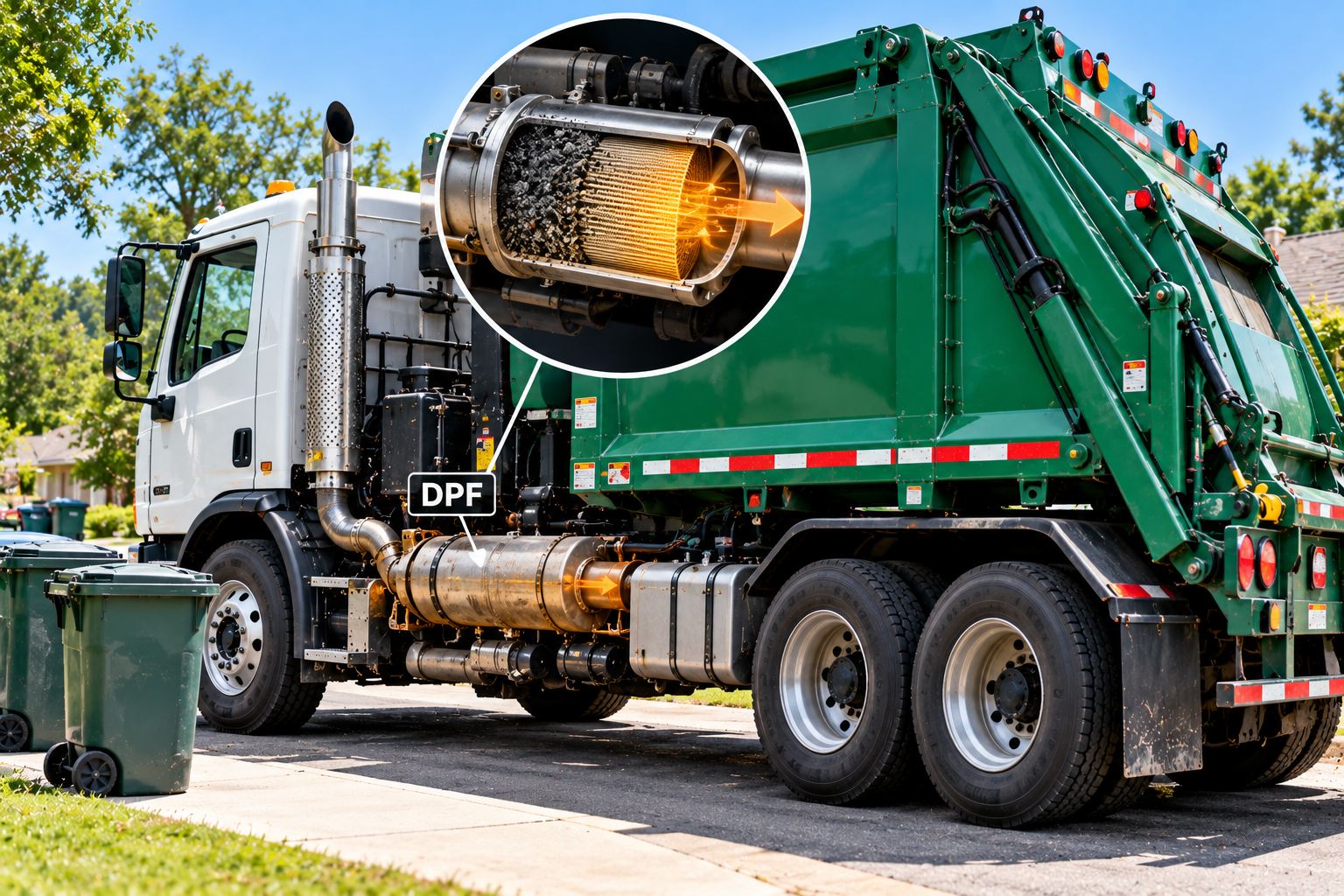
Garbage truck DPF problems are usually described as a reliability failure, when they are really a duty-cycle mismatch with a very specific consequence. The published escalation has four stages, and the first one offers two ways out: drive at highway speed for twenty to thirty minutes, or perform a parked regeneration. A residential collection route contains no twenty-minute highway leg, which means a refuse truck is effectively on the parked-regen path from the moment the lamp first lights. The only real decision left is when you take it, and whether anybody wrote it down — because the last stage on that ladder is a red stop lamp, a speed-limited truck, and a trip to a service location rather than to a landfill. Book a demo walkthrough.
Your Route Has No Highway Leg, So the Lamp Only Has One Exit
The four-stage lamp ladder, why passive regen barely happens on collection work, the two OEM steps everybody skips, and how to schedule a parked regen instead of being forced into one.
Three Regens, and a Collection Route Only Gets One of Them
The distinction matters because the three are not interchangeable, and the one a refuse truck can actually rely on is the slowest and most disruptive of the three.
Occurs when the vehicle’s duty cycle and exhaust temperature drive continuous soot oxidation during normal operation. No driver involvement, no performance effect, nothing on the dash.
The one a collection route almost never gets. Residential work does not hold exhaust temperature long enough for it to do meaningful work.
Used when the exhaust lacks enough heat on its own. The ECM adds unburned fuel to the exhaust stream to generate it, targeting roughly 1,100°F at the filter.
Runs while driving, but it needs the engine to stay in the right operating window long enough to finish. Constant stops keep interrupting it.
Driver-initiated with the manual regeneration switch, parking brake set, transmission in park or neutral. Guidance says to allow up to one hour.
Where a refuse truck ends up by default — which makes it a scheduling decision rather than a breakdown.
Passive regeneration is defined by the duty cycle producing the conditions on its own. That is the whole mechanism — and it is why a vocation built on constant low-speed stops gets so little benefit from it. The filter is not failing. It is being asked to work in conditions the strategy was not designed around.
The Four-Stage Lamp Ladder, and What Each Rung Costs
This is the sequence published by a major engine manufacturer. Reading it as a ladder rather than a set of warnings changes how a shift supervisor treats stage one.
Soot has reached the level where regeneration is needed.
Do: Confirm the inhibit switch is not engaged. Then either drive at highway speed for 20 to 30 minutes, or perform a parked regeneration.
Soot load is still climbing. The situation is more urgent than step one.
Do: Same two options, less time to choose between them. On a route day this is usually the point at which somebody should be deciding when, not whether.
The filter needs regeneration immediately.
Do: A parked regeneration is required. The highway option is effectively gone at this point.
Reached because no parked regeneration was performed.
Do: Stop the vehicle as soon as it is safe and take it to an authorised service location. This is no longer a route decision.
Notice where the options disappear. At stage one you have two routes and a free choice. By stage three one of them is gone. By stage four the decision has been made for you, and the vehicle is out of service at whatever point in the route it happened to reach. Every rung climbed removes an option that was available on the rung below.
The question worth asking tomorrow
How many parked regens did your fleet run last month?
Most fleets cannot answer, because each one is handled locally and never recorded anywhere. Yet the count per truck is the single clearest signal of which units have a route problem, a driver problem or a developing filter problem.
Symptom, Cause, and the Move That Actually Helps
Six situations crews meet on refuse routes. Swipe sideways on mobile.
| What you see | What it means | What to do | Worth knowing |
|---|---|---|---|
| DPF lamp comes on mid-route | Soot at the regeneration threshold | Check the inhibit switch first, then schedule the regen into the day | The highway option needs 20-30 continuous minutes a collection route does not contain |
| Parked regen requested repeatedly | Duty cycle is not supporting passive or active regen | Treat frequency as data, not nuisance — a rising count means something changed | Habitual inhibit-switch use makes this worse, not better |
| Regen starts then stops | Interrupted before completion | Allow the full cycle; guidance says to allow up to an hour | Repeatedly abandoned regens leave soot building until the filter cannot self-clear |
| Limp mode, speed capped | Escalation reached the final rung | Scan-tool regen required before normal operation resumes | Limp mode typically restricts the vehicle to around 5-10 mph |
| HEST lamp illuminated | High exhaust system temperature present | Keep the exhaust outlet clear of combustible surfaces and materials | Relevant at a tip face or near a loaded hopper more than on a road shoulder |
| Filter will not clean at service | Ash loading or thermal damage | Cleaning or replacement decision | Professional cleaning is commonly cited at 150,000-250,000 miles or 5,000 hours |
Six Things the Manual Says That Crews Routinely Skip
Two of these are printed steps in the OEM procedure and are missed constantly on refuse trucks specifically.
OEM guidance lists this explicitly as a step before pressing the manual regeneration switch. On a refuse truck the PTO is the packer, so this is not a footnote — it is the difference between a regen that runs and one that will not start.
Guidance for another stop-start vocation makes the point plainly: if the lamp comes on during a run, regenerate immediately after returning, because stationary regens are faster when the system is warm. The same applies at the end of a collection route.
Unnecessary or excessive use of the regeneration inhibit switch leads to more frequent parked regenerations or outright filter plugging. Used habitually to get through a street, it guarantees the problem it was avoiding.
A parked regen needs a safe location with nothing on or near the exhaust surfaces, and temperatures stay elevated for three to five minutes after it finishes. A yard corner beside dry material is the wrong place.
On some engines the ECM can be programmed to permit regeneration at zero road speed or during stationary work. Whether that fits your operation is worth asking the dealer rather than assuming.
A unit requesting parked regens twice as often as its sister truck is telling you something about its route, its driver or its condition. Nobody notices without a count.
What the Escalation Costs at Each Stage
The parts bill is the smallest part of this, which is why the economics are counterintuitive.
A parked regeneration taken deliberately costs route time — allow up to an hour, scheduled where it does least damage, ideally at the end of a run while the system is still hot. A parked regeneration taken because the lamp is flashing costs the same hour at the worst possible moment, usually mid-route with a loaded body and a schedule already committed. Limp mode costs the remainder of the route plus a recovery, because a vehicle restricted to roughly five to ten miles per hour is not completing collections.
The expensive outcome is thermal. A filter that has been allowed to load heavily and then regenerates can overheat badly enough to rupture its casing, which turns a cleaning into a replacement. Long periods of disabled regeneration can also cause permanent damage. Both are the end of the same road, and both start at a stage-one lamp that somebody decided to finish the street with.
Count the Regens Before They Become Replacements
Everything above is only actionable if somebody knows how often it is happening and on which trucks. That is exactly the gap the software fills.
Every parked regen recorded against the truck, so frequency becomes a trend you can act on rather than an impression the shop has.
A driver logs the DPF lamp the moment it appears, which is the only point at which the cheap options are still available.
A unit escalating to parked regen far more often than the rest of the fleet is surfaced instead of being quietly worked around.
If a truck is reaching step three regularly, it is worth knowing whether the inhibit switch is part of the story.
Filter cleaning tracked per unit against mileage and hours, so it is planned rather than discovered.
Regens, cleanings, sensor work and replacements on one timeline, which is what the next technician needs and rarely gets.
Product walkthrough · 20 minutes · no obligation
See Regen Frequency Per Truck on One Screen
We add DPF lamp reporting to your daily inspection, show a driver report becoming a work order, and pull up regen counts per unit so the outlier trucks identify themselves. If your current process already surfaces this, we will say so.
First three vehicles free. The daily inspection items can be live this afternoon.
Garbage Truck DPF Regen Questions Fleet Managers Ask
Why do garbage trucks have so many DPF problems?
Because passive regeneration depends on the duty cycle and exhaust temperature producing continuous soot oxidation during normal operation, and a residential collection route does not produce those conditions. The filter therefore relies on active regeneration, which needs the engine held in the right window long enough to finish — and constant stops keep interrupting it.
What do the DPF dash lamps mean in order?
Four stages. A solid DPF lamp means soot has reached the level where regeneration is needed. Solid DPF plus solid Check Engine means the load is still climbing. A flashing DPF lamp with solid Check Engine means regeneration is required immediately. DPF plus the red Stop Engine lamp means no parked regen was performed and the vehicle needs service.
Can we just drive it to clear the filter?
At the first stage, yes — guidance offers highway speed for 20 to 30 minutes as one of two options. The practical problem is that a collection route rarely contains 20 to 30 continuous highway minutes, which is why refuse trucks end up on the parked-regen path from the first lamp.
How long does a parked regeneration take?
Allow up to an hour. The procedure needs the parking brake set, the transmission in park or neutral, and the fast-idle and PTO switches turned off first. Exhaust and surface temperatures stay elevated for three to five minutes after it completes.
Is it safe to ignore the DPF lamp for one more street?
Once or twice, probably. As a habit, no — that is precisely how trucks reach the stage where the red Stop Engine lamp illuminates and the vehicle is going to a service location instead of a landfill.
What does the regeneration inhibit switch actually do?
It postpones regeneration, which is useful in a genuinely unsafe location. Used routinely it causes more frequent parked regenerations or filter plugging, so the switch that seems to save time costs considerably more of it.
When should a DPF be professionally cleaned?
Commonly cited at 150,000 to 250,000 miles or 5,000 hours, but duty cycle moves it substantially and a refuse truck sits at the demanding end. Track it per unit rather than applying one fleet-wide number.
Can the engine be set up to regen while stationary?
On some engines, yes — the ECM can be programmed to allow regeneration at zero road speed or during stationary work. Whether it applies to your engine and configuration is a dealer question worth asking.
Where This Belongs in the Maintenance Programme
Aftertreatment tends to be managed reactively because every individual event feels like an operational interruption rather than a maintenance task. A driver regenerates, the truck finishes the route, and nothing is written down. Repeat that across a fleet for a year and the only record of a developing problem is a replacement invoice.
The fix is to treat the regen count as a maintained number. Put DPF lamp reporting on the preventive maintenance schedule alongside filter cleaning intervals, log every parked regen against the vehicle, and review the per-truck count monthly. A unit running twice the fleet average is telling you something specific about its route, its driver or its condition — and that signal only exists if the events land on a maintenance record rather than in somebody’s memory.
Schedule it, do not get forced into it
Take the Regen at the End of the Route, Not at Stage Four
DPF lamps reported from the cab, every parked regen logged against the truck, repeat offenders flagged automatically, and cleaning intervals tracked per unit instead of per fleet. First three vehicles free.