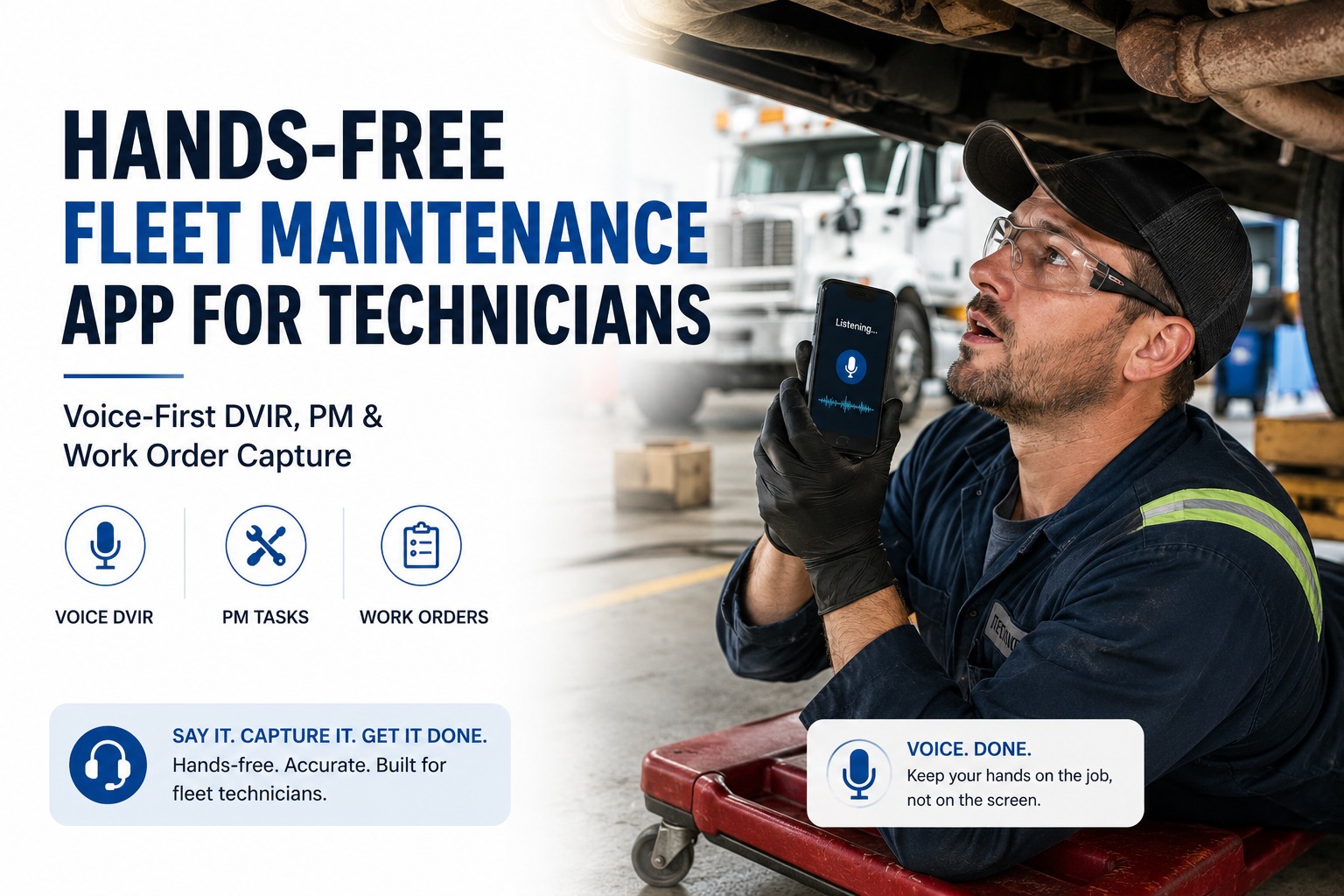
Picture the actual body position of fleet maintenance work: a technician flat on a creeper under a trailer, both hands on a leaking air line; a driver halfway up a ladder checking a reefer unit; a mechanic elbow-deep in an engine bay with grease to the wrist. Now picture the app most fleet software expects them to use — tap through six screens, pick from dropdowns, thumb-type into tiny fields. The two pictures don't fit together, and that mismatch is why so much maintenance goes undocumented until the end of a shift, if at all. A hands-free fleet maintenance app closes that gap by letting the technician talk instead of tap: voice-first DVIR, preventive-maintenance logging, and work-order capture that work when both hands are busy and the phone is in a pocket. It matters more than ever with 44% of diesel technicians considering leaving the trade — removing the friction they resent is one real lever on keeping them. This guide covers why hands-free is the right design for the physical reality of the job, what a voice-first app captures, and how a fleet can adopt one with no contracts and no setup fees. Start a free trial or book a demo to put a hands-free app in your technicians' pockets.
MOBILE APP · HANDS-FREE FLEET MAINTENANCE
A Hands-Free Fleet Maintenance App Built for How Technicians Actually Work
Under a trailer, on a ladder, gloves on, hands full — that's the real posture of maintenance work, and it's exactly where a tap-and-type app fails. Voice-first DVIR, PM, and work-order capture meet technicians where they are, so the documentation gets done without the job ever stopping.
No contracts
No setup fees
No hardware
Live in 72 hours
Why Hands-Free Is the Right Design, Not a Gimmick
Voice isn't a novelty feature bolted onto a maintenance app — for this workforce it's the correct interface, because the job physically occupies the hands and eyes that a touchscreen demands. Look at where the work actually happens.
Under the Vehicle
Flat on a creeper with both hands overhead, there's no way to reach a phone, unlock it, and type. Voice is the only interface that works from under the chassis.
On a Ladder
One hand on the ladder, one on the reefer unit or trailer roof — pulling out a phone means breaking three points of contact. Speaking the finding keeps the technician safe and steady.
Gloves On, Hands Greasy
Capacitive touchscreens don't register through greasy nitrile gloves, and nobody wants engine oil smeared across their phone. Voice needs neither clean hands nor bare fingers.
Mid-Task, Not After
Details logged at the moment of the finding are accurate; details reconstructed at the end of a shift are guesses. Voice captures it while the technician is still looking at the problem.
44%
of diesel technicians are considering leaving the trade — ATRI, 2025
The friction you remove is a retention lever you control
You can't fix pay scales or the labor market overnight, but you can stop making your best technicians fight a clumsy app. Paperwork and awkward software are consistently among the parts of the job techs resent most. A tool that lets them talk instead of tap won't single-handedly solve retention — but removing daily friction is a small, real signal that the shop respects their time.
What a Voice-First App Captures
A true hands-free app covers the three documentation tasks that eat a technician's day, all by voice. Each one replaces a screen-heavy workflow with a spoken one.
The app reads each inspection item aloud — brakes, lights, tires, mirrors, coupling — and the technician answers "Good" or "Defect" by voice. A full FMCSA-compliant DVIR completes in under four minutes with zero screen taps, and any defect routes straight to a work order.
02
Preventive Maintenance Logging
Completed PM tasks — oil and filter, lube points, fluid checks — are logged by voice as they're done, so the service record is built in real time against the vehicle instead of reconstructed later from memory or a greasy paper checklist.
The technician narrates the repair — complaint, cause, correction, parts, labor — and it becomes a structured work order without a keyboard. The record is filed, timestamped, and ready for the service advisor the moment the job ends.
Three of the most screen-heavy tasks in the shop, done by voice.
Fleet Rabbit puts voice-first DVIR, PM logging, and work-order capture in one app your technicians already carry — no extra device, no separate voice subscription.
Tap-and-Type vs. Hands-Free, Task by Task
The gap between a conventional mobile app and a voice-first one shows up in every routine task. Swipe the table horizontally on mobile.
← Swipe to see all columns →
What Gets Logged by Voice
Across the three capture types, here's what a technician can record hands-free and where it lands. Swipe the table horizontally on mobile.
← Swipe to see all columns →
Built for the Shop Floor, Not the Office
A hands-free app only earns its place if it holds up in the real environment. These are the design realities that separate a workshop-grade app from a repurposed office tool.
01
Works Over Shop Noise
Noise-cancelling recognition tuned for engines, air tools, and compressors keeps accuracy high — around 94% in high-ambient-noise testing — where consumer voice apps fall apart.
02
Runs on Devices You Own
It works on the phones and Bluetooth headsets your team already carries — no rugged tablets to buy, no special hardware, nothing new in anyone's pocket.
03
Works in Dead Zones
Capture continues offline in a back bay or steel building and syncs when the connection returns, so no record is lost to poor yard coverage.
04
Speak Naturally
Technicians describe the job the way they'd tell a coworker, not by memorizing rigid commands, so there's almost nothing to learn before day one.
05
Everything in One App
DVIR, PM, and work orders live in a single fleet-native app, so records connect to each other instead of scattering across separate tools.
06
No Contracts, No Setup Fees
Start on a free tier, pay a low per-vehicle rate as you grow, and walk away anytime — no lock-in, no implementation invoice, no risk to trying it.
Put a Hands-Free App in Every Technician's Pocket
Fleet Rabbit is a voice-first fleet maintenance app built for the real posture of the work — DVIR, PM, and work-order capture by voice, so documentation happens under the truck, on the ladder, and gloves-on, without the job ever stopping. No contracts, no setup fees, no hardware, at $5/vehicle/month with a free tier for up to three vehicles.
Voice-first DVIR
PM logging by voice
Work-order capture
No contracts
Frequently Asked Questions
What is a hands-free fleet maintenance app?
It's a mobile app that lets technicians document maintenance by voice instead of by tapping and typing — completing DVIRs, logging preventive-maintenance tasks, and capturing work orders while their hands stay on the vehicle. The design exists because the physical reality of the job, under a truck or on a ladder with gloves on, makes a touchscreen impractical. Seeing that voice-first workflow on your own fleet's tasks is exactly what you can
book a demo to watch.
Why does hands-free matter so much for technicians specifically?
Because maintenance work physically occupies the hands and eyes a touchscreen needs. A technician flat on a creeper can't reach and unlock a phone, someone on a ladder shouldn't break three points of contact to type, and greasy gloves don't register on a capacitive screen. Voice is simply the interface that matches the posture of the work, which is why documentation captured by voice gets done in the moment instead of deferred, and experiencing that difference is something you can
book a demo to feel firsthand.
Can it really help with technician retention?
It's not a cure, but it's a genuine lever. With 44% of diesel technicians considering leaving the trade, the parts of the job they resent matter, and clumsy paperwork and awkward software rank high on that list. A tool that lets them talk instead of fight a form removes a daily source of frustration and signals that the shop values their time. Removing that friction won't fix pay or the labor market, but it's one thing within your control, and seeing how it changes the day-to-day is something you can
book a demo to explore.
Does it work with gloves and over shop noise?
Yes on both counts, which is the whole point. Because it's voice-driven, gloves and greasy hands are irrelevant — there's no screen to touch. And because it's built for the shop rather than a quiet office, it uses noise-cancelling recognition tuned for engine, tool, and compressor noise, holding around 94% accuracy in high-ambient-noise testing. Testing that in your own bays is something you can
book a demo to do.
Do we need special hardware or devices?
No. A hands-free fleet app runs on the smartphones and Bluetooth headsets your team already carries, so there's nothing to buy or install and nothing new to keep charged. That's what makes deployment fast — live within 72 hours rather than the weeks a hardware rollout takes. Confirming it works with your current devices is something you can
book a demo to check.
Is the voice DVIR FMCSA-compliant?
Yes. A voice-first DVIR captures each response, driver-identifies and timestamps it, and files it as the FMCSA-compliant inspection record — the same legal document a manual DVIR produces, just completed hands-free in under four minutes. The automatic timestamps and driver identification actually strengthen the record versus paper, and reviewing that compliance fit for your operation is something you can
book a demo to do in detail.
Are there really no contracts or setup fees?
Correct. You can start on a free tier for up to three vehicles with no credit card, pay a low per-vehicle rate as you scale, and leave anytime — there's no long-term contract, no implementation invoice, and no hardware to purchase. The low barrier is deliberate, because the app should prove its value in your bays rather than in a sales pitch, and starting that trial is something you can
book a demo to set up.
How quickly can technicians start using it?
Almost immediately, because speaking naturally is far easier to learn than navigating software. Technicians describe a job the way they'd explain it to a coworker rather than memorizing commands or menu paths, so there's very little training required and new hires can be productive on day one. The app itself deploys live within 72 hours with no hardware, and planning that quick rollout for your team is something you can
book a demo to map out.
Meet Your Technicians Where the Work Happens
Fleet Rabbit is a hands-free, voice-first fleet maintenance app — DVIR, PM, and work-order capture that work under the truck, on the ladder, and gloves-on, so documentation gets done without the job ever stopping. Live within 72 hours, integrated in 5–7 working days, at $5/vehicle/month, with no contracts, no setup fees, and no hardware.
Free tier for up to 3 vehicles · No credit card required · No hardware installation
July 29, 2026
By Sam Parker
All Articles