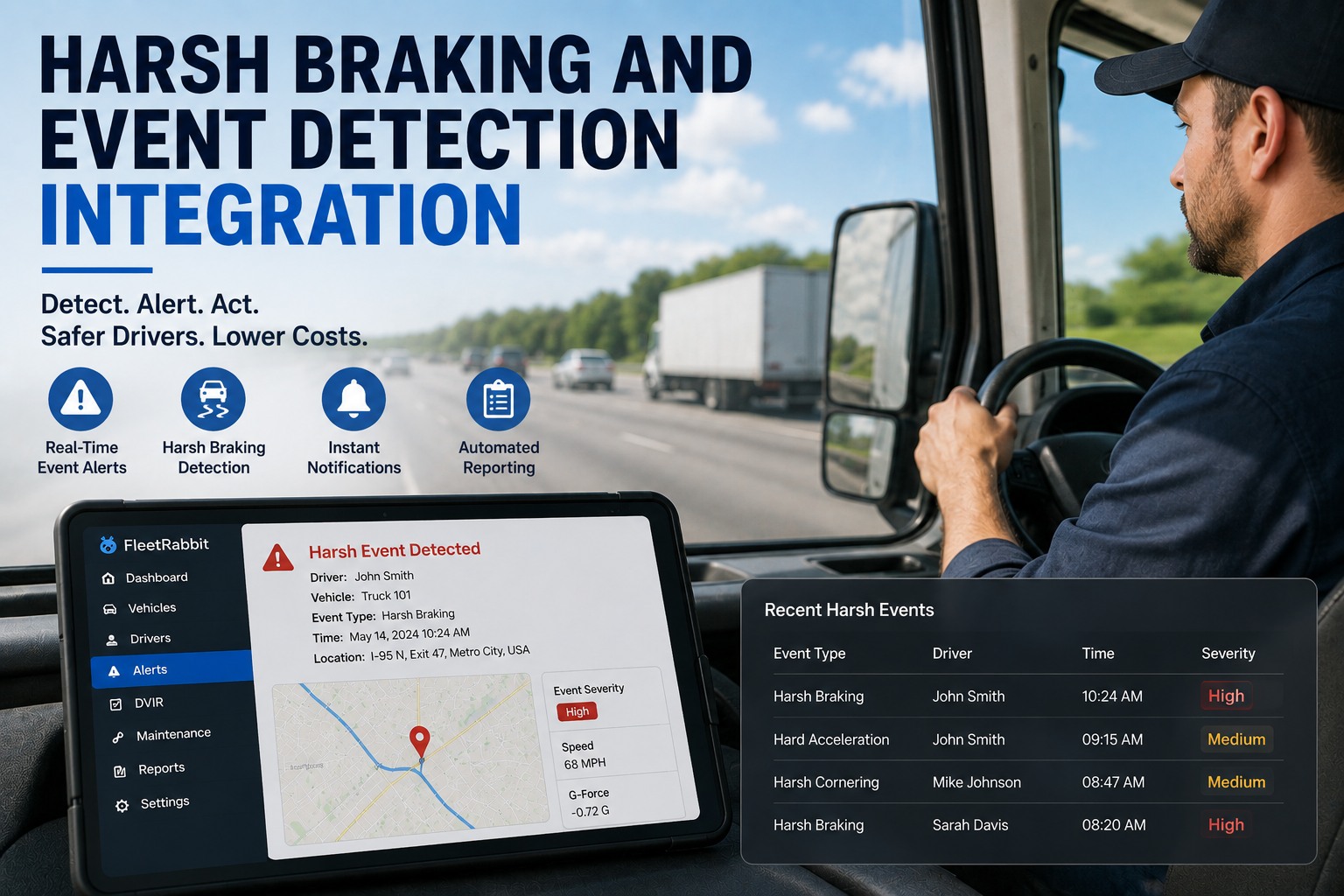
Every harsh braking event, hard acceleration, and sharp corner your telematics unit records is raw kinematic data — a spike in G-force captured by the three-axis accelerometer inside the device. Most fleets treat that data as a driver-coaching metric and stop there. But a harsh event is more than a behavior flag: it's measurable mechanical stress on the vehicle. Hard braking accelerates brake wear and shortens tire life; aggressive acceleration strains the drivetrain and burns fuel; harsh cornering loads the tires and suspension and raises rollover and cargo-shift risk. And at high enough force, a harsh event isn't a habit at all — it's a collision that needs an incident record. As the industry saying goes, a harsh braking flag sitting in a spreadsheet changes nothing. The value is in what you do with it. Connect harsh event detection to FleetRabbit and turn that raw data into automated maintenance, alerts, and audit-ready records in one platform — so kinematic stress becomes condition-based service, repeat patterns become coaching, and high-G impacts become documented incidents. This page shows how the data becomes action, what each event does to the vehicle, what connects, and why refined event data protects the fleet. Start free with 3 vehicles or book a demo to see harsh event data turned into action.
INTEGRATION · DRIVER BEHAVIOR & MAINTENANCE
Harsh Braking and Event Detection Integration
Connect harsh event detection to FleetRabbit and turn raw G-force data into automated maintenance, alerts, and audit-ready records in one platform. Kinematic stress becomes condition-based service — not a flag in a spreadsheet.
What Counts as a Harsh Event
Harsh events are sudden changes in a vehicle's motion, measured as G-force by the accelerometer in your telematics unit. Four behaviors make up the core of harsh-event detection, each with its own signature.
Harsh Braking
Rapid deceleration — often over 6 mph per second, or above roughly 0.265g — typically from tailgating or distraction. The most collision-linked event, and hard on brakes and tires.
Hard Acceleration
Abrupt throttle from a stop — over about 5 mph per second, or above roughly 0.220g. Signals aggressive driving and strains the drivetrain while burning extra fuel.
Harsh Cornering
High lateral G-force — above roughly 0.4g for two-plus seconds — from taking turns too fast. Loads tires and suspension and raises rollover and cargo-shift risk.
Overspeeding
Sustained speed over the limit, tracked in tiers so a brief highway lapse isn't scored like a school-zone violation. Extends stopping distance and raises impact severity.
What a Harsh Event Does to the Vehicle
This is what most fleets miss: a harsh event isn't just about the driver — it's a physical load on the machine. Each type of event stresses specific components, and that stress compounds into maintenance the vehicle will eventually demand.
Brakes
Frequent harsh braking accelerates pad and rotor wear, shortening the interval before the next brake service is due.
Tires
Hard braking, aggressive acceleration, and sharp cornering all reduce tire lifespan through excess friction and lateral scrub.
Suspension
High lateral G-force from harsh cornering loads suspension components and, on high-center-of-gravity vehicles, raises rollover risk.
Drivetrain & Engine
Aggressive acceleration adds stress to the engine and drivetrain and inflates fuel spend versus a smooth ramp-up.
The G-Force Scale: From Aggressive to Accident
0.5gAggressive braking or cornering
1.0gTires squeal — hard event
1.5g+Likely a collision
Above a set threshold, a harsh event stops being a coaching flag and becomes an impact that needs an incident record — which is exactly where connecting to FleetRabbit matters.
A Harsh Braking Flag in a Spreadsheet Changes Nothing
Your telematics unit already detects every harsh event. The question is whether anyone is using them — or whether they're waiting for an accident to make the pattern visible. On their own, harsh events pile up as a list of flags nobody acts on: the brake wear they represent isn't scheduled, the driver who generates them isn't coached in time, and the high-G impact that was actually a collision isn't logged as an incident. A standalone behavior dashboard shows the events but doesn't turn them into maintenance, coaching, or a record. FleetRabbit is what closes that loop — refining raw kinematic data into condition-based service on the stressed components, timely coaching before a pattern becomes a claim, and documented incidents when the G-force says it was a crash.
See how raw events become action.
From Raw Event to Automated Action
Connecting harsh event detection to FleetRabbit turns a stream of G-force spikes into three kinds of action — maintenance, coaching, and incident records. Here's the pipeline.
Raw Event Data
Detection Provides
Harsh braking & acceleration G-force
Cornering & overspeed events
Timestamp, GPS location, driver ID
High-G impact signatures
Automated Action
FleetRabbit Produces
Condition-based brake & tire service
Driver coaching on repeat patterns
Incident records for high-G impacts
One audit-ready event trail
Raw G-force data fills a dashboard. Refined event data protects the fleet.
FleetRabbit turns harsh events into condition-based maintenance, timely coaching, and documented incidents — before the pattern becomes a claim. Start free with 3 vehicles or book a demo.
What Connects Between Harsh Event Detection and FleetRabbit
The integration passes the kinematic, location, and driver data that matters, and refines each into a maintenance, coaching, or incident outcome. Swipe the table horizontally on mobile.
← Swipe to see all columns →
Turn Harsh Event Data Into Action
Connect harsh event detection to FleetRabbit and refine raw G-force data into automated maintenance, coaching, and audit-ready records — repeated harsh braking driving condition-based brake service, cornering and acceleration triggering component inspections, and high-G impacts logged as incidents. Make every event count before the claim arrives. At $5/vehicle/month, no hardware, live within 72 hours, free for up to three vehicles.
Events to component service
Patterns to coaching
Impacts to incident records
One audit trail
Why Refined Event Data Protects the Fleet
Harsh event detection gives you the raw signal. The value comes from what happens next — turning kinematic stress into maintenance, coaching, and records that prevent the next claim.
Maintenance Before Breakdown
Turning repeated harsh braking and cornering into condition-based brake, tire, and suspension service means components are maintained on real stress — not a fixed calendar that ignores how the vehicle is actually driven.
Coaching Before the Claim
Repeat harsh events are an early warning; a driver generating multiple near-miss patterns is statistically far more likely to have a reportable accident soon. Coaching them in time is cheaper than the claim.
Impacts Never Missed
When a high-G event that was actually a collision becomes a logged incident automatically, the investigation and claim start with a documented record instead of a driver's later recollection.
One Audit-Ready Trail
Events, the maintenance they triggered, the coaching they prompted, and the incidents they became live in one record — answering an insurer or auditor from a single source.
Frequently Asked Questions
What does the harsh event detection integration with FleetRabbit do?
It connects your telematics harsh-event data — harsh braking, hard acceleration, cornering, and overspeeding — to FleetRabbit and refines it into action. Repeated events become condition-based maintenance on the stressed brakes, tires, and suspension; repeat-offender patterns trigger driver coaching; and high-G impacts become logged incident records. Instead of harsh events piling up as flags in a behavior dashboard, each one becomes maintenance, coaching, or a documented record in one platform. Seeing that pipeline on your own fleet is what you can
book a demo to do, or you can
start free with 3 vehicles and try it directly.
How does harsh event detection actually work?
A three-axis accelerometer inside your telematics unit continuously measures the rate of change in velocity across forward-backward, left-right, and up-down directions, and combines that with GPS speed to detect G-force spikes. When a spike exceeds a set threshold — thresholds vary by behavior and vehicle type — it's flagged as a harsh braking, acceleration, cornering, or overspeed event, typically with a timestamp, location, and driver ID. FleetRabbit takes that detected event data and turns it into maintenance, coaching, and incident records. Seeing how your specific device's events map into FleetRabbit is something you can
book a demo to walk through.
How can harsh events drive maintenance?
Because a harsh event is mechanical stress, not just a behavior. Frequent harsh braking accelerates brake and tire wear; aggressive acceleration strains the drivetrain; harsh cornering loads tires and suspension. When that event data connects to FleetRabbit, repeated stress on a vehicle can trigger condition-based service and inspection on exactly those components — so a truck driven hard is serviced on its real wear rather than a fixed calendar that ignores how it's actually operated. Seeing harsh events drive component service is something you can
book a demo to review, or
start free with 3 vehicles to set up.
Does it detect collisions, not just harsh driving?
Yes — the same accelerometer that flags harsh braking distinguishes force levels, and above a set threshold a G-force spike indicates an impact rather than aggressive driving. Roughly, 0.5g is aggressive, around 1g makes tires squeal, and anything above about 1.5g is likely a crash. When a high-G impact signature connects to FleetRabbit, it becomes a logged incident record automatically, so a collision starts its investigation and claim with documentation instead of relying on the driver to report it later. Seeing high-G impacts become incident records is something you can
book a demo to explore.
Does FleetRabbit replace my telematics system?
No — it complements it. Your telematics device is what detects the harsh events with its accelerometer and GPS. FleetRabbit connects to that detected data and refines it into maintenance, coaching, and incident records — the action layer on top of the detection layer. You keep the telematics hardware you already run, whatever brand it is, and add the platform that turns its raw event stream into completed work and documentation, which you can
book a demo to see in practice.
Can it help with driver coaching?
Yes. Because each event carries a driver ID, FleetRabbit can surface repeat-offender patterns and turn them into a coaching workflow — and doing so in time matters, because a driver generating multiple near-miss patterns is statistically far more likely to be involved in a reportable accident in the following weeks. Catching that pattern early and coaching the driver is far cheaper than the claim that follows an ignored trend. Seeing repeat patterns turned into timely coaching is something you can
book a demo to review for your fleet.
How does this help with audits and insurance claims?
By keeping the whole event story in one place. When harsh events, the maintenance they triggered, the coaching they prompted, and any incidents they became all live together in FleetRabbit, an insurer or auditor request is answered from one connected, timestamped trail rather than reconstructed from a behavior dashboard and a separate maintenance system. A documented record of how events were acted on both supports legitimate claims and strengthens your defense against disputed ones, which you can
book a demo to see assembled end to end.
How quickly can we get started?
Fast — FleetRabbit goes live within 72 hours with no hardware to install, running on devices your team already has, so once your harsh-event data connection is configured you can start turning raw events into maintenance and records quickly. You keep your existing telematics hardware and simply add the refinement layer that acts on the data, with no rip-and-replace. It's free for up to three vehicles, so you can
start free with 3 vehicles today, or
book a demo to map how your harsh-event data should drive your maintenance and coaching workflow first.
Make Every Harsh Event Count
Connect harsh event detection to FleetRabbit and turn raw G-force data into automated maintenance, alerts, and audit-ready records in one platform — kinematic stress becoming condition-based service, repeat patterns becoming coaching, and high-G impacts becoming documented incidents. Surface the patterns before the claims arrive. Integrated in 5–7 working days, at $5/vehicle/month, free for up to three vehicles, with no hardware required.
Free tier for up to 3 vehicles · No credit card required · No hardware installation
August 10, 2026
By Emily Parker
All Articles