Engine oil is the cheapest insurance a fleet carries on a power unit that can cost two hundred thousand dollars, and the gap between a disciplined oil program and a sloppy one runs to roughly five thousand dollars per truck per year in undetected wear, early overhauls, and warranty exposure. Yet oil intervals are where fleets make two opposite mistakes: changing too often and throwing away good oil and uptime, or stretching a normal-duty number over a truck that idles half its life and grinding the engine down early. Getting it right means three decisions — the correct oil category for the engine, the baseline interval for the duty cycle, and the adjustments that severe service demands — backed by a schedule that never lets a truck slip past its due point. This guide covers the CK-4 versus FA-4 split and why one is backward-compatible and one is not, the baseline and extended interval ranges for modern engines, the severe-duty factors that shorten every number, the oil-analysis discipline that safely extends them, and how PM scheduling software makes sure no truck in the fleet ever misses a change. Start free trial or book a demo to put every truck's oil interval on autopilot.
PREVENTIVE MAINTENANCE · ENGINE OIL & DRAIN INTERVALS
The Right Oil, the Right Interval, and a Schedule That Never Slips
Change oil too soon and you throw away uptime and good lubricant. Stretch a highway interval over a high-idle truck and you overhaul the engine early. The difference between the two is a duty-cycle-aware interval and a system that flags every truck before it's due — not after.
$5,000
Per truck, per year — the gap between a disciplined and sloppy oil program
1–3%
Fuel economy gain from lower-viscosity 10W-30 over 15W-40
60–80 mi
Engine wear equivalent of roughly 2 hours of idling
50K+ mi
Intervals achievable on modern engines with oil analysis
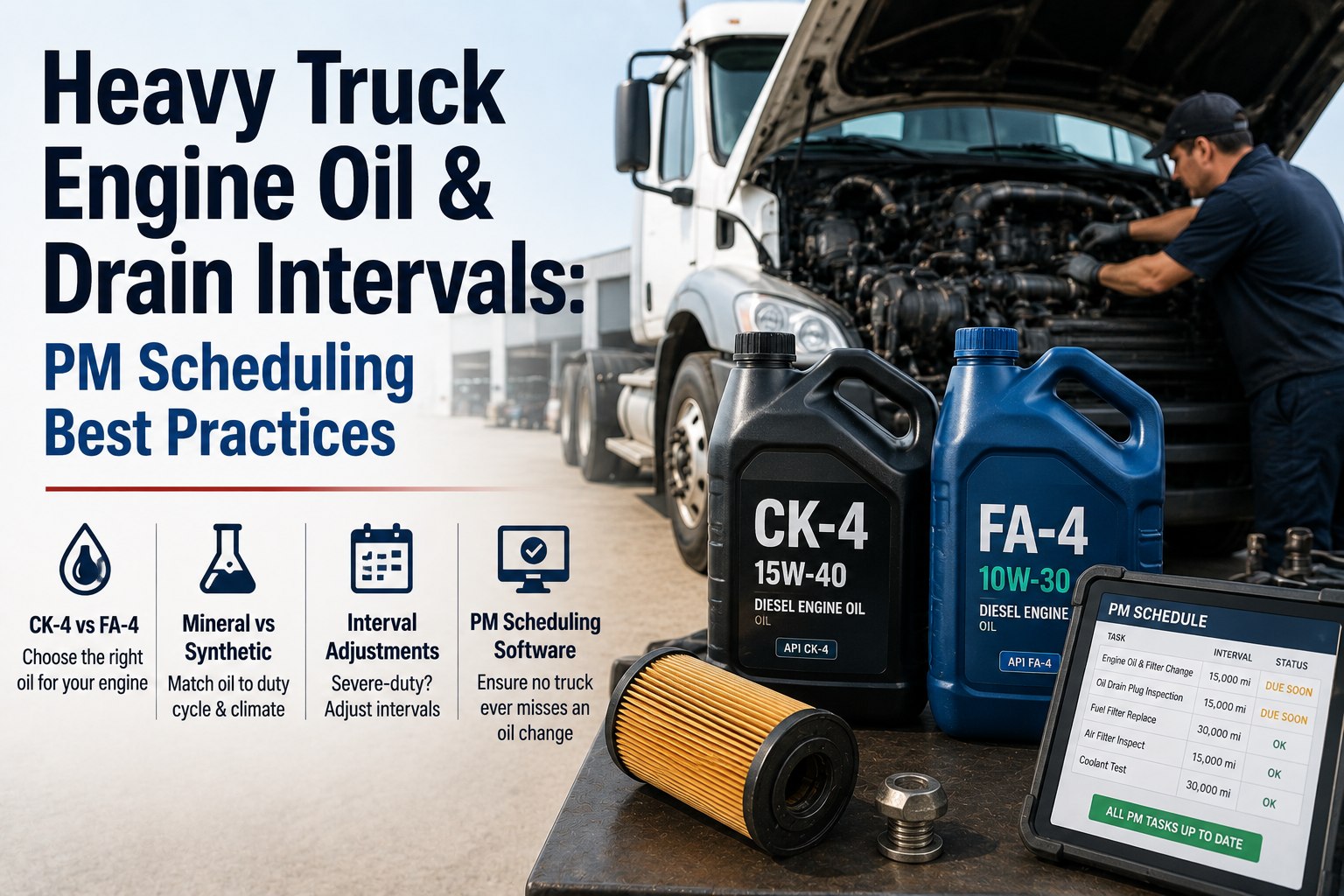
First Decision: CK-4 or FA-4?
Since late 2016, heavy-duty diesel oil split into two categories that replaced CJ-4. They pass the same performance tests, but they are not interchangeable — and putting the wrong one in an engine is a costly mistake. The difference comes down to viscosity and backward compatibility.
API CK-4
The universal, backward-compatible choice
CompatibilityAll diesel engines, on- and off-highway, old and new
ViscositiesTraditional grades — 15W-40, 10W-30, 5W-40
ReplacesBackward-compatible with CJ-4, CI-4 PLUS
Best forMixed fleets wanting one oil for everything
AvailabilityRoughly 600 licensed oils
API FA-4
The fuel-economy spec — not backward-compatible
CompatibilityOnly 2017+ engines that specifically call for it
ViscositiesLower HTHS grades, typically 10W-30; no 40-weight
ReplacesNot backward-compatible with older engines
Best forNewest on-highway engines built for it from the factory
AvailabilityRoughly 80 licensed oils
i
The one rule that prevents an expensive error: CK-4 goes in anything, but FA-4's lower high-temperature high-shear viscosity means it should only go in an engine the manufacturer designed for it — the thinner oil may not protect an older engine and can accelerate wear. Both use the same standard filters, and you identify the category by the API donut on the container, where FA-4 carries a shaded section to distinguish it. Many of the newest trucks left the factory filled with FA-4, so verify the spec per engine before every service rather than assuming the whole fleet takes the same oil.
See how per-VIN oil specs stop the wrong oil going in.
Second Decision: The Baseline Interval
Modern CK-4 and FA-4 oils, combined with today's engines, have pushed drain intervals far beyond what fleets ran a decade ago. But the baseline depends entirely on duty cycle, and the number only holds if the oil, filtration, and operating conditions are all in the assumed range.
10,000–15,000 mi
Severe / Vocational Duty
Construction, refuse, urban delivery, heavy idle. High engine-hour accumulation degrades oil faster than mileage alone suggests.
20,000–25,000 mi
Normal On-Highway Duty
The common baseline for line-haul on approved CK-4 or FA-4 oil, a normal duty cycle, and proper filtration.
40,000–50,000 mi
Modern Platform + Synthetic
Current engines like the DD15/DD16, X15, MX-13, and D13 on full-synthetic CK-4 can safely reach this range.
60,000–100,000 mi
Oil-Analysis Validated
Only with a monitoring program. Certain approvals reach 60,000; some documented programs run to 80,000 and even 100,000 miles.
The right interval is worthless if the truck blows past it because nobody flagged it.
Fleet Rabbit triggers each PM on mileage, engine hours, or calendar time — whichever arrives first — so a truck racking up idle hours without miles still gets its oil changed on time, not late.
Third Decision: Severe-Duty Adjustments
Baseline intervals assume normal service. The moment a truck's duty cycle turns severe, running the normal number is just deferred maintenance under another name. These are the factors that force the interval down, and why mileage alone hides them.
Extended Idling
Idle hours accumulate engine wear without adding a single odometer mile. Roughly two hours of idle equals 60 to 80 miles of wear, and trucks over a 35% idle ratio should trigger an automatic interval reduction.
Short Trips Under 5 Miles
The most underrecognized severe condition. The engine never fully warms, moisture and fuel don't burn off, and contaminants build in the oil far faster than highway running.
Stop-and-Go Operation
Constant load changes and low average speed stress the oil and raise operating temperatures, degrading the lubricant well ahead of the mileage the interval assumes.
Extreme Heat or Cold
Below −10°F, reduce the interval 15 to 20% or move to a 0W-40 synthetic for cold-start protection. Sustained heat accelerates oxidation and thins the oil under shear.
Interval Ranges at a Glance
Use this as a starting framework, then confirm against the engine OEM's guidance and any oil-analysis results. Swipe the table horizontally on mobile.
← Swipe to see all columns →
Never Let a Truck Miss an Oil Change Again
Fleet Rabbit schedules every oil service by mileage, engine hours, or calendar — whichever comes first — sends advance alerts before each truck is due, records the oil spec and interval per VIN, and tracks oil-analysis samples so extended intervals are managed by data, not assumption. Deploy at $5/vehicle/month, no hardware, live within 72 hours.
Mileage, hours, or calendar triggers
Advance due alerts
Per-VIN oil specs
Oil-analysis tracking
Extending Intervals Safely with Oil Analysis
Oil analysis is how disciplined fleets push intervals out without gambling on the engine. Regular sampling reads the oil's condition and the engine's wear so extended intervals are earned with data instead of assumed. Here's how the program works in practice.
1
Establish the Baseline
Start at the OEM's published interval for the engine and duty cycle. Extended drains are earned from a known-good starting point, not guessed from the top down.
2
Sample on a Schedule
Pull oil samples at each drain, and often mid-interval, tracking total base number, viscosity, and wear metals. Around $300 per sample is cheap insurance on a six-figure power unit.
3
Trend the Results
One sample is a snapshot; the trend is the signal. Rising wear metals, falling TBN, or viscosity drifting out of range tell you whether the oil still has life or the interval is already too long.
4
Extend With Built-In Margin
If the data supports a longer interval, extend it — but leave room below the limit so a truck that can't come in exactly on the number is still safely within spec.
5
Mind the Filter
The oil filter is often the limiting factor in an extended-drain program, not the oil itself. Confirm the filter can carry the fluid the whole interval before stretching the miles.
6
Keep the Audit Trail
Log sample dates, lab results, and the interval approval per truck. That record is what proves to a warranty claim that extended intervals were managed scientifically, not by assumption.
How PM Software Closes the Gap
Knowing the right interval is half the job. The other half is a system that tracks every truck against it and refuses to let one slip. Here's how Fleet Rabbit runs the oil program across the whole fleet.
01
Whichever-Comes-First Triggers
Each oil service fires on mileage, engine hours, or elapsed calendar time — whichever arrives first — so a high-idle truck accumulating hours without miles is never missed.
02
Advance Due Alerts
The system flags each truck before it's due, not after, so services are planned into the schedule instead of discovered when a truck rolls in already overdue.
03
Per-VIN Oil Specification
The correct oil category and viscosity are recorded against each truck, so a tech never puts FA-4 in an engine built for CK-4 or reaches for the wrong grade at service.
04
Idle-Aware Interval Math
High idle ratios and engine-hour accumulation feed into the interval, so severe-duty trucks get shortened schedules automatically instead of running highway numbers.
05
Oil-Analysis Records
Sample dates, TBN, viscosity, and wear-metal values are tracked per truck, building the audit trail that lets you extend intervals on evidence and defend them on a warranty claim.
06
Tiered PM Coordination
Oil changes line up with the broader PM-A, PM-B, and PM-C tiers, so drains complement the rest of the service schedule instead of colliding with it.
Where Oil Fits in the Tiered PM Schedule
Oil changes don't happen in isolation — they sit inside a tiered PM program where each level bundles more work. Aligning drains with these tiers keeps service efficient. Swipe the table horizontally on mobile.
← Swipe to see all columns →
Frequently Asked Questions
What's the real difference between CK-4 and FA-4 oil?
Both replaced CJ-4 in late 2016 and both pass the same performance tests for oxidation, wear, and aftertreatment protection, but they differ in viscosity and compatibility. CK-4 comes in traditional grades like 15W-40 and 10W-30 and is fully backward-compatible, so it works in every diesel engine, old or new, on- or off-highway. FA-4 uses a lower high-temperature high-shear viscosity, typically 10W-30, to improve fuel economy, but it is not backward-compatible and should only go in engines designed for it. Keeping the correct category recorded against each engine is exactly what you can
book a demo to see prevent the wrong oil going in at service.
Can I use FA-4 oil in my older trucks?
Generally no, and it's an important line not to cross. FA-4's lower viscosity is what delivers its fuel-economy benefit, but that same thinness means it may not provide adequate protection in an engine that wasn't designed for it, potentially accelerating wear. It also isn't available in a 40-weight grade, which further limits its use in older equipment. CK-4 is the safe universal choice for a mixed fleet, and FA-4 belongs only in the newer engines that specifically call for it — most of which left the factory already filled with it. Managing that split across a mixed fleet is something you can
book a demo to see handled per truck.
How often should I really change heavy truck oil?
It depends heavily on duty cycle. Severe and vocational service — construction, refuse, urban delivery, high idle — typically calls for 10,000 to 15,000 miles, while normal on-highway running on approved oil sits around 20,000 to 25,000 miles. Modern engines on full-synthetic CK-4 can reach 40,000 to 50,000 miles, and analysis-validated programs push further still. The mistake is running a highway interval over a truck that idles heavily, since idle hours accumulate wear without adding miles. Letting the interval follow the actual duty cycle rather than a single fleet-wide number is something you can
book a demo to see automated per truck.
Why does idling shorten my oil interval so much?
Because idling is engine running time that your odometer never sees. An engine burning fuel at idle is still generating heat, combustion byproducts, and wear, but it adds no miles to trigger a mileage-based service — so a heavy-idle truck can be far past its real oil life while its odometer says it's fine. As a rule of thumb, roughly two hours of idle equals 60 to 80 miles of engine wear, and any truck over about a 35% idle ratio should have its interval shortened. Tracking engine hours alongside mileage so idle time actually counts is exactly what you can
book a demo to see built into the schedule.
Is oil analysis worth it for extending drain intervals?
For fleets serious about uptime, yes. Oil analysis reads the oil's total base number, viscosity, and wear-metal content so you can extend intervals on evidence instead of a guess, and it catches contamination or abnormal wear before it becomes a failure. At around $300 per sample it's inexpensive against a six-figure power unit and the roughly five-thousand-dollar-per-year gap between disciplined and undisciplined programs. The key is trending results over time and keeping the audit trail, which both proves the interval is managed scientifically and protects warranty claims — and maintaining those records per truck is something you can
book a demo to see kept automatically.
Should I build margin into an extended interval?
Always. Even when oil analysis supports a longer interval, the target should sit below the true limit because a truck can't always come in for service exactly on the number — routes, availability, and breakdowns get in the way. Setting a 50,000-mile target on an engine that can only just reach it leaves no room for the reality that some units will run over before they get back to the shop. Building that cushion in, and getting an advance alert well before the due point, is exactly what you can
book a demo to see keep every truck safely inside spec.
Right Oil. Right Interval. Never Missed.
Fleet Rabbit records the correct oil spec per VIN, schedules every drain by mileage, hours, or calendar with advance alerts, adjusts for idle and severe duty, and tracks oil-analysis samples so extended intervals are earned with data — turning your oil program from a source of missed services and wrong-oil errors into a managed, auditable system. Integrated with your existing tools in 5–7 working days, at $5/vehicle/month, with no new hardware required.
Free tier for up to 3 vehicles · No credit card required · No hardware installation
July 28, 2026
By Emily Davis
All Articles