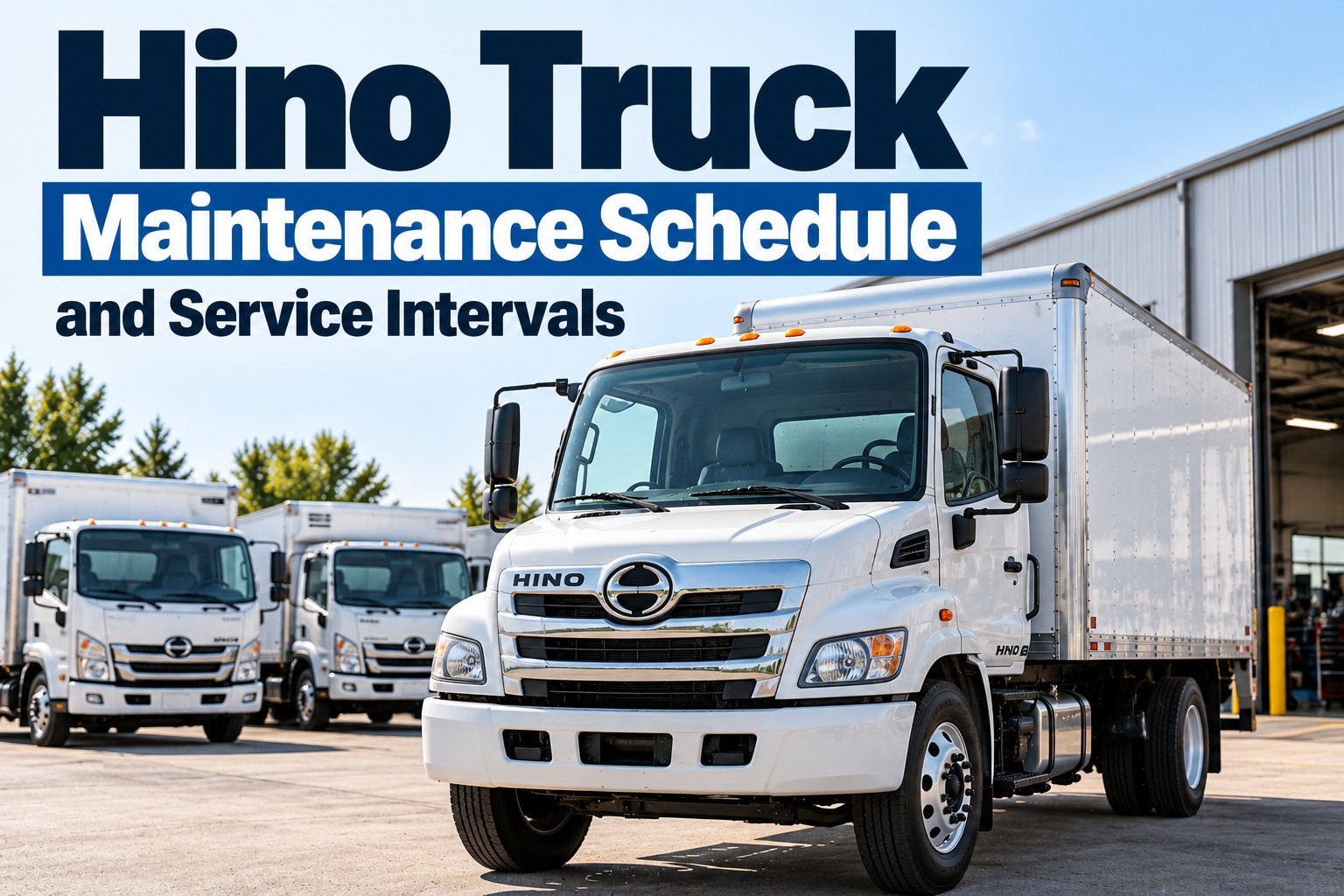
Hino does not publish a maintenance interval. It publishes a sequence of numbered service packages — COE0005, COE0010, COE0020 and so on up to COE0120 — each one a specific set of items due at a specific point. The numbers are kilometres, which for a fleet working in miles means every single service point is a conversion. None of them lands on a round mileage. The first package falls at 5,000 km, which is 3,107 miles, and it exists mainly to retorque the leaf spring u-bolts on a truck that has just been delivered. Several codes carry a month limit as well, and on medium-duty work the months frequently arrive first. Book a Hino fleet review.
A Schedule in Kilometres, Run in Miles
What each Hino service code actually contains, why not one of them converts to a round mileage, which direction the rounding errors run, and the early service most fleets have never performed.
The Same Ruler, Read Two Ways
This is the structural problem with running a metric schedule in imperial units, and it is easier to see than to describe.
The upper scale is kilometres, where every Hino service code sits on a clean figure. The lower scale is miles, on exactly the same positions. The two sets of ticks do not line up anywhere after zero, which is the whole point — 5,000 km is 3,107 miles, 80,000 km is 49,710, and 120,000 km is 74,565. A fleet entering this schedule into a mileage-based system is converting eight separate numbers, and whatever it rounds them to becomes the real schedule from then on.
Which Way the Rounding Goes
Worth doing the arithmetic, because the errors are not random — they change direction as the intervals get longer.
| Published | Exact in miles | Commonly rounded to | Effect |
|---|---|---|---|
| 5,000 km | 3,107 mi | 3,000 mi | 107 miles early |
| 10,000 km | 6,214 mi | 6,000 mi | 214 miles early |
| 20,000 km | 12,427 mi | 12,000 mi | 427 miles early |
| 25,000 km | 15,534 mi | 15,000 mi | 534 miles early |
| 40,000 km | 24,855 mi | 25,000 mi | 145 miles late |
| 60,000 km | 37,282 mi | 37,500 mi | 218 miles late |
| 80,000 km | 49,710 mi | 50,000 mi | 290 miles late |
| 120,000 km | 74,565 mi | 75,000 mi | 435 miles late |
The short codes get rounded down and come early, which is harmless. The long ones get rounded up and run late — and the long ones are where the brake fluid flush, the valve adjustment, the wheel bearing repack and the belts live. Rounding 80,000 km to fifty thousand miles is only 290 miles, but it is 290 miles in the wrong direction on a brake fluid service.
What Each Code Actually Contains
The packages are not the same size and they do not simply nest inside each other, so the code matters as much as the mileage.
Notice that engine oil appears at COE0010, COE0025 and COE0040 but not at COE0020 or COE0060, and the universal reference puts the oil interval at 15,000 to 20,000 km or six months. So the oil change does not map neatly onto the code sequence — it has its own rhythm running underneath it, which is exactly the kind of detail that gets flattened when somebody transcribes a schedule into a single mileage field.
Eight codes, eight conversions, and one chance to get them right
Whatever you round these to at setup becomes your schedule for the life of the truck, and the errors compound in the wrong direction on the safety items. In thirty minutes we will load the code sequence against your units with the conversions done properly and the month limits running alongside.
How the Work Accumulates
Counting the named items across the sequence shows where the heavy packages actually sit.
Each step is one service code, and its height is the number of named items in that package. The steps are uneven: COE0060 and COE0080 are the two largest, which is where the differential oil, power steering fluid, brake booster oil, belts, wheel bearings, brake fluid and valve adjustment all land. By 120,000 km the sequence has called for twenty-six distinct items, and two codes account for the bulk of the awkward ones.
COE0080 is the package worth protecting. Valve adjustment, brake fluid flush and wheel bearing repack in one visit, at a point that converts to 49,710 miles and carries a 21 to 24 month limit. It is the single most consequential service in the sequence and the one most exposed to a rounding error.
The First Service Most Fleets Never Do
COE0005 is unusual enough across the whole medium-duty field to be worth its own section.
At 5,000 km or three months — 3,107 miles — Hino asks for the leaf spring u-bolts to be retorqued, the brake pedal travel adjusted and the chassis lubricated. There is no oil change in it. It is a settling-in service, and the u-bolt retorque is the reason it exists: spring packs bed in under their first loads, clamping force drops, and a u-bolt that has lost torque allows movement that wears the spring and the mounting rather than holding them still.
It is also the easiest service in the sequence to miss, because it arrives at an odd mileage on a truck that is brand new and running perfectly. Three thousand miles into ownership, nothing feels like it needs attention. The fleets that miss it generally do not find out that they did.
If you have taken delivery of a Hino in the last few months and nobody has retorqued the u-bolts, that is worth a phone call to your dealer rather than a note for the next service. The window is measured in months as well as distance.
Where the Months Matter More Than the Distance
Several codes carry a time limit alongside the kilometres, and on medium-duty work the time limit often wins.
COE0005 is three months, COE0010 is six, COE0020 is nine, COE0025 is twelve, COE0060 is fifteen to eighteen and COE0080 is twenty-one to twenty-four. Run those against a truck covering 20,000 miles a year and the picture is mixed: the early codes are reached on distance, but COE0080 at 49,710 miles would take two and a half years to arrive on the odometer while its 24-month limit lands at two. The calendar governs, and a distance-only schedule misses it by six months.
The lower the annual mileage, the more of the sequence is governed by time rather than distance. A municipal or utility Hino covering 10,000 miles a year is on a calendar schedule almost throughout, and transcribing only the kilometre figures leaves it years behind.
The figures on this page come from a published Hino warranty-paid maintenance schedule covering the cab-over and conventional ranges, and the universal item reference alongside it. Intervals vary by model, engine and year, and the conventional range does not share the cab-over code sequence. For your own trucks the Hino owner's manual for that model year is the authority and your dealer can confirm which sequence applies to a given VIN.
Why a Coded Schedule Is Worth Keeping Coded
There is a temptation to flatten all of this into one number, and it is worth resisting for a reason beyond tidiness.
The usual shortcut is to pick an average — service the truck every 10,000 miles and call it covered. On the distances that roughly works, because the codes are 3,107 to 15,534 miles apart in the early sequence. What it loses is the content. A technician handed a generic service does the generic items, and the turbo control rod lubrication at COE0025, the CCV filter at COE0020 and COE0040, and the brake power booster oil at COE0060 are not generic items. They appear once each in the sequence, in one package, and nowhere else.
So a flattened schedule produces a truck that has been serviced regularly and still never had several of its specified jobs done. That failure is invisible in a service history that records visits rather than items, which is why the code matters as much as the date it was performed.
The practical test is whether your records can answer a question like "when was the brake power booster oil last changed on unit 14". On a visit-based history the answer is usually a shrug. On an item-based one it is a date.
How FleetRabbit Handles This
Four things, built around a schedule that arrives in the wrong units and the wrong shape for a mileage field.
Each Hino code is a different set of items. FleetRabbit raises the package rather than a generic service, so the technician sees what that specific code asks for.
The conversion happens at setup and then never again, so nobody is rounding 80,000 km to fifty thousand miles on a Friday afternoon and losing the brake fluid flush.
Several codes carry a month limit as well as a distance, and on a low-mileage truck the calendar arrives first. Both run, and the work is raised on whichever lands.
The cab-over and conventional ranges do not share a schedule. Recording the model means the correct code sequence attaches to each unit.
Questions Hino Operators Ask
What is the service interval on a Hino truck?
There is no single interval. Hino publishes numbered service packages at 5,000, 10,000, 20,000, 25,000, 40,000, 60,000, 80,000 and 120,000 kilometres, each containing a different set of items, with the oil interval quoted separately at 15,000 to 20,000 km or six months. Match Your Hino Series.
What are those in miles?
3,107 / 6,214 / 12,427 / 15,534 / 24,855 / 37,282 / 49,710 and 74,565 miles. Not one is a round figure, which is why the conversion is worth doing once properly rather than approximating each time. Convert the Schedule Properly.
Is rounding to the nearest thousand miles a problem?
On the short codes, no — rounding down brings them slightly early. On the long codes it runs late, and those are the ones carrying the brake fluid flush, valve adjustment and wheel bearing repack. 120,000 km rounded to 75,000 miles is 435 miles late. Check Your Rounding.
What is the 5,000 km service for?
Retorquing the leaf spring u-bolts, adjusting brake pedal travel and chassis lubrication. It is a settling-in service with no oil change in it, and it is the one most often missed because it falls on a nearly new truck at an odd mileage. Add it to new units.
When is the valve adjustment due?
At COE0080 — 80,000 km, 49,710 miles, or 21 to 24 months. It shares that visit with the brake fluid flush, wheel bearing repack and transmission fluid, which makes it the heaviest and most consequential package in the sequence. Protect that visit.
Do the month limits ever arrive first?
Frequently. A truck on 20,000 miles a year reaches COE0080’s 24-month limit around six months before its mileage, and a low-mileage municipal unit is effectively on a calendar schedule throughout. Run both clocks. Set the month limits.
Do all Hino models use the same codes?
No. The cab-over range and the conventional range have different code sequences, so the model has to be right before the schedule is. Transcribing one range’s codes onto the other is a common way these go wrong. Confirm by model.
Can Hinos sit alongside our other makes?
Yes, and a coded metric schedule is the clearest argument for per-unit intervals — it shares almost nothing structurally with a mileage-banded heavy-duty schedule. Both belong on one maintenance record, with each make keeping the interval structure its own manufacturer published rather than being flattened into a shared field. Start Free on Three Trucks.
Run the Schedule Hino Actually Published
FleetRabbit holds each code as its own package with its own item list, converts the kilometres once and correctly, runs the month limits beside the distance, and attaches the right sequence to the right model — so what falls due is what Hino asked for rather than what somebody rounded it to.
Free for 3 vehicles · no credit card required