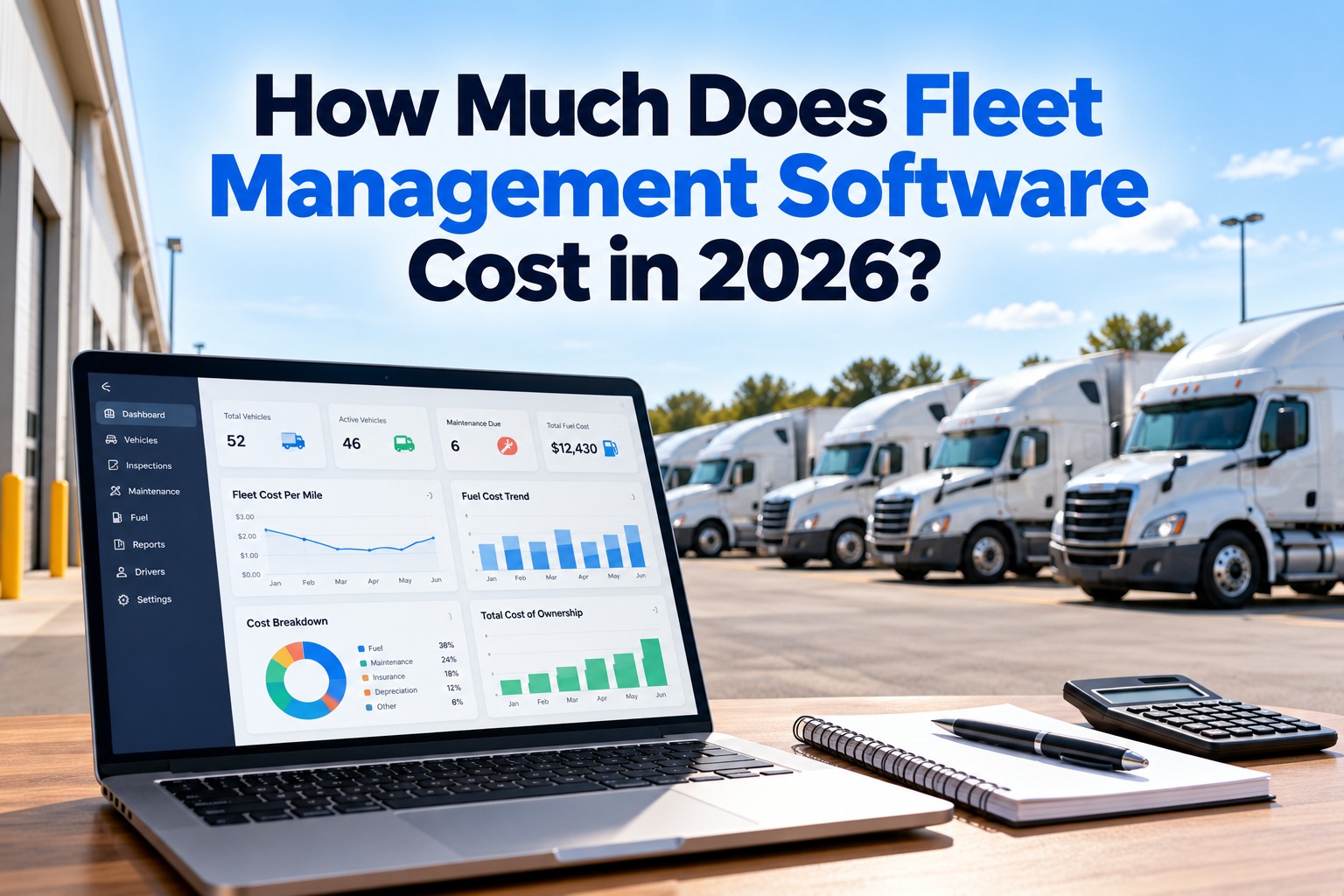
Fleet management software prices range from free to several hundred dollars per vehicle per year, and the sticker price is rarely the whole bill. Some platforms are software only. Others bundle telematics hardware, installation and a multi-year contract into the price. Comparing a $4 monthly fee with a $30 one means little until you know what each includes and what it costs over three years. This guide explains the four common pricing models, the published price points we could verify, the cost lines that sit outside the subscription, a three-year cost worksheet for a 25-truck fleet, and the questions to ask before signing. To see how FleetRabbit’s pricing fits your fleet, book a short walkthrough with our team.
Four pricing models, and what each one usually includes
Most fleet software is priced per vehicle. The difference is what that price covers. Before comparing numbers, work out which model each vendor uses, because a software-only price and a bundled telematics price are not the same product.
Software per vehicle
Software plus telematics
Tiered by feature
Enterprise quote
Published price points we could verify, and how far to trust them
Many vendors don’t publish prices, so most figures online are estimates. The table shows FleetRabbit’s published pricing alongside two widely reviewed platforms, with the source and how firm each figure is.
| Platform | Model | Price | Contract | Source |
|---|---|---|---|---|
| FleetRabbit | Software per vehicle; hardware bundle on request | Free up to 3 assets; Business $50 per vehicle a year, billed annually | Monthly option with no long-term contract; multi-year discounts | Published price list |
| Fleetio | Tiered software per vehicle | Essential about $4–5 per vehicle a month; higher tiers more | Five-vehicle minimum; auto-renews, 90 days’ notice | Third-party pricing tracker, June 2026 |
| Samsara | Software plus telematics hardware | About $27–33 per vehicle a month, plus $99–148 hardware | Three-year minimum reported | Tech.co estimate, Sept 2026; not published |
The gap between rows is mostly a difference in product, not just price. A telematics platform includes tracking hardware and its data; a software-only platform relies on the telematics you already have, or connects to it. Compare like with like, or compare the full bundle you would need from each.
Monthly or annual billing, trucks or every asset: the small print that moves the price
Two details change the real price more than the headline rate. The first is billing. Annual billing usually costs less per month than monthly billing, but it commits the budget up front; monthly billing costs more and keeps the option to leave. Fleetio’s Essential plan, for example, is tracked at about $5 per vehicle a month billed monthly and $4 billed annually. Decide which matters more to you before comparing quotes.
The second is what counts as a vehicle. Some vendors price only powered units; others count every trailer, chassis, forklift and piece of equipment you want to track. A fleet of 25 tractors with 60 trailers can be a 25-unit quote or an 85-unit quote depending on that one definition. Ask how trailers and equipment are priced, and whether assets you only want to inspect, not track, cost the same as trucks.
Minimums matter too. A five-vehicle minimum is no problem for a 25-truck fleet but doubles the cost for an owner-operator with two trucks. That is where a free tier, such as FleetRabbit’s plan for up to three assets, changes the decision for the smallest fleets.
A three-year cost worksheet for a 25-truck fleet
Three years is the right horizon because many telematics contracts run that long. The two options below are illustrative: one software-only platform at FleetRabbit’s published Business price, and one bundled telematics platform using the midpoints of the Tech.co estimate ranges. Replace every figure with the quotes you actually receive.
These options don’t do the same job. Option B includes GPS tracking and its hardware; Option A doesn’t. The worksheet is useful because it makes the question explicit: do you need to buy telematics, or do you need software to run maintenance, inspections and costs on data you already have? Many fleets already pay for telematics through an ELD provider, and buying a second set of hardware to get maintenance software is the most common way to overspend.
Already have telematics? Connect it instead of replacing it
If your trucks already carry an ELD or GPS unit, check what your current provider can share. FleetRabbit connects to telematics providers including Geotab, Samsara and Verizon Connect, bringing location, odometer, engine hours and fault codes into each vehicle’s record, and it imports transactions from fuel cards such as WEX, Comdata and EFS. That keeps the hardware you’ve paid for and adds the maintenance, inspection and cost layer on top. When you compare quotes, ask each vendor whether it can run on your existing telematics, and what it charges for the connection.
Software cost per mile: the comparison that puts the price in context
A per-vehicle price looks large on a budget line and small on a cost-per-mile report. ATRI’s 2025 operating cost study put average annual mileage at 85,991 miles per truck. At that mileage, the two example prices work out as follows.
Against an average operating cost of $2.336 per mile in 2025, both are small. What matters is whether the software removes more cost than it adds. A system that prevents one roadside breakdown a year per ten trucks, or lifts fuel economy by a fraction of a mile per gallon, typically covers its cost many times over. A system nobody uses removes nothing, whatever it costs.
The cost nobody quotes: your team’s time in the first 90 days
Every new system takes internal time to set up, and that time is a real cost even when no invoice arrives. Budget for it the same way you budget for the subscription.
Vendors that offer paid onboarding can shorten the first stage, and FleetRabbit lists onboarding and implementation as a paid service from its customer success team. Whether it is worth paying for depends on how many vehicles you have, how clean your current records are, and how much internal time you can spare. Either way, put the hours on the worksheet.
Ten questions to ask every vendor before you sign
Ask for the answers in writing, and compare the three-year totals, not the first-year price. The cheapest first year is not always the cheapest contract.
Which pricing model fits which fleet
Start free, pay per vehicle when you grow, and keep your existing telematics
The two features most fleets start with are a digital DVIR and DOT inspection routine and preventive maintenance scheduling, because they produce savings in the first few months that justify the rest.