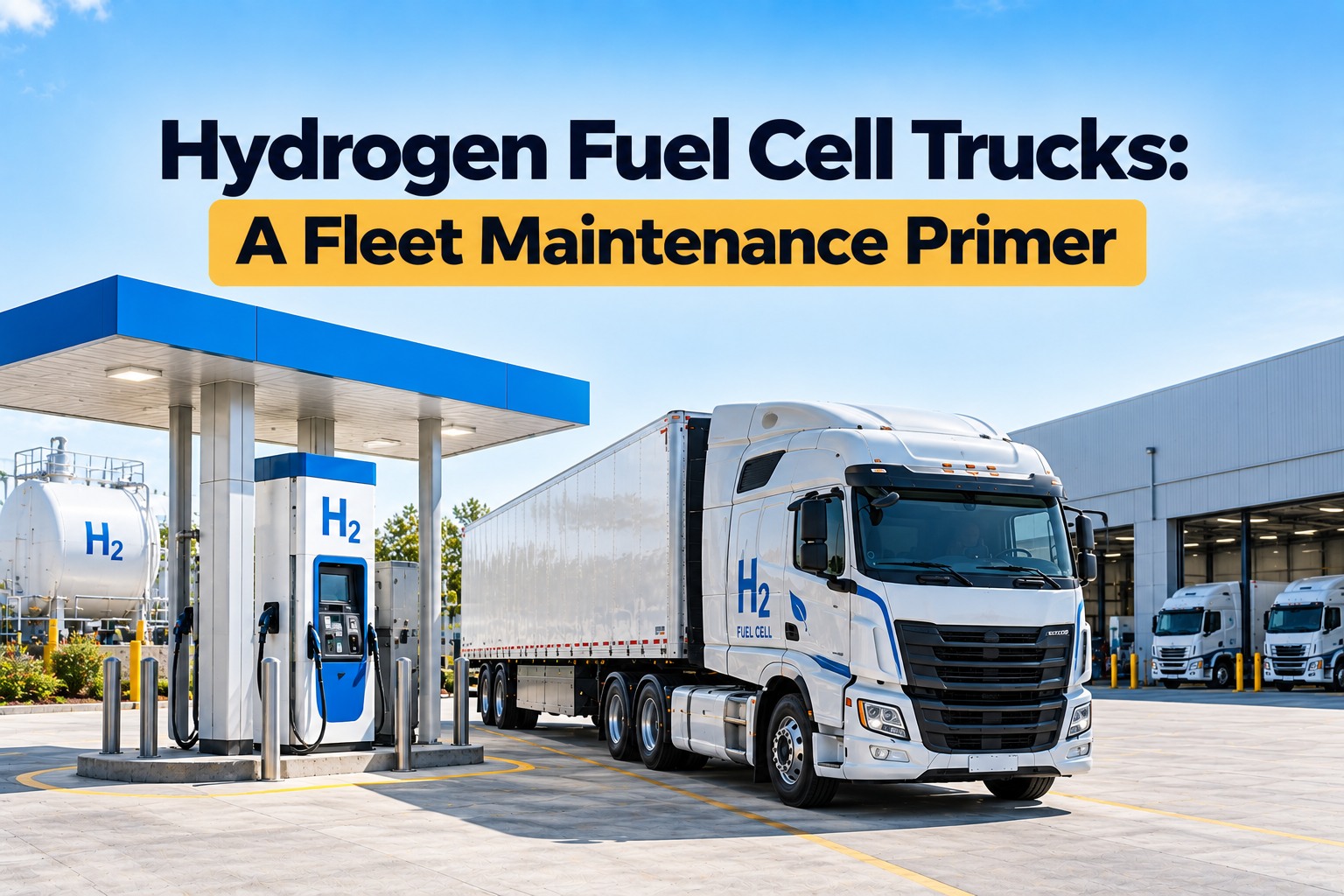
A hydrogen fuel cell truck is a battery electric truck that carries its own power station. DOE describes the drivetrain as a fuel cell, a battery, an electric motor and a hydrogen storage tank, with regenerative braking feeding the battery — so every high-voltage requirement that applies to a battery electric vehicle applies here in full, and then a fuel cell stack and a 5,000 to 10,000 psi storage system sit on top of it. That makes it the most demanding option a workshop can take on. What it buys back is the one thing a battery electric truck cannot offer: DOE puts heavy-duty hydrogen refuelling at 10 to 15 minutes rather than a charging window. Whether that trade is worth the complexity depends on whether dwell time is your binding constraint. Book a hydrogen readiness call.
Maximum Workshop Complexity, Bought for Minimum Downtime
What a fuel cell truck adds, what it removes, where it sits on the pressure ladder against every other alternative fuel, and the six questions worth asking a manufacturer when the published maintenance data does not yet exist.
Where It Sits on the Pressure Ladder
Every gaseous fuel brings a pressure regime, and the regime decides the components, the tooling and who is allowed to touch it. Hydrogen sits at the top.
DOE lists light-duty fuel cell vehicles with "10,000 psi tanks" marketed as H70, and heavy-duty buses with "5,000 psi tanks" marketed as H35 — so the figure that matters for a truck fleet is usually 5,000 rather than the 10,000 commonly quoted. Either way it is above CNG's 3,600 psi service pressure, and far above propane's 150. The reason is physics rather than engineering preference: DOE notes hydrogen's low volumetric energy density means it must be stored at high pressure to deliver comparable range.
The Stack of What You Are Taking On
Three layers added, one genuinely removed. Reading them in order is the clearest way to understand the workshop consequence.
Traction motor, high-voltage battery, power electronics, HV cabling and regenerative braking. DOE names the battery, electric motor and regen system as part of the FCEV drivetrain, so every high-voltage qualification requirement applies in full.
A polymer electrolyte membrane device where, in DOE's description, “hydrogen is introduced to the anode, and oxygen (from air) is introduced to the cathode” and splits into protons and electrons via a catalyst. A new component class with no diesel analogue.
5,000 psi on heavy-duty vehicles, 10,000 psi on light duty. A pressure regime above CNG, with its own components, fuelling protocol and handling discipline.
No engine, no oil, no fuel filters, no aftertreatment, no DPF or DEF. DOE notes an FCEV “emits only water vapor and warm air as exhaust.”
The last row is real and worth weighing properly. Removing the engine takes out oil, filters, fuel system and the entire aftertreatment burden that makes diesel expensive to maintain — and DOE confirms an FCEV "emits only water vapor and warm air as exhaust." But it is removed in exchange for two component classes your workshop has never held, not in exchange for nothing.
Work out what your shop can legally touch
High-voltage qualification, hydrogen handling and manufacturer-specific stack training are three separate things, and the work you cannot cover goes back to the dealer at dealer rates. In thirty minutes we will map what your technicians currently hold against what a fuel cell unit will require, and set up the record that tracks it.
Six Fuels, One Table
Everything a mixed fleet might run, across the dimensions a workshop plans around. Swipe the table sideways on mobile.
| What the workshop carries | Diesel | Propane | CNG | Battery electric | Fuel cell |
|---|---|---|---|---|---|
| Onboard pressure | None | 150 psi | 3,600 psi | None | 5,000–10,000 psi |
| High-voltage qualification | No | No | No | Yes | Yes |
| Certified container inspection regime | No | By container type | Annual on heavy vehicles | No | Yes, high pressure |
| Refuelling or recharging time | Minutes | Minutes | Minutes | Hours at a depot | 10–15 minutes, heavy duty |
| Aftertreatment burden | Full | Much reduced | Much reduced | None | None |
| Site infrastructure | Existing | Tank and dispenser | Compressor and storage | Chargers and electrical service | Hydrogen supply, early stage |
| Argonne MHDV repair cost scaling | 100% | Not published separately | Not published separately | 60% | 60%, grouped with battery electric |
| Published fleet maintenance history | Decades | Substantial | Substantial | Growing | Thin |
The last row is the one that should shape how you deploy. Argonne groups fuel cell with battery electric at 60% repair cost scaling, but that is a modelled figure for the powertrain and it does not capture the hydrogen storage regime, the stack, or the thinness of real operating history behind it. Treat it as an indication rather than a budget.
What the Stack Actually Does
Worth understanding plainly, because the mechanism explains most of the maintenance consequences further down this page.
DOE's description is a polymer electrolyte membrane device in which "hydrogen is introduced to the anode, and oxygen (from air) is introduced to the cathode," and "the hydrogen molecules break apart into protons and electrons due to an electrochemical reaction aided by a catalyst." The electrons do the useful work on the way round, the protons cross the membrane, and what comes out the other side is water. There is no combustion anywhere in it, which is why DOE can state an FCEV "emits only water vapor and warm air as exhaust" and describe fuel cell vehicles as "more efficient than conventional internal combustion engine vehicles."
Three things in that description have direct workshop consequences. It needs clean air, because the oxygen comes from the atmosphere the truck is driving through. It produces water, which has to be managed and which behaves differently in winter. And it depends on a catalyst and a membrane, which are the components that degrade and which no amount of good practice on your part will stop degrading.
The energy density point is worth holding alongside it. DOE puts the energy in 2.2 pounds — one kilogram — of hydrogen gas at roughly the same as the energy in a gallon of gasoline, which weighs 6.2 pounds. By weight hydrogen is exceptional. By volume it is poor, and that single fact is the reason the storage pressures in the chart above are what they are.
The Honest Position on Maintenance Data
This is a maintenance primer, so it should say plainly what is not yet known rather than filling the gap with confident-sounding estimates.
DOE's own description of the category is that fuel cell electric vehicles and hydrogen infrastructure "are in the early stages of implementation," with manufacturers offering "a limited but growing number" of vehicles "in certain markets." Its published material covers how the technology works and what it emits. It does not publish fuel cell stack service life, degradation curves or maintenance intervals, because for heavy duty in real fleet service those numbers are still being generated.
That has a direct consequence for anyone deploying now. You are not buying into an established body of maintenance knowledge the way you would with diesel. You are among the people producing it. Which means the value of recording everything, from the first vehicle, is far higher here than on any other powertrain — and the cost of not doing so is arriving in three years with a yard full of fuel cell trucks and the same uncertainty you started with.
Anyone quoting you a confident cost per mile for heavy-duty fuel cell maintenance is extrapolating. That is not necessarily dishonest, but ask what fleet, what duty cycle and how many vehicle-years it came from, and weight the answer accordingly.
Six Questions for the Manufacturer
Since the public data is thin, these go directly to whoever is selling you the vehicle — and the answers belong in the contract rather than in a conversation. Swipe on mobile.
| The unknown | Why it matters | What to ask |
|---|---|---|
| Fuel cell stack service life | The number that decides the economics, and the one with the least public data behind it for heavy duty in real service. | Ask for the warranty terms and what voids them |
| Degradation behaviour | Stacks lose output over time. How fast, under what duty cycle, and what that does to available power is manufacturer-specific and not widely published. | Ask how performance is measured and reported |
| Air quality sensitivity | A fuel cell takes oxygen from ambient air, which means what is in that air matters. Filtration requirements and replacement intervals are a real maintenance line. | Ask for the filtration schedule and consumable cost |
| Water and thermal management | The byproduct is water, and the stack has demanding thermal requirements. Both are managed systems with their own servicing. | Ask what fluids are specified and who may change them |
| Technician availability | High-voltage qualification plus hydrogen handling plus whatever the manufacturer requires for the stack. The pool of people who hold all three is small. | Ask what work must go back to the manufacturer |
| Cold weather behaviour | Water in a stack and freezing temperatures are an engineering problem manufacturers solve in different ways, with different consequences for start-up time. | Ask for cold-start specification and data |
How FleetRabbit Handles This
Four things, and the first matters more on this powertrain than on any other.
If the published maintenance history is thin, yours becomes the evidence. Fleets that log from the first unit can answer in a year what everyone else is still guessing about.
High-voltage plus hydrogen handling plus manufacturer-specific training. Knowing who holds what, and until when, is a scheduling constraint before it is a compliance one.
Early deployments find out what the real intervals are. A system that lets you adjust a schedule from evidence beats one built on a manufacturer's first estimate.
Fuel cell units on the same record as diesel, propane, CNG, hybrid and battery electric — because the body, brakes, tires and every inspection obligation are identical across all six.
Questions Fleets Ask
How much maintenance does a fuel cell truck need?
Honestly, nobody has enough heavy-duty fleet-years to answer that with confidence yet, and DOE describes the category as in the early stages of implementation. What is knowable is the shape: no engine, oil, fuel filters or aftertreatment, but a high-voltage system, a fuel cell stack and high-pressure hydrogen storage. Record your own from day one. Start capturing free.
What pressure does hydrogen storage run at?
DOE lists 10,000 psi tanks on light-duty fuel cell vehicles and 5,000 psi on heavy-duty buses, so a truck fleet is usually dealing with the lower figure. Both sit above CNG's 3,600 psi service pressure and far above propane's 150 psi, and the handling regime scales accordingly. Review your fuel mix.
How long does refuelling take?
DOE puts heavy-duty buses at 10 to 15 minutes and light-duty vehicles at 3 to 5. That is hydrogen's clearest operational advantage over battery electric, and for operations where dwell time is the binding constraint it can be the whole reason to consider it. Compare against charging windows.
Do our technicians need high-voltage qualification?
Yes. A fuel cell vehicle has a traction battery, an electric motor and high-voltage distribution, so every requirement that applies to a battery electric vehicle applies here — plus hydrogen handling, plus whatever the manufacturer specifies for the stack. Those are three separate qualifications and the overlap between people holding all three is small. Map the gap.
Is it cleaner than battery electric?
At the vehicle, both emit nothing harmful — DOE states an FCEV emits only water vapour and warm air. The meaningful difference is upstream in how the hydrogen or the electricity was produced, which is a procurement question about your energy supply rather than a vehicle question. Compare the six options.
Should we wait?
A fair question and it depends on your constraint. If dwell time is what rules out battery electric on your routes, there may be no alternative worth waiting for. If it is not, then deploying early means carrying the cost of immaturity for a benefit you may not need. Decide on the constraint rather than on the technology. Talk through the constraint.
Can we run it with everything else?
Yes, and by this point most fleets exploring hydrogen already run two or three powertrains. The body, brakes, tires, suspension and every inspection obligation are identical across all six fuel types — only the powertrain tasks differ, which is why they belong on one maintenance record rather than six. Add fuel cell units free.
If the Data Does Not Exist Yet, Be the Fleet That Has It
FleetRabbit records intervals, consumables, qualifications and failures from the first fuel cell unit, alongside diesel, propane, CNG, hybrid and battery electric on one schedule — so in a year your answers come from your own operation rather than from an extrapolation.
Free for 3 vehicles · no credit card required