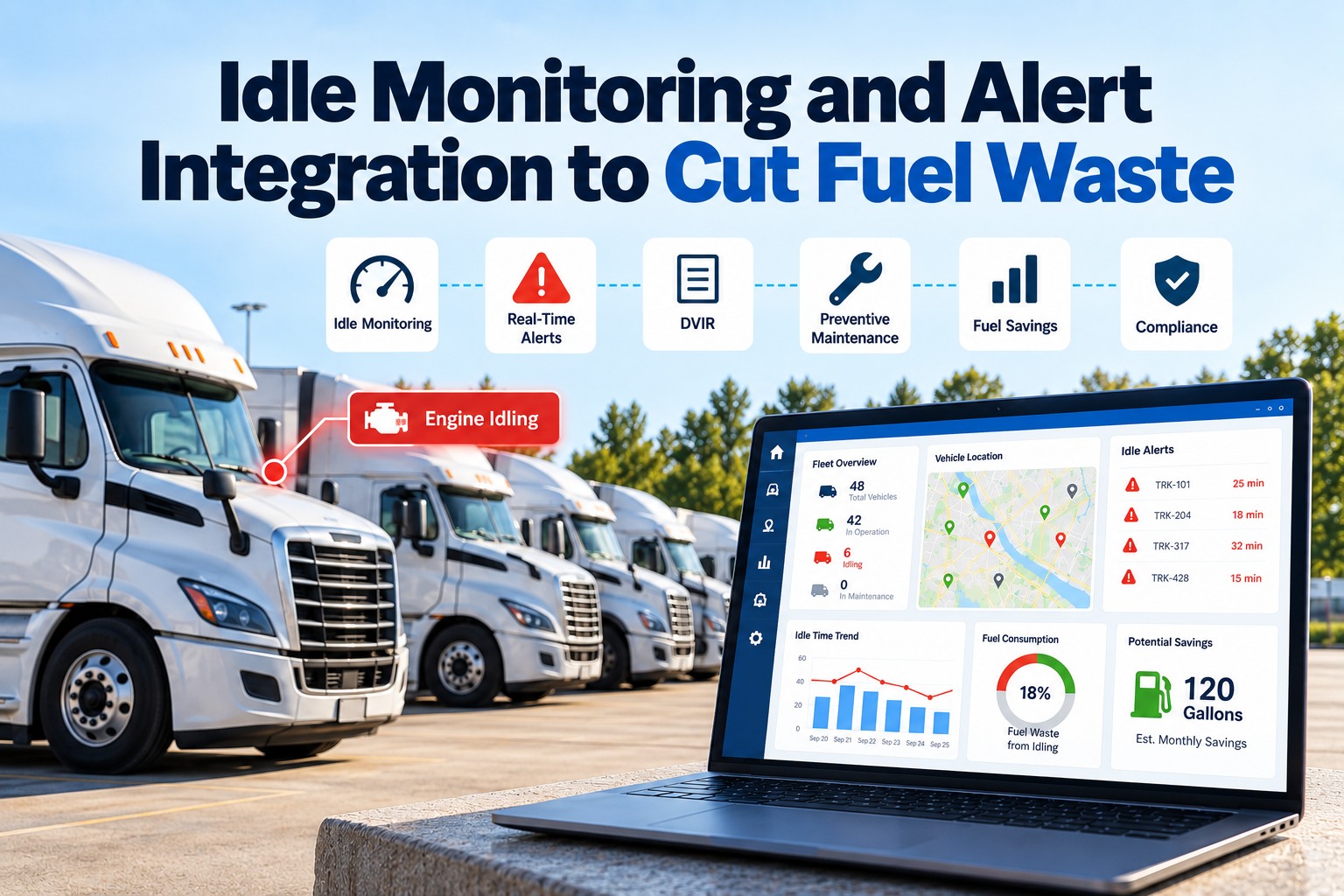
Idle monitoring fails in a predictable way: the alert fires, the driver was running a reefer or sitting in a legally required break, and within a fortnight nobody reads the alerts at all. The fix is not a better sensor. It is a classification, and the useful thing is that it has already been written for you — the anti-idling regulations themselves publish the list of idle that does not count. Traffic and traffic control. Operating a lift, crane, pump, drill, hoist, mixer or other auxiliary equipment. Cargo refrigeration. Loading and unloading. Servicing, repair or diagnostics. A required safety inspection. Warm-up and cool-down, typically three to five minutes. Sleeper berth rest. Cab heating below a cold threshold, which across several states is set at 20°F. That exemption list is a ready-made taxonomy for your alerting, and using it is the difference between a system drivers cooperate with and one they route around. The scale is worth knowing before you start: the Department of Energy puts heavy-duty truck idle consumption at about 0.8 gallons of fuel per hour, with a working range of 0.6 to 1.5, and a typical long-haul truck idling roughly 1,800 hours per year — about 1,500 gallons of diesel each. This guide covers the three-tier classification, the legal limits by tier, the annual arithmetic per truck, six rules for designing alerts drivers will actually use, and how to read the resulting data. See idle data classified in one view, or start with three trucks.
Most Idle Alerts Get Ignored Because Most Idle Is Legitimate.
For fleet operations managers, fuel and sustainability leads and finance: how to separate the idle you cannot alert away from the idle that is pure waste, using the categories the regulations already define.
No credit card required. Idle, DVIR, PM and compliance against the same unit.
The Only Classification That Matters
Sort every idle hour into one of three tiers before you configure a single alert. Two of them should never trigger anything, and the third is where all the recoverable fuel is. Bring a week of your own idle data and we will sort it live.
Idle the rules themselves carve out. Alerting on these trains your drivers to ignore alerts.
Not always written into the exemption list, but the job genuinely requires it. Needs a reason code, not an alert.
The only category an alert should ever fire on. Usually a small share of total hours and almost all of the recoverable fuel.
The exempt list is drawn from the exemptions that recur across state and local anti-idling regulations as compiled by the EPA — traffic and traffic control, auxiliary equipment operation including lifts, cranes, pumps, drills, hoists and mixers, cargo refrigeration, loading and unloading, servicing, repair and diagnostics, required safety inspections, warm-up and cool-down periods typically of three to five minutes, sleeper berth rest and emergency vehicles on duty. Exemptions vary by jurisdiction and change over time, so confirm the current rules for every state you run in rather than treating this as a legal list.
What the Limits Actually Are
There is no federal idling limit for commercial vehicles. There are dozens of state and municipal ones, they do not agree, and a truck on a multi-state lane passes through several in a day. Track it per unit free.
District of Columbia, Wilmington in Delaware, and some Connecticut municipalities
Arizona, California, Colorado, Connecticut, Delaware, Illinois, Maine, Maryland and Massachusetts among others
Denver, Atlanta, and several Connecticut towns
Nevada and Clark County, and Atlanta under some conditions
New Orleans, and Atlanta under some conditions
Tiers and examples per the EPA's compilation of state, county and local anti-idling regulations, in which the five-minute limit is the most prevalent. That compilation is a snapshot rather than a live register — limits and exemptions are amended regularly and several jurisdictions have changed since it was published, so treat the structure as reliable and every individual figure as something to verify before you configure a threshold against it.
The Arithmetic on One Truck
Worth doing before you buy anything, because it tells you which tier is worth attacking. We will run this with your own fuel price.
Those 1,800 hours are, per DOE, primarily accumulated during mandated rest periods, because most drivers remain in their trucks and keep them running for heating, cooling and other necessities. That is the largest block of idle fuel in a long-haul fleet, and it sits in the tiers an alert must not fire on. Alerts recover the discretionary tier. The rest-period block is recovered with equipment — an APU, a bunk heater, shore power — or not at all. Any idle programme that does not separate the two will report a small win against a big number and confuse everybody about why the fuel spend did not move.
Bring One Week of Idle Data to the Session
Thirty minutes, your own numbers, and we sort the hours into the three tiers on the call — so you leave knowing which share is actually recoverable by alerting, which needs equipment, and what a sensible threshold is for the states you run in. It is a more useful conversation than a product tour.
Six Rules for Alerts Drivers Will Actually Use
Every one of these exists because a fleet somewhere did the opposite and lost the room.
The regulations already tell you what legitimate idle looks like. An alert that fires while a driver runs a reefer or takes a legally required break is not a safety tool, it is a reason to stop reading alerts.
Asking a driver to pick from a short list at the moment of the idle takes three seconds and produces data. Asking them to explain themselves afterwards produces resentment and nothing else.
If you alert at exactly five minutes you will catch every lawful warm-up and traffic stop in the fleet. Alert at a duration that could only be discretionary for your operation, then tighten it once the data is clean.
They are different problems with different fixes. Rest-period idle is solved with equipment; workday idle is solved with alerts and habits. Reporting them as one number hides both.
A queue at one dock will show up as six drivers with an idle problem. The pattern is the site, and the fix is the site.
A unit reporting zero idle hours is far more likely to have a telemetry problem than a perfect driver.
Reading the Data Once It Is Clean
Seven patterns and what each one is really telling you. Note how few of them end in coaching a driver. Swipe the table on mobile.
| What the report shows | What it usually is | What to do |
|---|---|---|
| Discretionary idle concentrated on a few units | Habit, or a cab comfort problem on those specific trucks | Check the HVAC and bunk heater on those units before coaching anybody |
| Idle clustered at one customer site | Dock queue, not driver behaviour | Take the data to the customer or to scheduling; no amount of coaching fixes a queue |
| High idle on cold mornings across the whole fleet | Cab heat, which most regulations exempt below a cold threshold | Price auxiliary heat against the fuel; this is an equipment decision, not a compliance one |
| Long rest-period idle on sleeper units | Drivers keeping the engine running for heating, cooling and power | APU, bunk heater or shore power. Alerts cannot solve this category and should not try |
| Idle rising on one unit over weeks with no route change | Possible aftertreatment or engine issue driving longer regeneration or warm-up | Treat it as a maintenance signal and pull the fault history for that unit |
| Zero recorded idle on an active unit | Device offline, parameter not exposed, or idle not being reported | Verify the signal before congratulating anyone |
| Idle down but fuel spend flat | Idle was not where the waste was | Stop optimising it and go look at the route, the load or the driving |
On the maintenance link: the Alternative Fuels Data Center states that decreasing idle time can also reduce engine wear and associated maintenance costs, especially for heavy-duty trucks — but publishes no figure alongside it. So treat reduced wear as a real secondary benefit and keep it out of the business case, which stands up perfectly well on fuel alone. Put idle data next to the inspection report and the preventive maintenance schedule so a unit whose idle is climbing can be read against its own fault history.
Idle Monitoring Questions Fleets Ask
How much fuel does an idling truck actually use?
The Department of Energy puts heavy-duty truck idling at about 0.8 gallons per hour, with a working range of 0.6 to 1.5 depending on accessory load and conditions. At a typical 1,800 long-haul idle hours a year that is roughly 1,500 gallons per truck. Your own rate will sit somewhere in that band depending on how much heating, cooling and auxiliary load the engine is carrying. Run the numbers with us.
Is there a federal limit on truck idling?
No. Limits are set by states, counties and municipalities, and they differ — three minutes in some jurisdictions, five in the largest group, ten, fifteen or twenty elsewhere. A truck crossing several states in a day is subject to several different limits, which is why a single fleet-wide alert threshold is usually either too tight to be useful or too loose to matter. Set it per unit and lane, free.
What idling is exempt?
Commonly: traffic and traffic control, operating auxiliary equipment such as a lift, crane, pump, drill, hoist or mixer, cargo refrigeration, loading and unloading, servicing, repair and diagnostics, required safety inspections, warm-up and cool-down of typically three to five minutes, sleeper berth rest, and emergency vehicles on duty. Many jurisdictions also permit extended idling for cab heat below a cold threshold, frequently 20°F. Exemptions vary and change, so verify for each state you operate in. Map your lanes with our team.
Why do my drivers ignore idle alerts?
Almost always because the alerts fire on legitimate idle. If a driver gets an alert while running a reefer, building air pressure or sitting in a legally required break, the rational response is to stop reading alerts — and once that happens the system is dead whether or not it is still running. Classify first, alert second. Try the classified version free.
Should I alert at the legal limit?
No. Alerting at exactly five minutes catches every lawful warm-up, traffic stop and dock wait in the fleet. Set the threshold at a duration that could only be discretionary for your operation, get the data clean, then tighten. The legal limit is a compliance fact, not an alert setting. Pick a sensible threshold with us.
Can alerts fix rest-period idling?
No, and this is the most common disappointment in idle programmes. Rest-period idle is the largest block of idle fuel in a long-haul fleet, and drivers are running the engine for heating, cooling and power during a break they are legally required to take. That block is recovered with an APU, a bunk heater or shore power. Alerts recover the discretionary block, which is smaller but genuinely free. Separate the two in your reporting.
Does idling damage the engine?
The Alternative Fuels Data Center states that decreasing idle time can reduce engine wear and associated maintenance costs, particularly on heavy-duty trucks, though it publishes no figure. Extended low-load running also has implications for aftertreatment behaviour that vary by engine, so check your engine maker's guidance rather than a general rule. Build the case on fuel and treat wear as a bonus. Discuss the maintenance side.
One View, Three Tiers, and an Alert Worth Reading
FleetRabbit holds idle hours with their reason codes against the same unit as the DVIR record, the open defects and the work orders — so discretionary idle reaches the right person, exempt idle stops generating noise, and a unit whose idle is quietly climbing gets read against its own fault history instead of its driver's record.
No credit card required. Bring a week of idle data and we will work through it together.