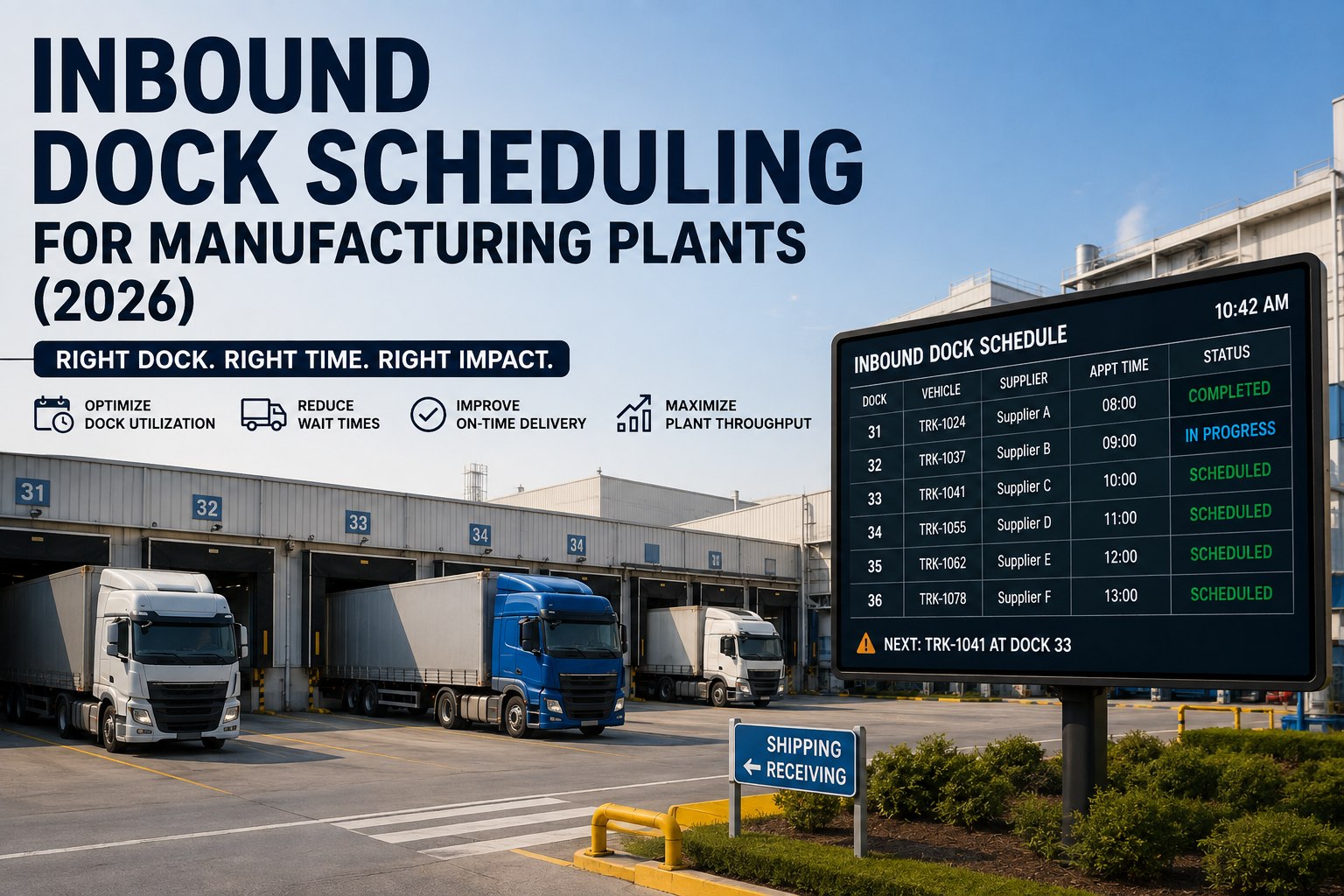
Most inbound dock schedules are built on a false assumption: that a door is a door. In practice, a plant's doors differ by leveler capacity, approach grade, trailer length tolerance, temperature and hazmat segregation, and — most importantly — by how the freight actually leaves the trailer, which might be a forklift, a powered assist, a conveyor, or a straight crossdock transfer. Those eligibility rules exist at every site. They just usually live in the head of the dock supervisor who has been there nine years, which means the schedule is theoretically valid and operationally wrong about twice a shift. Add the automotive complication — that some of those trailers are feeding a frozen sequence window and the rest are not — and scheduling stops being a calendar problem and becomes a constrained assignment problem. This covers how to classify doors by unload capability, how to score sequence-critical priority, how to size a slot properly, and what to do in the twenty minutes after a supplier misses. See it on your own data against your door list and appointment bank.
2026 GUIDE · AUTOMOTIVE INBOUND
Inbound Dock Scheduling That Survives the Shift
Door assignment scored against real unload capability, sequence-critical prioritisation that beats arrival order, and a re-slotting playbook for the moment a supplier misses their window.
Classify Every Door by What It Can Actually Do
Before any scheduling logic works, doors need a capability tier. This is the classification that lets a scheduler assign on product and process fit rather than on which door happens to be empty — and it is the fastest way to get eligibility rules out of tribal knowledge and into a system.
T1
Manual unload only
Forklift or pallet truck from the trailer floor. Highest labour minutes per trailer, widest freight tolerance. Slot duration is dominated by pallet count and floor-loaded content.
Schedule here: mixed pallets, low-frequency suppliers, anything non-standard
T2
Powered assist
Connected dock equipment with software coordination — interlocked restraints, levelers and door controls, unload assist at the door face. Predictable cycle time, narrower trailer tolerance.
Schedule here: repeatable carrier mix, consistent trailer dimensions
T3
Conveyor integrated
Direct conveyor-fed transfer into the building. Fastest per-unit, but only for freight that suits it. Substituting a forklift-dependent door for one of these during a surge fails unless labour and staging can support the swap.
Schedule here: high-volume standardised unit loads
T4
Orchestrated crossdock
Arrival, door assignment, restraint, unload, verification and warehouse handoff synchronised across dock controls, yard and execution systems. The trailer contents move to line-side or staging without an intermediate decision.
Schedule here: sequence-critical and line-feed freight
The substitution trap
If Door 6 is conveyor-fed and Door 7 depends on forklift replenishment, they are not interchangeable — but under pressure a supervisor will treat them as if they are, because both show as free. Encoding the tier is what stops that, and it costs nothing but an afternoon walking the dock with a clipboard.
Door Eligibility Constraints Worth Encoding
Every one of these already governs your dock. The only question is whether it governs from a system or from memory. Audit them once, write them down, and the schedule stops producing assignments that have to be undone on arrival.
← Swipe to see all columns →
Stop Using Fixed Slot Lengths
A flat sixty-minute appointment is the single most common source of schedule drift, because it is right on average and wrong on almost every individual load. Slot duration is additive, and the components are all knowable in advance. Build it up rather than assuming it.
Slot duration, built from its components
Spot & secure
Unload time = units × method rate
Verify & count
Clear-away & release
Spot and secureFixed per door tier — T3 and T4 doors are faster and more consistent
Unload timeUnit-load count multiplied by the rate for that door's unload method. Floor-loaded freight is a different rate again
Verify and countFalls sharply where a validated despatch advice exists and the transport label is scanned rather than keyed
Clear-away and releaseInterior clear-away before the next trailer can be spotted. The component most often omitted entirely
Two loads of the same pallet count can differ by half an hour on these four components alone. Once slot length varies correctly, appointment adherence improves without changing a single carrier behaviour — because the windows finally reflect what the door can do.
Size on the peak bank, not the annual plan
Dock capacity inherited from an annual volume forecast is too coarse to schedule against. The bottleneck is at the door during the peak appointment bank, not at average daily flow — so throughput has to be calculated door by door, using arrival clustering, unload method, unit-load profile and interior clear-away time. A dock that is comfortable on the annual number and congested every Tuesday morning is behaving exactly as the arithmetic predicts.
Your door eligibility rules already exist. They are just not written down anywhere.
Bring your door list, tier classification and a week of appointments — we will run the assignment logic against your real constraints and show where the current schedule is producing assignments your dock has to undo.
Sequence-Critical Prioritisation
This is what separates a plant dock from a distribution dock. When two eligible trailers want the same door, arrival order is the wrong tie-breaker — demand urgency is the right one. Score it rather than debating it, because the debate always happens at the worst possible moment.
Priority weighting for the next available door
Sequence window proximity
Time until the freight is required at line. Dominates everything below it.
Line buffer coverage
How many minutes of stock the station already holds for this part.
Door tier fit
A perfect-fit door beats a marginal one, because cycle time is the shared resource.
Detention exposure
Time already accrued against free window. Real cost, but recoverable.
Onward carrier commitment
Driver hours or a booked collection elsewhere. Matters, but rarely decides.
Arrival order
Where most docks start. Should be the last input, not the first.
The point of writing the weights down is not precision — it is consistency. A scored assignment can be explained to a carrier, defended in a review and audited afterwards. A supervisor's judgement call cannot, and that is the difference between a dock that improves and one that just changes.
Re-Slotting When a Supplier Misses
The miss itself is not the expensive part. The expensive part is the twenty minutes afterwards, when the schedule is still assuming a trailer that is not coming. Encode this branch logic so the recovery is a rule rather than a scramble.
Is the freight sequence-critical?
NoRelease the door immediately to the next scored trailer. Re-slot the missing load into the first slot its tier supports. Log the miss and move on — this is the common case and it should require no human decision.
YesContinue below. Do not release the door yet.
Does the line buffer cover the gap?
Yes, coveredHold the door for the revised ETA if it lands inside coverage. Notify line feed of the reduced buffer so they are not surprised later. No escalation.
No, exposedContinue below. Escalation clock starts now, not when the line stops.
Is the part available elsewhere on site?
YesPull from an unstaged trailer, buffer stock or another staged load. Re-point the kitting instruction. Fastest recovery available and it uses no external spend.
NoExpedite decision, with the door held and the sequence position flagged. This is the branch that costs money, and it should be reached deliberately rather than discovered.
One rule worth adding above all of these: a door held for a trailer that is not coming is worse than a door released to the wrong trailer. Set a maximum hold duration per tier and let it expire automatically. Docks lose more capacity to optimistic holding than to bad assignment.
Implementation Checklist
Work through these in order. The first group can be completed with a clipboard and a week; the later groups need system support. Most projects that fail do so in group one, not group three. Our analytics and reporting module covers the measurement group.
Group 1 — Define the physical reality
Classify every inbound door into a capability tier
Document leveler capacity, approach grade and trailer length tolerance per door
Record temperature and hazmat segregation rules
Measure yard travel time from gate to each door group
Separate inbound and outbound door and lane dedication explicitly
Group 2 — Fix the scheduling object and slot logic
Decide the scheduling unit — PO, despatch advice, load, trailer, carrier or door
Replace fixed slot length with the four-component build-up
Calculate door-level throughput against the peak appointment bank
Set maximum hold duration per door tier
Define no-show handling before it is needed
Group 3 — Encode priority and recovery
Publish the priority weighting used for door contention
Wire the sequence window into the assignment logic as an input
Encode the re-slot branch tree with owners at each branch
Connect gate and yard events so dwell is not invisible to the dock
Give carriers a self-service view of their own slot and any reslot
Group 4 — Measure what changed
Door utilisation per tier, not averaged across all doors
Assignments overridden on arrival — the direct measure of rule quality
Slot accuracy: planned duration against actual, by tier
Re-slot count and the branch each one took
Sequence-critical loads that reached the door inside their window
Run the Assignment Logic Against Your Dock
Bring your door list, current appointment bank and a week of actual arrivals. We will apply the tier classification, eligibility constraints, variable slot model and priority weighting to your own data, and show where the current schedule and the physical dock disagree. Integration with existing WMS, ERP, gate and telematics systems included in scope.
Door tier classification
Variable slot duration
Sequence-critical scoring
Automated re-slotting
Frequently Asked Questions
What is the difference between dock scheduling for a plant and for a distribution centre?
The tie-breaker. A DC can legitimately assign the next door to whichever eligible trailer arrived first, because the consumer is a picking wave that can be resequenced. A plant feeding a frozen sequence window cannot — the line does not wait, so proximity to the sequence window has to outrank arrival order in the scoring. Everything else, from eligibility constraints to slot build-up, is shared discipline. It is only the priority model that genuinely differs, and it differs completely.
How do we set slot durations if we have no historical data?
Time twenty trailers by hand across your door tiers, splitting each into spot and secure, unload, verify, and clear-away. That gives you a method rate per tier and a fixed component per door, which is enough to build the additive model. Refine it monthly against actuals. It is far more accurate than a flat sixty-minute slot from week one, and the exercise itself usually surfaces two or three eligibility rules nobody had written down.
Should we automate unloading before fixing the schedule?
Almost never. The bottleneck at most sites is not unloading speed — it is appointment adherence, invisible yard queues and unbalanced door assignment. Moving from largely manual coordination to connected dock equipment and software-driven scheduling usually unlocks more effective capacity than jumping straight to semi-automated unloading, at a fraction of the capital. Fix the assignment logic, measure what is left, then select pilot lanes for automation based on repeatability rather than on which door is busiest.
Which scheduling object should appointments be set against?
Decide deliberately and once. Appointments can be set by purchase order, despatch advice, load, route, trailer, carrier or door, and each choice pushes complexity somewhere different. Plants running sequence-critical inbound generally want the trailer as the object, with the despatch advice bound to it, because that is the unit the yard physically moves and the unit the door consumes. Setting appointments by purchase order is the most common mismatch, and it shows up as trailers containing three appointments.
How much door capacity should we hold in reserve?
Enough that utilisation during the peak appointment bank does not sit at the top of its range, since recovery capacity is what absorbs a miss without a cascade. On the yard side the same logic applies to trailer positions — planning roughly twenty per cent above average daily requirement is a reasonable starting point for surge and drop trailers. A dock scheduled to full theoretical capacity has no ability to re-slot, which means every supplier miss becomes a line exposure rather than an inconvenience.
Does this replace our WMS or EWM dock functions?
No. Warehouse tasks, bins, stock and goods receipt stay where they are. What sits in front is the assignment and appointment layer — door eligibility, variable slot construction, priority scoring against the sequence window, and re-slot execution — which are sub-minute decisions the system of record was not designed to make in real time. The events flow back so receipt posts against a real physical unload. Our
integrations overview covers the handoffs.
What should we measure to know it is working?
Assignments overridden on arrival is the sharpest single indicator, because it directly measures whether your encoded rules match your physical dock. Alongside it, track slot accuracy by tier — planned duration against actual — and door utilisation per tier rather than averaged, since an average across a mixed dock hides the fact that your two conveyor doors are saturated while four manual doors sit idle. Re-slot count broken down by branch tells you where recovery cost is concentrating.
Schedule Against the Dock You Actually Have
Capability-tiered doors, encoded eligibility constraints, slot durations built from their components, priority scored against the sequence window, and re-slotting that runs as a rule instead of a scramble — demonstrated against your own door list and appointment bank.
Works alongside existing WMS and EWM · No dock hardware required to start · Site-level configuration
August 11, 2026
By Sam Parker
All Articles