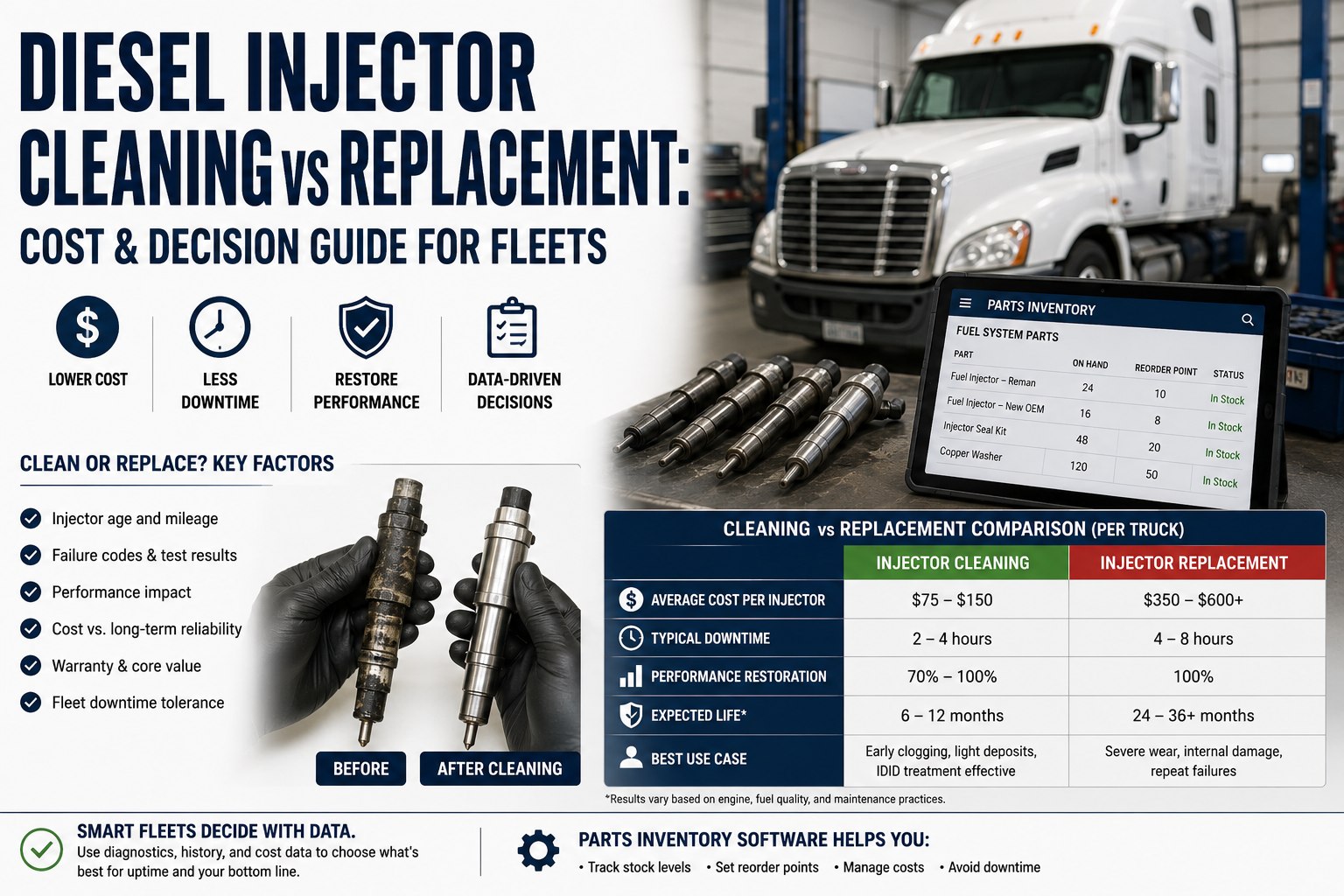
When a diesel injector starts misbehaving, the question a fleet manager faces isn't just "fix it" — it's clean, rebuild, or replace, and getting that call right is worth thousands of dollars per truck. A professional cleaning runs $50–$200 per injector; a rebuild $200–$400; a full replacement $300–$900+ per injector on a common-rail diesel, with a complete set easily reaching $2,000–$5,000. The trap is at both ends: clean an injector that's actually scored and you've wasted money and downtime on a part that needs replacing, but replace one that a $150 cleaning would have restored and you've burned four figures for nothing. The right answer depends on the injector's condition, mileage, and whether it's even serviceable — and on a fleet-wide view of cumulative repair spend that tells you when a truck has crossed the replace threshold. This guide breaks down the three options, the cost and downtime of each, the decision factors that separate them, and how parts-inventory software helps fleets stock the right injector options and make the call on data instead of guesswork. Start free trial or book a demo to make injector decisions on data, not guesswork.
DIAGNOSTICS & REPAIR · REPAIR DECISIONS
Clean, Rebuild, or Replace? The Wrong Call Costs Thousands Per Truck
Clean an injector that's scored and you've wasted the downtime. Replace one a $150 cleaning would have saved and you've burned four figures. The right decision hinges on condition, mileage, and a fleet-wide view of what each truck has already cost you.
OPTION 1
Clean
$50–$200
per injector
Minor clogging, deposits, prevention
OPTION 2
Rebuild
$200–$400
per injector
Worn but salvageable internals
OPTION 3
Replace
$300–$900+
per injector
Severe damage, scoring, non-serviceable
$2K–$5K
Full-set replacement on a diesel, in parts and labor
60–70%
Of a replacement bill is parts; the rest is labor
15–25%
Better fuel economy from preventive cleaning programs
60%
Fewer injector failures with preventive vs. reactive upkeep
The Three Options, Head to Head
Each path fits a different injector condition. Cleaning is maintenance, rebuilding is restoration, and replacement is for damage beyond saving. Here's how they compare on cost, downtime, what they fix, and how long the result lasts. Swipe the table horizontally on mobile.
← Swipe to see all columns →
i
Cleaning methods aren't all equal. The cheapest option is a fuel-additive or in-rail solvent flush, done without removing the injectors — good for prevention and minor deposits. Professional ultrasonic cleaning removes the injectors and runs them through ultrasonic baths and back-flush rigs, restoring stubborn cases a bottle of additive can't touch. When chemical cleaning fails or codes persist, the next step is bench testing — pop testing, flow checks, and spray-pattern analysis on a common-rail test bench — which tells you definitively whether an injector is salvageable before you spend on replacement.
See how logged repair history tells you which method to start with.
The Decision: When to Clean vs. Replace
The choice is not a coin flip — it follows a clear logic based on the injector's condition and history. Work through these factors in order, and the right path usually becomes obvious.
Symptoms caught early — reduced economy, mild rough idle
Deposit-related issues, not mechanical wear
Injector responds to a chemical clean and codes clear
Mileage is moderate and the core is otherwise healthy
Part of a scheduled preventive-maintenance program
Balance-rate or fuel-trim codes persist after cleaning
Bench testing shows scoring or a bad spray pattern
The injector design is non-serviceable
High mileage in severe duty with a maintenance gap
Cumulative repair spend is nearing replacement cost
To make it concrete, here is how common real-world scenarios map to the right decision — and the approximate cost of each. Swipe the table horizontally on mobile.
← Swipe to see all columns →
The fleet-level decision most managers miss: the clean-vs-replace call shouldn't be made truck by truck in isolation. When you track repair spend by vehicle asset over time, it becomes obvious when a truck's cumulative injector and fuel-system costs are approaching the replacement threshold — the point where one more $200 cleaning is throwing good money after bad. Without that data, every decision is guesswork, and fleets fall into the opposite traps: cleaning too often without justification, or replacing reactively after a failure that data would have predicted.
Book a demo to see cumulative cost per truck at a glance.
The narrow window between "alert" and "failure" is where fleets lose money.
Fleet Rabbit tracks fuel-system symptoms, repair history, and cumulative spend per truck — so the clean-or-replace call is made on data, and the right injectors are already on the shelf when you need them.
Why Cleaning Early Pays for Itself
The economics strongly favor catching injector issues at the cleaning stage. The cost of delay compounds fast — and the fleet-wide fuel-economy gains from clean injectors add up to real money on their own.
$150
A cleaning at the right point...
→
$1,000+
...becomes this if ignored two service cycles
And the fuel savings alone can justify a preventive program: even a 2% fuel-economy improvement across 50 trucks running 40,000 miles a year, at $4/gallon and 15 MPG, is roughly $10,700 saved fleet-wide every year — before counting the avoided replacements. Preventive cleaning programs are reported to deliver 15–25% better fuel economy and 60% fewer injector failures than reactive maintenance. The catch is that the savings only materialize when cleaning is targeted by data, not applied to every truck on the same blind interval.
Stock the Right Injectors and Make the Call on Data
Fleet Rabbit tracks fuel-system symptoms and repair history per truck, surfaces cumulative spend so you know when a truck crosses the replace threshold, and manages parts inventory so the right clean-kit, reman, or new injector is on the shelf before the truck is in the bay. Deploy at $5/vehicle/month, no hardware, live within 72 hours.
Per-truck repair-cost tracking
Replace-threshold visibility
Parts inventory management
Symptom & code history
Symptoms That Trigger the Decision
The clean-or-replace question starts when an injector shows symptoms. Reduced fuel economy is usually the first and quietest sign; the rest follow as deposits or wear progress. Catching these early is what keeps you in cleaning territory instead of replacement territory.
Reduced Fuel Economy
Often the first sign — dirty injectors deliver inconsistent fuel metering, and fleet fuel-per-mile data catches it before a driver does.
Rough Idle & Vibration
Uneven fuel delivery creates irregular combustion and unbalanced power across cylinders, felt as shaking at stoplights.
Black or Gray Smoke
Incomplete combustion from poor fuel atomization — a visible cue that spray patterns have degraded.
Power Loss Under Load
Particularly noticeable pulling a grade or accelerating, as injectors can't deliver clean, well-atomized fuel on demand.
Engine Knock & Hard Starts
Poor fuel timing from sticky components causes knock; degraded delivery shows up as long cranks, especially in cold weather.
Misfires & Fuel-Trim Codes
Individual cylinders failing to fire and the ECM logging fuel-delivery codes — persistent ones after cleaning point to replacement.
How Parts-Inventory Software Supports the Decision
Making the right clean-or-replace call is only half the battle — the other half is having the right part on hand when the decision is made. Here's how Fleet Rabbit connects the diagnosis to the shelf.
01
Cumulative Cost Per Truck
Track injector and fuel-system spend by vehicle asset over time, so you can see at a glance when a truck's repair history is approaching the point where replacement beats another cleaning.
02
Repair & Symptom History
Every symptom, code, cleaning, and replacement is logged against the VIN, so when an injector acts up again you know whether it was cleaned last month or replaced last year — and which method to try next.
03
Parts Inventory Management
Track clean kits, reman cores, and new injectors on the shelf so the right option is in stock when the decision is made — no waiting on a part while a truck sits down.
04
Low-Stock Reorder Alerts
Set minimum stock levels for common injector parts and get reordered before you run out, so a fleet-wide contamination event doesn't leave you scrambling for cores.
05
Targeted Preventive Cleaning
Schedule cleaning based on each truck's actual symptoms and mileage instead of a blind fleet-wide interval, capturing the fuel-economy gains without wasting money on trucks that don't need it.
06
Cost-Per-Repair Reporting
See what cleaning and replacement actually cost across the fleet, so you can justify a preventive program with real numbers and spot the trucks quietly draining the budget.
Frequently Asked Questions
Is it cheaper to clean or replace a diesel injector?
Cleaning is far cheaper — $50–$200 per injector versus $300–$900+ for replacement on a common-rail diesel, with a full set reaching $2,000–$5,000. That's the central argument for treating cleaning as preventive maintenance: a $150 cleaning at the right point avoids a four-figure replacement later. But cleaning only helps if the injector is dirty rather than damaged — cleaning a scored injector wastes money and downtime on a part that ultimately needs replacing. The economics favor cleaning early, before deposits become mechanical wear.
Book a demo.
When should I replace an injector instead of cleaning it?
Replace when the damage is beyond what cleaning can fix: persistent balance-rate or fuel-trim codes after a cleaning, scoring or a bad spray pattern confirmed by bench testing, a non-serviceable injector design, or high mileage in severe duty with a maintenance gap. The clearest signal is when chemical cleaning fails and codes persist — that's the cue to bench test, and if the injector shows scoring, it can't be fixed, only replaced. Cumulative repair spend nearing replacement cost is another trigger to stop cleaning and swap.
Book a demo.
What's the difference between cleaning and rebuilding an injector?
Cleaning removes deposits — either through a fuel additive or in-rail flush, or by removing the injector for professional ultrasonic cleaning — and restores performance when the problem is buildup, not wear. Rebuilding goes further, replacing worn internal components like seals and nozzles on a salvageable core, and runs $200–$400 per injector. Cleaning is maintenance for a healthy injector; rebuilding is restoration for a worn one. Not all injectors are serviceable, so which options are even available depends on the specific injector design.
Book a demo.
Should I replace one injector or the whole set?
It depends on the injectors' shared history and your engine access. Injectors on the same engine have seen the same fuel, heat, and mileage, so when one fails from wear, others may be close behind — replacing the full set at once can save a second round of labor. But if a single injector failed from an isolated cause, replacing just that one is reasonable. Because parts make up 60–70% of the bill and labor the rest, the labor savings of doing them together often tips the math on high-mileage engines. Your repair history per truck is what makes this call clear.
Book a demo.
How does bench testing help the clean-or-replace decision?
Bench testing takes the guesswork out. When chemical cleaning fails or fuel-trim codes persist, sending injectors to a specialist shop for pop testing, flow checks, and spray-pattern analysis on a common-rail test bench tells you definitively whether each injector is salvageable. This can save you from replacing good parts — an injector that tests fine after cleaning goes back in, while one showing scoring or a bad pattern gets replaced. For repeated balance issues across a fleet, bench testing pays for itself by preventing unnecessary replacements.
Book a demo.
How does software help fleets make injector decisions?
It replaces guesswork with data. By tracking repair spend per vehicle over time, you can see when a truck's cumulative injector and fuel-system costs are approaching the replacement threshold — the point where another cleaning is throwing good money after bad. Repair and symptom history tells you whether an injector was cleaned last month or replaced last year, parts-inventory tracking keeps the right clean kits and cores on the shelf, and targeted scheduling captures fuel-economy gains without cleaning trucks that don't need it. It turns a per-truck guess into a fleet-wide, data-driven policy.
Book a demo.
Make Every Clean-or-Replace Call on Data, With the Right Part Already on the Shelf.
Fleet Rabbit tracks fuel-system symptoms and repair spend per truck, shows you when each truck crosses the replace threshold, and manages parts inventory so the right injector option is in stock when the decision is made — turning a costly guess into a data-driven policy. Integrated with your existing systems in 5–7 working days, at $5/vehicle/month, with no new hardware required.
Free tier for up to 3 vehicles · No credit card required · No hardware installation
July 21, 2026
By Derek Goes
All Articles