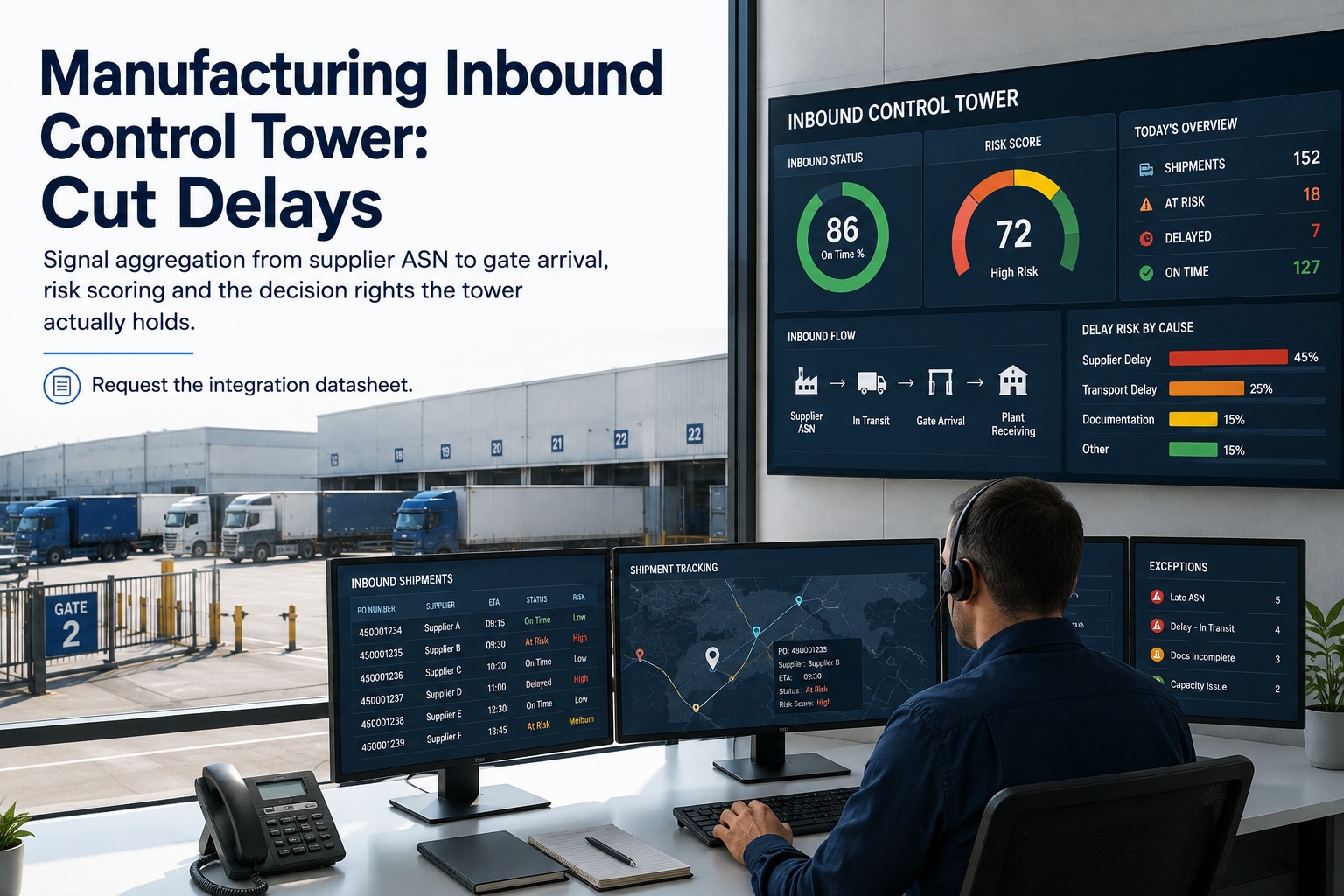
A control tower that cannot act is a dashboard with a more expensive name. This is the defining problem of the category in 2026: the technology exposes the exception, the operating model does not assign decision authority clearly enough, and the recommendation stalls waiting for someone to own it — which is a governance failure, not a dashboard failure. The test is uncomfortable but simple. When your tower detects that an A-class component will arrive ninety minutes late into a frozen sequence window, does it reslot the door, notify line feed with the coverage impact calculated, and hold the expedite option open with a named owner and a deadline? Or does it turn a tile red and wait? The first is a control system. The second is visibility, and visibility without action is just a faster way of finding out bad news. What follows is which signals a plant inbound tower needs and how far ahead each one fires, how to score risk so alerts are ranked rather than merely numerous, and the decision rights the tower must actually hold. Request the integration datasheet to see the signal and authority model against your own landscape.
ENTERPRISE GUIDE · INBOUND CONTROL
The Manufacturing Inbound Control Tower
Signals aggregated from supplier despatch advice through to gate arrival, risk scored so ranking replaces volume, and decision rights defined explicitly — because a tower without authority is a tower that watches.
The Signal Stack, by How Early It Fires
A tower is only as useful as its earliest reliable signal. Order the inputs by lead time and the design priority becomes obvious — the top of this stack is where recovery is cheap, and the bottom is where you are already choosing between bad options.
T-7d
Delivery schedule and call-off forecastExpected volume by supplier and part family. Sets the capacity expectation everything downstream is measured against.Recovery: replan. Cheapest available.
T-48h
Supplier commitment and slot bookingConfirmed window against demonstrated dock capacity. The first point at which a specific load becomes a specific risk.Recovery: reslot, resequence supply.
T-24h
Despatch advice transmitted and validatedContents bound to a load, acknowledgement returned. An unvalidated advice at this point is itself the signal.Recovery: chase, or plan around.
T-6h
In-transit position and ETACarrier telematics or driver app. The highest-value signal in the stack, because it is the last one that arrives while options remain cheap.Recovery: reslot in transit, pre-position.
T-30m
Approach and holding-yard statusVehicle near site or held off site under call-forward. Options are narrowing but the door decision is still open.Recovery: priority call-forward.
T-0
Gate arrival and check-inThe event most towers are actually built around — and by definition the point at which nothing upstream can be changed.Recovery: expedite, sort, or absorb.
T+
Dock, receipt and line-side consumptionConfirms what actually happened and feeds the learning loop. Valuable for tomorrow, useless for today.Recovery: none. This is the record.
Where most towers are actually wired
If your tower's earliest reliable input is the gate event, you have built an excellent reporting system. The value in an inbound tower is concentrated in the T-48h to T-6h band, because that is the window in which a reslot costs nothing and an expedite is still avoidable. A tower fed only by arrival data will faithfully tell you about problems at precisely the moment you can no longer do anything cheap about them.
Scoring Risk So Alerts Get Ranked
Undefined thresholds are why alert fatigue sets in — without them, nothing can reliably separate noise from risk. A composite score does two jobs: it ranks, and it decides which authority tier the response falls into. This is a worked example rather than a prescription; the weights are yours to set.
Worked example — late A-class component, sequence-critical lane
Part criticality — A-class, sequence-fed+30
Coverage remaining below buffer+25
ETA variance beyond tolerance+18
No alternate source on site+12
Supplier repeat-failure history+8
Dock at peak utilisation+5
Validated despatch advice present−6
Composite risk score92
0–39 · Log only
40–64 · Tower acts
65–84 · Tower acts, notifies owner
85+ · Tower contains, human decides
The scale matters more than the arithmetic. Every band maps to a defined authority tier, so the score is not a colour on a screen — it is the input that determines whether the system acts, recommends or escalates. Score bands without authority attached are decoration.
Decision Rights: What the Tower Actually Holds
This is the section most implementations skip, and skipping it is why recommendations stall. Write the grid, name the owners, and publish it — because the technology exposing an exception achieves nothing if nobody has been given authority over the response.
← Swipe to see all columns →
Note the shape: everything the tower holds autonomously is reversible and bounded — a reslot, a door swap, a queue reorder. Everything requiring a human commits money, changes the build, or affects a commercial relationship. That is the correct dividing line, and it is why autonomy can expand safely over time. The governance framework needs explicit criteria for that expansion, or autonomy stays frozen at whatever was agreed on day one.
The hard part is not the data. It is deciding what the system is allowed to do without asking.
The integration datasheet covers signal capture, ERP and EDI mapping, the scoring model, and how the authority tiers are configured and audited.
Three Layers, Three Failure Modes
Control towers fail in identifiable ways, and each failure sits in a specific architectural layer. Read the failure column first — it is usually easier to recognise your own implementation there than in the requirement column.
Layer 1
Unified data architecture
RequiresSignals from ERP, EDI, telematics, gate, yard and dock joined on a common object, at a latency that supports decisions rather than reporting.
Fails whenThe architecture supports display refresh but not automated decisioning — data arrives fast enough to draw a chart and too slowly, or too inconsistently, to trigger anything.
Layer 2
Decision authority framework
RequiresExplicit rules stating which decisions are automated, which are recommended, which need review — plus defined criteria for expanding autonomy as confidence builds.
Fails whenThe governance framework has no autonomy expansion criteria, so the tower is permanently stuck at whatever authority it launched with, however well it performs.
Layer 3
Execution integration
RequiresThe tower writes to the systems that execute — appointment, yard, dock, notification — rather than producing a task for a person to re-key.
Fails whenThe tower notifies operations teams instead of triggering operational systems directly. Everything still works, just at human speed and with a re-keying error rate.
Five Things a Control System Does
A useful checklist, because it distinguishes a control system from a control tower cleanly. Miss any one of the five and the loop is open.
1Detects the eventFrom the earliest reliable signal, not the most convenient one
2Assesses business impactCoverage, cost and sequence exposure, calculated not estimated
3Applies decision rulesAgainst published thresholds, so ranking is consistent
4Executes or routesActs within its authority, escalates with options attached
5Records the outcomeAnd feeds it back, so thresholds improve rather than ossify
Scope the First Release Around One Decision
The most reliable way to fail here is to specify a platform. The most reliable way to succeed is to pick a single decision that attacks a cost line finance already tracks, and ignore most of what a full tower could eventually do.
A first release worth building
Exception typeInbound supplier delay on A-class components only
Joined toProduction schedule impact
Single ruleAny delay putting a scheduled build at risk inside 72 hours
ActionFlag, rank by downstream cost, route to a named buyer
AttachedThree options, so the decision is a choice not a research task
IgnoresRoughly ninety per cent of what a full tower could do
Why this version pays
It attacks premium freight, a cost line the finance function already tracks and already dislikes. At a mid-market industrial manufacturer running three plants and around four hundred active suppliers, roughly six per cent of inbound spend can go on expedites with nobody able to say which of them were avoidable. A release that answers that one question tends to pay for itself inside two quarters — which is what funds the second decision, and the third.
The sequence matters more than the vendor choice. Pick one decision, not one platform.
Measure Outcomes, Not Screen Time
Five metrics. Usage statistics and dashboard adoption are not on the list deliberately — a tower everyone looks at and nobody acts on is the failure mode, not the success case. Our analytics and reporting module tracks these.
Exception resolution timeMeasured from detection to resolved, never from detection to acknowledged. Acknowledgement is not an outcome and measuring it flatters everybody.
Share caught before the line noticesThe honest test of whether the signal stack reaches high enough. If this is low, your earliest input is too late regardless of how good the interface is.
Premium freight as a share of spendThe cost line that funds the programme. Track avoidable versus unavoidable separately, since the split is the whole argument.
Alert-to-action ratioIf two hundred alerts fire a week and twelve produce an action, you have an alarm system nobody hears. This number should improve as thresholds are tuned.
Share resolved within tower authorityRises as autonomy criteria are met. A flat reading means layer two has no expansion path and the tower is frozen at launch authority.
On automation appetite
Enterprise teams are not asking for less automation — they are asking for accountable automation. In a January 2026 survey of 514 retail, manufacturing and supply chain leaders, 54% wanted the system to make the recommendation while a human finalises the decision, even though 67% said their confidence in automated supply chain decisions had grown over the year. That is an argument for tiered authority with clean audit trails, not for keeping everything manual.
Get the Integration Datasheet
Covers signal capture across ERP, EDI, telematics, gate, yard and dock, the object model that joins them, latency requirements per signal, the risk scoring configuration, and how authority tiers are set, audited and expanded. Written for enterprise integration and supply chain technology teams.
Signal and latency map
Composite risk scoring
Tiered decision rights
Execution write-back
Frequently Asked Questions
What separates a control tower from a control system?
Authority and execution. A control tower provides visibility; a control system connects that visibility to context, decision logic, workflow and feedback — it knows which exceptions matter, what options exist, which decisions can be automated and which need human review, and it records the outcome so it improves. Most implementations stop at the first half and label it control. The practical question to ask a vendor, or your own team, is what the system does without a person: if the answer is "displays it", you have a visibility tower.
We have dashboards already. Why is nothing improving?
Because awareness improved and the decision model did not. The technology exposes the exception, but if the operating model does not assign decision authority clearly enough the recommendation stalls — that is a governance problem rather than a dashboard problem. Seeing five systems' worth of red flags on one screen does not shorten the time a person takes to decide what to do about any of them. The fix is writing the decision rights grid, not buying a better interface.
Does adding AI solve the decision problem?
It sharpens it rather than removing it. Predicting delays, ranking exceptions and recommending actions all help, but if data is incomplete the recommendations are weak, if decision rights are unclear they stall, if workflows are not connected the actions stay manual, and if thresholds are undefined nothing can separate noise from risk reliably. Automation increases the need for explicit decision logic rather than replacing it. The gains attach to organisations that already sorted out data and decision rights; they do not arrive with the licence.
Which signal should we invest in first?
In-transit ETA, if you do not already have it reliably. It sits in the band where recovery is still cheap — a reslot costs nothing and an expedite is still avoidable — and it is the last signal that arrives before options start closing. Sites whose earliest reliable input is the gate event have built a reporting system that will tell them about problems at exactly the moment nothing cheap can be done. Everything above it in the stack is planning data you probably already hold.
How wide should the first release be?
Deliberately narrow. One exception type, joined to production schedule impact, with one rule and a named owner — ignoring the large majority of what a full tower could eventually do. Pick one decision, not one platform. The reason is not caution but funding: a narrow release attacking a cost line finance already tracks tends to pay for itself within two quarters, and that return is what buys permission for the second decision. Broad first releases usually deliver a dashboard and a disappointed sponsor.
Should the tower be allowed to act without human approval?
For bounded, reversible decisions, yes — reslotting an appointment, swapping an eligible door, reordering the yard queue. For anything that commits money, changes the build sequence, or touches a commercial relationship, no. What matters as much as the initial split is having explicit criteria for expanding autonomy, because without them the tower stays at launch authority permanently even after it has demonstrably earned more. Publish the criteria alongside the grid.
How does this relate to our existing ERP and EDI?
The tower reads from them and writes back to the execution systems; it does not replace either. Delivery documents, stock, production orders and supplier messaging stay where they are, and the tower joins those signals with gate, yard, dock and telematics events to produce a decision. The integration requirement is bidirectional — a tower that only reads can rank exceptions but cannot resolve them, which puts it straight back into the visibility category. Our
integrations overview covers the handoff surface.
Build the Authority, Not Just the View
Signals ordered by how early they fire, risk scored so ranking replaces alert volume, decision rights written down with owners and bounds, and execution that writes back to the systems that act — measured on resolution, not on adoption.
Reads and writes alongside existing ERP and EDI · Tiered authority · Site-level configuration