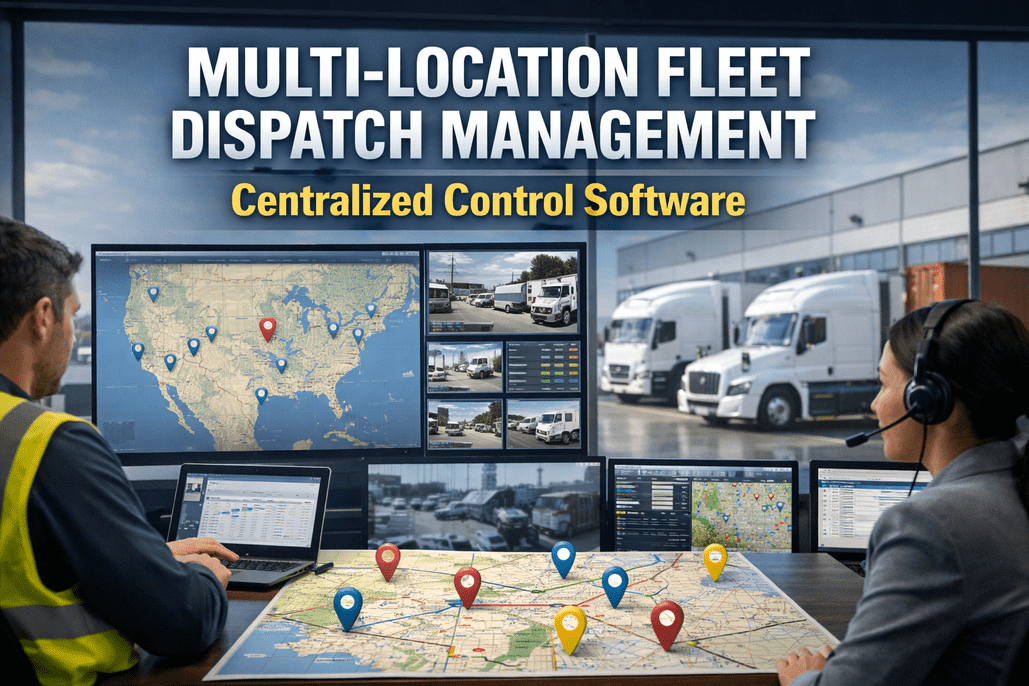
Running dispatch from a single terminal is straightforward. Running it across 5, 15, or 50 locations — each with its own drivers, vehicles, customers, and local quirks — is where fleet operations break down. Data silos form between locations. Dispatch standards drift. One branch optimizes routes while another uses paper maps. Maintenance gets tracked in three different systems. Nobody has a company-wide view of what's actually happening. Multi-location fleet dispatch management solves this by putting every terminal, warehouse, and distribution center on one platform with centralized visibility, standardized workflows, and local execution flexibility. Book a demo to see centralized dispatch in action.
6 Problems That Multiply With Every New Location
These challenges don't just add up — they compound. A problem that costs $10K/year at one location can cost $200K+ across 20 locations because inconsistency breeds inefficiency.
1
Data Silos Between Locations
Each location uses different software, spreadsheets, or processes to manage dispatch. Vehicle data in Houston doesn't sync with Dallas. Maintenance records in Chicago don't inform dispatch decisions in Detroit. Fleet managers fly blind when they can't see cross-location patterns — like which terminal has idle vehicles while another is short-staffed.
2
Inconsistent Dispatch Standards
Without a centralized platform, each location develops its own dispatch rules. One branch prioritizes fastest delivery; another minimizes fuel cost; a third dispatches based on driver seniority. The result: inconsistent service levels, unpredictable costs, and no way to benchmark performance across sites.
3
Vehicle Underutilization Across Sites
Location A has 3 trucks sitting idle while Location B is turning down loads because every vehicle is deployed. Without cross-location visibility, fleet managers can't rebalance assets. Industry data shows multi-location fleets with decentralized management have 15-25% lower vehicle utilization than centrally managed operations.
4
Communication Breakdowns
Dispatchers, drivers, and management operate on different platforms at different locations. Messages get lost between phone calls, texts, emails, and radio. A load reassignment at HQ doesn't reach the terminal in time. Driver availability changes at one site don't update the central schedule. Delays cascade.
5
Maintenance Scheduling Chaos
With decentralized maintenance tracking, PM schedules vary wildly across locations. Some branches run preventive maintenance religiously; others delay servicing until breakdowns happen. Standardized inspection checklists don't exist across sites. The same vehicle type gets different maintenance intervals depending on which terminal it's parked at.
6
Compliance and Reporting Gaps
DOT compliance, HOS tracking, DVIR records, and IFTA reporting require consistent documentation across every location. When each site manages compliance independently, audits become nightmares. Missing records at one terminal create company-wide liability. CSA scores suffer because violations at a single branch impact the entire DOT number.
See All Your Locations on One Screen
In a 30-minute demo, we'll show you how FleetRabbit gives you centralized visibility across every terminal, warehouse, and distribution center — with standardized dispatch workflows that each location can execute locally.
Decentralized vs. Centralized Dispatch: Side by Side
The shift from decentralized to centralized doesn't mean removing local autonomy. It means giving every location the same tools, data, and standards — while letting local dispatchers execute within those guardrails.
Each location picks its own dispatch software or spreadsheets
Fleet managers call each terminal for status updates
Route optimization done manually or not at all
Vehicle availability known only at each site — no cross-location sharing
Maintenance tracked in separate systems per location
Compliance documentation scattered across branches
KPIs measured differently at each site — no benchmarking
Result: Higher costs, inconsistent service, zero cross-location visibility, and every audit is a scramble.
Every location on the same cloud-based platform with role-based access
Real-time dashboard shows all locations, vehicles, and drivers at once
AI-powered route optimization considers traffic, capacity, and priorities
Cross-location vehicle sharing — idle trucks at Site A dispatched to Site B
Unified maintenance scheduling with standardized PM intervals across fleet
Compliance records centralized — one audit trail for the entire organization
Standardized KPIs with location-by-location benchmarking
Result: Lower costs, consistent service, real-time visibility across every site, and audit-ready at any moment.
Want to see how FleetRabbit handles the centralized-to-local dispatch workflow? Book a 30-minute demo and we'll walk you through role-based access, location hierarchies, cross-site vehicle sharing, and unified reporting — all on a single dashboard.
What a Centralized Dispatch Platform Actually Looks Like
Centralized doesn't mean one person dispatching for 50 locations. It means one platform with five capability layers that work together.
Layer 1
Real-Time Fleet Visibility
Every vehicle across every location plotted on one map. GPS positions, current assignments, driver status, ETA to destination, and vehicle health — all in a single view. Filter by location, region, vehicle type, or driver. No more calling terminals to ask "where's truck #47?"
Layer 2
Standardized Dispatch Workflows
Same dispatch process at every location: order intake, driver assignment, route optimization, departure confirmation, in-transit tracking, proof of delivery. Local dispatchers follow the same workflow with the same tools. Headquarters sees the same data format from every site.
Layer 3
Role-Based Access Control
Regional managers see all locations in their region. Terminal dispatchers see only their own vehicles and drivers. Corporate sees everything. Each role gets exactly the data and controls they need — no more, no less. This balances centralized visibility with local execution authority.
Layer 4
Cross-Location Asset Sharing
When Location A is overloaded and Location B has spare capacity, the platform surfaces the opportunity automatically. Vehicles, drivers, and loads can be reassigned across terminals without phone calls or email chains. Dynamic rebalancing optimizes fleet utilization company-wide.
Layer 5
Unified Analytics and Benchmarking
Every location measured by the same KPIs: on-time delivery rate, cost per mile, vehicle utilization, fuel efficiency, maintenance compliance, driver performance. Compare terminal against terminal. Identify best practices at your top-performing sites and replicate them everywhere.
See All 5 Layers Working Together
In a live demo, we'll show you FleetRabbit's multi-location dispatch dashboard — from the fleet map to the analytics layer — and how it connects dispatch, maintenance, inspections, and fuel data across every site.
2026 Trending: AI Dispatch, Data Integration, and Scalable Operations
Multi-location fleet operations are evolving rapidly. These are the technology trends reshaping how enterprise fleets manage dispatch across distributed sites.
AI-Powered Dispatch Orchestration
AI dispatch engines now optimize across 180+ variables simultaneously: traffic, driver hours, vehicle capacity, delivery windows, weather, and customer priority. Platforms are building dispatch planning that adapts routes in real time. Some even accept conversational inputs — dispatchers describe constraints in plain text and the AI recalculates optimal routes across all locations.
Impact: Fleets using AI-powered dispatch report 20% reduction in delivery delays and significant fuel savings through optimized routing.
Breaking Data Silos Across Locations
The biggest barrier to multi-location dispatch is disconnected systems. In 2026, API-first platforms are replacing location-specific tools with centralized data layers that connect TMS, WMS, ERP, telematics, and dispatch into a single source of truth. Active fleet management systems in North America reached 19.2 million units in 2024 — projected to hit 33.2 million by 2029 — creating the connected vehicle foundation for unified dispatch.
Impact: Integrated platforms eliminate manual data re-entry, reduce errors, and give operations leaders real-time visibility across every location.
Cloud-Native Scalability for Growing Fleets
Cloud-based dispatch platforms allow fleets to add new locations, vehicles, or service types without replatforming. While 72% of fleets use dedicated maintenance software, many still juggle spreadsheets and multiple platforms across locations. The shift to cloud-native architecture means a fleet that opens a new terminal can be dispatching from the same platform on day one — no new software installation required.
Impact: New location onboarding drops from weeks to days. Every site starts with the same tools, data access, and workflows from the first dispatch.
Implementation Roadmap: From Scattered to Centralized
Moving to centralized dispatch doesn't happen overnight. Here's the phased approach that works for fleets transitioning from decentralized, location-specific operations.
Phase 1
Audit and Map Current Operations (Weeks 1-2)
Document every system, process, and tool used at each location. Identify where data silos exist, which locations are high-performing, and where the biggest inconsistencies are. Map the current dispatch workflow at each site. This audit becomes your baseline for measuring improvement.
Phase 2
Standardize Policies and KPIs (Weeks 2-3)
Define company-wide dispatch standards: assignment rules, routing priorities, maintenance intervals, inspection checklists, and compliance documentation. Establish the KPIs every location will be measured by: on-time rate, cost per mile, vehicle utilization, fuel efficiency.
Phase 3
Deploy Platform at Pilot Location (Weeks 3-5)
Start with one or two locations — ideally one high-performer and one that's struggling. Configure role-based access, set up location hierarchies, and migrate existing vehicle and driver data. Run parallel operations for 1-2 weeks to validate data accuracy and workflow compatibility.
Phase 4
Train Teams and Roll Out Regionally (Weeks 5-8)
Train dispatchers, drivers, and managers at each location. Use the pilot site's results as proof points. Roll out region by region — not all at once. Each new location follows the same onboarding playbook. Regional managers validate data and workflows before the next region goes live.
Phase 5
Optimize and Benchmark (Ongoing)
With all locations on the same platform, start benchmarking. Identify top-performing terminals and replicate their practices. Use cross-location analytics to find vehicle rebalancing opportunities, route optimization gains, and maintenance cost reductions. Continuous improvement becomes possible when you can finally measure everything the same way.
Ready to see how this roadmap works for your fleet? Book a demo and we'll map your current operations to FleetRabbit's multi-location dispatch capabilities. We'll show you exactly how centralized visibility, standardized workflows, and cross-site analytics work for fleets your size. Or start a free trial and connect your first location today.
Frequently Asked Questions
QDoes centralized dispatch mean local dispatchers lose control?
No. Centralized dispatch means every location operates on the same platform with the same standards — but local dispatchers retain execution authority for their site. Role-based access ensures terminal dispatchers manage their own vehicles and drivers while regional and corporate managers get cross-location visibility. Think of it as "centralized visibility with local execution."
QHow long does it take to centralize dispatch across multiple locations?
Typical timeline is 6-8 weeks for initial rollout using a phased approach: 2 weeks for audit and standardization, 2 weeks for pilot deployment, and 3-4 weeks for regional rollout. Cloud-based platforms like FleetRabbit significantly accelerate this because there's no hardware to install at each location — just configure access, migrate data, and train the team.
QCan I start with just a few locations and expand later?
Yes, and this is the recommended approach. Start with 1-2 pilot locations to validate workflows, then roll out region by region. Cloud-native platforms scale by adding locations without replatforming — a new terminal can be dispatching on the same system within days of opening. Book a demo to see how FleetRabbit's location hierarchy scales from 2 sites to 200.
QHow does centralized dispatch handle different time zones and operating hours?
Multi-location platforms are built for this. Each location has its own operating hours, time zone, and local dispatch schedule. The centralized dashboard normalizes everything so corporate sees real-time status regardless of time zone. Automated dispatch rules can be configured per location to account for different shift schedules, delivery windows, and regional operating patterns.
QWhat ROI can we expect from centralizing multi-location dispatch?
Fleets that move from decentralized to centralized dispatch typically see 15-25% improvement in vehicle utilization from cross-location rebalancing, 10-20% reduction in fuel costs through optimized routing, 20-30% reduction in administrative overhead from eliminating duplicate tools, and significantly faster audit preparation. The biggest ROI often comes from eliminating the hidden costs of inconsistency — the loads that get missed, the vehicles that sit idle, and the compliance gaps nobody sees until audit time.
One Platform. Every Location. Complete Control.
FleetRabbit connects dispatch, maintenance, inspections, and fleet data across every terminal, warehouse, and distribution center in your network. Centralized visibility. Standardized workflows. Local execution. See it in action.
February 20, 2026
By James Henderson
All Articles