When a new commercial truck rolls off the assembly line in 2026, there is an 82.7% chance it already has telematics hardware embedded from the factory. Ford Pro Intelligence, Daimler Fleetboard, Volvo Connect, Navistar OnCommand — OEM telematics systems are now standard equipment on most new commercial vehicles, not optional add-ons. But the existence of factory telematics does not automatically answer the question every fleet manager faces: should your fleet rely on the OEM system your vehicles came with, deploy an aftermarket platform like Samsara or Geotab across everything, or find a way to make both work together? The answer hinges on three realities of commercial fleet operations that OEM marketing materials rarely address honestly.
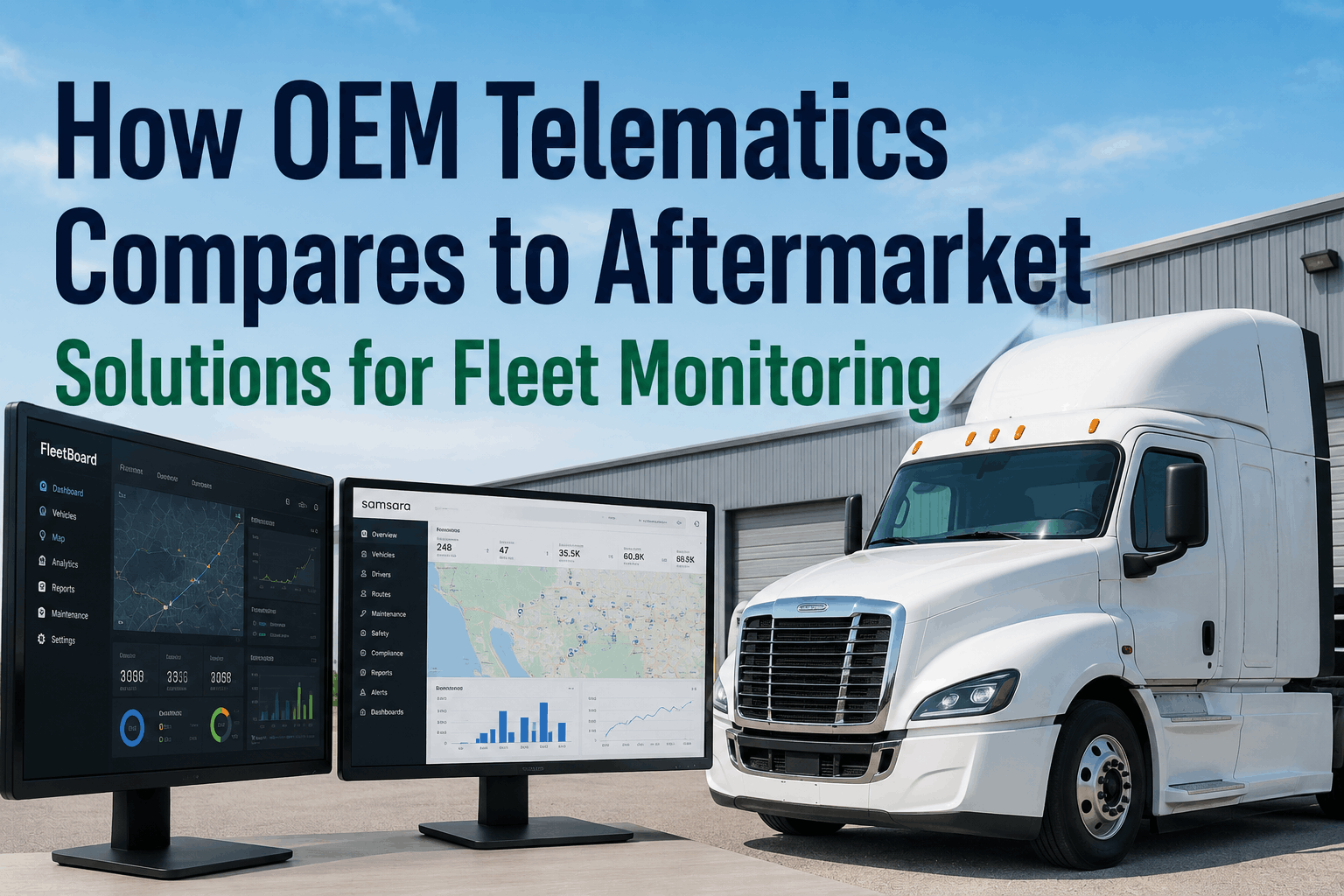
How OEM Telematics Compares to Aftermarket Solutions for Fleet Monitoring
The debate is not which approach is better in theory — it is which approach fits your fleet composition, data priorities, and vendor independence requirements in practice.
What OEM Telematics Actually Provides
OEM telematics — also called embedded telematics — consists of factory-installed hardware integrated directly with a vehicle's engine control unit, onboard diagnostics bus, and proprietary vehicle systems, paired with a cloud-based SaaS platform for data management. Because the telematics hardware is designed alongside the machine it monitors, OEM systems access data depths that aftermarket devices positioned at the OBD-II port often cannot match. DPF regeneration cycles, proprietary fault code interpretations, factory-calibrated fuel consumption data, and transmission control module readings are examples of signals that OEM systems can access natively.
For fleet managers running a uniform fleet of vehicles from a single manufacturer, OEM telematics represents a compelling proposition: no additional hardware to install, no per-device subscription on top of vehicle financing, and diagnostic data matched to the vehicle's own engineering parameters. At the Fleet Forward 2025 conference in San Diego, leaders from Ford Pro, Stellantis, and Enterprise Fleet Management described onboarding new vehicles to an OEM platform in days rather than the weeks required for aftermarket hardware installation. Sign up with FleetRabbit to connect both OEM and aftermarket telematics data into a unified fleet intelligence layer.
Direct ECU integration provides proprietary fault code access and factory-calibrated sensor data that OBD-II adapters cannot fully replicate.
Embedded from factory — no installation project, no per-device hardware cost. Vehicles arrive connected and ready to report immediately.
Direct firmware updates, recall integration, and warranty-linked maintenance alerts aligned with manufacturer service intervals.
New vehicles activate on the platform immediately — no hardware procurement, installer scheduling, or configuration delay before data flows.
The Problem OEM Telematics Cannot Solve: Mixed-Fleet Reality
The foundational limitation of OEM telematics is that it is not brand agnostic. Ford Pro Intelligence only covers Ford and Lincoln commercial vehicles. Daimler Fleetboard covers Mercedes-Benz trucks. Volvo Connect covers Volvo trucks. Each system speaks its manufacturer's language — and over 90% of commercial fleets globally contain vehicles from more than one manufacturer. Purchasing decisions are made based on payload requirements, pricing, availability, and route fit — not on which OEM telematics platform the vehicles report to.
A fleet running 15 Freightliner day cabs, 8 Ford F-650 stake bodies, and 7 Hino box trucks cannot achieve unified telematics visibility through any single OEM platform. Switching between three separate portals to build a complete picture of fleet health, driver behavior, and maintenance scheduling is not fleet management — it is data fragmentation. Book a FleetRabbit demo to see how a unified platform consolidates data across all your vehicle brands into one actionable dashboard.
Aftermarket Telematics: What It Offers That OEM Cannot Match
Aftermarket telematics platforms — led in 2025–2026 by Geotab (4.6 million connected vehicles, ranked No.1 by ABI Research), Samsara (ranked No.2, with 84% user satisfaction and $1.35 billion in ARR), Motive, and Powerfleet — deliver several capabilities that factory-embedded systems inherently cannot provide due to their manufacturer-specific architecture.
The data ownership issue deserves attention. OEM telematics transmits vehicle and driver data back to the manufacturer, raising concerns about who controls that data and how it can be accessed. Aftermarket platforms give the fleet operator full ownership and portability of their data — the ability to export, analyze, and integrate it with other business systems without depending on a manufacturer's data-sharing policies. Sign up with FleetRabbit to see how an open-architecture platform handles your fleet data on your terms.
FleetRabbit aggregates data from OEM-embedded systems and aftermarket devices into a single fleet intelligence dashboard — ending the fragmentation that plagues mixed-brand fleet monitoring.
OEM vs Aftermarket: The Decision Framework
The choice between OEM and aftermarket telematics is a fleet-specific decision that depends on fleet composition, average vehicle age, data depth requirements, and vendor independence priorities. The most sophisticated fleet operators increasingly deploy both: OEM telematics for the deep, manufacturer-specific diagnostic signals on new vehicles, and an aftermarket integration layer that normalizes and consolidates data across all brands. Geotab supports over 37 OEM integrations, meaning its platform can ingest native OEM data streams and present them alongside aftermarket device data in a unified dashboard — the hybrid architecture increasingly standard for enterprise fleets. Book a demo with FleetRabbit to explore the integration architecture that works for your specific fleet brand mix.
Leading Aftermarket Platforms: Samsara, Geotab, and Motive
Geotab — ranked No.1 overall by ABI Research in February 2025 — leads on data depth, open architecture, and enterprise scalability with its 430-partner marketplace and 37 OEM integrations, optimal for fleets of 1,000-plus vehicles. Samsara — ranked No.2, 84% user satisfaction, 90% recommendation rate, $1.35 billion ARR — leads on AI-powered safety features, AI dash cams documented to reduce crashes 30 to 50% in the first year, and rapid deployment at scale. Motive holds strong mid-market position with 70% satisfaction for fleets prioritizing driver coaching, IFTA reporting, and cost-competitive ELD compliance. Start your free FleetRabbit account and integrate your existing telematics platform regardless of which provider you currently use.
Enterprise fleets 1,000+ requiring maximum data flexibility, deep OEM integrations, and a 430-partner ecosystem.
Large-scale fleets prioritizing AI safety, dashcam coaching, and fast deployment across high-volume operations.
Mid-market fleets seeking driver coaching, IFTA reporting, ELD compliance, and fuel management at a competitive price.