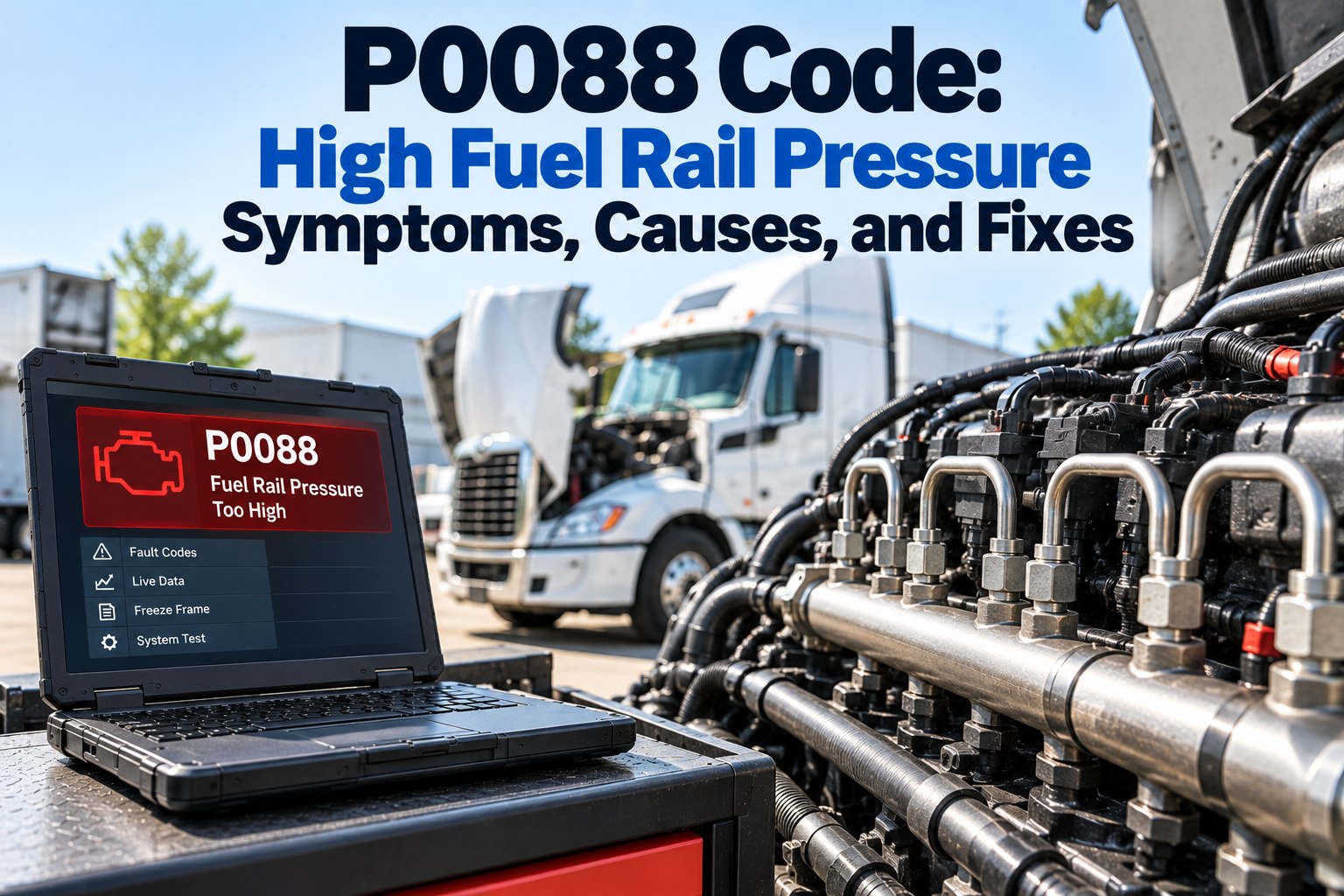
P0088 means the ECM saw rail pressure higher than it commanded, by more than the calibration allows. It reads like the opposite of P0087 and it is diagnosed almost completely differently, for one reason: with a low-pressure fault the engine always feels wrong, but with a high-pressure fault the engine may feel entirely normal — because the pressure might not actually be high. A rail pressure sensor reading high on a healthy fuel system produces a real P0088 with no driveability symptoms at all. So the first question is not which part failed, it is whether the pressure is real, and the answer determines whether you are looking at a connector or at a fuel system full of metal. The rest of the loop offers only three ways to fail high: the regulator or suction control valve stuck toward closed, a restricted return path that traps pressure the ECM is trying to relieve, or a sensor over-reporting. When the pressure is genuinely high it is not a fault to keep driving on — the rail, lines and injectors are being stressed beyond their commanded operating point. GM's service bulletin 16-NA-102 lists P0088 alongside P0087, P0191 and P128E on the Duramax LML and LGH with hard start or no start as the presenting complaint, and names magnetic debris in the injection pump system as the cause, with a correction that includes flushing the tank, lines and filter housing rather than simply replacing a part. This page covers the control loop and its three failure modes, the two-path fork that saves the most time, the test sequence, and how P0088 differs from P0087 in practice. Talk to us about your fault data, or try it free on three units.
Before You Chase High Rail Pressure, Find Out Whether the Pressure Is Actually High.
For diesel technicians and shop leads: the three ways a rail pressure loop fails high, the fork that tells you in ten minutes whether you have a wiring fault or a mechanical one, and the debris rule that decides whether this is a part swap or a system flush.
No credit card required. Codes, test readings and repairs on one unit record.
Three Ways the Loop Fails High
The control loop is small, which is good news — there are only three places the pressure can get away from the ECM. Record which one it was, free on three units.
Schematic is simplified — regulator placement, the number of control valves and the return arrangement vary by engine and injection system, and some designs regulate on the inlet side while others regulate at the rail. Work to your engine's own service information for the actual architecture. The logic, however, holds everywhere: pressure that will not come down is either not being metered, not being relieved, or not being measured correctly.
The valve meters how much fuel the high-pressure pump gets. Stuck toward the closed-to-return position, the pump keeps making pressure the loop cannot relieve. Check the commanded duty cycle against the valve's actual response, not its resistance.
Excess rail fuel has to get back to tank. A pinched return line, a blocked restrictor or a seized pressure-limiting valve traps pressure that the ECM is trying to bleed off. Cheap to check and easy to overlook.
The pressure may be perfectly normal and the sensor lying about it. A high-biased signal, a chafed harness or corrosion in the connector produces a genuine P0088 on a healthy fuel system, which is why this is the first thing to rule out rather than the last.
The Fork That Saves the Most Time
Ask one question before touching anything: does the engine actually run badly? The answer splits the diagnosis in two and the two branches share almost no work.
- Engine runs normally, no complaint from the driver
- No knock, no smoke, no derate
- Fuel economy unchanged
- Code may be intermittent or set on a cold start
- Hard start, or a start that needs extended cranking
- Audible knock or harsh combustion noise
- Smoke, usually under load
- Derate or limp mode, and it repeats reliably
Has This Unit Set This Code Before?
On a rail pressure fault that answer changes the repair completely. A first occurrence with no symptoms is usually a sensor or a connector. A third occurrence, or one that follows a pump replacement, points at debris nobody flushed. In thirty minutes we will show you that history sitting on the unit record, where the technician sees it before ordering parts.
The Test Sequence
In order. The third row is the one that resolves most genuine overpressure faults, and the one most often skipped in favour of a resistance check. Swipe the table on mobile.
| Test | How | What the result means |
|---|---|---|
| Rail pressure sensor signal against a known good reference | Compare live sensor voltage or reported pressure with a second gauge or a substitute sensor | If the sensor disagrees with the gauge, the sensor or its wiring is the fault. Stop here |
| Sensor harness and connector | Inspect for chafe, corrosion, spread terminals and moisture; wiggle-test while monitoring live data | A signal that jumps on movement is a wiring fault, not a pressure fault |
| Commanded duty cycle against actual pressure response | Log what the ECM asks the regulator to do and what the pressure does in reply | A valve that does not move when commanded is the fault. This is the single most diagnostic log on the page |
| Return line and restrictor | Check for kinks, crush damage, blockage and a seized pressure-limiting valve | A restricted return traps pressure the ECM cannot relieve |
| Regulator or SCV operation | Test response, not just coil resistance; a coil can read in spec and the valve still stick | Resistance-only testing is why this fault gets missed |
| Injector return volume | Measure per injector against specification | Rules injectors in or out before anyone opens the high-pressure side |
| Debris inspection if the pump is implicated | Inspect the regulator and sensor for magnetic metal debris before fitting anything new | Debris changes the job from a part swap to a full system clean |
How P0088 Differs From P0087 in Practice
They are stored by the same monitor watching the same two values, and they are almost opposite jobs. If both are present, read the note underneath.
Almost always wrong — power loss under load
Restriction on the low-pressure supply side
Plugged fuel filter
Less often, and it usually reads low with symptoms present
Derate, and risk if a pump is shedding debris
May be completely normal, which is the key clue
The sensor and its wiring, then the regulator
A corroded or chafed sensor connector
Yes, commonly — and it does so with no symptoms
If the pressure is real, stop. The hardware is being overstressed
Stop treating them as two faults. Pressure control disturbed in both directions points at the control loop itself or at contamination, not at two unrelated parts. GM's bulletin 16-NA-102 lists P0087, P0088, P0191 and P128E together for the Duramax LML and LGH with hard start or no start as the complaint, and names magnetic debris within the fuel injection pump system as the cause. Its correction is instructive: inspect Fuel Pressure Regulator 1 for magnetic metal debris, inspect the rail pressure sensor and Fuel Pressure Regulator 2 if anything is questionable, then replace the affected parts and clean and flush the chassis lines, filter pipes, engine-mounted fuel pipes, filter housing, fuel tank and fuel sender. Both codes together should raise contamination to the top of your list before any part is ordered.
Bulletin details per GM 16-NA-102, issued May 2016 and revised August 2019, as published in NHTSA's technical service bulletin archive; that bulletin also gives a low-side reference of at least 10 psi at the fuel system service port for the engines it covers. Verify every figure against your own engine's current service information. Keep the fuel filter interval, the fault history and the repair on one record by linking the inspection report to preventive maintenance.
P0088 Questions Technicians Ask
What does P0088 mean?
That actual fuel rail pressure exceeded the pressure the ECM commanded, by more than the calibration permits. It describes a failed control loop rather than a specific failed part, and the loop can only fail high in three ways — metering, relief, or measurement. Discuss a live case with us.
Can a sensor cause P0088?
Yes, and it is one of the most common causes when the engine runs normally. A high-biased sensor, a chafed harness or a corroded connector reports pressure the engine is not making, and the ECM stores a genuine code for it. This is why the presence or absence of driveability symptoms is the most useful first question on this fault. Log the finding per unit free.
Is it safe to drive with P0088?
If the pressure is genuinely high, no. The rail, high-pressure lines and injectors are operating above their commanded point, and the engine will usually derate anyway. If the fault turns out to be a sensor misreporting on a healthy system the mechanical risk is different, but you do not know which case you have until you have compared the sensor against a reference. Establish that first. Book a walkthrough.
What is the most common mechanical cause?
A pressure regulator or suction control valve stuck toward closed, followed by a restricted return path. Both trap pressure the ECM is trying to bleed off. Test the valve's response to command rather than its coil resistance — a coil can measure within specification while the valve itself sticks, which is the main reason this fault gets missed. Record the test result free.
Why did P0088 appear after a fuel system repair?
Two likely reasons. A connector disturbed during the work is now intermittent, which produces the no-symptoms version of the code; or debris from the original failure was never flushed out and is now interfering with the regulator or the return. The OEM correction for debris findings includes cleaning the tank, lines, pipes and filter housing, not just replacing components. Review a post-repair fault with us.
Do I need to replace injectors for P0088?
Rarely as the primary fix, but measure return volume per injector before opening the high-pressure side, because it rules them in or out cheaply. Replacing a set on suspicion of a high-pressure code is an expensive way to guess, particularly when the fault turns out to be a connector. Keep return-flow figures on record.
What if P0088 is intermittent?
An intermittent high-pressure code with no driveability symptoms is a strong signal for wiring. Monitor live sensor data while wiggle-testing the harness and connector, and look for the signal jumping rather than drifting. Capture the freeze-frame conditions too — a fault that only appears on cold starts points somewhere different from one that appears under load. Bring the freeze-frame data to a session.
The Next Technician Should Not Have to Guess What You Already Ruled Out
FleetRabbit keeps the code, the sensor comparison, the commanded-against-actual log and every closed work order against the unit — so a returning P0088 starts from what was already tested and whether the system was ever flushed, instead of starting from scratch.
No credit card required. Start with the unit that keeps setting it.