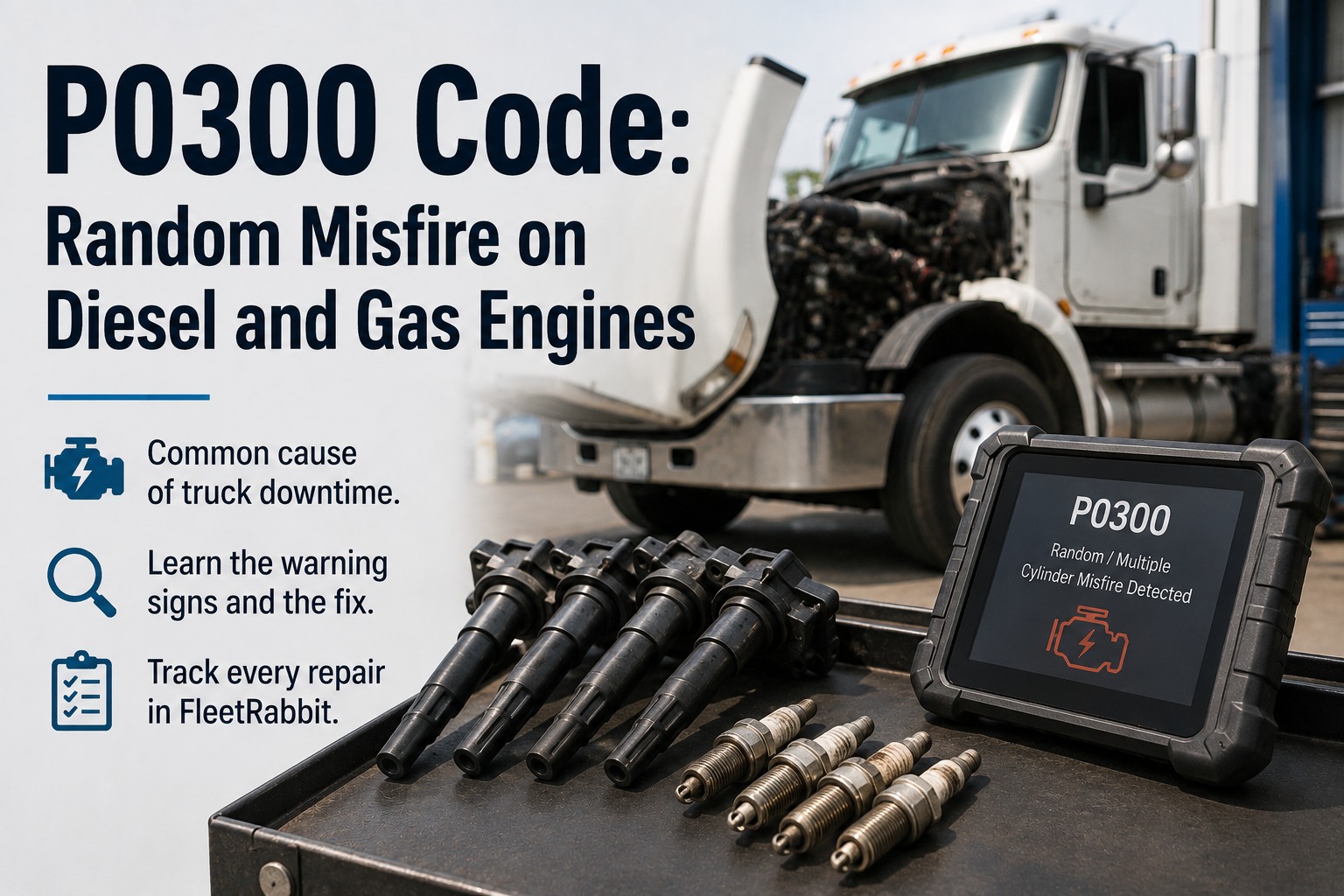
P0300 is the misfire code that tells you the least. Its siblings — P0301 through to P0312 — each name a specific cylinder, which immediately narrows the investigation to that cylinder's injector, its spark or glow components, and its compression. P0300 names none of them. It means the control module detected misfires spread across multiple cylinders rather than isolated in one, and that shifts the question from "which cylinder" to "what do these cylinders share". Usually the answer is something common to all of them: air, fuel, or a mechanical condition affecting the whole engine. The temptation is to start replacing the cheap parts and see what happens, and it is the single most expensive way to approach this code. Diagnose the pattern first — when the misfire happens tells you more than any part swap. Book a demo and see how keeping every code, test and repair on one asset record stops the second occurrence starting from scratch.
DIAGNOSTIC GUIDE · OBD-II CODE
P0300
Random / Multiple Cylinder Misfire Detected
Why a random misfire is harder than a numbered one, how to read the pattern before touching a part, and what each cause costs on spark-ignition and diesel engines.
P0301
123456
One suspect. Targeted.
P0300
123456
No suspect. Find what they share.
This is the whole difficulty of the code in one picture — and the reason the diagnostic approach has to start with pattern rather than with parts.
What a Misfire Actually Costs While You Think About It
The code will rarely strand a truck, which is exactly why it gets deferred. Three things are happening in the meantime.
Unburned fuel washes the bores
Fuel that does not combust washes oil from the cylinder walls, accelerating wear on components that are expensive to reach and expensive to replace.
Aftertreatment gets cooked
Unburned fuel reaching the exhaust superheats the catalytic converter and causes internal damage. Misfires can damage aftertreatment quickly, and that repair usually exceeds the one that would have prevented it.
It escalates
Left unaddressed, misfires become more frequent and more intense. The code is rated high severity for that reason — not because the truck stops, but because the cheap window closes.
When to stop the truck
Driving is not recommended where the warning lamp is flashing, where the engine is running visibly poorly, or where any safety-related symptom is present. A flashing lamp on a misfire code specifically indicates a condition severe enough to cause rapid damage — treat it as a recovery, not a limp home.
Diagnose the Pattern Before the Parts
When the misfire occurs is the most useful diagnostic information available, and it costs nothing to gather. Five patterns, each pointing somewhere different.
← Swipe to see all columns →
One rule that follows from the table: if the scan data begins pointing at a numbered cylinder code alongside P0300, stop treating it as random. Isolate that cylinder with component swaps, inspection and injector checks instead — the code has just told you something P0300 alone never will.
Causes, Split by Engine Type
The title of this code is the same on both, and the likely causes are not. Most published guidance is written for spark-ignition engines, which is worth knowing before applying it to a diesel.
Spark-ignition engines
HighWorn or fouled spark plugs no longer producing a strong enough spark across several cylinders
HighFailing coils or coil packs delivering weak or intermittent spark — often causing misfires that move between cylinders
MediumVacuum leak at the intake manifold gasket or a cracked hose, leaning the mixture across all cylinders
MediumDirty mass airflow sensor, or air entering after it, producing inaccurate readings and lean conditions
MediumCarbon buildup on intake valves, or an exhaust gas recirculation valve stuck open, diluting the charge
LowerLow compression from a head gasket leak or worn rings
Diesel engines
HighInjector condition — clogged, worn or delivering an uneven pattern across multiple cylinders
HighFuel delivery shortfall — weak lift or high-pressure pump, restricted filter, or air drawn into the fuel system
MediumFuel quality — water intrusion, degraded stock, or contamination affecting every cylinder at once
MediumIntake restriction or leaks after the airflow sensor, upsetting the charge across the engine
MediumCold-start aids where fitted, on a misfire that appears only when cold
LowerCompression loss — head gasket, valve sealing or ring wear across several cylinders
What both lists have in common
Every high-likelihood cause on either side is something shared between cylinders — air, fuel, or a condition affecting the whole engine. That is the logic of the code. Where a fault is genuinely confined to one cylinder's own components, the module would normally name that cylinder instead.
Cold start?
Under load?
After a fill-up?
Three questions to the driver, before anyone opens the bonnet.
Each answer eliminates a whole category. The problem is that the answers usually live in a conversation rather than a record — so the next occurrence starts from nothing. Bring a unit with a misfire history to a 30-minute call and we'll show how the code, the driver report and the repair sit together on one timeline in Fleet Rabbit.
The Fleet-Specific Cause Nobody Checks
Worth its own section because it behaves differently from everything else on this page, and because a fleet is more exposed to it than a private owner.
01
Contaminated fuel causes misfires that resolve on their own
Water intrusion at the pump, fuel that has degraded in storage, or stock with inadequate detergent can all produce misfires which clear once the contaminated fuel is burned through and replaced. If P0300 appeared shortly after a fill, this belongs at the top of the list rather than the bottom.
02
On a bulk tank it will not be one truck
This is the fleet difference. A private vehicle picks up bad fuel once; a depot tank feeds it to everything that fuels there. Multiple units setting misfire codes within a few days of each other is a fuel quality investigation, not six separate engine diagnoses — and treating it as the latter is expensive in a very specific way.
03
The tell is the timing across the fleet
Look at when each code appeared against when each unit last fuelled. That correlation is trivial to check where fuel transactions and fault codes sit on the same asset records, and effectively impossible where they live in separate systems.
Test Order
Seven steps. Work down the list rather than across it, and stop at whatever the pattern already told you to check first.
1Scan for companion codesA numbered cylinder code alongside P0300 changes the whole approach. Fuel trim data is equally informative — positive trims across the board point at unmetered air or shared fuel starvation.
2Establish the pattern from the driverCold start, under load, after a fill, or constant. Two minutes of questions, and it eliminates more possibilities than any single test.
3Inspect for air leaksIntake manifold gaskets are a common cause of multi-cylinder misfire and worth checking early. A smoke test, or soapy water on hoses, finds them quickly — and inspect anything after the airflow sensor with particular attention.
4Check the ignition or injection componentsOn spark-ignition, plug condition, gap and coil output including boots. On diesel, injector delivery and pulse — verified with a scan tool rather than assumed.
5Verify fuel supplyFilter condition and pressure against specification. Low pressure from a tired pump or a restricted filter produces misfires that appear specifically under load.
6Compression test across all cylindersWhere spark and fuel checks have not moved the fault, this is the step that separates a maintenance repair from a mechanical one. Low readings across several cylinders point at a shared mechanical condition.
7Leak-down testing and timing verificationLeak-down where compression is low, to locate where it is going. And confirm timing, since incorrect valve timing affects several cylinders at once and produces misfires that look random precisely because the effect varies with speed and load.
The reason for this order is economic rather than technical. Do not throw parts at the problem hoping something works — with a code this broad, parts-swapping can run through several hundred dollars of components before touching the actual cause, and the diagnosis would have cost less than the first replacement.
Cost by Cause
The spread is wide because the causes range from a filter to a timing component. Published ranges, offered as planning figures rather than quotes.
Air filter, hoses, minor leaks
Modest — often the cheapest useful fix on the list
Spark plug replacement
Around $100–$300
Ignition coil
Around $150–$400 per coil
Fuel injector cleaning or service
Around $150–$500
Fuel pump replacement or mechanical work
$500 to over $1,500
Timing components
Can exceed $2,500
Many straightforward cases land between roughly $100 and $500 including parts and labour. Diagnostic time, labour rates and vehicle type all move the figure, and heavy-duty diesel work sits at the upper end of anything quoted for light vehicles.
Reducing How Often You See It
Four measures, and the first is close to free.
Treat the air filter as a real item
Check it visually every few months and replace it when dirty. A restricted filter contributes to exactly the air-fuel disruption that produces this code, and it is one of the cheapest parts on the vehicle.
Act on the early symptoms
Rough idle, hesitation and declining fuel economy arrive before the lamp does. A driver reporting any of these is describing a developing misfire, and that is the cheap window.
Manage fuel quality deliberately
Water in a bulk tank, degraded stock and inadequate detergent all produce misfires. Tank checks and stock rotation are a maintenance activity, not a fuelling one.
Record the pattern, not just the repair
Whether it was cold-start, load-related or post-fuelling, alongside what was replaced. A second P0300 on the same unit is a much shorter job when the first one's pattern is written down — and a much longer one when it is not.
A misfire on four trucks in one week is one problem, not four
Fleet Rabbit records fault codes, driver reports and repairs against each unit and keeps fuel transactions on the same asset record — so a cluster of misfire codes across units that all fuelled at the same tank shows up as a pattern rather than as four independent diagnoses running in parallel.
Frequently Asked Questions
What is the difference between P0300 and P0301?
P0301 through P0312 each identify a specific cylinder misfiring, which narrows the investigation dramatically — a technician goes straight to that cylinder's ignition or injection components and its compression. P0300 means misfires were detected across multiple cylinders rather than isolated in one, so the question becomes what those cylinders share. That usually means air, fuel or a mechanical condition affecting the whole engine.
Can we keep driving with P0300?
It will rarely strand the truck, but it should be diagnosed immediately rather than scheduled. Unburned fuel washes oil from the cylinder walls and accelerates wear, and it superheats the catalytic converter causing internal damage — misfires can damage aftertreatment quickly. Stop driving if the warning lamp is flashing, the engine is running visibly poorly, or any safety-related symptom is present.
Where should diagnosis start?
With the pattern rather than the parts. Establish whether the misfire occurs only on cold start, only under acceleration or load, across multiple cylinders with positive fuel trims, or persistently on one cylinder after a component swap. Each of those points somewhere different — cold start toward injector leakage or valve sealing, load toward ignition or fuel delivery, positive trims toward air leaks or shared fuel starvation. Two minutes of questions eliminates more than any single test.
Is this different on a diesel?
Substantially, and most published guidance is written for spark-ignition engines. A diesel has no plugs or coils to replace, so the likely causes shift to injector condition, fuel delivery shortfall from a weak pump or restricted filter, air drawn into the fuel system, fuel quality, and compression loss. The underlying logic is the same — with multiple cylinders affected, look for what they share — but the parts list is not.
Could bad fuel cause this?
Yes, and it is worth checking early on a fleet. Contaminated fuel — water intrusion, fuel degraded in storage, or stock with inadequate detergent — can cause misfires that resolve once the affected fuel is burned through. If the code appeared shortly after a fill, consider it before ordering parts. And on a depot tank the exposure multiplies: several units setting misfire codes within days of each other is a fuel investigation rather than several separate engine faults.
When do we need a compression test?
When ignition and fuel checks have not moved the fault. Low compression across several cylinders prevents proper combustion even where everything else is functioning, and compression testing is what reveals it — with leak-down testing following to locate where the pressure is going. Verify timing at the same stage, since incorrect valve timing affects multiple cylinders simultaneously and produces misfires that look random because the effect changes with speed and load.
What does it cost to fix?
Entirely dependent on the cause. Many straightforward cases land between roughly $100 and $500 including parts and labour: spark plugs around $100 to $300, an ignition coil around $150 to $400, injector cleaning around $150 to $500. Fuel pump replacement or mechanical work runs from $500 to over $1,500, and timing components can exceed $2,500. That spread is exactly why parts-swapping is the expensive approach.
Book a demo to see repeat-fault tracking per unit.
Find What the Cylinders Share
Ask when it happens before deciding what it is, check the air path and the fuel before the components, look across the fleet if several units set it at once, and write down the pattern alongside the repair so the next occurrence starts halfway through.
General guidance — follow the manufacturer's diagnostic procedure for your specific engine · Cost ranges are drawn from light-vehicle sources and sit higher on heavy-duty diesel work