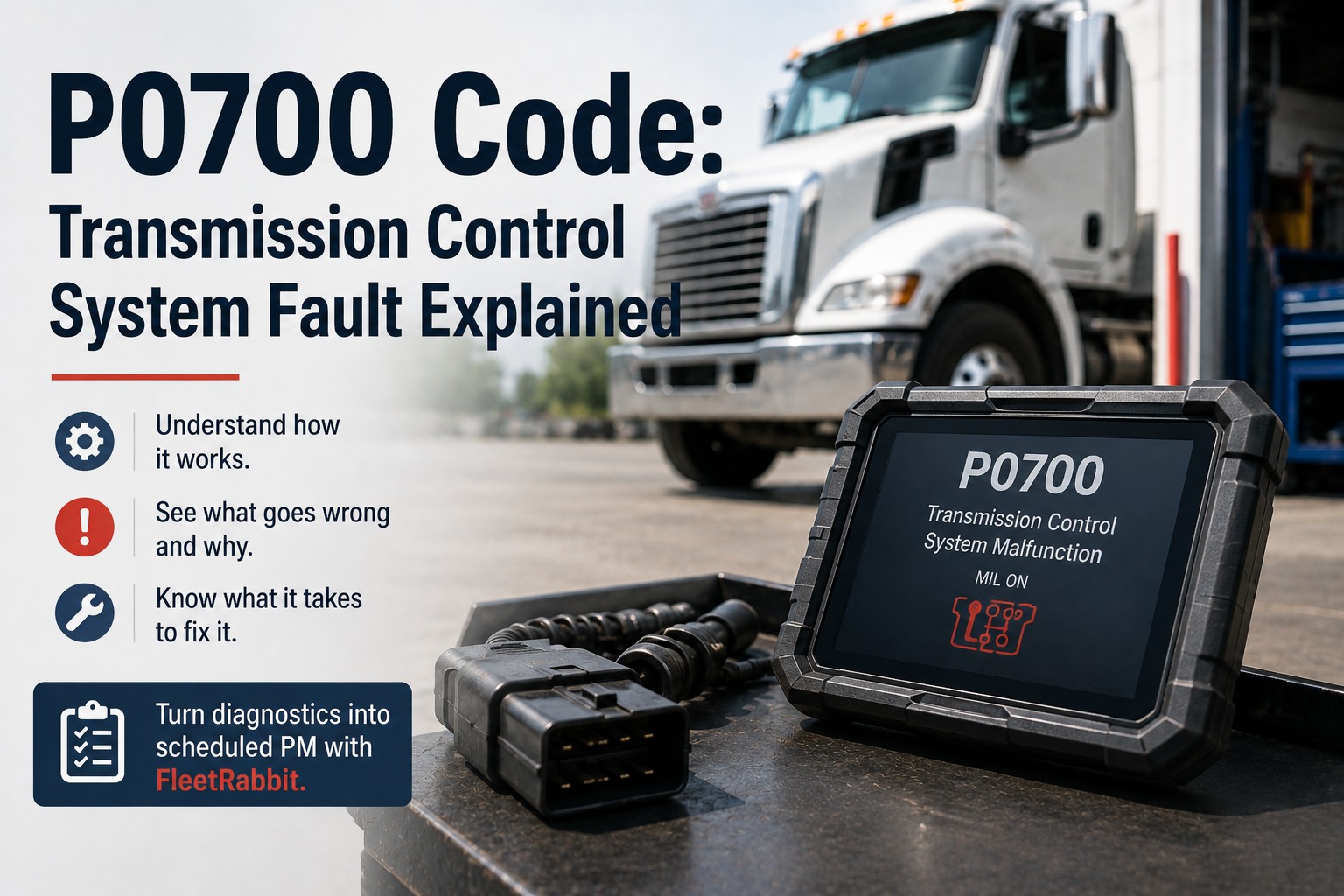
P0700 is the code that answers a question nobody asked. Its formal definition is "Transmission Control System — MIL Request", and those last two words are the whole story: the transmission control module is asking the engine module to switch on the warning lamp, because the transmission module has stored at least one fault of its own. P0700 does not name that fault. It is a flag rather than a diagnosis, which is why forums are full of people reporting they got P0700 and nothing else. They did get something else — their scanner simply could not read it. The actual fault lives inside the transmission module, and a basic code reader talking only to the engine module will never show it. That single misunderstanding is what turns a solenoid into a rebuild quote. Start free with three vehicles and keep the companion code, the fluid check and the repair on one record.
DIAGNOSTIC GUIDE · OBD-II CODE
P0700
Transmission Control System Malfunction — MIL Request
A gateway code that flags a fault stored elsewhere. What it actually means, the two free checks that come first, and how to avoid paying rebuild money for a solenoid.
Basic code reader
P0700
—
—
Engine module only. The fault is not here.
Scanner reading the transmission module
P0700
Companion code
Freeze frame data
The companion code is the diagnosis. Everything else is a flag.
Same truck, same moment, two different pictures. "P0700 and nothing else" almost always means the tool could not reach the module that holds the answer.
What the Code Literally Says
Reading the definition carefully saves a great deal of confusion, because the plain-English version sounds far more specific than it is.
1
The transmission module detects a fault
It monitors the sensors and actuators relating to transmission control. When something falls outside its expectations, it logs a specific code of its own — a solenoid fault, a sensor fault, a ratio error.
2
It asks the engine module for a lamp
The transmission module cannot illuminate the warning lamp itself, so it sends a request to the engine module. That request is what P0700 records — hence "MIL Request" in the formal definition.
3
The specific fault stays where it was logged
The real code remains in the transmission module's memory. P0700 is the doorbell, not the visitor — and a reader that only talks to the engine module hears the bell without ever seeing who rang it.
Why this matters commercially
Because the broad official wording — "transmission control system malfunction" — sounds like a specific and serious diagnosis when it is neither. A driver or a manager reading that phrase has no way to tell whether this is a two-hundred-dollar repair or a four-thousand-dollar rebuild, and that ambiguity is precisely where money gets spent unnecessarily.
Two Free Checks Before Anything Else
Both take minutes, both cost nothing, and both are documented causes of transmission codes that are not transmission faults.
Transmission fluid level and condition
With the engine running and the vehicle positioned as the manual specifies. Low fluid frequently triggers transmission codes on an otherwise healthy unit — on some transmissions, fluid dropping below the crosshatch marks alone is enough to set the module off and illuminate the lamp.
Bright red, correct level — as it should be
Brown or black, burnt smell — the fluid has been overheating
Fine metallic glitter — serious internal wear
Battery and charging voltage
The check almost nobody runs on a transmission complaint. Voltage dropping below around 12 volts frequently triggers false transmission codes, because the module loses confidence in its own inputs when the supply sags. A load test here has resolved a great many expensive-looking transmission investigations.
Run this before the scan tool comes out, not after the diagnosis has stalled.
If either check finds something, correct it and see whether the code returns. A fluid service to specification or a battery repair costs a fraction of what follows — and a code caused by low voltage will not be fixed by any transmission part, however carefully it is selected.
P0700
↓
Companion?
Does your record show the companion code, or just the flag?
Most fleets log "P0700" against the unit and nothing else, which means the next occurrence starts from zero. Bring a unit with a transmission history to a 30-minute call and we'll show how the flag, the companion code, the fluid condition and the repair sit on one asset timeline in Fleet Rabbit — so a second P0700 arrives with the first one's answer attached.
You Need the Right Tool, Not a Better Guess
This is the one code where equipment genuinely determines whether diagnosis is possible at all.
When the module will not answer at all
If a scan tool that should communicate with the transmission module cannot establish a connection, that is itself a strong indication of a fault with the module or its supply. Check power, ground and network continuity to it before assuming anything mechanical — a silent module and a failed transmission look identical from the driver's seat and cost very different amounts to resolve.
Read Both Modules Together
One comparison worth making deliberately, because it isolates a whole class of fault in a single step.
Compare vehicle speed across modules
Read live data from the engine module and the transmission module simultaneously. Where the engine module sees a vehicle speed that disagrees with what the transmission module sees, suspect a speed sensor or a harness fault rather than anything internal to the transmission.
Road test before and after
Test the vehicle first to verify the reported concern and gather data under real conditions. Freeze frame data recorded at the moment the code set will tell you what the truck was doing — speed, load, temperature — which frequently points straight at the cause.
Record everything before clearing
Write down every present code, capture the freeze frame and note the road test findings before you erase anything. Clearing a code destroys the evidence, and on this code the evidence is the diagnosis.
Then clear it and road test again
If the codes clear and do not return on a final road test, the original may have been set by an anomaly — a sticky solenoid or valve, or an erratic sensor reading. That is a legitimate outcome, provided the data was captured first.
Why It Goes Into Limp Mode
Four conditions, and understanding them explains why the module is being protective rather than difficult.
1Critical sensor failureThe module no longer has enough data to shift safely, so it holds a fixed gear rather than guessing.
2Severe solenoid malfunctionWhere shifting could produce a flare — a sudden engine speed spike as drive is lost — or a tie-up, with two gears attempting to engage at once. Both are damaging, and limp mode prevents them.
3Dangerously high fluid temperatureProtecting the fluid and the friction material from heat that would destroy both. Worth correlating with the fluid condition check.
4Electrical faults within the module itselfThe rarest of the four, and reached by elimination rather than assumed at the outset.
Before You Accept a Rebuild Quote
The most valuable section on this page. The spread between the likely repair and the worst case on this code is larger than on almost any other.
Fluid and filter service to specification
Around $100–$350
Professional diagnosis
Around $100–$200 · commonly about one hour of labour
Speed sensor, wiring repair or similar
Often at the low end — a significant share of cases resolve for modest sums
Solenoid or solenoid pack replacement
Roughly $250–$700
Full rebuild or replacement
$3,000 to $9,000 and upward
Labour rates commonly run somewhere around $80 to $150 per hour, higher at dealerships and in metropolitan areas. The important observation is the shape of this list rather than the numbers: most P0700 triggers are accessible electrical issues — a speed sensor, a solenoid pack, a chafed wire — rather than a failed transmission.
If someone quotes four figures to "fix a P0700"
Slow down and ask which companion code they are fixing. Nobody can quote a repair for P0700 itself, because P0700 is not a repairable fault — it is a request for a warning lamp. A quote that does not name the underlying code is a quote for an unknown job, and on this particular code the difference between the likely answer and the worst case runs into thousands.
Keeping It Off the Fleet
Four measures, and the first is the one that prevents most occurrences.
Fluid on a real schedule
Level and condition checked, and fluid changed to specification on an interval rather than on complaint. Regular transmission maintenance is the most effective prevention available for this code, and low fluid is among its most common triggers.
Treat shift complaints as early warnings
Harsh shifting, hesitation, slipping or a delay before drive engages all arrive before the lamp does. A driver reporting any of these is describing the fault while it is still cheap.
Keep electrical health in scope
Battery condition and charging voltage genuinely affect whether transmission codes appear. A unit with a marginal battery will keep producing puzzling faults across several systems, and this is one of them.
Record the companion, always
Logging "P0700" against a unit records almost nothing. Logging the companion code, the fluid condition found and the repair performed turns the next occurrence into a five-minute comparison rather than a fresh investigation — and makes a repeat pattern visible across the fleet.
Start free · 3 vehicles
"P0700" in your maintenance log is a note, not a record
Fleet Rabbit stores the companion code alongside the flag, keeps fluid condition findings and repairs on the same asset timeline, and flags a recurrence of the same underlying fault after a completed job — so the second occurrence starts from what the first one taught you rather than from a scan tool and a blank page.
Frequently Asked Questions
What does P0700 actually mean?
Its formal definition is "Transmission Control System — MIL Request". The transmission control module has stored at least one fault of its own and is asking the engine module to illuminate the warning lamp on its behalf. P0700 is informational: it flags that a transmission fault exists somewhere without identifying what it is. The specific code stays in the transmission module's memory, which is where the diagnosis actually lives.
We got P0700 and no other codes. What now?
You almost certainly did get other codes — your scanner could not read them. A basic reader communicates with the engine module only and will show P0700 while the companion code sits in the transmission module, invisible to it. You need a scanner capable of reading enhanced, manufacturer-specific data from the transmission module. Without the companion code, there is nothing to diagnose and nothing to quote against.
What should we check before scanning?
Transmission fluid and battery voltage — both free, both common causes of codes that are not transmission faults. Fluid should be bright red and at the correct level; brown or black with a burnt smell indicates overheating, and fine metallic glitter indicates serious internal wear. Low fluid frequently triggers transmission codes on its own. Separately, voltage below roughly 12 volts also triggers false transmission codes, so run a load test before drawing conclusions.
Can we keep driving?
Usually in the short term, but it should be diagnosed promptly — the code is rated high severity. Stop driving if the warning lamp is flashing, the engine is running poorly, or any safety-related symptom is present. If the vehicle has entered limp mode it will hold a fixed gear, which makes merging and hill work genuinely unsafe rather than merely awkward, and that condition exists to prevent damage rather than to inconvenience the driver.
A shop quoted several thousand to fix P0700. Is that right?
Ask which companion code they are repairing, because nobody can quote a fix for P0700 itself — it is a request for a warning lamp, not a repairable fault. Most triggers are accessible electrical issues: a speed sensor, a solenoid pack, or a chafed wire. Solenoid work commonly runs a few hundred dollars and a fluid service less than that, while a rebuild starts in the thousands. A quote that does not name the underlying code is a quote for an unknown job.
Is it worth clearing the code?
Yes, but only after capturing everything first. Write down all present codes, save the freeze frame data and record the road test findings, then clear and road test again. If the codes do not return, the original may have been set by an anomaly such as a sticky solenoid or valve or an erratic sensor reading — a legitimate outcome. Clearing before capturing destroys the only evidence you had, and on this code the evidence is the diagnosis.
How do we stop it recurring across the fleet?
Put transmission fluid checks and changes on a defined interval rather than waiting for symptoms, since regular maintenance is the most effective prevention available here. Treat harsh shifting, slipping and engagement delay as reportable rather than tolerable. Keep battery condition in scope. And record the companion code rather than just the flag —
start free with three vehicles and the second occurrence becomes a comparison instead of an investigation.
The Flag Is Not the Fault
Check fluid and voltage before the scan tool, read the module that actually holds the code, capture the freeze frame before clearing anything, make any quote name the companion code — and record that companion so the next one is already half diagnosed.
General guidance — follow the manufacturer's diagnostic procedure for your specific transmission · Cost ranges vary by make, model, region and labour rate