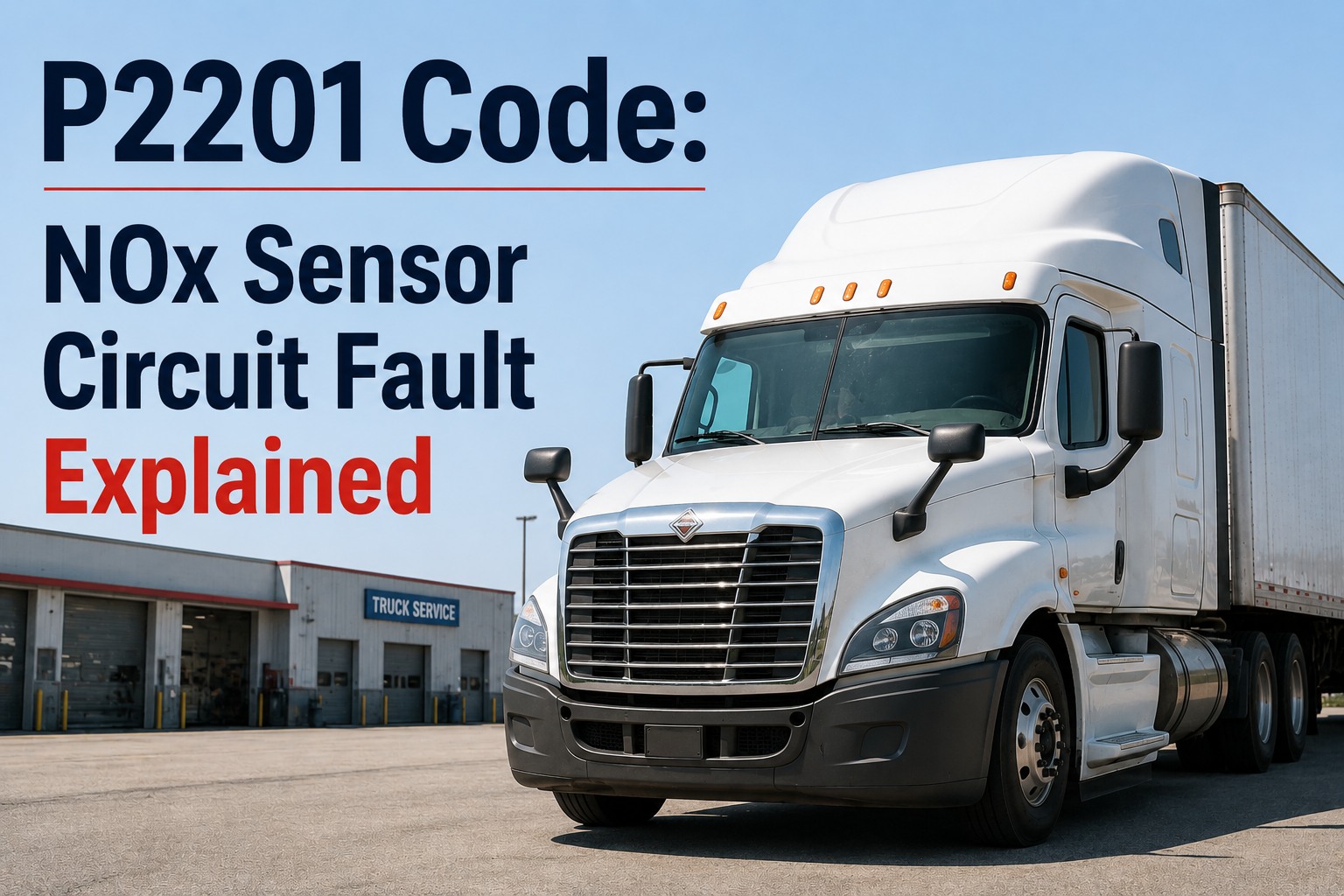
P2201 reads like an electrical fault and usually is not one. The formal definition is a nitrogen oxide sensor circuit range or performance fault on the upstream sensor — the one sitting in the exhaust just after the turbocharger, measuring what enters the selective catalytic reduction system. But that sensor is essentially a small computer rather than a simple probe, so what the module reports as a circuit problem can be an internally failed heater element, a dead controller chip, a corroded connector or a lost network message. All of them get lumped under the same report. Which is precisely why fitting a sensor before diagnosing is the single most common reason the same code reappears within a few hundred miles, on a truck that has just been charged for the part. Book a demo to see repeat-fault tracking against the unit.
P2201
NOx Sensor Circuit Range / Performance, Bank 1
Turbo
›
Upstream sensor
›
SCR
›
Downstream sensor
This code is the first sensor in that chain. Everything after it is judged using its readings.
Fix Upstream First, Always
The most important rule on this page, because ignoring it leads to replacing components that were working perfectly.
The upstream sensor is the reference
It measures what enters the catalyst. The module then compares that against the downstream reading to judge whether the catalyst is doing its job. A wrong upstream number makes every downstream conclusion wrong too.
A bad upstream signal fakes a catalyst failure
A faulty upstream sensor providing incorrect data can trigger a catalyst-efficiency-below-threshold code, leading the module to conclude the catalyst is not working even when it is. That is a several-thousand-dollar misdiagnosis waiting to be authorised.
Downstream codes are frequently collateral
A downstream sensor fault appearing alongside this one is common, and published guidance is direct: diagnose and fix the upstream fault first, because it causes false downstream codes. Fix the reference, then re-evaluate what remains.
There is a practical corollary for anyone reading a quote. If a shop has found this code alongside a catalyst efficiency code and is quoting for the catalyst, ask what they found after repairing the upstream sensor — because the correct sequence resolves the second code often enough that quoting both together suggests the sequence was not followed.
What "Circuit Fault" Is Actually Hiding
Four distinct failures, one reported symptom. This is why the diagnosis matters more than the part.
1An internally failed heater element inside the sensor assembly
2A dead controller chip — the sensor's own electronics, not the vehicle's
3A corroded connector, which is a repair rather than a replacement
4A lost network message — nothing wrong with the sensor at all
The 500-mile problem
That ambiguity is why blindly replacing the sensor before diagnosing is described as the leading reason customers return with the same code within a few hundred miles. Two of the four causes above are not fixed by a new sensor, and on current parts pricing that is an expensive coin toss to run twice.
Check for a Software Update Before Touching Hardware
An unusually high-value step on this code family, and one that takes minutes.
~15%
Of cases in this code family reported to trace back to a known calibration issue corrected by a control module update, particularly on several common diesel platforms
$150 vs $700
The published comparison — a reflash against a sensor. Some bulletins list both the upstream and downstream codes as resolved by a software update alone
VIN
Query the specific vehicle against the manufacturer's portal or a bulletin database before ordering. On a fleet running one platform, an applicable update may explain several trucks
500
miles
and the same code is back
Would you know it was the same code, on the same truck?
Fleet Rabbit records every fault code against the vehicle alongside the repair that followed, and flags a recurrence of the same code after a completed job — so a sensor fitted last month that has not solved anything becomes visible immediately rather than at the third invoice.
Symptoms, Including One That Costs Money Quietly
Five. The third is the one a fleet notices on a fuel and fluid report long before anyone connects it to a sensor.
Warning lamp and stored codesUsually with companions from the same sensor family, which help identify whether the fault is electrical or performance-related.
Reduced power or limp modeDrivable but restricted, and on some platforms a speed limitation as low as five miles per hour can follow on a subsequent restart, preceded by a dash countdown.
Fluid consumption climbingThe module over-injects diesel exhaust fluid to compensate for falsely reported high nitrogen oxide levels, producing noticeably more frequent refills. Visible on a scanner and, more usefully for a fleet, visible on your own consumption records.
Excess exhaust smokeReported as a symptom, and a sign the aftertreatment loop is not operating as intended.
Blocked or incomplete regenerationLose the upstream reading and the whole aftertreatment loop is effectively blind, which cascades into fluid system faults and regeneration problems.
That third symptom is worth setting an alert on. A unit whose fluid consumption rises without a corresponding change in duty is telling you about a sensor before it tells you about itself — and unlike the warning lamp, it appears while the truck is still working normally.
Causes Beyond the Sensor
Four that are not the sensor, and the last one is a genuine case worth remembering.
Wiring and connectors
Harness damage between the module and the sensor, or a corroded connector. The cable runs from the exhaust and lives in heat and vibration accordingly. Check power, ground and network integrity here before condemning the part.
Soot contamination
Diesels produce a great deal of soot, and buildup on the sensor affects what it reports. A contaminated sensor is behaving exactly as a failing one does, which is another reason live data matters more than the code text.
Exhaust leaks upstream of the sensor
A leak in pipes, gaskets or flex sections before the sensor lets ambient air in and distorts the reading. Less common than a sensor fault and considerably cheaper to fix once found.
Air ingress from elsewhere
A documented real-world case resolved this code by repairing a blown exhaust gas recirculation cooler gasket that was allowing air ingress and disrupting sensor readings. Nothing was wrong with the sensor. Worth holding in mind before the third replacement.
Diagnostic Order
Six steps. Note that the sensor is not purchased until step five.
01Pull every code and capture freeze frameCurrent, pending and history across powertrain and aftertreatment. Capture coolant temperature, exhaust temperature upstream of the catalyst, vehicle speed, run time since start and battery voltage at the moment the fault set — those five put the fault in context.
02Check for an applicable software updateQuery the vehicle against the manufacturer portal or bulletin database before any hardware is touched. This is the cheapest possible outcome and a meaningful share of cases resolve here.
03Inspect the harness and connector visuallyTrace the cable from the exhaust, looking for damage, chafe and corrosion. Check power, ground and network integrity at the connector rather than assuming continuity.
04Monitor live sensor dataWatch the upstream reading with a capable scan tool to establish whether it is stuck, erratic or plausible. This is the test that separates an internally failed sensor from a wiring or network problem.
05Check for exhaust and air leaksUpstream pipes, gaskets and flex sections, and anything else admitting air into the stream. Only once this is clean does the sensor itself become the leading candidate.
06Replace, then clear and complete a drive cycleThis is a hard emissions fault that will not clear on its own. After repair, clear the code and complete a full drive cycle — and note that some repairs also require a scan-tool adaptation, which needs a properly equipped shop.
On buying the part
Published prices put a quality aftermarket sensor somewhere in the range of $280 to $800 depending on platform, with original equipment parts running from around $400 to well over $1,500. Owners and technicians are consistently emphatic on one point: avoid cheap unbranded sensors, which carry extremely high premature failure rates. On a component this expensive to fit, a part that fails early costs the labour twice and the diagnosis a third time.
Severity and What Deferral Costs
Moderate on paper. The consequences of leaving it are neither moderate nor slow.
Short term
Drivable for short trips if the truck otherwise runs normally, but avoid hard driving and schedule the repair. Reduced power and limp mode are common, and a speed restriction can follow on a later restart.
Medium term
Fluid over-consumption continues, regenerations are disrupted, and soot accumulates. Every day of this is money leaving through the fluid tank rather than through the workshop.
If left
Soot buildup and damage to the particulate filter and catalyst — both far more expensive than the sensor — plus a failed emissions test. A moderate code becomes a major bill by neglect rather than by escalation.
Before the next sensor goes on a truck
Has this unit set the same code before?
Was a sensor already fitted for it?
Was a software update ever checked?
Has fluid consumption been rising?
Four questions, all answerable from a maintenance record — if one exists.
Fleet Rabbit keeps fault codes, repairs, parts fitted and fluid records on one vehicle timeline, with telematics codes arriving as work orders that already carry that history. Free for three vehicles, no credit card.
Frequently Asked Questions
What does P2201 mean?
A nitrogen oxide sensor circuit range or performance fault on bank one — specifically the upstream sensor, positioned in the exhaust just after the turbocharger. It measures the nitrogen oxide level entering the selective catalytic reduction system, and the code sets when the module sees a signal outside the expected range or behaving erratically. Definitions vary slightly by manufacturer, so confirm against the correct repair information for your engine.
Should we just replace the sensor?
Not before diagnosing, and this is the most expensive mistake on this code. The sensor is essentially a small computer, so what the module reports as a circuit fault can be an internally failed heater element, a dead controller chip, a corroded connector or a lost network message. Two of those four are not fixed by a new sensor — which is why fitting one blind is described as the leading reason the same code returns within a few hundred miles.
We also have a catalyst efficiency code. Do we need a catalyst?
Very possibly not. A faulty upstream sensor providing incorrect data can trigger a catalyst-efficiency-below-threshold code, leading the module to conclude the catalyst has failed when it has not. Published guidance is explicit: diagnose and fix the upstream fault first, because it causes false downstream codes. Repair the reference sensor, clear the codes, complete a drive cycle, and see what actually remains before authorising anything expensive.
Is a software update really worth checking?
On this code family, yes. Roughly fifteen percent of cases are reported to trace back to a known calibration issue corrected by a control module update, particularly on several common diesel platforms — with the published comparison being around a hundred and fifty dollars for a reflash against seven hundred for a sensor. Some bulletins list both the upstream and downstream sensor codes as resolved by a software update alone. Query the specific vehicle before ordering parts.
Why has our fluid consumption gone up?
Because the module is over-injecting to compensate. When the upstream sensor falsely reports high nitrogen oxide levels, the module doses more diesel exhaust fluid than the engine actually needs, producing noticeably more frequent refills. It is visible on a scanner, but on a fleet it is visible earlier in your own consumption data — and it appears while the truck is still running normally, which makes it a genuinely useful early warning.
Can it be something other than the sensor entirely?
Yes. Harness damage and corroded connectors, soot contamination affecting what the sensor reports, and exhaust leaks upstream admitting air into the stream all produce this code. One documented case was resolved by repairing a blown exhaust gas recirculation cooler gasket that was allowing air ingress and disrupting sensor readings — nothing wrong with the sensor at all. Check power, ground and network integrity before condemning the part.
What does the part cost, and does brand matter?
Quality aftermarket sensors run roughly $280 to $800 depending on platform, with original equipment parts from about $400 to well over $1,500. Brand matters more here than on most components — owners and technicians consistently warn against cheap unbranded sensors because of extremely high premature failure rates. Given the labour involved in fitting one, an early failure costs you the job twice and the diagnosis a third time.
Start free with three vehicles and record which brand went on, so the next failure tells you something.
Upstream first
Reflash before hardware
Never unbranded
Diagnose the Circuit, Not the Word "Circuit"
Four different failures arrive under one report, two of them unfixed by a new sensor. Check for an update, inspect the harness, watch live data, rule out leaks — and repair the upstream sensor before anyone forms an opinion about the catalyst.
Code definitions, prices and bulletin availability vary by manufacturer and platform — confirm against the correct repair information for your engine