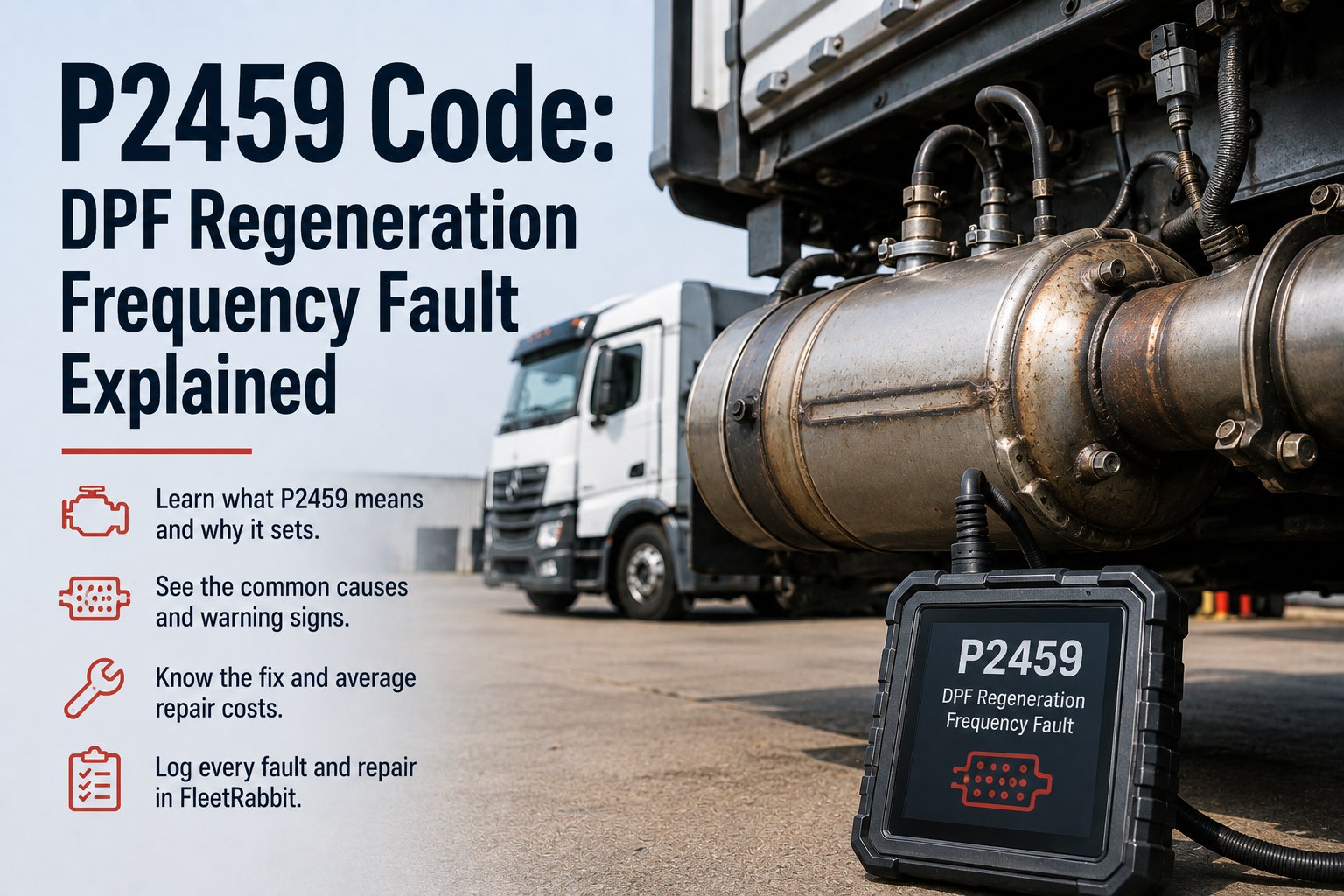
P2459 is a diesel-only code, and on a fleet it is as often a routing problem as a mechanical one. The module is comparing how frequently the particulate filter is regenerating against how frequently it expects to — and when the cycles come far too close together, it flags. A healthy system typically regenerates somewhere around every two to three hundred miles. A system cycling every fifty to eighty is telling you something is loading the filter faster than it should. Sometimes that is a failing sensor or an engine producing excess soot. Very often on a vocational fleet it is simply that the truck never runs long enough or hot enough to complete a passive regeneration, because its route does not allow it. Those two situations need completely different responses, and telling them apart before ordering parts is the whole job. Book a demo and see how holding regen events, duty cycle and repairs on one record answers that question in minutes.
DIAGNOSTIC GUIDE · OBD-II CODE · DIESEL ONLY
P2459
Diesel Particulate Filter Regeneration Frequency
Why the filter is cycling too often, how to tell a duty-cycle cause from a mechanical one, and the difference between the deposit that burns off and the one that never does.
What accumulates inside the filter
Soot
Burns off during regeneration. This is what the cycle exists to remove.
Ash
Does not burn off. Accumulates permanently, and as it builds, regeneration is forced to happen more often.
Every regen removes the top layer and leaves the bottom one slightly thicker. That is why a filter approaching end of life regenerates more frequently even when nothing has failed.
What the Module Is Actually Measuring
Not soot level in isolation — frequency. The comparison is between how often regeneration is being triggered and how often the calibration expects it.
Typically expected
Roughly every 200–300 miles
Flagged as too frequent
Every 50–80 miles
Where regeneration triggers repeatedly inside a short window, or where the soot level found at the trigger point is higher than the module expected, the code sets. Figures vary by engine and calibration — the pattern is what matters, not the exact number.
Two things a regeneration cycle needs
Heat and time. Passive regeneration relies on the exhaust reaching temperature during normal running, which is why sustained highway work completes it and stop-start urban work does not. Where passive regeneration cannot happen, the system falls back on active cycles — and a truck forced onto active regeneration constantly is a truck being asked to do something its route will not permit.
Is This a Fault or a Route?
The first question on a fleet, and the one that determines whether the answer is a part or a scheduling change. Four indicators separate them.
← Swipe to see all columns →
This is the single most useful diagnostic step available to a fleet and it requires no tools at all. Compare the affected unit against others running the same duty. If they all do it, the route is the cause and the fix is operational. If one does it alone, something on that truck is producing more soot than its peers — and now the mechanical investigation is worth running.
Causes, Grouped by What They Do
Four families. Each produces the same code by a different mechanism, which is why grouping them helps more than a flat list.
The engine cannot complete a regeneration
Frequent short trips that never let the exhaust reach the temperature regeneration requires
Cold weather working against exhaust heating and forcing active cycles
Low sustained load — the engine simply is not being asked to work hard enough
Fixable operationally rather than mechanically. This group dominates on urban and vocational fleets.
Something is producing extra soot
Injector problems — worn, dirty or delivering a poor spray pattern
A clogged exhaust gas recirculation valve or cooler adding soot to the stream
Turbocharger issues, where poor boost produces incomplete combustion
The filter is doing its job correctly on an engine that is giving it too much to handle.
The module is being told the wrong thing
A faulty differential pressure sensor across the filter, giving incorrect readings
Exhaust temperature sensor faults, or circuit and connector problems
Exhaust leaks upstream of a sensor, distorting what it reads
Outdated control module calibration misjudging the thresholds
Nothing is wrong with the filter or the engine — the measurement is wrong.
The filter is reaching the end of its life
Accumulated ash reducing usable capacity, forcing more frequent cycles
Restriction in the filter or elsewhere in the exhaust
Oil specification contributing non-burnable ash faster than it should
The only group where the answer is service or replacement of the filter itself — and the one people assume first.
Unit 214
Unit 219
Unit 087
Same route, same code, three trucks — or one truck alone?
That comparison answers the expensive question before any part is ordered, and it needs regen events and route data on the same record to be possible at all. Bring a unit with a P2459 history to a 30-minute call and we'll show how Fleet Rabbit puts its regen frequency alongside its peers on the same duty, so the route-versus-fault question resolves in minutes rather than in a workshop.
Symptoms, and What Ignoring It Costs
Six symptoms, then three consequences. The code is not an emergency, but the consequences are cumulative and one of them is expensive.
Warning lamp and a filter maintenance reminderFrequently accompanied by other exhaust or emissions codes, which are worth pulling deliberately since they often name the mechanism.
Manual regeneration prompts more often than the factory intervalThe clearest operational signal, and one drivers notice immediately because it costs them time.
Fuel consumption climbingActive regeneration burns fuel deliberately. Cycling far more often than designed shows up directly on the fuel figures.
Sluggish performance or limp modePoor acceleration, difficulty maintaining engine speed, and in some cases a deliberate power restriction.
Black smoke from the exhaustWhere larger soot particles are not being burned off properly during the cycle.
Elevated temperaturesHigher engine temperature, and heat in the filter housing and surrounding exhaust components.
Fuel
Every unnecessary active regeneration burns fuel that produced no work. Across a fleet on the wrong duty cycle this is a permanent, invisible cost line.
Components under stress
Repeated high-temperature cycles put load on the turbocharger and surrounding exhaust hardware, and can pull sensors, recirculation components and injectors into the problem.
The filter itself
Excess soot can crack the filter during a regeneration, and continued neglect risks a replacement — the most expensive outcome available from a code that started as a routing question.
It will not clear itself
Unlike some codes set by transient conditions, this one does not simply go away. It requires either a successfully completed regeneration or an actual repair. Where the cause is duty cycle, a sustained highway run of roughly twenty to thirty minutes can complete the cycle and resolve it — which is worth trying deliberately before anything else, precisely because it is both a fix and a diagnostic test.
Diagnostic Order
Six steps. Note that the first two cost nothing and resolve a large share of fleet cases.
01
Compare against peer units on the same duty
Before touching the truck. Several units on one route type doing the same thing is a duty-cycle answer; one unit alone is a mechanical one. This single comparison determines everything that follows.
02
Give it a sustained highway run
Twenty to thirty minutes of open-road running at load. If a complete regeneration follows and the code stays away, the cause was the route and the fix is operational. If it returns quickly, you have eliminated the cheapest explanation and can proceed with confidence.
03
Scan for companion codes and capture freeze frame
Other emissions codes stored alongside frequently identify the mechanism. Record engine speed, load and exhaust temperature at the moment the code set — those three values usually say whether the engine was even in a position to regenerate.
04
Verify the sensing before the hardware
Differential pressure and exhaust temperature readings checked in live data, with the wiring harness and connectors inspected for pins that are broken, bent, pushed out or corroded. Also look for exhaust leaks upstream of a sensor, which distort what it reports.
05
Run a forced regeneration
With live data monitored throughout. Whether it completes, and what the temperatures and pressures do while it runs, separates a filter that is loaded from one that is being reported incorrectly.
06
Then look upstream at soot production
Injector condition, recirculation valve and cooler restriction, and turbocharger performance — the things that put more soot into the filter than it was designed to receive. Check for an available control module calibration update at this stage too.
Cost by Cause
Wide, as with most emissions codes, and heavily dependent on which of the four families it turns out to be.
Operational fix — scheduled highway running, route reassignment
No parts cost
Diagnosis
Commonly around one hour of labour
Sensor replacement
From around $50 for the part
Control module calibration update
Around $150–$250 for the flash plus $100–$150 labour
Injector work or filter service
$500 and upward
Filter replacement
The outcome worth avoiding — repairs overall span roughly $100 to $1,500
Heavy-duty figures sit above anything quoted for light vehicles, and the shape of this list is the point: the cheapest fix is a route change and the most expensive is a filter, with the diagnostic order determining which one you end up paying for.
Preventing the Next One
Five measures. Two of them are fleet decisions rather than workshop tasks, and those are the ones that stop this recurring.
Match the truck to the route
A unit permanently assigned to short stop-start work will keep producing this code however many parts are fitted. Rotating assignments, or giving affected units regular longer runs, addresses the cause rather than the symptom.
Schedule deliberate highway running
Where rotation is not practical, a planned sustained run of twenty to thirty minutes at intervals lets passive regeneration do its work. Cheaper than any part on this page, and it can go on the maintenance schedule like anything else.
Use the specified oil
Oil that is not to the correct low-ash specification increases the non-burnable ash reaching the filter, which shortens its usable life and forces regeneration to happen more often. This is a purchasing decision with a maintenance consequence.
Keep the soot producers healthy
Injectors, recirculation components and the turbocharger all determine how much soot reaches the filter. Anything degrading upstream loads the filter faster and shows up here first.
Track regen frequency per unit
The measure that makes all of the above visible. A truck whose interval between regenerations is shortening month over month is telling you about ash accumulation or a developing upstream fault long before the code sets — and that trend only exists if somebody is recording it.
Some codes are answered in the workshop. This one is often answered in the schedule.
Fleet Rabbit records fault codes and repairs against each unit alongside its duty and route data, so a P2459 can be compared instantly against peer trucks on the same work — separating the units with a genuine fault from the ones simply being asked to do a job their exhaust system cannot support.
Frequently Asked Questions
What does P2459 actually mean?
It is a diesel-only code covering diesel particulate filter regeneration frequency. The module compares how often regeneration is being triggered against how often its calibration expects — and flags when cycles come far too close together, or when the soot level found at the trigger point is higher than anticipated. A healthy system commonly regenerates around every two to three hundred miles; a system cycling every fifty to eighty is loading the filter far faster than intended.
Can short trips alone cause this?
Yes, and on vocational fleets it is among the most common causes. Passive regeneration depends on the exhaust reaching temperature during normal running, which sustained highway work provides and stop-start urban work does not. A truck that never gets hot enough for passive regeneration is forced onto active cycles constantly. That is a duty-cycle problem, and no part will fix it — the answer is route assignment or scheduled longer runs.
How do we tell a route problem from a real fault?
Compare the affected unit against others doing the same work. Several trucks on one route type showing the same behaviour points at the duty cycle; one unit alone while its stablemates stay clean points at that truck. Then give it a sustained highway run of twenty to thirty minutes — if a regeneration completes and the code stays away, the route was the cause. Both checks cost nothing and together they resolve most fleet cases.
What is the difference between soot and ash?
Soot burns off during regeneration — removing it is what the cycle is for. Ash does not burn off at all; it accumulates permanently and progressively reduces the filter's usable capacity, which forces regeneration to occur more frequently as it builds. That is why a filter approaching end of life cycles more often even with nothing failed. Oil that is not to the correct low-ash specification accelerates the process, which makes oil choice a maintenance decision rather than a purchasing one.
Can we keep driving with it?
Generally in the short term, but not indefinitely. It is not an immediate safety issue, though it does increase emissions and fuel consumption, stresses the turbocharger and surrounding components, and can end in limp mode. The serious risk is the filter itself — excess soot can crack it during a regeneration, and continued neglect ends in a replacement that costs many times more than the original cause. It will not clear on its own either; it needs a completed regeneration or a repair.
Does it always mean a bad sensor?
No, though a faulty differential pressure or exhaust temperature sensor is a genuine and common cause. The other families are the engine being unable to complete a regeneration, something upstream producing excess soot — injectors, recirculation valve or cooler, turbocharger — and the filter approaching end of life through ash accumulation or restriction. An outdated control module calibration can also misjudge the thresholds, and a software update sometimes resolves the discrepancy on its own.
What will it cost?
Anywhere from nothing to a great deal, which is exactly why the diagnostic order matters. An operational fix costs no parts at all. A sensor starts around fifty dollars; a calibration update runs roughly a hundred and fifty to two hundred and fifty for the flash plus labour; injector work or filter service starts around five hundred; and repairs overall span roughly one hundred to fifteen hundred dollars, with heavy-duty work above that.
Book a demo to see regen frequency tracked per unit.
Check the Route Before the Parts List
Compare the unit against its peers on the same duty, try a sustained highway run before ordering anything, verify the sensing before the hardware, use the specified oil — and track how the interval between regenerations is trending, because that is the warning that arrives before the code.
General guidance — follow the manufacturer's diagnostic and regeneration procedure for your specific engine · Regeneration intervals and cost ranges vary by engine, calibration and region