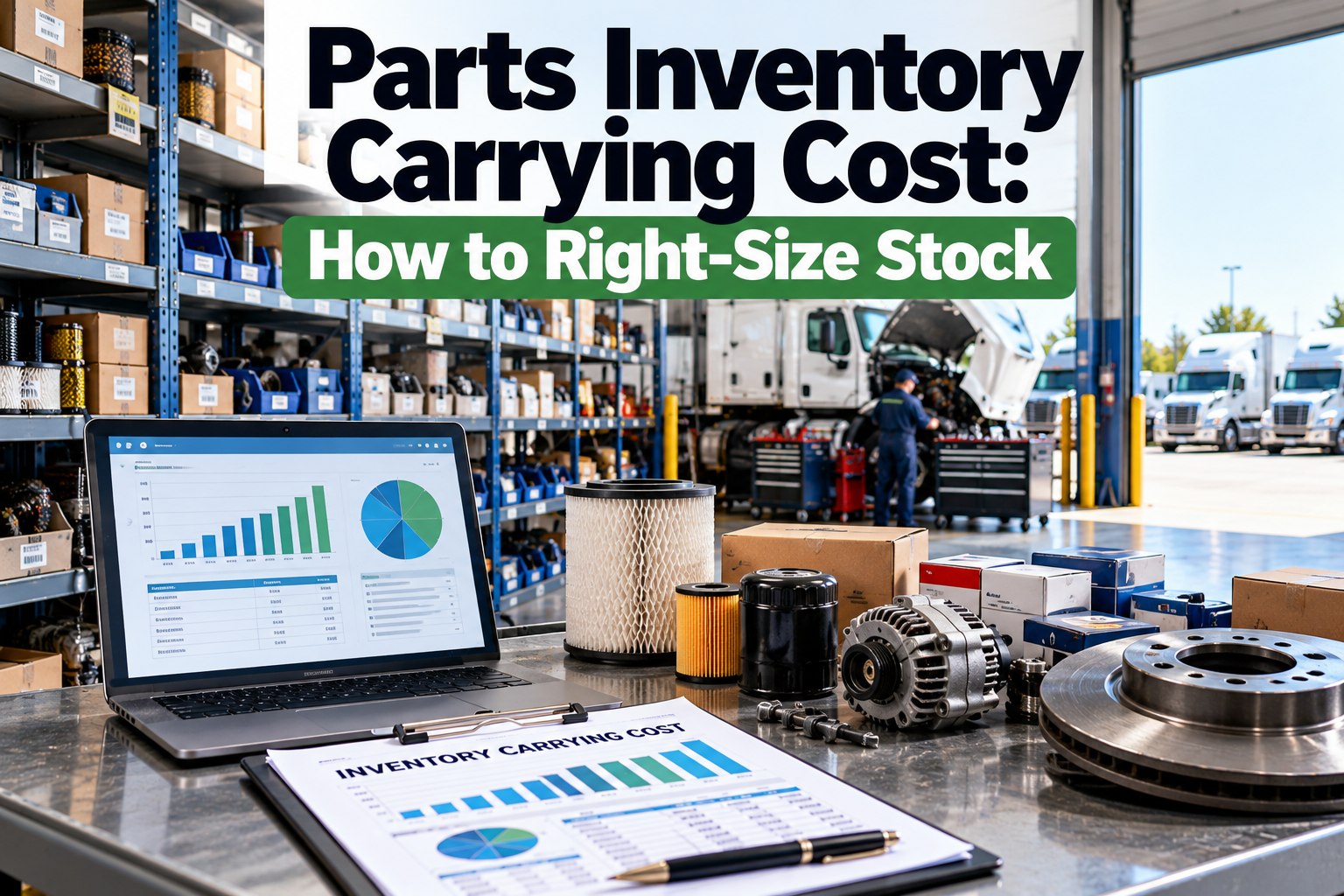
Parts inventory carrying cost is what it costs you each year to hold stock: tied-up cash, storage, insurance and parts that go unused or obsolete. It is expressed as a percentage of average inventory value. This page breaks the cost into its parts, shows the published percentage ranges and how little backs them, and covers the stocking methods fleets use to right-size a storeroom. Schedule a call to track parts usage by vehicle and work order.
PARTS INVENTORY · CARRYING COST · STOCKING METHODS
Every Part on the Shelf Is Costing You Money Until a Truck Uses It
What carrying cost includes, the ranges quoted for it and how to decide what stock to hold.
15% to 35%annual carrying cost range quoted for inventory in general, unsourced
4cost components: capital, storage, service and risk
What Parts Inventory Carrying Cost Includes: Capital, Storage, Service and Risk
Carrying cost is the sum of a year of holding expenses divided by the average value of stock on hand
Cleverence defines carrying cost percent as annual carrying costs divided by average inventory value, and suggests using a rolling 12-month average of month-end inventory at cost. It groups the costs into four parts.
CAPITAL
Interest on borrowed money or the opportunity cost of cash tied up in stock
STORAGE
Space, utilities, handling equipment, put-away labor and consumables
SERVICE
Insurance, property taxes and the cost of running inventory systems
RISK
Shrinkage, damage, obsolescence and expiry
Risk covers parts that never get used. For a fleet, that includes parts bought for vehicles you have since sold or retired.
How Much Does It Cost to Hold Inventory? Published Percentage Ranges and Why to Question Them
Quoted ranges run from 15 to 35 percent a year, but none of the pages we found cite a study
ANNUAL CARRYING COST AS A SHARE OF INVENTORY VALUE. QUOTED, NOT INDEPENDENTLY VERIFIED
General inventory range (Cleverence)
15% to 35%
Fleet parts claim (FleetRabbit, HVI)
20% to 30%
Treat every percentage here as an assumption. Cleverence gives 15 to 35 percent with no source. FleetRabbit and Heavy Vehicle Inspection both say 20 to 30 percent for fleet parts, again without naming a study, and both sell inventory software. Use your own capital cost, storage cost and write-offs.
As an illustration of the arithmetic only, on $200,000 of average parts inventory the cost per year at three assumed rates would be:
ILLUSTRATIVE ANNUAL CARRYING COST ON $200,000 OF STOCK. OUR ARITHMETIC, NOT A BENCHMARK
Not sure what your storeroom costs to hold? Schedule a call and we will map parts used to each truck and work order.
See which parts move and which sit.
ABC Classification: Which Parts Deserve Stock and Which Should Be Ordered on Demand
A small share of part numbers drives most of the spend, so each class needs its own stocking rule
Heavy Vehicle Inspection sorts parts into three classes and suggests reclassifying quarterly as usage changes. The shares are described as approximate and no study is named.
| Class | Share of part numbers | Share of spend | Typical parts | Handling |
|---|
| A | About 20% | About 80% | Engines, transmissions, injectors, turbos, aftertreatment | Tight counts, forecast-driven ordering, safety stock |
| B | About 30% | About 15% | Filters, brakes, belts, hoses, batteries | Min-max or kanban, monthly review |
| C | About 50% | About 5% | Fasteners, clamps, wipers, cleaners | Vendor-managed or bulk min-max, quarterly review |
Stocking Methods for Fleet Parts: Safety Stock, Kanban, Min-Max and Just in Time
Match the method to how critical the part is and how predictable its demand is, and never run a critical part just in time
SAFETY STOCK
Critical parts with unpredictable demand, such as injectors, ECMs, turbos and transmissions
KANBAN OR MIN-MAX
Critical or mid-tier parts with predictable use, such as filters, brake pads, belts and batteries
JUST IN TIME
Non-critical, predictable items such as fasteners and cleaning supplies
ON DEMAND OR VENDOR-MANAGED
Non-critical parts with erratic demand
FleetRabbit's strategy page adds that reorder points should rest on daily usage, supplier lead time and a safety buffer, not last year's purchase orders, and that parts for retired vehicles should be returned or scrapped so the freed cash goes to critical parts. It also says total inventory investment may run about 1.5 to 2.5 percent of fleet value, a figure it does not source.
Parts Inventory Review Checklist: Right-Size Your Stock Before the Next Purchase Order
Tick each step so you hold what trucks actually use and stop paying to store what they do not
Right-Size Parts Stock: Link Parts to Vehicles and Work Orders in FleetRabbit
FleetRabbit keeps work orders, service history and costs for every vehicle in one record, so you can see which parts each truck uses and what repairs cost per vehicle. Free for up to 3 vehicles, then $5 per vehicle per month.
Work orders per vehicle
Cost per vehicle
Service history
Free for 3 vehicles
Parts Inventory Carrying Cost FAQs: Formula, Percentage, Obsolete Stock and Stocking Methods
Short answers on what it costs to hold fleet parts and how to reduce it
What is inventory carrying cost?
The annual cost of holding stock, covering capital, storage, service and risk, usually shown as a percentage of average inventory value.
How do I calculate it?
Add a year of holding costs and divide by average inventory value, using a rolling 12-month average of month-end stock at cost.
What is a typical carrying cost percentage?
Pages quote 15 to 35 percent for inventory in general and 20 to 30 percent for fleet parts, but none cites a study. Calculate your own.
Which parts should I stock?
Critical parts with unpredictable demand get safety stock, steady wear items use kanban or min-max, and low-value consumables can be ordered on demand.
What do I do with parts for retired trucks?
Flag them, return or scrap them where you can, and move the freed cash to parts that active trucks use.
What does FleetRabbit cost?
Hold the Parts Your Trucks Use and Stop Paying for the Rest
Tie parts to vehicles and work orders so stocking decisions rest on usage records.
Free tier for up to 3 vehicles · No credit card required · Records stored per vehicle
October 17, 2026
By Sam Parker
All Articles