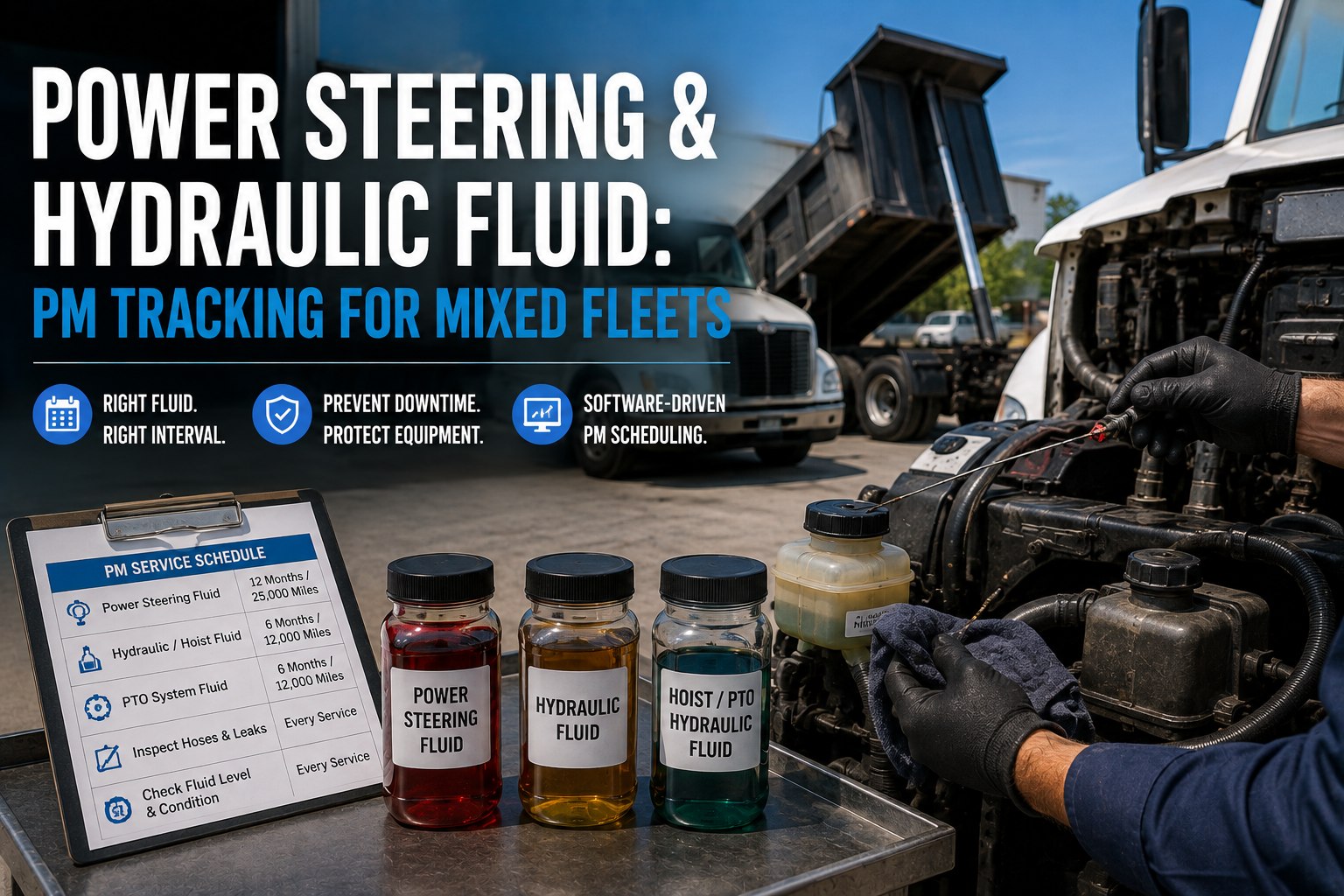
Hydraulic maintenance is the one PM item where nothing warns you. An engine fault throws a code, a brake problem announces itself, a coolant issue shows on a gauge — hydraulic degradation is silent. Fluid contaminates and seals wear with no dashboard indication at all, right up until a hose bursts or a dump body will not raise, at which point the truck is out of service and the repair is a several-thousand-dollar event. And the dominant cause is not wear, it is contamination, arriving through three predictable routes: water pulled in through the reservoir breather, particles shed by worn components, and someone topping up with the wrong fluid. Only the third of those is a decision, and it is the one software can eliminate outright. Start a free trial to hold fluid specification per circuit and schedule hydraulic service on real operating hours.
PREVENTIVE MAINTENANCE · HYDRAULICS
Power Steering and Hydraulic Fluid PM
Steering, hoist and PTO circuits on one chassis, each with its own specification — plus grade selection, hour-based intervals and the analysis thresholds that catch failure before it is visible.
BreatherWater ingress
WearParticles from components
Top-upWrong specification
Reservoir
Three pathways, one destination. Two are physical and one is a procedure — which makes the third the cheapest to close.
Three Circuits, One Chassis
A vocational truck can carry three independent hydraulic systems with three different fluid requirements, and the mistake that causes cross-contamination is treating "hydraulic fluid" as one thing.
Power steering
Specification varies by manufacturer — some systems call for automatic transmission fluid, others for a dedicated power steering fluid, and some accept an anti-wear hydraulic oil. Never assume across a mixed fleet.
Confirm fromThe reservoir cap marking or the OEM manual for that chassis
Hoist and dump body
Typically an anti-wear hydraulic oil in an ISO viscosity grade. Large volume, large displacement, and a reservoir that breathes heavily every cycle.
Confirm fromThe body builder's spec, not the chassis manufacturer's
PTO-driven equipment
Cranes, compactors, tail lifts, vacuum and blower systems. Often a separate reservoir with its own grade requirement and its own duty cycle entirely.
Confirm fromThe equipment manufacturer, which is frequently a third party again
Why this specific error is so common
Cross-contamination during top-up with the wrong fluid specification is one of the three primary contamination pathways — and unlike breather ingress or component wear, it is entirely avoidable. The fix is not training, it is availability: put the correct specification for each circuit where the technician is standing when they open the container. A fluid spec held in a manual in an office prevents nothing.
Choosing the Grade
ISO viscosity grade is chosen against operating temperature and pressure, not against equipment type. Get it wrong in either direction and the system either cavitates or runs hot.
← Swipe to see all columns →
ISO VG 46 covers the majority of construction hydraulic applications, which is why it ends up as the default — but "most" is not "all", and the default is wrong for cold-climate plough equipment and for continuously hot applications. Verify against the current fluid drums, the owner's manual or the dealer recommendation rather than matching what is already in the tank, since what is in the tank may itself be the previous person's assumption.
Anti-Wear Is Not Optional
The letters in front of the grade matter more than the number after it. AW denotes the anti-wear additive package, and its absence in a system that requires it is not a gradual problem.
What AW does
Provides a strong oil film preventing metal-to-metal contact between rotating parts, alongside anti-foam additives and rust and corrosion protection where water contamination occurs.
What happens without it
Using a non-AW fluid in a system requiring anti-wear protection voids warranties and causes rapid pump destruction. This is a failure measured in hours rather than in service intervals.
The zinc question
Some environmentally sensitive applications use zinc-free AW alternatives, which deliver the anti-wear function through a different chemistry. Where these are specified, they are specified for a reason.
On mixing brands
Mixing products alters the additive balance and can change performance. Check manufacturer guidance before blending, and standardise the product per circuit so the question stops arising.
Fluid analysis result
Cleanliness codeWithin limit
Water contentTrending up
Scheduled work orderNot raised
A result nobody acts on is a cost with no benefit.
Analysis only pays where an out-of-spec reading raises a work order automatically and the trend is visible per asset rather than sitting in an inbox.
Intervals Run on Hours, Not Dates
This is the single biggest scheduling error in hydraulic PM. Calendar-based intervals miss heavy-use equipment and over-service light-use units, and on PTO-driven equipment the truck's odometer bears no relationship to how hard the hydraulic system has worked.
Normal
Around 2,000 hoursAchievable in normal conditions with proper filtration in place. The upper end of the standard range.
Standard
1,000 to 2,000 hoursThe general range, varying with operating conditions, contamination control and fluid quality.
Severe
1,000 hoursHigh contamination environments, temperature extremes or continuous operation. Half the interval on the same equipment.
Analysis
Every 500 hoursOil analysis at this cadence lets you optimise the change against actual fluid condition rather than against a fixed number.
Sampling cadence is separate again. Most heavy equipment warrants sampling every 250 to 500 operating hours, and severe-service applications — refuse trucks, construction equipment working in dusty conditions — benefit from intervals as short as 100 hours. Pull engine hours and PTO hours where telematics provides them, because a chassis that has covered few miles may have run its hydraulics all week.
The Numbers That Trigger a Change
Analysis converts a fixed interval into a condition-based one, but only if the thresholds are agreed in advance and wired to an action.
1ISO cleanliness codeCodes exceeding 20/18/15 indicate particle contamination beyond acceptable limits. Record and trend the code from every sample rather than reading each one in isolation.
2Water contentAbove 500 parts per million is a threshold worth acting on. Rising water is usually a breather or a seal, not the fluid.
3Viscosity changeMovement away from the grade's specification indicates degradation or cross-contamination with a different product.
4Additive depletionThe anti-wear package does not last forever. Depletion is the point at which the fluid stops doing the job the AW designation promised.
5The trend, not the readingProgressive contamination across successive samples usually signals a failed breather, damaged seals or an external dirt ingress point — a root cause to correct rather than a fluid to change.
The Dump Body Problem
Hoist circuits have a specific vulnerability that other hydraulic systems do not, and it explains why water content on these units climbs faster than anyone expects.
01
Massive displacement per cycleA dump truck displaces a large volume of oil when the cylinder is at full extension, which means the reservoir moves a lot of air in and out on every single raise and lower.
02
Air in means moisture inWith that much air entering and leaving the sump tank, condensation becomes a real and recurring problem rather than an occasional one.
03
Demulsibility matters hereA fluid with good demulsibility drops water out of suspension so it settles and can be drained from the bottom of the tank rather than circulating through the pump.
04
Some bodies ship without filtersNot every dump body is supplied with an in-circuit filter, and the hydraulic filter is one of the most commonly forgotten service items even where one is fitted. Confirm what is actually on the truck before writing the PM.
Breathers are a cheap fix for an expensive problem
Water ingress through the reservoir breather is one of the three main contamination routes, and on a heavily breathing hoist circuit it is the dominant one. Desiccant breather caps that trap moisture on the intake are inexpensive relative to a pump, and they turn a recurring contamination source into a consumable with its own replacement schedule.
What Goes in the PM System
Seven fields, and each one closes a specific failure route.
Fluid specification per circuitSteering, hoist and each PTO system held separately, surfaced on the work order before a top-up. This is what removes cross-contamination as a category.
Reservoir capacity per circuitSo the job is kitted with the right volume rather than a guess, and a change does not stop halfway.
Hours from telematics, including PTOFluid and filter intervals triggered on actual operating time rather than calendar dates that miss heavy-use equipment and over-service light-use units.
Duty classificationNormal or severe, per unit. It halves the interval and changes the sampling cadence, so it cannot be a fleet-level setting.
Analysis results captured and trendedCleanliness code, water content, viscosity and additive depletion recorded per asset, with out-of-spec readings raising a work order rather than an email.
Filter presence and intervalIncluding whether a filter exists at all on that body — and a differential pressure check where one is fitted.
Breather as a scheduled itemDesiccant elements are consumables with a life. Treating the breather as permanent is how water content climbs quietly for two years.
Hydraulic PM that runs on hours, per circuit
Fleet Rabbit holds fluid specification and capacity per circuit, pulls engine and PTO hours to trigger fluid and filter intervals on real operating time, captures analysis results against the asset, and raises a work order automatically when a reading goes out of spec.
Frequently Asked Questions
How often should hydraulic fluid be changed?
Standard intervals run roughly 1,000 to 2,000 hours depending on operating conditions, contamination control and fluid quality. Severe service — high contamination, temperature extremes or continuous operation — warrants 1,000-hour changes, while normal conditions with proper filtration support 2,000. Better still, run oil analysis at around 500-hour intervals and change against actual fluid condition rather than a fixed number. Hours, not calendar dates: a calendar interval misses heavy-use equipment and over-services light-use units.
Which ISO grade should I use?
Choose against temperature and pressure. ISO VG 46 suits equipment running roughly 1,500 to 3,000 PSI with moderate-speed pumps and covers the majority of applications, which is why it is the common default. Consider VG 32 for consistent cold operation below about 40°F, and VG 68 for continuous high-temperature operation above about 95°F. A high-viscosity-index 46 can cover year-round operation across roughly 10 to 100°F and remove the seasonal changeover entirely.
Can I use the same fluid in steering and the hoist?
Not without checking, and this is exactly where cross-contamination starts. Power steering specification varies by manufacturer — some systems call for automatic transmission fluid, some for a dedicated power steering fluid, some accept an anti-wear hydraulic oil. The hoist typically takes an ISO-graded AW hydraulic oil per the body builder rather than the chassis manufacturer, and PTO equipment is often a third specification again. Confirm each circuit from its own source and record all three.
What does AW actually mean, and can I skip it?
AW is the anti-wear additive package, and the number after it is the ISO viscosity grade. It provides the oil film that prevents metal-to-metal contact between rotating parts, alongside anti-foam and corrosion protection. Never use a non-AW fluid in a system requiring anti-wear protection — it voids warranties and causes rapid pump destruction. Some environmentally sensitive applications use zinc-free AW alternatives, which still deliver the anti-wear function through different chemistry.
What thresholds should trigger a fluid change?
ISO cleanliness codes exceeding 20/18/15, water content above 500 parts per million, and viscosity moving away from the grade's specification are the standard triggers, with additive depletion alongside them. Trend them rather than reading each sample alone — progressive contamination across successive samples usually points at a failed breather, damaged seals or an external dirt ingress point, which is a root cause to correct rather than just a fluid to replace.
Why does water keep showing up in a dump truck's hydraulics?
Because the reservoir breathes heavily. A dump truck displaces a large volume of oil when the cylinder is at full extension, so a great deal of air enters and leaves the sump tank on every cycle and condensation becomes a persistent problem. Two responses help: a fluid with good demulsibility, which drops water out of suspension so it can be drained from the bottom of the tank, and a desiccant breather cap that traps moisture on the intake before it gets in.
How do I schedule this across a mixed fleet?
Hold the specification per circuit rather than per truck, and drive the intervals from operating hours including PTO hours where telematics provides them. Classify duty as normal or severe per unit, because severe service halves the interval and shortens the sampling cadence to as little as 100 hours. Then make analysis results raise work orders automatically — an out-of-spec reading sitting in an inbox has cost you the price of the sample and bought nothing.
Start a free trial to set it up per circuit.
Silent Failure Needs a Scheduled Check
Specification held per circuit, grade chosen against temperature and pressure, intervals driven by operating hours, and analysis thresholds wired to a work order rather than an inbox.