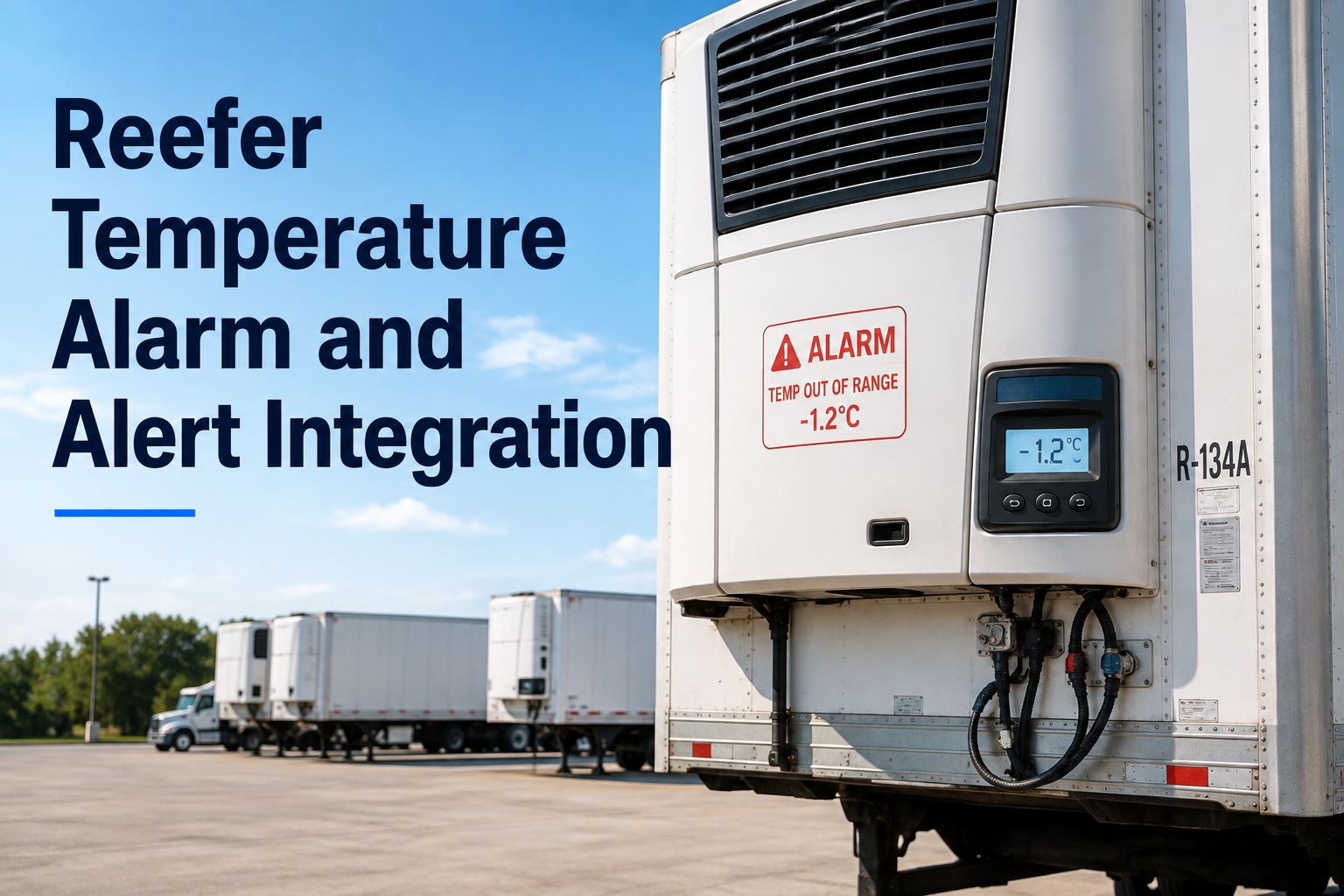
A reefer alarm is worth exactly what happens after it fires. Most fleets already have temperature data streaming from the unit, and most can produce a log if a customer asks. What far fewer can produce is the other half of the obligation: under the sanitary transportation rule, carriers must keep written records showing that corrective action was taken whenever a deviation occurred. An excursion with a perfect temperature trace and no documented response is a compliance gap, not a clean record — and it is also the exact scenario in which a rejected load becomes an argument you lose. The gap is rarely the sensor. It is that the alert lands in a reefer portal while the work order, the inspection and the service history live in a different system entirely. Book a demo and bring one recent excursion — we'll rebuild it in Fleet Rabbit and show what your file would look like if the FDA asked for it tomorrow.
INTEGRATIONS · REEFER ALARM ALERTS
Reefer Temperature Alarm and Alert Integration
Real-time excursion alerts connected to inspections, corrective actions and preventive maintenance — so a temperature breach produces a documented response rather than a notification nobody logged.
One load · setpoint held, then not
Excursion
Alert fires
Action taken
Corrective action recorded
Most setups produce the first two and lose the third. The rule asks for all three — and so does a customer disputing a delivery six weeks later.
What the Alarm Is Actually Protecting
Four exposures, and they compound. A refrigeration failure mid-route is rarely a single loss.
The load itself
A single truckload of frozen seafood or pharmaceuticals can exceed six figures in value. The alarm buys the minutes in which the cargo is still recoverable — enough to redirect, dispatch a relief unit or otherwise act before the load is gone rather than after.
The rejected delivery
A receiver refusing a load on temperature grounds creates a return trip, a disposal question and a claim — all downstream of a deviation that a live alert would have caught while the vehicle was still moving.
The compliance record
Temperature control has to be documented through pre-cooling, transit and delivery, with written corrective actions on any deviation. An excursion is not itself a violation; an undocumented one is a different matter.
The contract
Shippers increasingly require carriers to demonstrate documented temperature control as a condition of doing business. Being able to share temperature reports directly with a customer is now a commercial capability rather than an administrative one — and it shows up at renewal.
Why the excursion is not the failure
Deviations happen — a long dock wait with the doors open, a defrost cycle at the wrong moment, a unit struggling in extreme ambient conditions. What separates a defensible operation from an exposed one is whether the deviation was detected in time to act, acted on, and written down. All three, in that order, and the third is the one that survives to be examined months later.
The Record Set the Rule Expects
Seven items, and most fleets can produce two or three of them on demand. The remainder exist somewhere — on paper, in a cab, in an email — which is not the same as being retrievable.
1Pre-cool verificationDocumented evidence the box was at temperature before loading began, not just that the unit was running.
2Continuous logs from pre-cool through deliveryTimestamped and unbroken across the whole transit rather than sampled at the ends.
3Setpoint alongside actual temperatureWhat was commanded and what was achieved. A log of actuals alone cannot demonstrate the unit was asked for the right thing.
4Written corrective action for every deviationThe item most often missing. Records must show corrective action was taken whenever a deviation occurred — which means the alert has to produce a documented response, not a notification.
5Sanitation and washout recordsVehicles must be kept in a condition that does not create a contamination risk, and the evidence of that sits alongside the temperature file.
6Sensor calibration recordsA temperature log is only as good as the instrument that produced it, and calibration evidence is what makes the log defensible rather than merely present.
7Equipment capability evidenceVehicles and equipment must be capable of holding the specified conditions for the full anticipated transit — which is a maintenance history question as much as a specification one.
On retention: records must generally be kept for at least twelve months from the date each individual record was created — not from the end of the calendar year — and made available to the FDA within twenty-four hours of a request. Paper or electronic both qualify. Longer retention applies to foods on the traceability list under the additional traceability requirements, so check which of your commodities fall inside that scope rather than applying one retention period across everything.
24
hours
to produce records on request
Could you assemble a full temperature file for one load by tomorrow?
Bring a recent excursion and whatever you currently hold about it to a 30-minute call. We'll assemble the file in Fleet Rabbit — pre-cool, continuous log, setpoint, corrective action, calibration and service history — and show you which of the seven items your current systems can actually produce without a manual search.
The Corrective Action Gap
This is where reefer monitoring most often stops short, and the failure is structural rather than careless.
← Swipe to see all columns →
Read the third and fourth rows together. Somebody almost always does respond to a reefer alarm — they call the driver, they check the setpoint, they redirect. The response is real and the record of it is not, which means the operation is behaving correctly and documenting nothing. That is the cheapest gap on this page to close, because the behaviour already exists.
Designing Alerts That Are Worth Reacting To
Six design decisions. Two of them determine whether people take the alerts seriously after the first month.
Independent thresholds per compartment
On multi-temperature vehicles each zone needs its own configuration, so a breach in a secondary chilled section is never hidden behind a healthy primary reading. A single averaged number across zones is worse than no alert at all.
Door events alongside temperature
Door-open sensors give the context that turns a reading into a diagnosis. A rise during a long dock wait with the doors open is a different event from the same rise with the doors shut, and only one of them is an equipment fault.
Duration as well as threshold
A brief deviation during a defrost cycle is not the same as a sustained climb. Alerting on both magnitude and duration is what stops the category being ignored by the people who most need to act on it.
Coverage outside cellular
Where routes cross areas without reliable cellular service, dual-mode connectivity keeps alarms reporting rather than leaving a silent gap that only resolves at the destination — which is the point at which the load is already lost.
Fault codes, not just temperature
Reefer unit fault codes and operating status arriving alongside the readings distinguish a unit that is failing from a load that is warming for an external reason. Different alarms, different responses.
One route out, not several
Every alert should terminate in the same place as everything else about that asset. Mixed fleets running units from different manufacturers should not require staff to switch between manufacturer portals to answer one question about one load.
The Reefer Unit Has Its Own Maintenance Life
A point that gets lost when the refrigeration unit is treated as an accessory on a trailer rather than as an engine in its own right.
01
Reefer hours, not tractor miles
The refrigeration unit runs on its own duty cycle and accumulates hours independently of anything the tractor does. Service scheduled on tractor mileage services the unit on a schedule that has nothing to do with its own wear.
02
Excursion history is maintenance data
A unit producing repeated deviations under normal conditions is telling you something before it fails outright. That signal only exists if excursions and service history sit on the same timeline rather than in separate systems.
03
Small physical faults have large running costs
A modest gap in a rear door seal forces the unit to run continuously to compensate for air infiltration — burning materially more fuel and creating condensation damage to packaging. The repair costs under a hundred dollars and takes about half an hour, and the running cost of leaving it exceeds that many times over within weeks.
04
Unnecessary continuous run is real spend
Units running continuously when cycling would suffice, or running longer than the load required, consume fuel with no benefit. Visible in the operating data, invisible in a fuel report that does not separate reefer consumption.
On integration approach
Where the refrigeration unit has native telematics, connecting to it directly is generally preferable to bolting on third-party hardware — you get setpoint, actual temperature, fault codes and operating status from the source. Where units lack native telematics, wireless environmental sensors fill the gap. Either way the objective is the same: the data reaching the system where the work order gets raised, rather than a manufacturer portal that has to be checked separately.
What to Track
Six figures. The second one is the compliance measure, and almost nobody reports it.
Excursions per hundred loadsBy lane and by unit. Separates a refrigeration problem from a route problem from a customer whose dock keeps trailers waiting with the doors open.
Excursions with a documented corrective actionThe share that produced a written response. This should be complete, and in most fleets it is nowhere near it.
Time from alert to responseMinutes. This is the window in which the load is still recoverable, and it is the operational measure of whether the alerting is working.
Rejected loads and claimsThe outcome measure. Should fall as response time improves, and if it does not, the alerts are firing too late to matter.
Reefer hours against service intervalPer unit, on the refrigeration unit's own clock rather than the tractor's. Reveals which units are overdue on the meter that actually applies.
Record completeness per loadHow many of the seven record items exist and are retrievable. The number you would want to know before an inspection rather than during one.
Connect the alarm to the work order, and the work order to the record
Fleet Rabbit takes setpoint, actual temperature, door events and fault codes from your reefer telematics, raises excursions as assigned exceptions with a documented corrective action, and keeps the whole file on the same asset timeline as inspections, PM history and reefer running hours — so producing a complete temperature record is an export rather than an investigation.
Frequently Asked Questions
What does the sanitary transportation rule actually require?
Documented temperature control through pre-cooling, transit and delivery, with written records showing that corrective action was taken whenever a deviation occurred. Vehicles and equipment must also be capable of holding the required conditions for the full anticipated transit duration. In practice that means a continuous log, evidence of pre-cool, calibration records, sanitation records and a written corrective action for every excursion — not just a temperature trace.
How long do we have to keep the records?
Generally at least twelve months from the date each individual record was created — an important detail, since the clock runs per record rather than from the end of the calendar year — and they must be made available to the FDA within twenty-four hours of a request. Paper or electronic formats both qualify. Longer retention applies to foods covered by the additional traceability requirements, so confirm which of your commodities fall inside that scope.
Is a paper temperature log still acceptable?
Records may be kept in paper or electronic form, so paper is not disqualified. The practical problem is retrieval rather than format: producing a complete file for a specific load within twenty-four hours, months after the fact, from paper held across cabs and offices is a very different exercise from exporting it. Automated continuous logging also removes the accuracy and human-error problems inherent in manual clipboard checks.
Our team already responds to alarms. Isn't that enough?
Not on its own, and this is the most common gap. Somebody almost always does respond — they call the driver, check the setpoint, redirect the load. What is usually missing is the written record that corrective action was taken, which the rule specifically asks for. The behaviour already exists; only the documentation is absent, which makes it the cheapest exposure in the whole cold chain to close.
How should multi-temperature vehicles be configured?
With independent alert thresholds for each compartment, so a breach in a secondary chilled zone is never hidden behind a healthy primary reading. Averaging across zones produces an alert that fires late or not at all on exactly the compartment carrying the sensitive product. Pair the thresholds with door-open sensors, because a rise during a long dock wait with doors open is a different event from the same rise with the doors closed.
Should the reefer unit be on its own maintenance schedule?
Yes. The refrigeration unit runs on its own duty cycle and accumulates operating hours independently of tractor mileage, so servicing it against the tractor's schedule services it against a meter with no relationship to its wear. Keeping reefer hours as a separate trigger, on the same record as excursion history, also means a unit producing repeated deviations under normal conditions gets attention before it fails outright.
Do we need to replace our reefer telematics?
No. Where units have native telematics, connecting directly to them is generally preferable to adding third-party hardware — you get setpoint, actuals, fault codes and operating status from the source, across mixed fleets running different manufacturers. Where units lack native telematics, wireless environmental sensors cover the gap. The change is that the data lands where work is scheduled and records are held.
Start a free trial and connect a few units first.
An Alarm Is Only Worth Its Response
Excursions detected in time to act, thresholds set per compartment with door context, responses recorded as written corrective actions, root causes raised as work orders against the unit — and the whole file retrievable in one export rather than assembled across three systems.
General guidance on cold chain recordkeeping, not regulatory advice — confirm the requirements applicable to your own commodities and operation · Bring one recent excursion to the call