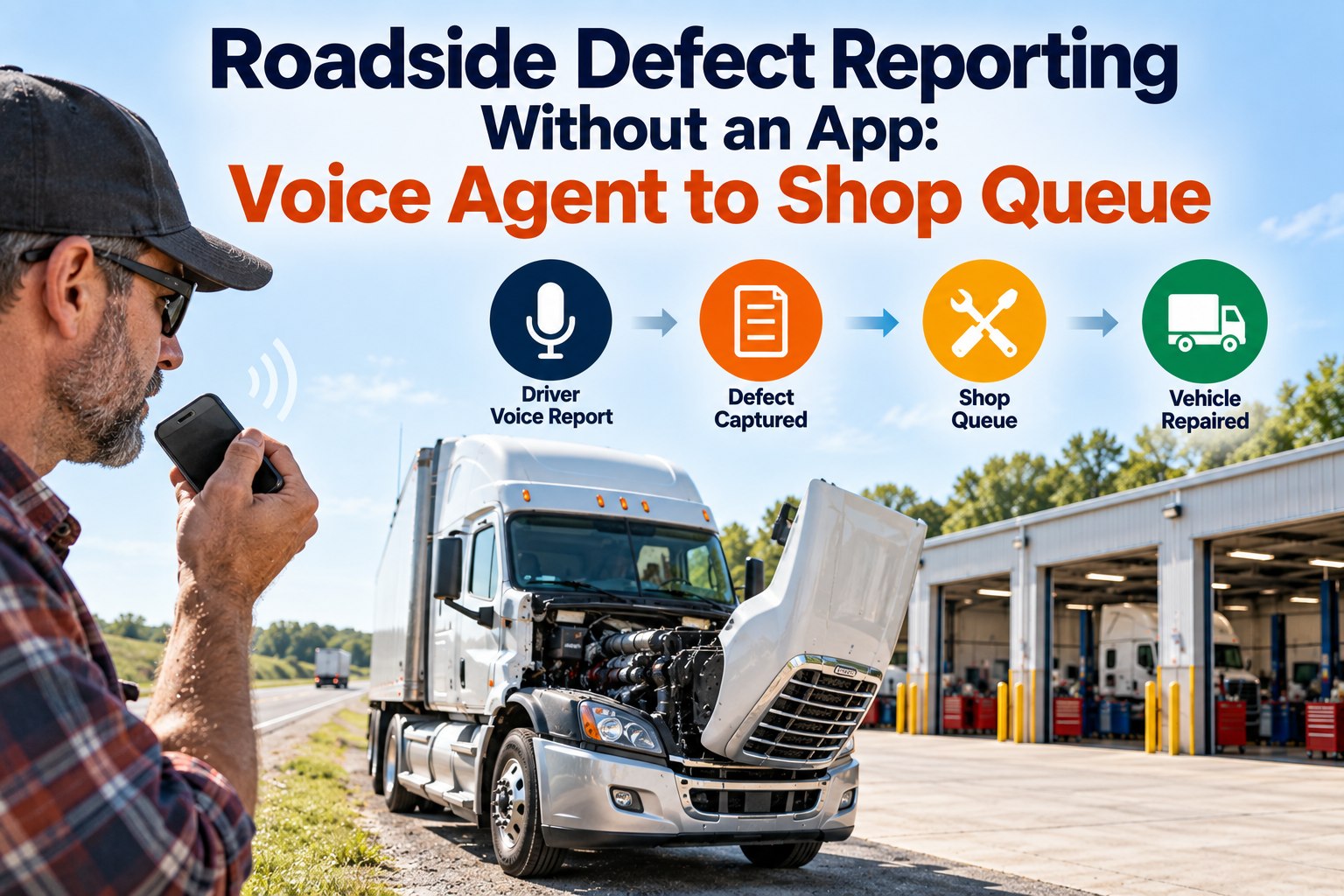
A voice report from the roadside is only useful if the shop can act on it within minutes. That means the call has to end with four things decided: how urgent this is, whether the truck can move, who is going to touch it, and what parts they need. Getting those four right is worth real money, because roadside work has been getting more expensive for years — FleetOwner, reporting FleetNet America's benchmarking, found average cost per event excluding towing up 16.6% year over year in one quarter, and up 19.1% including towing, with FleetNet's Tim Moore pointing fleets back at preventive maintenance on tires, lighting and brakes to reduce emergency call-outs. This guide covers what the shop needs in the first five minutes, the repair-in-place versus tow decision, how to prioritize the queue, what to settle with vendors before you need them, and how to close the loop with the driver. Book a 30-minute demo to see a roadside report land in a queue, or start free with 3 vehicles.
Taking the Call Is Ten Percent of It. Everything That Decides the Outcome Happens in the Next Five Minutes.
For shop leads, maintenance managers and dispatchers: how a driver's roadside report should arrive in the queue already triaged, prioritized, assigned and parts-checked — with no app for the driver to open.
FIRST FIVE MINUTES
What the Shop Needs Before It Can Decide Anything at All
Every minute spent calling the driver back is a minute the truck sits. These six answers should arrive with the report, whether a person or a voice agent takes it, so triage can happen without a second conversation. Capture all six automatically on a free account.
THE BRANCH
Repair in Place, Tow to a Shop, or Bring It In Under Its Own Power
This is the decision that sets the cost of the whole event. Industry reporting in Fleet Maintenance describes the practical line well: mobile service can handle a great deal at the roadside — air hoses, brake adjustment, spring work — but a wheel-end job is usually a tow, and when a truck is close to a shop already, towing it in can be the cheaper answer. Scale matters too: Cox Automotive Mobility Fleet Services alone runs more than 750 mobile service trucks nationally. We'll shape this rule around your own network in a demo.
- Air lines and hoses
- Brake adjustment
- Lighting and electrical
- Tire service
- Filters and fluids
- Wheel-end and hub jobs
- Driveline and transmission
- Anything unsafe to move under power
- Jobs needing diagnosis and road testing
- Unsafe roadside location
- Derate with power remaining
- Slow air leak that holds pressure
- Non-safety defects
- Shop within a sensible distance
- Driver hours available
PRIORITY
How to Prioritize a Roadside Report Against Everything Else in the Queue
A shop queue with no priority is a first-in, first-out list, which is exactly wrong when one truck is on a shoulder and another is parked in the yard. Four levels cover it, and every level states what happens to the truck and to the driver. Set these levels free on 3 vehicles. Swipe the table on mobile.
| Level | Condition | Shop action | Driver and load |
|---|---|---|---|
| P1 | Unsafe to move: brakes, steering, tires, coupling, smoke or fire risk | Dispatch help now | Driver stays with the truck in a safe place |
| P2 | Moving but degraded: derate, power loss, air leak that holds | Nearest qualified shop today | Route changed, load re-planned if needed |
| P3 | Running normally with a defect logged | Booked into the next shop window | Finish the run, repair before next dispatch |
| P4 | Cosmetic or non-safety, already on an open job | Added to the existing work order | No separate visit |
Priority definitions are our assessment of common practice. Anchor the top level to the rule in 49 CFR 396.7 that a vehicle must not be operated in a condition likely to cause an accident or breakdown.
Bring Your Last Five Roadside Events. We'll Rebuild Them as a Queue.
We'll take the calls as they actually happened, apply triage and priority rules, and show where the time went — the callbacks, the wait for a decision, the parts that weren't checked until the tech arrived.
BEFORE ARRIVAL
Parts and People Decided While the Truck Is Still on the Shoulder
The gap between assigning a job and starting it is where most roadside hours disappear. Four checks, all of which can happen while the driver is still describing the problem, remove a second trip. See these run automatically in a demo.
From the defect text and the codes, not from a guess made on arrival.
On the truck, at the terminal, or at the vendor — decided before anyone drives.
The nearest tech is not always the right tech for a wheel end or an aftertreatment fault.
The last three jobs on that system, so a repeat failure is obvious before diagnosis starts.
THE NETWORK
What to Agree With Service Vendors Before You Actually Need Them
At two in the morning is the wrong time to negotiate. Settle these in advance and record them where the person taking the call can see them. Keep vendor terms on the unit record free.
Who covers which corridors, and what response time is actually promised.
Labor, call-out and mileage agreed in advance rather than quoted under pressure.
The list differs by vendor; knowing it avoids a wasted dispatch.
Work performed, parts used and photos, in a form that lands on your work order.
THE LOOP
Closing the Loop With the Driver and the Load
A driver who hears nothing after reporting a defect stops reporting defects. The communication back is as much a part of the workflow as the repair, and each step below should be automatic rather than remembered. See the driver-facing side in a demo.
THE MONEY
Why Roadside Cost Control Is Mostly a Decision-Speed Problem
Roadside events have been getting more expensive: FleetOwner's coverage of FleetNet America's benchmarking reported average cost per event rising 16.6% year over year excluding towing and 19.1% including it in a single quarter, with rising labor and fuel costs cited by FleetNet. Industry benchmarking also puts unplanned downtime at roughly $448 to $760 per truck per day before towing and repair, and ATRI puts 2025 repair and maintenance cost at $0.215 per mile. The controllable part is how long it takes to decide and dispatch. Track your own decision times free.
QUESTIONS
Roadside Reporting and Shop Queue Questions Maintenance Teams Ask
Do drivers need an app to report a roadside defect?
No. A call-in workflow works from any phone with no app and no login, which is what keeps reporting rates up. Photos and signatures wait until the truck is safely parked. See the intake flow in a demo.
How do we decide between a mobile repair and a tow?
By what the job needs. Air lines, brake adjustment, lighting and tire work are common roadside repairs, while wheel-end and driveline jobs usually need a bay — and a truck already close to a shop is often cheaper to tow in. Set the rule free on 3 vehicles.
How should a roadside job be prioritized against shop work?
By safety and by whether the truck can move. Anything unsafe to operate comes first under the rule in 396.7; degraded-but-moving goes to the nearest qualified shop; logged defects on a running truck get booked into the next window. Review your levels with our team.
How do we stop the second trip for parts?
Match likely parts from the defect text and codes, check stock before dispatching anyone, and attach the unit's recent work order history so a repeat failure is visible. Try the parts check free.
What should we agree with vendors in advance?
Coverage and response times, rates including after hours, what they will do at the roadside, and how they report work and parts back into your records. Build the vendor list with us.
How does this connect to the inspection record?
A roadside defect still belongs on the inspection report and still needs repair certification before the next driver takes the truck. The queue speeds the repair; it doesn't replace the chain. Keep both together free.
A Roadside Call That Ends With a Decision, an Owner and the Right Parts on the Way
FleetRabbit takes the driver's report from any phone, opens the job with location, codes and history attached, applies your priority rules, and shows the shop what to bring — then tells the driver what happens next without anyone chasing.
Six answers, no app, hands free while moving.
Priority, repair-in-place or tow, tech and parts.
Driver, shop and vendor on one record until it closes.
No credit card required. Works with the phones your drivers already carry.