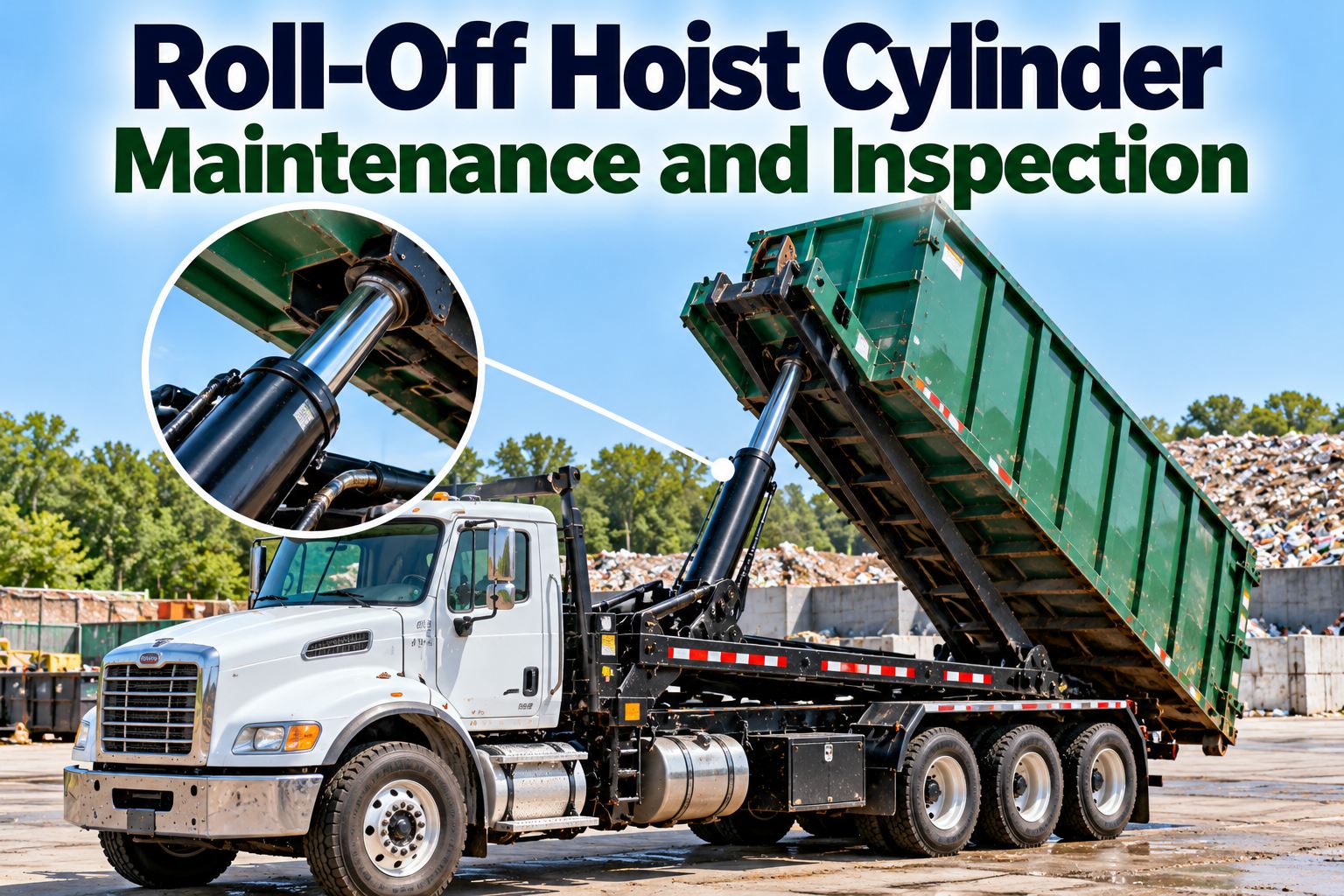
A roll-off hoist cylinder is, by design, the hardest case the hydraulics literature describes. It is a long-stroke cylinder asked to do its heaviest work at full extension, pulling a container sideways across rails rather than lifting it vertically, on ground that is rarely level and with a load that is rarely balanced. Cylinder engineering guidance names side loading as probably the most common cause of rod-bearing failure — and it also notes that resistance to side load is at its lowest precisely when the cylinder is fully extended. That is the whole problem in two sentences, and it explains why a reseal that was not preceded by a diagnosis so often fails again within weeks of going back into service. Book a demo call.
One Shiny Side on the Rod Tells You What Is Killing the Cylinder
Symptoms matched to causes, why full extension is the weak point, what to inspect and how often, and how to stop paying for the same reseal twice.
Uneven polish on the rod means a side load exists. It shows roughly 180° opposite the direction of the load — so it also tells you where to look.
Seven Symptoms, Ranked by How Fast They Need Attention
Start here. Three of these mean the truck should not finish the shift without being looked at, and four can wait for the next scheduled visit if they are recorded.
Side load. Uneven rod contact is the classic signature, and the polish typically appears about 180 degrees opposite the direction of the actual load.
Internal leakage past the piston seals, or a holding valve not sealing. Either way the body is coming down, and the only question is how fast.
Once the chrome is broken the seals run on a cutting edge. This does not improve and it destroys seals repeatedly until the rod is replaced or re-chromed.
Early seal distress. Often follows rod damage or bearing wear rather than being a seal fault in itself.
Air in the circuit, a sticking stage on a telescopic cylinder, or uneven lubrication. Worth distinguishing before parts are ordered.
Internal bypass, a tired pump, or fluid viscosity. Compare against a sister unit before assuming the cylinder.
The mount is no longer holding the cylinder on its intended line, which generates the side load that destroys everything else.
The first and last entries are the same fault seen from two ends. A worn mount stops the cylinder pivoting cleanly, the binding becomes a side load, and the side load prints itself onto the rod as one-sided polish. Replace the seals and you have fixed the symptom furthest from the cause.
Why Full Extension Is the Weak Point
This is the mechanism worth understanding, because it explains why hoist cylinders fail in a pattern that looks like bad luck.
A cylinder resists side load through two bearing points: the piston inside the bore and the head bushing at the barrel mouth. Retracted, those sit far apart and the rod is well braced. As the cylinder extends, the piston travels toward the head, that bracing effect reduces, and the lever arm able to bend the rod lengthens. Guidance states the potential for side loading and column bending rises with longer strokes and greater extension.
Now overlay the job. A roll-off is at or near full extension exactly when the container is heaviest, most off-centre and being dragged across the rails — and frequently while the truck sits on a slope at a tip face. The duty cycle puts maximum lateral force at the point of minimum resistance, every single cycle.
Six Things That Generate the Side Load
In rough order of how often they turn out to be the real answer.
Every roll-off loads the cylinder off-axis to some degree, because the container is pulled across rails rather than lifted vertically. The engineering definition of side loading is a piston rod forced from its designed travel route, and that is a fair description of normal roll-off work.
A clevis or trunnion mount is supposed to let the cylinder move with the load. Once the pin and bore have worn oval, it no longer pivots cleanly — it binds, and the binding becomes a side load applied directly to the rod.
Guidance on preventing side loading is blunt about this: there is no substitute for precision alignment, and it should be checked both extended and retracted. A chassis that has been twisted or a subframe that has shifted puts the cylinder permanently off its line.
Resistance to side load is at its lowest when the cylinder is fully extended, because the piston has travelled toward the head and the two bearing points are at their closest. A sloped or soft tipping area adds a lateral component exactly there.
Abrasive particles circulating through the circuit score the rod and the bore, and a scored surface then destroys seals continuously. This is the failure that keeps coming back after a reseal.
A nick or pit in the chrome is a cutting edge the seal passes over on every stroke. Running it until the leak is bad enough to notice usually means replacing more than the seals.
Two minutes per truck
Has anyone looked at the rod in daylight this month?
Extend the hoist, walk round it, and look for polish on one side. It needs no tools, no gauge and no appointment — and on a fleet of roll-offs it usually finds at least one developing problem that nothing else would have caught.
What to Inspect, How Often, and What You Are Looking For
Seven items. The first one is free and finds more than the other six combined. Swipe sideways on mobile.
| Item | Frequency | Looking for | Why |
|---|---|---|---|
| Rod surface, full extension | Every shift | Polishing on one side, scoring, pitting, nicks | One-sided polish means a side load exists — find the source before replacing seals |
| Mount pins and bushings | Weekly | Fretting, oval wear, play, missing retention | Worn mounts are usually the cause rather than a symptom |
| Alignment, extended and retracted | Monthly | Rails square, subframe true, no twist in the chassis | Guidance is explicit that alignment should be checked in both positions |
| Gland and seal area | Every shift | Weeping under load, fluid tracks on the rod | Distinguish a wet rod film from an actual leak |
| Hose routing and chafe points | Every shift | Rub marks, cover damage, contact at full stroke | Hoses fail where they rub, not at the fitting |
| Hold position test, body raised | Monthly | Measured drift over a set period | A pass or fail on a stopwatch, not an impression |
| Fluid condition and level | Per PM schedule | Contamination, water, aeration | Contamination shortens every seal in the circuit, not just this one |
What It Costs to Diagnose Late
The parts are not what makes this expensive. The sequence is.
A seal kit fitted to a sound rod on a correctly aligned hoist is an ordinary workshop job. The same kit fitted to a rod that is scored will fail again, often within weeks, because the seal is running across a cutting edge on every stroke — and the second reseal costs the same as the first plus the downtime nobody planned for. Let the chrome go far enough and the rod is replaced or re-chromed rather than resealed, which is a different order of cost and a longer truck-out-of-service window.
The expensive version is the one that never gets diagnosed: a worn mount generating a side load, a rod replaced because it was damaged, and a new rod installed into the same misalignment that destroyed the last one. Fleets in that loop are usually paying for a cylinder every eighteen months and treating it as the cost of running roll-offs.
Keep Rod Condition and Reseal History on the Vehicle Record
Every diagnosis above depends on knowing what this cylinder has already been through. That is the specific job the software does.
- Cylinder checks on the daily inspectionRod condition, gland weeping and mount play as named DVIR items, so a one-sided polish is noticed by the person who sees the truck every day.
- Hold-position test on a scheduleA recurring task with a recorded result, which turns body drift from an opinion into a measurement anybody can repeat.
- Repeat-fault detection per unitA cylinder resealed twice on the same truck is an alignment or mount problem. The pattern surfaces instead of being treated as three separate jobs.
- Failed checks open work ordersAn inspection failure becomes a job with an owner and a date rather than something a driver mentioned at shift change.
- Full repair history per vehicleSeals, rods, pins and alignment work on one timeline, so the next technician can see what has already been tried.
- Parts and labour cost per truckHoist spend per unit, which is how the vehicle quietly consuming the hydraulic budget becomes visible.
Product walkthrough · 20 minutes
See a Rod Inspection Become a Tracked Repair
We add the cylinder items to your daily inspection, show a failed check opening a work order, and pull up the repeat-fault view on a unit of your choosing. No obligation, and if your current process already catches this we will say so.
Watch a Live WalkthroughOr set it up yourself — first three vehicles free, and the daily inspection items can be live today.
Roll-Off Hoist Cylinder Questions Fleet Mechanics Ask
What causes a roll-off hoist cylinder to fail?
Side load, more often than anything else. Cylinder engineering guidance calls it probably the most common cause of rod-bearing failure. The rod is pressed into one side of its bushing while the piston drags harder on one side of the barrel, and the resulting uneven wear leads to surface damage, leaks and seal failure.
Why is one side of the rod shiny?
That is the signature of a side load, and it is the most useful free diagnostic you have. Guidance describes the wear as appearing roughly 180 degrees opposite the direction of the actual load, so the polish also tells you which way the cylinder is being pushed.
Is some side load normal on a roll-off?
Some is unavoidable, because the container is dragged across rails rather than lifted vertically. What is not normal is a rod showing one-sided polish early in its life, which points at mounts, alignment or the surface being worked on rather than at the design.
Why does it fail at full extension?
Because that is where the cylinder is least able to resist. Retracted, the rod is braced by both the head bushing and the piston inside the bore. As it extends, the piston travels toward the head, bearing separation shrinks and the lever arm that can bend the rod grows.
Should I just replace the seals?
Not until you know why they failed. If the rod is scored or the mounts are worn, new seals will run on the same cutting edge or the same misalignment and fail again. A reseal that does not outlast the previous one is a diagnosis problem, not a parts problem.
What does a stop tube do?
It sits between the piston and the head to limit full extension, which increases the spacing between the two bearing points and reduces side-load effects. Guidance associates them with longer strokes, generally above roughly 36 to 40 inches. The trade-off is reduced usable stroke.
How do I tell drift from a slow leak?
Measure it. Raise the body, mark the position, and record the movement over a set period on a schedule. A number you can compare against last month is worth more than an impression of whether it seems worse.
Can a bent rod be straightened?
Treat it as a replacement rather than a repair. A rod that has bent has already been loaded well outside its design, and the chrome and bearing surfaces will have suffered alongside it.
Where This Fits in the Wider Schedule
Hoist cylinders tend to sit outside the maintenance programme because they are body equipment rather than chassis, and body equipment frequently belongs to a different budget and sometimes a different supplier. That split is how a component with a predictable failure mode ends up being managed reactively.
The fix is unglamorous. Put rod condition and mount play on the same preventive maintenance schedule as the chassis items, give the hold-position test a date rather than a feeling, and keep every reseal on the vehicle’s own maintenance record so the second one is recognised as a repeat rather than logged as a new job. None of that requires new equipment, and all of it is far cheaper than the cylinder.
Diagnose once, fix once
Stop Paying for the Same Reseal Twice
Rod condition and mount play on the daily inspection, a hold-position test with a recorded result, repeat faults flagged per unit, and every cylinder repair on one vehicle timeline. First three vehicles free.