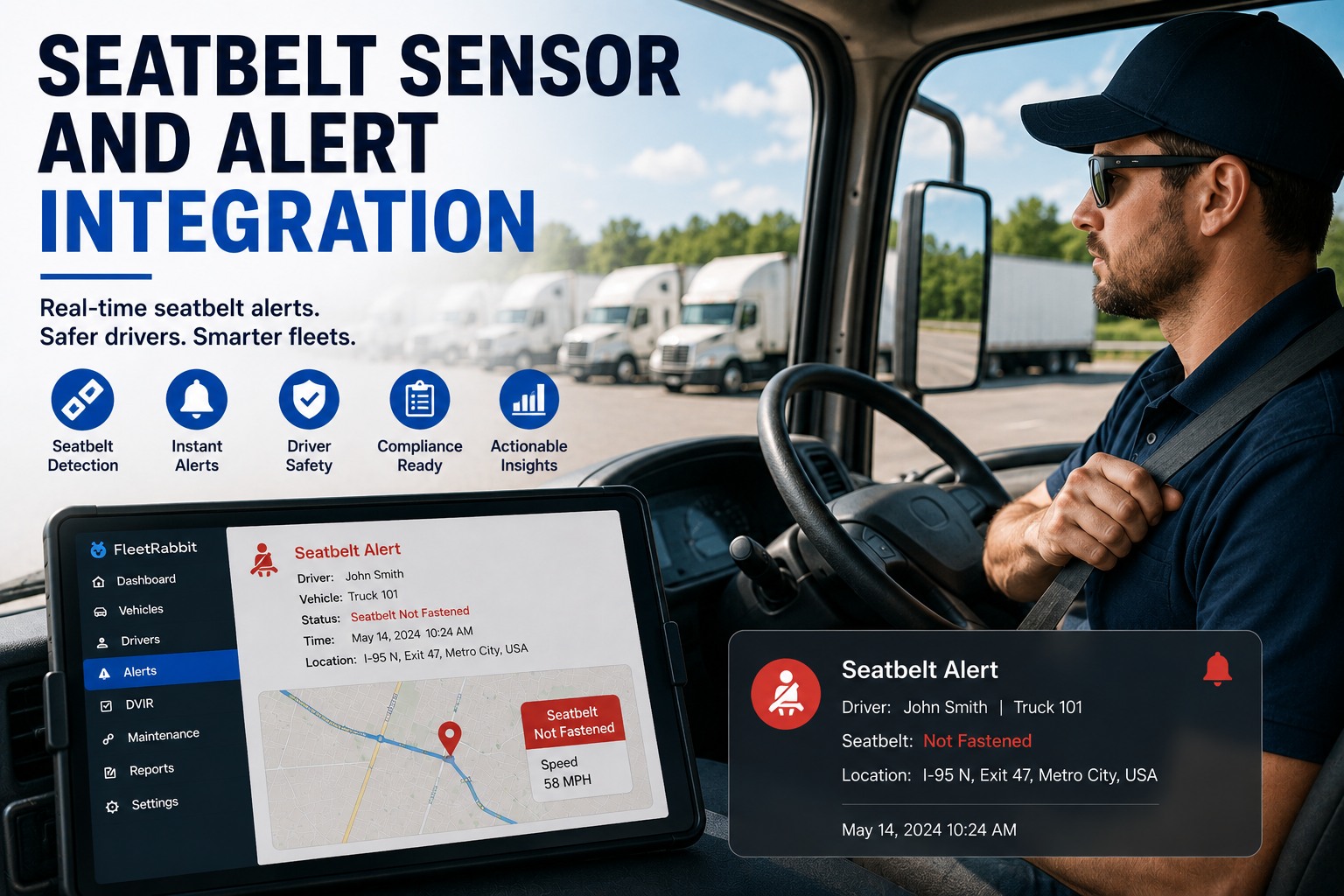
The seatbelt is the single most effective piece of safety equipment in any vehicle — and the most ignored. The National Highway Traffic Safety Administration found that 69.3% of drivers who died in crashes in 2022 were not wearing a seatbelt, and the FMCSA reports that roughly 14% of commercial motor vehicle drivers still don't buckle up. A seatbelt sensor alert is how a fleet catches that in real time: the moment a driver operates unbelted, the system flags it, and many pair it with an in-cab chime or even slow the vehicle until the belt is fastened. But a real-time alert is only the first link in a chain. The alert needs to become coaching for the driver who keeps unbuckling, a compliance record for the CSA violation it represents, and — uniquely for seatbelts — it depends on the belt hardware itself actually working, which means the sensor, buckle, and webbing need to be inspected like any other safety component. Bring seatbelt sensor alerts into your fleet workflow with FleetRabbit: real-time alerts, inspections, and preventive maintenance connected end to end, so an unbuckled event becomes coaching, a documented record, and a verified, working belt. This page shows why it matters, the connected chain, what links, and why alert plus inspection beats an alert alone. Start free with 3 vehicles or book a demo to see seatbelt alerts connected end to end.
INTEGRATION · SEATBELT SAFETY & COMPLIANCE
Seatbelt Sensor and Alert Integration for Fleets
Bring seatbelt sensor alerts into your fleet workflow with FleetRabbit — real-time alerts, inspections, and preventive maintenance connected end to end, so an unbuckled event becomes coaching, a documented compliance record, and a verified, working belt.
Why Seatbelt Compliance Matters So Much
No other safety behavior moves the fatality numbers like belt use. The data is stark, and it's exactly why seatbelt alerts are worth connecting to real action.
69.3%
of drivers who died in 2022 crashes were unbelted, according to NHTSA — the single largest modifiable fatality factor
~14%
of commercial motor vehicle drivers still don't wear their seatbelt, the FMCSA reports
Seatbelt violations aren't only a safety issue — they're scored under the FMCSA's CSA Unsafe Driving BASIC alongside speeding and reckless driving, and belt status is increasingly logged in event data recorders that can be admissible in civil liability cases. Catching and documenting belt use is both a life-safety and a compliance priority.
A Real-Time Alert Is Only Real If the Hardware Works
A seatbelt alert does two jobs, and both need follow-through the alert itself can't provide. First, it flags an unbuckled driver — but a single alert changes nothing unless the driver who keeps unbuckling is coached and the violation is documented for the CSA record. Second, and unique to seatbelts, the alert depends entirely on working hardware: a faulty buckle sensor, a frayed belt, or a jammed retractor is both a safety failure and a false-signal source, and seatbelt data is famously noisy — systems must filter erratic buckled/unbuckled readings to be trusted. A belt that won't latch or a sensor that misreports is a safety system quietly not doing its job. That's why seatbelts belong in your inspection routine, not just your alert feed. FleetRabbit connects all of it end to end — the alert to coaching, the violation to a compliance record, and the belt hardware to the inspection and maintenance that keep it working.
See how the whole chain connects.
The Connected Chain, End to End
When seatbelt sensor alerts connect to FleetRabbit, a single unbuckled signal flows through the whole safety-and-maintenance workflow — alert, coaching, record, and the inspection that verifies the belt itself.
Link 1
Real-Time Alert
The sensor flags an unbuckled driver instantly, often with an in-cab chime — the immediate feedback that fixes behavior in the moment.
Link 2
Coaching
FleetRabbit surfaces the drivers who repeatedly unbuckle so a recurring pattern becomes a fair, evidence-based coaching conversation.
Link 3
Compliance Record
The violation becomes a documented, timestamped record supporting the CSA Unsafe Driving BASIC and any liability defense.
Link 4
Belt Inspection
The sensor, buckle, and webbing enter the inspection and PM routine, so the hardware the alert depends on is verified and repaired.
An alert on a broken belt sensor protects no one.
FleetRabbit connects seatbelt alerts to coaching, compliance records, and the inspection that keeps the hardware working — end to end. Start free with 3 vehicles or book a demo.
What Connects Between Seatbelt Alerts and FleetRabbit
The integration passes the belt-status, driver, and hardware data that matters for coaching, compliance, and inspection. Swipe the table horizontally on mobile.
← Swipe to see all columns →
Connect Seatbelt Alerts End to End
Bring seatbelt sensor alerts into FleetRabbit and connect real-time alerts, inspections, and preventive maintenance from end to end — unbuckled events becoming coaching, violations becoming CSA-ready records, and the belt hardware entering the inspection routine that keeps it working. Protect drivers and prove it. At $5/vehicle/month, no hardware, live within 72 hours, free for up to three vehicles.
Alerts to coaching
Violations to CSA records
Belts in inspections
One safety trail
Why Alert Plus Inspection Beats an Alert Alone
A seatbelt alert flags the behavior. Connecting it to coaching, compliance, and inspection is what turns a flag into a life saved and a record you can stand behind.
The Belt Actually Works
Putting the sensor, buckle, and webbing into the inspection routine means the safety system the alert relies on is verified and repaired — not quietly failing while the feed looks fine.
Coaching That Sticks
Surfacing repeat unbucklers turns a stream of alerts into targeted, fair coaching — addressing the driver who keeps unbuckling rather than letting the pattern hide in a dashboard.
CSA and Liability Covered
A documented, timestamped belt-use record supports the Unsafe Driving BASIC and provides defensible evidence when belt status becomes a factor in a liability case.
Keep the Sensors You Have
You don't replace your seatbelt sensors or telematics — you connect them. The hardware keeps detecting belt use while FleetRabbit adds the coaching, compliance, and inspection layer.
Frequently Asked Questions
What does the seatbelt sensor integration with FleetRabbit do?
It connects your seatbelt sensor alerts to FleetRabbit and links them to coaching, compliance, and inspection end to end. A real-time unbuckled alert triggers immediate feedback, repeat offenders flow into a coaching workflow, the violation becomes a CSA-ready compliance record, and the belt hardware — sensor, buckle, and webbing — enters the inspection and preventive-maintenance routine. Instead of belt alerts living alone in a telematics feed, they become behavior change, documentation, and verified working hardware in one platform. Seeing that connected chain on your own fleet is what you can
book a demo to do, or you can
start free with 3 vehicles and try it directly.
Does FleetRabbit replace my seatbelt sensors or telematics?
No — it complements them. Your seatbelt sensors and telematics units are what detect belt status and generate the real-time alerts, sometimes with in-cab chimes or speed limiting when unbuckled. FleetRabbit connects to that data and links it to coaching, compliance records, and the inspection that verifies the belt hardware. You keep the sensors and telematics you already run and add the layer that turns belt alerts into end-to-end action, which you can
book a demo to see in practice.
Why do seatbelts need inspection, not just alerts?
Because the alert depends entirely on working hardware. A faulty buckle sensor, a frayed belt, or a jammed retractor is both a safety failure and a source of false signals — and seatbelt data is notoriously noisy, with systems needing to filter erratic buckled and unbuckled readings to be accurate. If the sensor misreports or the belt won't latch properly, the safety system isn't protecting the driver no matter what the feed shows. Putting the belt into your inspection and PM routine is how you verify it actually works, which FleetRabbit makes part of the same workflow — something you can
book a demo to explore, or
start free with 3 vehicles to set up.
How do seatbelt violations affect CSA compliance?
Seatbelt violations are scored under the FMCSA's CSA Unsafe Driving BASIC, right alongside speeding and reckless driving. That means unbuckled driving isn't just a safety concern — it directly affects the score that can trigger investigations, higher insurance premiums, and more frequent audits. Documenting belt use and the fleet's response to violations is how you manage that exposure proactively. FleetRabbit keeps the timestamped, tracked record that supports CSA management, which you can
book a demo to review for your operation.
Can it help with driver coaching on belt use?
Yes. Because each alert carries a driver ID, FleetRabbit can surface the drivers who repeatedly operate unbuckled and turn that into a targeted coaching workflow. Context matters for fairness — a driver who briefly unbuckled to reach for paperwork is different from one who never buckles on long routes — and having the pattern documented lets managers coach fairly and effectively rather than making it personal. Seeing repeat unbucklers turned into fair, evidence-based coaching is something you can
book a demo to see for your fleet.
Is belt-status data admissible in liability cases?
Increasingly, yes — some manufacturers now log belt status in event data recorders that can be admissible in civil liability cases, which makes documented belt use a real factor in litigation. Having a clear, timestamped record of belt use and how your fleet responded to violations strengthens your position when a claim arises. FleetRabbit keeps that documentation connected to the driver, vehicle, and inspection history in one place, so it's defensible and findable rather than scattered, which you can
book a demo to see assembled.
Which fleets benefit most from this?
Any fleet subject to CSA scoring or serious about driver safety, but especially commercial motor carriers — given that roughly 14% of CMV drivers still don't buckle up and belt use is the single largest modifiable factor in crash fatalities. Long-haul operations, delivery fleets, and any fleet where drivers spend long hours alone benefit most from connecting real-time belt alerts to coaching, compliance, and hardware inspection. Seeing it configured for your fleet type is something you can
book a demo to walk through.
How quickly can we get started?
Fast — FleetRabbit goes live within 72 hours with no hardware to install, running on devices your team already has, so once your seatbelt-alert data connection is configured you can start connecting alerts to coaching, compliance, and inspection quickly. You keep your existing sensors and telematics and simply add the end-to-end workflow layer, with no rip-and-replace. It's free for up to three vehicles, so you can
start free with 3 vehicles today, or
book a demo to map how your belt alerts should flow into coaching, compliance, and inspection first.
Connect Every Seatbelt Alert to Real Action
Bring seatbelt sensor alerts into FleetRabbit and connect real-time alerts, inspections, and preventive maintenance end to end — unbuckled events becoming coaching, violations becoming CSA-ready records, and the belt hardware verified in your inspection routine. Protect drivers with the safety equipment that matters most, and prove it works. Integrated in 5–7 working days, at $5/vehicle/month, free for up to three vehicles, with no hardware required.
Free tier for up to 3 vehicles · No credit card required · No hardware installation
August 10, 2026
By Derek Goes
All Articles