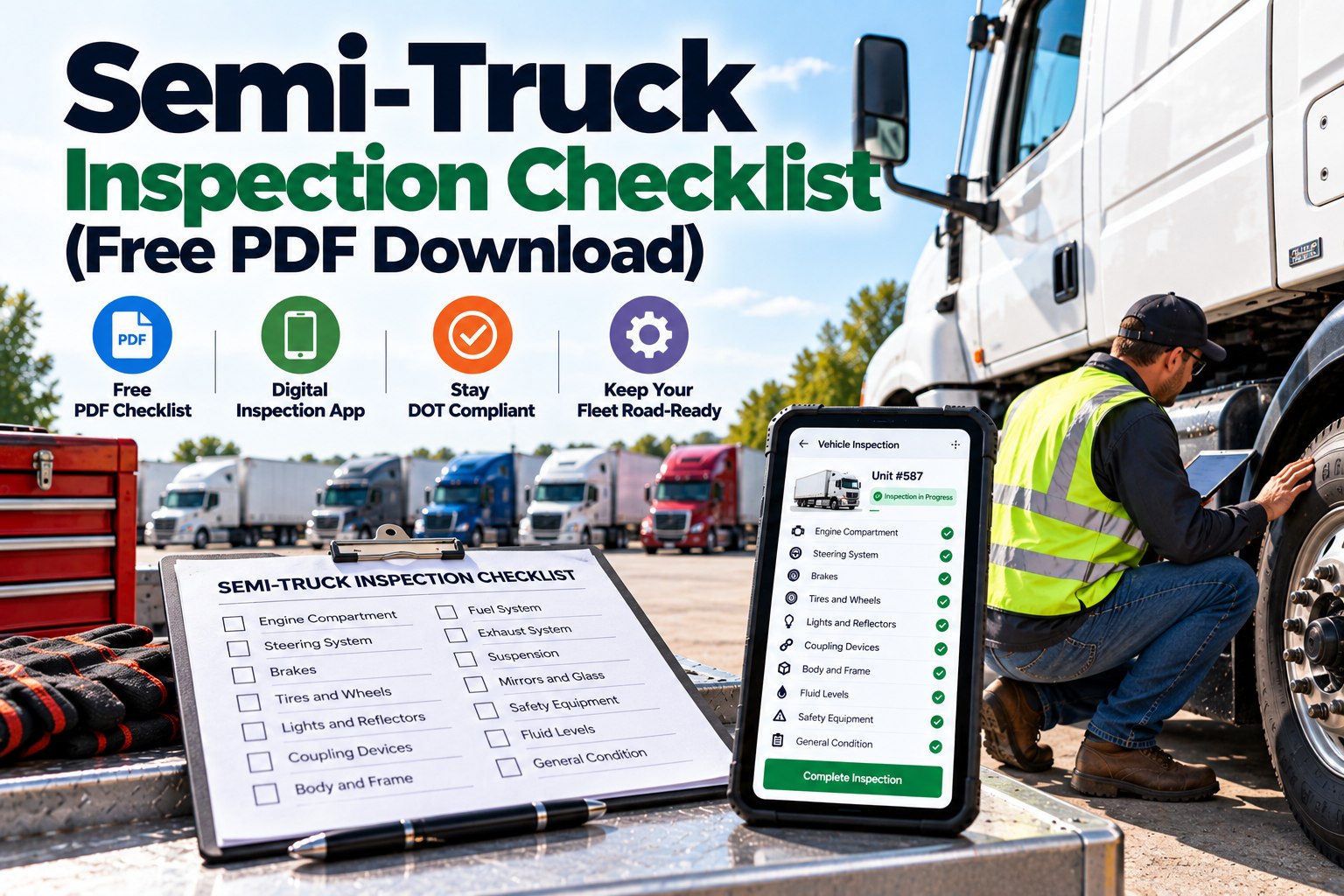
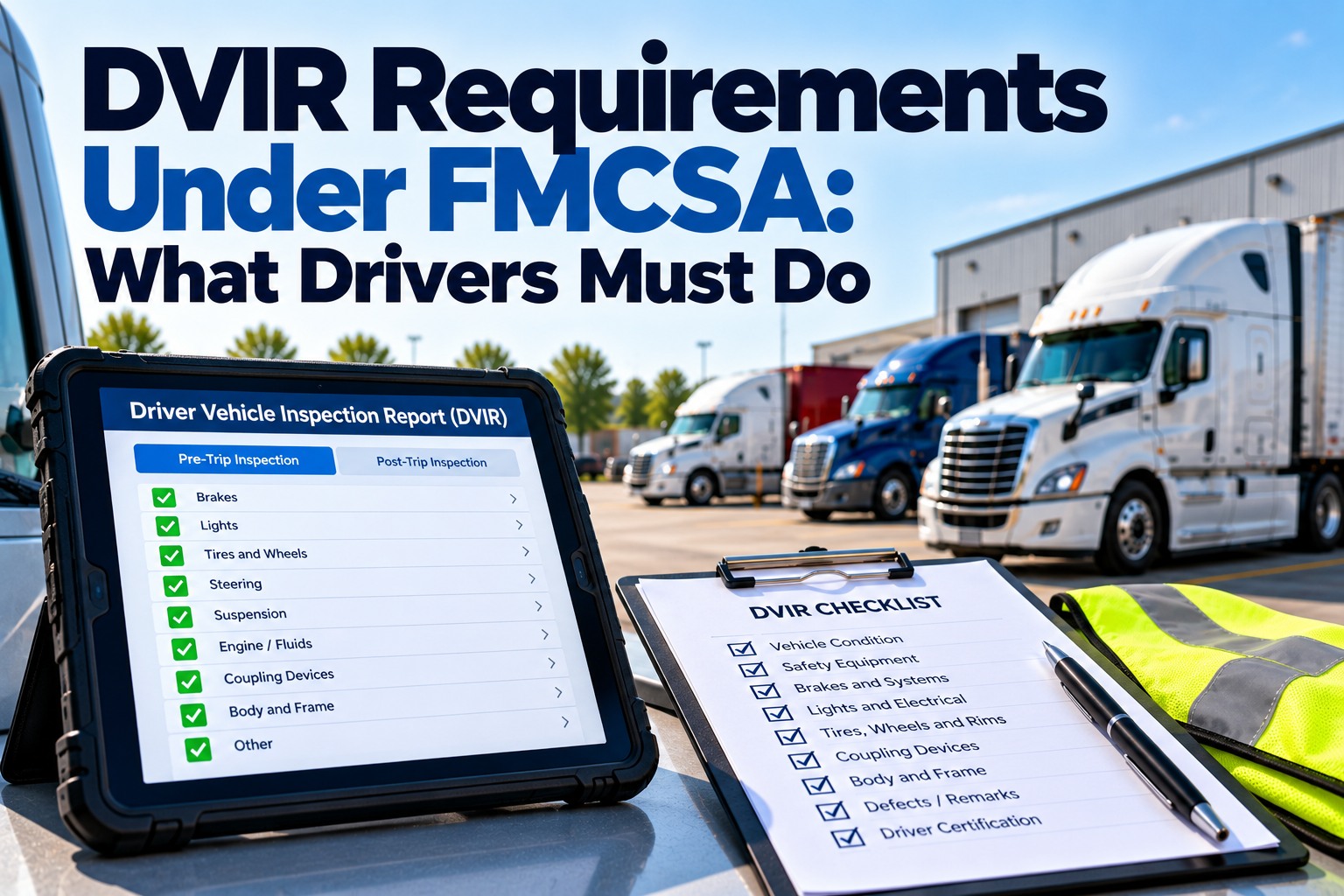
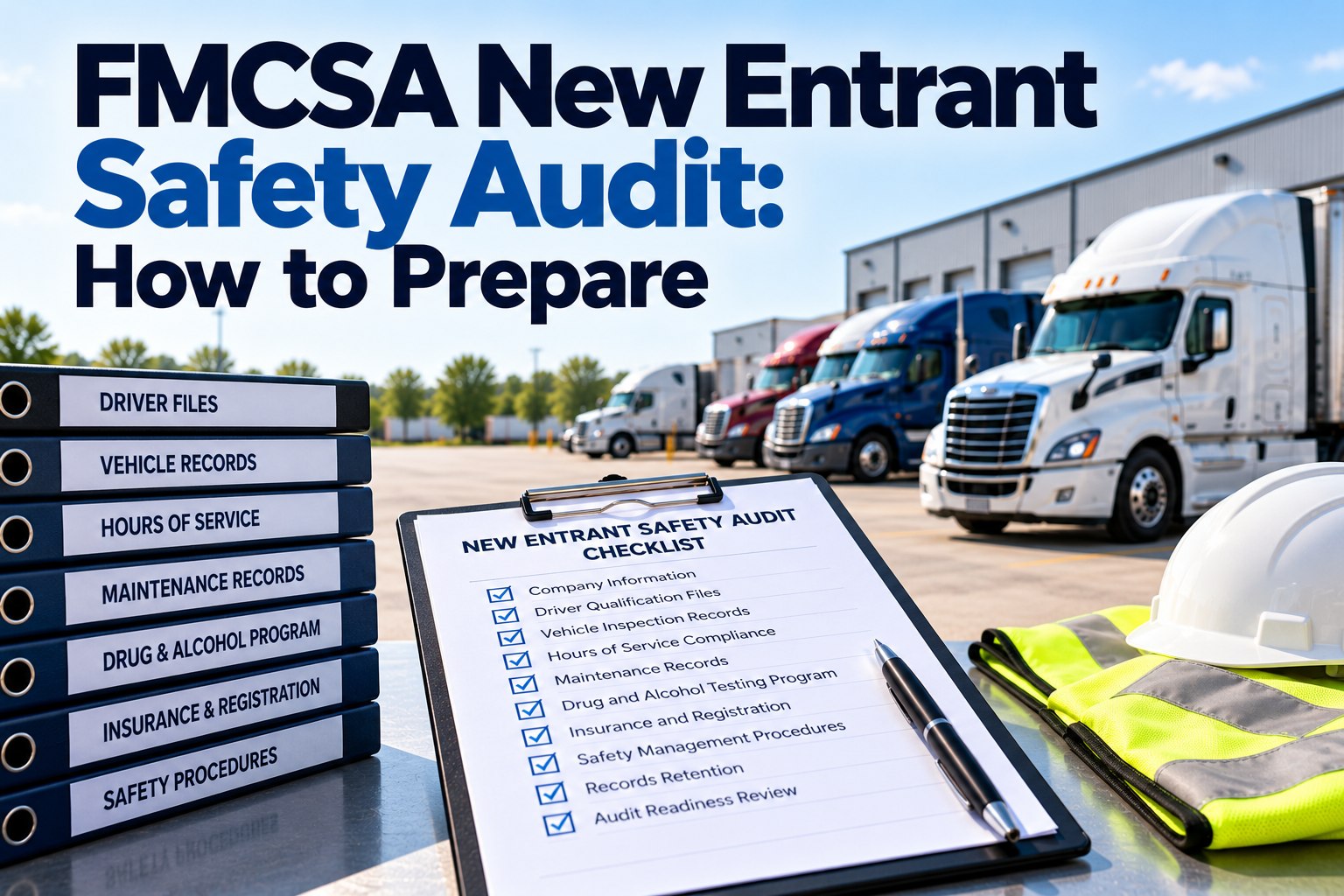
A semi-truck inspection covers two vehicles in one: the tractor and the trailer. Each has its own brakes, tires, lights and coupling points, and each goes through four different inspections in its life: the driver's daily check, the shop's interval inspection, the annual inspection required by federal rules, and the roadside inspection an officer can start at any time. This guide gives you a 57-point tractor-and-trailer checklist ordered by what roadside inspectors write up most, explains what the annual inspection file must contain and shows how to run the whole thing paperless. Schedule a call and we'll send you the PDF checklist, or work through it below.
SEMI-TRUCK INSPECTION · TRACTOR + TRAILER CHECKLIST
Two Units, Four Inspections, One Record Trail
Two vehicles, four kinds of inspection and one record trail. Check what roadside inspectors check most, keep what the annual inspection requires and stop losing paper.
57 checkpoints across both units
Four Inspections Every Semi Goes Through
A single checklist doesn't cover them all. Each inspection has a different owner, a different frequency and a different record.
1
Daily driver inspection
Who: the driver · When: before driving and at the end of the day · Record: written DVIR for any defect, kept 3 months · Rules: 49 CFR 392.7, 396.11, 396.13
2
Preventive maintenance inspection
Who: the shop · When: at your mileage, hour or time interval · Record: work order tied to the unit · Rules: your carrier's maintenance program
3
Annual inspection
Who: a qualified inspector · When: at least once every 12 months · Record: inspection report kept 14 months, plus proof on the vehicle · Rules: 49 CFR 396.17, 396.19, 396.21
4
Roadside inspection
Who: an enforcement officer · When: without notice · Record: inspection report left with the driver · Standard: CVSA out-of-service criteria
What Roadside Inspectors Write Up Most
CVSA's 2025 International Roadcheck put 18.1% of inspected vehicles out of service. These five categories made up the top vehicle out-of-service violations, so the checklist below starts with them.
Top vehicle out-of-service violations, share of all violations (violation count)
Brake systems
24.4% (3,304)
20% defective brakes
16.7% (2,257)
Cargo securement
11.4% (1,549)
The Semi-Truck Inspection Checklist
Work through each system for the tractor and the trailer, ticking each box as you go. Items marked CRITICAL are the ones most likely to put a vehicle out of service. A vehicle can also be placed out of service when 20% or more of its brakes are defective, so don't treat a brake defect as minor. Use your browser's print function to print this page as a checklist.
1
Brakes
The top out-of-service category
24.4% of OOS violations
2
Tires, Wheels and Rims
Second most common out-of-service category
21.4% of OOS violations
3
Lights and Electrical
Walk it with a helper or use a reflection
12.8% of OOS violations
Want the full tractor-and-trailer checklist as a printable PDF?
Schedule a call with us and we'll send the PDF, then show you how the same inspection runs paperless on a phone.
4
Cargo and Trailer Body
Check it again after the first 50 miles
11.4% of OOS violations
5
Coupling
Where tractor meets trailer
Critical to safe operation
6
Steering, Suspension and Frame
Walk the vehicle front to back
Part of every Level I inspection
7
Engine, Fuel and Exhaust
Tractor only
Fluids and leaks
8
Cab, Emergency Equipment and Documents
Tractor only
The paperwork inspectors ask for
Run Every Semi Inspection Without the Paper
Schedule a call and we'll send the PDF checklist, then set up the same inspection in FleetRabbit's mobile DVIR so each tractor and trailer check is timestamped and photographed, defects reach the shop at once and records are stored for you. Free for up to three vehicles, then $5 per vehicle per month.
Mobile DVIR with photos
Defect to work order
PM scheduling
Records kept for you
The Annual Inspection File: What to Keep
The annual inspection is the one carriers most often cannot prove. Under 49 CFR 396.17 every component in Appendix A must have passed an inspection at least once in the preceding 12 months, on each vehicle in the combination, tractor and trailer alike. The report is kept for 14 months under 396.21. Use this as the template for each unit's file.
Proof of a passed inspection must also be available on or with the vehicle, either as the report itself or as a decal or sticker showing the inspection date, the carrier, the vehicle identification and a certification of compliance. You can find the rules in 49 CFR 396.17.
Putting the Four Inspections Online
The point of going paperless isn't the app, it's that each inspection leaves a record you can find. Here is how each of the four maps onto FleetRabbit.
DAILY
Mobile DVIR
Drivers complete the checklist on a phone with photos. Defects reach the shop immediately and the repair is certified on the same record.
INTERVAL
PM scheduling
Set mileage, hour or time intervals per unit. Each service becomes a work order tied to the tractor or trailer.
ANNUAL
Recurring service and file
Schedule the annual as a recurring service per unit, and keep the report on the vehicle's record so it's ready for 14 months.
ROADSIDE
Readiness
With records, open defects and repairs in one place, you know before an officer does what would be found.
Frequently Asked Questions
What should a semi-truck inspection checklist include?
Both the tractor and the trailer: brakes, tires and wheels, lights and electrical, cargo securement, coupling, steering, suspension and frame, engine, fuel and exhaust, and the cab with its emergency equipment and documents. The checklist above covers all eight groups.
How often must a semi truck be inspected?
Daily by the driver, before driving and at the end of the day, and at least once every 12 months through the annual inspection in 49 CFR 396.17. Roadside inspections can happen at any time, and carriers also inspect on a preventive maintenance schedule.
Is the annual inspection required for trailers too?
Yes. The annual inspection rule applies to all vehicles under the carrier's control, including each vehicle in a combination such as tractors, semitrailers, full trailers and converter dollies.
Who can perform the annual inspection?
A qualified inspector under 49 CFR 396.19, whether employed by the carrier or a commercial garage or other provider with suitable facilities. The carrier remains responsible for the report.
How long do I keep inspection records?
Annual inspection reports are kept for 14 months from the date of the report, where the vehicle is housed or maintained, and driver vehicle inspection reports are kept for 3 months.
See how FleetRabbit stores both in one place.
What are the most common reasons a semi is put out of service?
In CVSA's 2025 International Roadcheck, brake systems, tires, defective brakes at the 20% threshold, lights and cargo securement were the top vehicle out-of-service categories. That's why they lead the checklist.
Is a PDF checklist enough?
A completed and kept PDF or paper form satisfies the daily rule. The weak point is what happens next: lost forms, slow defect reporting and scattered records.
Try the mobile DVIR on three trucks to see the difference.
One Checklist. Two Units. Every Record in One Place.
Use the PDF today, then move your tractor and trailer inspections to your drivers' phones so every check, photo and repair stays with the unit.
Free tier for up to 3 vehicles · No credit card required · Works on the phones your drivers already have
October 2, 2026
By Sam Parker
All Articles