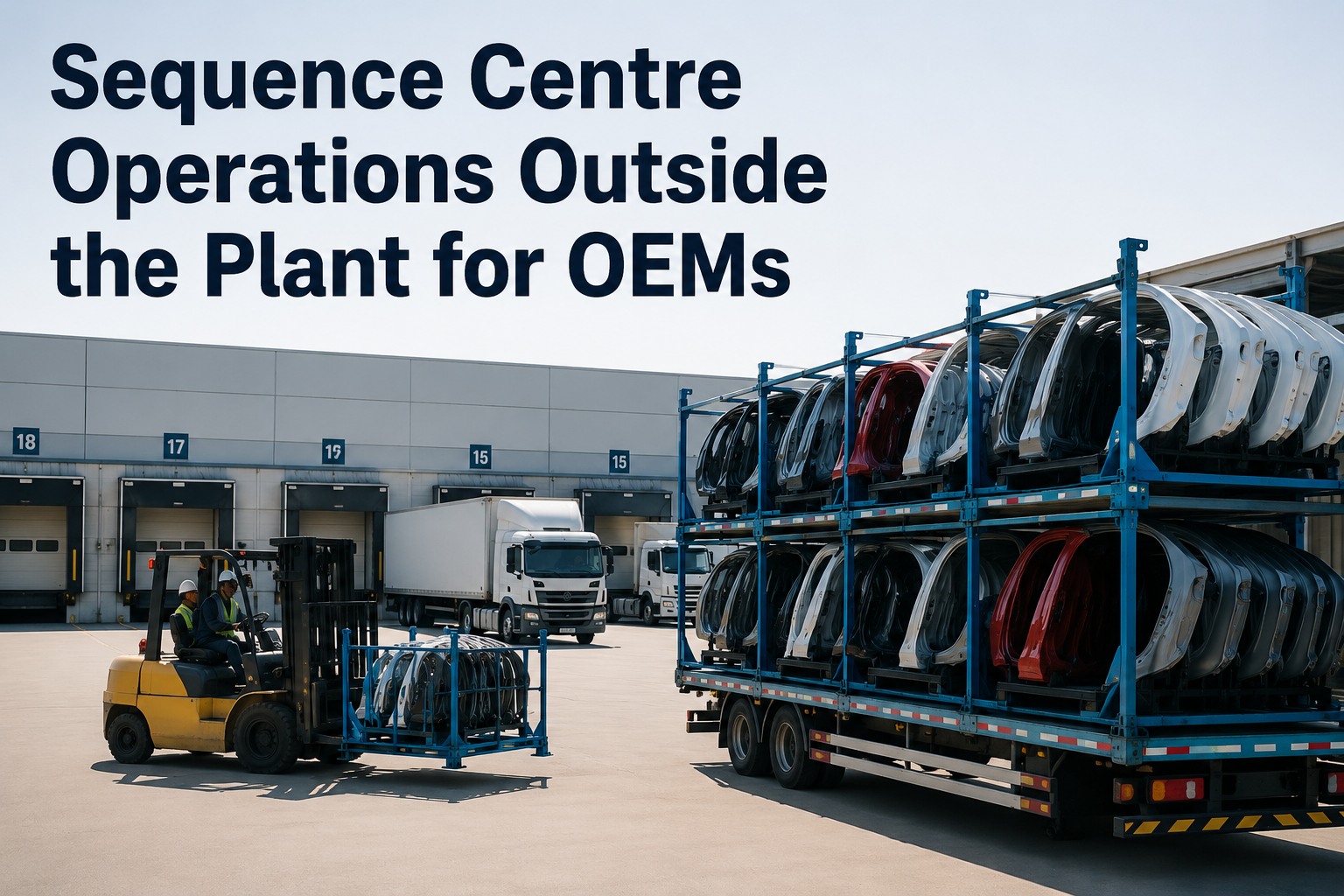
Putting the sequencing operation outside the plant solves a floor-space problem and creates an accountability one. The centre now sits between a Tier 1 who built the parts and an OEM whose line consumes them, which means every sequence break has two plausible owners and one clear victim. Worse, the model compresses the very interval that used to provide recovery time — in automotive there is often very little time between sequence retrieval and production-synchronous delivery to the assembly site, so a build error discovered at the plant gate cannot be corrected at the centre. That is not an argument against off-site sequencing, which for many part families is the only economic option. It is an argument for designing the accountability and the transport window before the first module ships, because both are extremely difficult to renegotiate once a centre is running and a line is depending on it. Book an architecture review to map the handovers across your own centre.
Tier 1Builds and ships to the centre in bulk
Sequence centreReceives, sequences, loads to build order
PlantConsumes in sequence, no time to correct
ENTERPRISE GUIDE · OFF-SITE SEQUENCING
Sequence Centre Operations Outside the Plant
Transfer accuracy across four handovers, a transport window with no slack in it, and dual accountability written into the contract rather than discovered during an incident.
When an Off-Site Centre Is the Right Answer
Four conditions. Where three or more hold, off-site sequencing usually wins on economics; where only one does, you are probably exporting a problem rather than solving it.
1The variant count exceeds line-side spaceSequencing collapses many variants into one delivered stream, which is worth most where storing all variants at the station is physically impossible.
2Multiple Tier 1s feed one moduleA centre can consolidate components from several suppliers into one sequenced delivery — axles, shocks and brakes arriving separately and leaving as one ordered stream.
3The supplier lacks sequencing capabilitySmaller suppliers meet demanding OEM requirements through a provider's established infrastructure and expertise rather than a prohibitive capital investment of their own.
4Geography has movedTrade and sourcing shifts change where it is optimal to ship from, and a centre can be relocated far more easily than a supplier plant.
The condition that is not on the list
"Our sequencing is unreliable and we want someone else to own it." Moving an unstable process off site does not stabilise it — it adds a transport leg and a contractual boundary to a process that was already failing, and it removes your ability to fix problems by walking over to the cell. Fix first, outsource second.
Four Handovers, Four Failure Modes
Transfer accuracy in the off-site model is not one problem. It is four, in series, and each needs its own verification — because a break at any one of them looks identical at the station.
H1Tier 1 into the centre
Bulk receipt of components, usually unsequenced. Standard inbound with one difference: the receiving party has no visibility of the build plan these parts will eventually serve, so quantity and variant errors are invisible here.
Verify byDespatch advice against call-off, plus variant reconciliation at receipt rather than at build
H2Build at the centre
The sequencing itself — components ordered against the OEM's published build order, then packed. This is where sequence identity is created, and where a mis-pick becomes a mis-sequence rather than a wrong part.
Verify byDirected picking with location lock, plus scan confirmation per position before the rack closes
H3Centre into transport
Loading order determines unloading order. Last-in-first-out loading is what allows the plant to unload straight into consumption sequence without a sort — and this is the last point at which an error costs minutes rather than a line stop.
Verify byLoad-order scan at the trailer door, compared against the published sequence before departure
H4Transport into the plant
Arrival, unload and delivery to the station. Nothing can be corrected here — the window is gone. Verification at this point is confirmation for the record and an input to attribution, not a recovery opportunity.
Verify byStation-side confirmation before install, closing the loop for both parties
Note that H3 carries the weight. It is the last controllable point in the chain, it is entirely within the centre's operation, and it is cheap to instrument — a scan at the trailer door against the published order. Centres that verify at H2 only are verifying that the right rack was built, not that the right rack was loaded in the right order.
Every off-site model has four handovers. Most contracts describe one.
An architecture review maps your handovers, identifies which are currently unverified, and sets out the accountability split and evidence set for each — usable in a contract negotiation regardless of vendor.
Dual Accountability, Written Down
Three parties, one line. This is the split that works — and the principle underneath it is that a provider remains accountable for outcomes, inventory accuracy, service levels, damage rates and on-time performance under contract even where it subcontracts parts of the execution.
← Swipe to see all columns →
The row people argue about
Transport execution belongs with the centre even when a carrier does the driving, because splitting it produces a gap the moment a load is late — the centre points at the carrier, the carrier is not a party to your contract, and the OEM has a stopped line and nobody to hold. A provider that subcontracts remains accountable for on-time performance under its contract; make that explicit rather than assumed.
The Transport Window Has No Slack
The defining constraint of the off-site model. Budget it explicitly, because every component below is real and the total is usually shorter than anyone assumes when the centre is selected on land cost.
From sequence retrieval to line-side, component by component
Sequence retrieval and releaseThe centre receives the confirmed build order and releases it to the floor. Latency here is pure loss.
Pick and buildThe only component the centre can compress through process improvement.
Load in reverse orderLIFO loading plus the verification scan. Skipping the scan buys minutes and costs the recovery option.
TransitFixed by geography, variable by traffic. The component that decides whether the centre location was a good decision.
Gate, yard and dock at the plantFrequently omitted from the window budget entirely, and frequently the largest surprise.
Unload to line-sideStraight into consumption order if H3 held. A sort here means the window has already been overrun.
Recovery allowanceWhat remains after the above. In most off-site models this is close to zero — which is why prevention at H2 and H3 matters more than any recovery plan.
Contract Terms Worth Specifying
Written before go-live, these prevent almost every dispute that off-site models generate. Written afterwards, they are a renegotiation with a party who knows your line depends on them.
Sequence accuracy, in ppmMeasured at station confirmation, not at centre despatch. A percentage figure conceals the volume; parts per million does not.
Load-order verification as an obligationNamed as a contractual step at H3, with the scan record retained. This is the single clause that most reduces disputes.
Window definition and ownershipWhich clock starts at retrieval, which segments belong to whom, and what happens when the OEM's own gate consumes the slack.
Late amendment protocolHow far into the window the OEM may still change the order, what it costs, and when the centre may refuse.
Component shortage escalationThreshold, notification route and decision rights when a Tier 1 fails to feed the centre. Otherwise the centre absorbs it silently until it cannot.
Evidence retention and accessWhich records exist, for how long, and who may query them. Attribution without shared evidence is a negotiation.
Subcontracted transport accountabilityExplicitly retained by the centre, so a carrier failure is not a gap in the chain of responsibility.
Exit and continuityHow sequencing capability transfers if the relationship ends. Rarely written, and the reason some centres become impossible to replace.
What to Measure Across the Boundary
Both parties should see the same numbers on the same cadence. A centre and a plant working from different reports will disagree about reality within a quarter. Our analytics and reporting module carries the shared view.
Sequence accuracy at stationThe headline. Measured where consumption happens, since everything upstream reports intent rather than outcome.
Breaks by handoverH1 through H4, attributed. Without this split, every break becomes an argument about which of four things went wrong.
Window consumption by segmentIncluding the plant's own gate, yard and dock time. Shows whether the centre or the plant is eating the slack.
Load-order verification coverageShare of despatches with a completed H3 scan. Should be total, and is frequently not.
Amendments issued inside the windowThe OEM's own contribution to instability, and the metric most likely to be missing from a centre performance review.
Component coverage at the centreTier 1 supply position seen from the centre, so a shortage is visible to the OEM before it becomes a missed sequence.
Map the Handovers Before You Sign
An architecture review takes your part families, centre location, transport leg and plant receiving process, and produces the four-handover map, the accountability split by line item, and the window budget with each segment's owner named. Usable in a contract negotiation whichever provider you choose.
Four-handover verification
Tri-party accountability
Window budgeting
Shared evidence set
Frequently Asked Questions
Where should sequence accuracy be measured?
At station confirmation in the plant, not at centre despatch. Despatch measurement tells you the rack was built and loaded as intended; only consumption proves the right module reached the right build. This matters commercially as well as operationally — a centre measuring itself at its own door will report a better number than the plant experiences, and the gap between those two figures becomes the substance of every quarterly review until someone agrees a single measurement point.
Which handover deserves the most investment?
H3, the load into transport. It is the last controllable point in the chain, it sits entirely within the centre's operation, and load order determines unload order — last-in-first-out loading is what lets the plant unload straight into consumption sequence without a sort. A scan at the trailer door comparing load order against the published sequence is inexpensive and catches the errors that would otherwise be discovered when correction is impossible. Verifying only at build confirms the rack, not the load.
Who is accountable when a subcontracted carrier is late?
The centre, and this should be explicit in the contract. A provider can subcontract components of the service but remains accountable for outcomes, inventory accuracy, service levels, damage rates and on-time performance under its contract. Splitting transport accountability out creates a gap precisely when it matters most: the centre points at the carrier, the carrier has no contract with you, and the plant has a stopped line and no counterparty. Retain it with the centre and let them manage their own carrier arrangements.
How much recovery time does the off-site model leave?
Very little, by design. There is often extremely little time between sequence retrieval and production-synchronous delivery to the assembly site, and once the window budget is broken down — retrieval, build, load, transit, gate and yard, unload — the residual allowance is usually close to zero. That is why the emphasis has to sit on prevention at build and load rather than on a recovery plan. A recovery plan that assumes forty minutes you do not have is a document, not a capability.
Should the plant's gate and yard time be inside the window budget?
Yes, and it is the most commonly omitted segment. A centre can execute perfectly and still miss the station if the load spends twenty-five minutes in a gate queue, and the resulting dispute is unwinnable for both sides because neither has instrumented that segment. Including plant gate, yard and dock time in the shared window budget makes the OEM's own contribution visible, which tends to improve it — and removes the most common source of unresolvable attribution arguments.
Can a centre serve multiple Tier 1s for one module?
Yes, and it is one of the stronger cases for the model. A provider can receive related components from different suppliers — axles, shock absorbers and brakes, for instance — and despatch them as one correctly sequenced stream, which the plant could not achieve without either a supplier park or considerable line-side space. The complication is upstream: a component shortage from any one Tier 1 breaks the whole sequenced delivery, so coverage visibility at the centre needs to reach back to each supplier individually.
What does the OEM still have to do?
Publish a stable sequence, honour the frozen window, and instrument its own receiving. Off-site sequencing shifts execution, not planning — a centre working from a build order amended repeatedly inside the window will fail regardless of how well it is run, and the amendments will be attributed to them. Track amendments issued inside the window as a first-class metric on the OEM side; it is usually the fastest available improvement and it is entirely within your control. Our
integrations overview covers the data handoffs.
Design the Boundary, Not Just the Building
Four handovers each verified where correction is still possible, accountability specified line by line across three parties, a transport window budgeted including your own gate, and both sides reading the same numbers on the same cadence.
Works with any sequencing provider · Shared evidence model · Site-level configuration