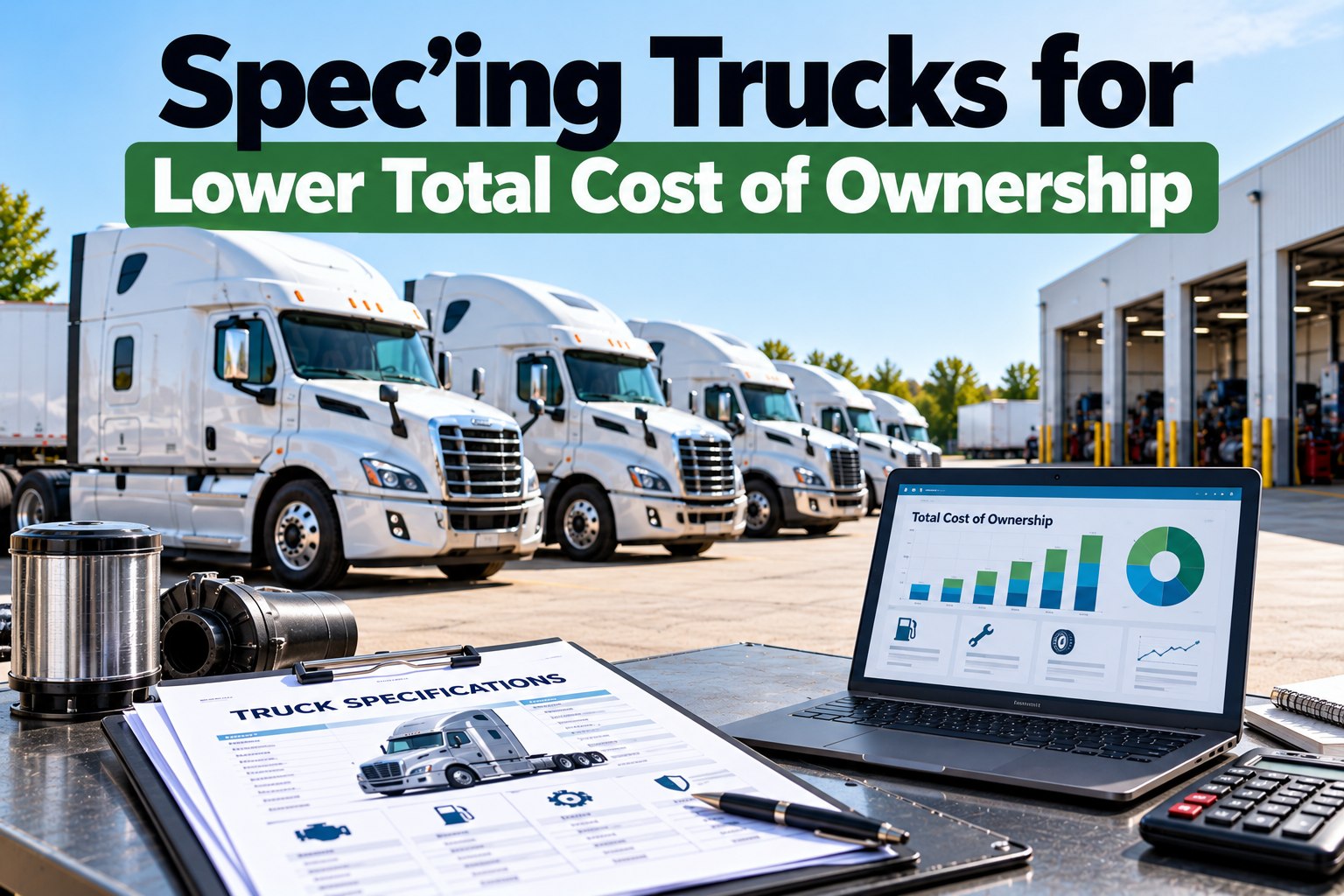
Spec'ing a truck decides most of its cost before it leaves the dealer: the engine, transmission, axle ratio, tires and aerodynamics set fuel use, and the components set how often it breaks. The aim is lowest total cost over the years you keep it, not the lowest price on the order. This page covers the spec choices the trade press and efficiency groups point to, the fuel savings they report and the trade-offs behind each. Schedule a call to track fuel and maintenance cost per truck by spec.
How Fleets Spec a Truck for Lower Total Cost: Start with the Duty Cycle, Not the Price
Weight, region, speed and annual miles decide which specs fit, and both over-spec and under-spec cost money
FleetOwner's Jeremy Wolfe (April 2025) says to define the duty cycle first and to involve drivers, technicians and dealers. Under-specifying raises downtime and maintenance cost, while over-specifying wastes money up front. He adds that you should weigh price, resale value, financing and order lead times, and review past maintenance records, since repeat failures can signal an under-specified part. The article gives no dollar figures.
Weight, region, speed and annual miles
Choose parts that last that long
Engine, transmission and axle as a set
Aero, tires, axle ratio
Repeat failures can mean under-spec
Spec Choices That Move Fuel Economy and Reliability, with the Trade-Off Behind Each
Automated transmissions, axle configuration and axle ratio each help in some duty cycles and hurt in others
| Spec choice | What the sources say it does | Trade-off to weigh |
|---|---|---|
| Automated transmission | Can extend clutch life, improve fuel economy and reduce driver strain | Manuals still suit some very heavy applications |
| Engine and transmission from one OEM | Designed to work together | Less freedom to mix suppliers |
| 6x2 instead of 6x4 | About 2.5% more fuel efficient (Cummins figure) | 6x4 gives more torque for heavy loads and rough terrain |
| Lower axle ratio | 2.79:1 favors fuel economy over 3.73:1 for torque | Steep terrain and heavy hauls may need higher ratios |
| Downspeeding | About 1% fuel gain per 100 rpm lower cruise speed | Higher driveline torque and about $500 more upfront in a mid-2010s study |
| Aerodynamic and low-rolling-resistance packages | Recommended by OEMs and NACFE for fuel economy | Match to duty cycle and speed |
Most of this table comes from one FleetOwner explainer. The 6x2 figure is a Cummins number the article cites, and we could not check it at the source.
Fuel Savings Reported for Truck Specs: Axle Configuration and Downspeeding Compared
Published gains are a few percent each, so the spec only pays if it matches your routes and speeds
NACFE and RMI's downspeeding summary, which dates from the mid-2010s, reports 2 to 3 percent fuel savings from downspeeding alone, 3 to 6 percent combined with complementary technologies, and about 1 percent per 100 rpm drop in cruise speed. It cuts 65 mph cruise from 1,600 rpm or more to under 1,200 rpm by changing rear-axle ratios, and says the best results pair it with an automated manual transmission.
Fuel Economy by Weight Class: Why Your Operation Sets the Target Before the Spec Does
A 4.9 mpg figure for heaviest fleets and 7.2 mpg for mid-weight fleets show how much load and duty cycle matter
A September 2019 FreightWaves piece cites ATRI average fuel economy by loaded weight and NACFE's national average, shown below. It also says fuel was about $14.50 an hour on the road and 22 percent of a Class 8 truck's cost of ownership, per ATRI, and repeats a 2-to-1 aerodynamics rule from a low-quality site, so we leave that rule out. The OEM spec advice in the article comes from Navistar, Volvo, Freightliner and Mack marketing staff.
These are 2019 figures. Check current ATRI and NACFE data before using them to set a target.