Every fleet already generates speeding data — the GPS and telematics units on your vehicles compare real-time speed against posted limits on every mile. The problem is what happens to it. Too often a speeding alert sits inside a telematics export nobody opens, right up until a pattern nobody acted on turns into a rear-end collision, a six-figure claim, and an insurance review that points straight at data the fleet already had. Speeding isn't just a safety issue: every mile per hour over the limit lengthens stopping distance and raises the force of a potential collision, it's scored directly under the FMCSA's CSA Unsafe Driving category where violations stay on record and drive up premiums and audits, and it quietly inflates fuel spend and wear on brakes, tires, and drivetrains. Get more from your speeding alerts by unifying inspections, maintenance, and compliance data in one place with FleetRabbit — so a speeding event becomes coaching, the wear it causes becomes scheduled service, and the whole pattern becomes an audit-ready record. This page shows the three ways speeding costs you, how the data unifies, what connects, and why one record beats scattered alerts. Start free with 3 vehicles or book a demo to see speeding data unified with maintenance.
INTEGRATION · SPEED SAFETY & COMPLIANCE
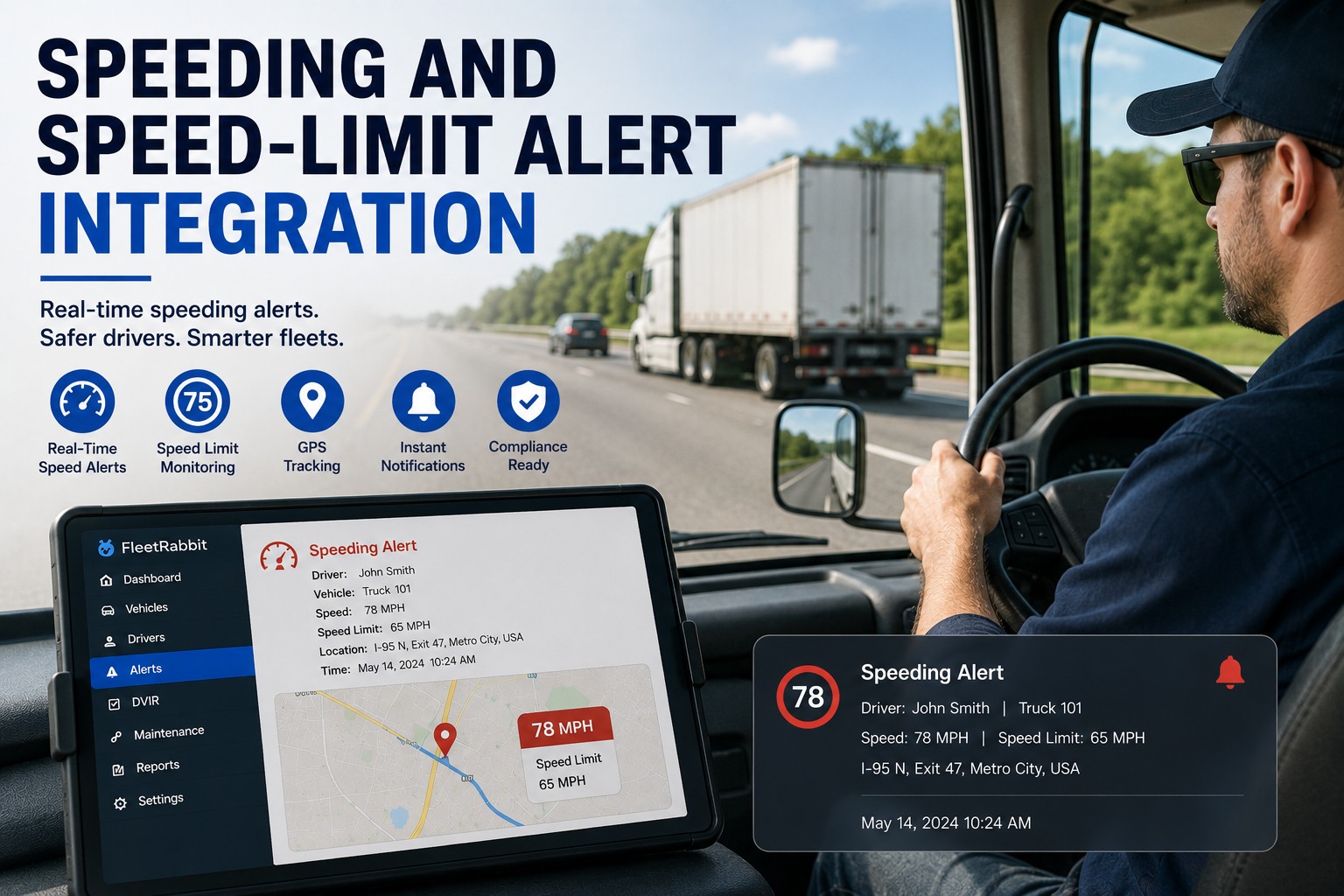
Speeding and Speed-Limit Alert Integration for Fleets
Get more from your speeding alerts by unifying inspections, maintenance, and compliance in one place with FleetRabbit — so a speeding event becomes coaching, the wear it causes becomes scheduled service, and the pattern becomes an audit-ready record.
CSAScored under Unsafe Driving
Every mphraises collision force
Wearbrakes, tires, fuel, drivetrain
Three Ways Speeding Costs Your Fleet
A speeding alert is easy to dismiss as a minor infraction. It isn't. Speeding hits a fleet in three distinct places at once — and unifying the alert with maintenance and compliance is what addresses all three.
Safety & Collision Severity
The faster a vehicle travels, the greater the force in any collision and the longer the stopping distance. Speeding raises both the likelihood and the severity of a crash — the risk that ends in injury, litigation, and a claim.
CSA Compliance Exposure
Speeding is scored directly under the FMCSA's CSA Unsafe Driving BASIC. Those scores stay on record and, past a threshold, can trigger investigations, higher insurance premiums, and more frequent audits.
Fuel & Component Wear
Sustained high speed and the hard braking that follows it burn extra fuel and accelerate wear on brakes, tires, engines, and drivetrains — a maintenance cost that compounds quietly across a fleet.
A Speeding Alert Nobody Acts On Is Just a Claim Waiting to Happen
Your telematics already flags every speeding event. But an alert that sits in an export nobody opens changes nothing — the driver isn't coached, the wear isn't serviced, and the CSA exposure isn't managed until a roadside inspection or a collision makes the pattern impossible to ignore. In one documented case, a delivery fleet had drivers running 20-plus mph over posted limits on residential routes several times a shift, and none of it surfaced until a rear-end collision produced a $61,000 claim and an insurance review that pointed straight at data the fleet already had. A standalone speed dashboard shows the alerts but doesn't turn them into coaching, maintenance, or a compliance record. FleetRabbit closes that gap — unifying speeding data with the coaching, the service the wear demands, and the audit-ready record, all in one place.
See how speeding alerts become action.
How FleetRabbit Unifies Your Speeding Data
Connecting speeding alerts to FleetRabbit turns a stream of violations into coaching, maintenance, and compliance — everything tied to the driver and vehicle in one view instead of scattered across tools.
Your Telematics Provides
Speed vs. posted-limit events
Tiered severity of violations
Timestamp, GPS location, driver ID
Repeat-offender patterns
FleetRabbit Unifies Into
Driver coaching workflows
Wear-based inspection & PM triggers
CSA-ready compliance records
One audit-ready event trail
Speeding data you don't act on is a premium increase you can't explain.
FleetRabbit turns speeding alerts into coaching, wear-based maintenance, and a CSA-ready record — before the claim and the audit arrive. Start free with 3 vehicles or book a demo.
What Connects Between Speeding Alerts and FleetRabbit
The integration passes the speed, location, and driver data that matters for coaching, maintenance, and compliance. Swipe the table horizontally on mobile.
← Swipe to see all columns →
Unify Speeding Alerts With FleetRabbit
Connect your speeding and speed-limit alerts to FleetRabbit and bring coaching, maintenance, and compliance into one place — violations becoming CSA-ready records, repeat patterns becoming driver coaching, and high-speed wear becoming scheduled service. Get more from data your telematics already generates. At $5/vehicle/month, no hardware, live within 72 hours, free for up to three vehicles.
Violations to CSA records
Patterns to coaching
Wear to scheduled service
One audit trail
Why One Record Beats Scattered Alerts
A speeding alert protects nothing on its own. Unifying it with maintenance and compliance is what turns a raw violation into fewer claims, lower premiums, and a cleaner audit.
Manage CSA Before It Manages You
Speeding feeds the Unsafe Driving BASIC. Turning each violation into a tracked, coached, documented record keeps that score in hand instead of discovered at a roadside inspection.
Coaching Before the Claim
A driver running well over the limit several times a shift is a claim in waiting. Coaching them the week it starts is far cheaper than the collision and the premium hike that follow.
Wear Serviced, Not Ignored
Sustained speeding and the hard braking it brings wear brakes and tires faster. Tying that to condition-based service means the wear is maintained before it becomes a breakdown.
Evidence, Not Argument
Timestamped, GPS-located speed data makes enforcement fair and disputes short — drivers can't argue with hard data, and the fleet is protected from false claims.
Frequently Asked Questions
What does the speeding alert integration with FleetRabbit do?
It connects your telematics speeding and speed-limit alerts to FleetRabbit and unifies them with coaching, maintenance, and compliance. A speed-limit violation becomes a CSA-ready compliance record, repeat-offender patterns trigger a driver coaching workflow, and the component wear that sustained speeding causes drives condition-based inspection and service. Instead of speeding alerts piling up in a telematics export nobody opens, each one becomes action in one platform. Seeing that on your own fleet is what you can
book a demo to do, or you can
start free with 3 vehicles and try it directly.
Does FleetRabbit replace my telematics or GPS system?
No — it complements it. Your GPS and telematics units are what detect speed against posted limits and generate the alerts. FleetRabbit connects to that data and unifies it with maintenance, coaching, and compliance — the action layer on top of the tracking layer. You keep the telematics hardware you already run, whatever brand it is, and add the platform that turns speeding alerts into coaching, service, and audit-ready records, which you can
book a demo to see in practice.
How does speeding affect my CSA score?
Speeding is one of the violations scored under the FMCSA's CSA Unsafe Driving BASIC, alongside reckless driving and improper lane changes. Those scores stay on record and, once a carrier crosses a threshold, can trigger investigations, interventions, higher insurance premiums, and more frequent audits. Managing speeding proactively — coaching drivers and documenting the response — is how fleets keep that BASIC in hand. FleetRabbit keeps the tracked, documented record that supports proactive CSA management, which you can
book a demo to review for your operation.
Can speeding data really drive maintenance?
Yes. Sustained high speed and the hard braking that tends to follow it accelerate wear on brakes, tires, engines, and drivetrains — unsafe driving creates real maintenance cost. When speeding data connects to FleetRabbit, a pattern of high-speed operation on a vehicle can trigger condition-based inspection and service on those components, so a truck driven hard is maintained on its real wear rather than a fixed calendar. Seeing speeding patterns drive component service is something you can
book a demo to review, or
start free with 3 vehicles to set up.
How does it help with driver coaching?
Because each speeding event carries a driver ID and severity tier, FleetRabbit can surface repeat offenders and turn them into a coaching workflow, prioritizing serious violations over a brief highway lapse. Coaching a driver the week a pattern starts is far cheaper than the collision and premium increase that follow an ignored trend — and timestamped, GPS-located data makes the conversation evidence-based rather than a dispute. Seeing repeat patterns turned into fair, timely coaching is something you can
book a demo to see for your fleet.
Does this help with the coming speed-limiter rules?
It supports your readiness. Federal speed-limiter requirements are on the horizon for commercial vehicles, and fleets that already monitor and manage speed are best positioned for the transition. FleetRabbit unifies your speed data with maintenance and compliance so you have a documented, managed speed program in place rather than scrambling when rules take effect. Discussing how a unified speed-and-maintenance record fits your compliance roadmap is something you can
book a demo to work through.
How does this help with audits and insurance?
By keeping the whole speed story in one place. When speeding violations, the coaching they prompted, the maintenance they triggered, and any incidents all live together in FleetRabbit, an auditor or insurer request is answered from one connected, timestamped trail. Insurers increasingly price fleets on how well they use safety technology and can show improvement, so a documented record of managed speed behavior directly supports better terms. Seeing that compliance and insurance trail assembled is something you can
book a demo to explore.
How quickly can we get started?
Fast — FleetRabbit goes live within 72 hours with no hardware to install, running on devices your team already has, so once your speeding-alert data connection is configured you can start turning violations into coaching and records quickly. You keep your existing telematics hardware and simply add the layer that unifies speed data with maintenance and compliance, with no rip-and-replace. It's free for up to three vehicles, so you can
start free with 3 vehicles today, or
book a demo to map how your speeding data should drive your workflow first.
Turn Speeding Alerts Into Managed Risk
Connect your speeding and speed-limit alerts to FleetRabbit and unify inspections, maintenance, and compliance in one place — violations becoming CSA-ready records, patterns becoming coaching, and high-speed wear becoming scheduled service. Get more from data your telematics already generates, before the claim and the audit arrive. Integrated in 5–7 working days, at $5/vehicle/month, free for up to three vehicles, with no hardware required.
Free tier for up to 3 vehicles · No credit card required · No hardware installation
August 10, 2026
By Derek Goes
All Articles