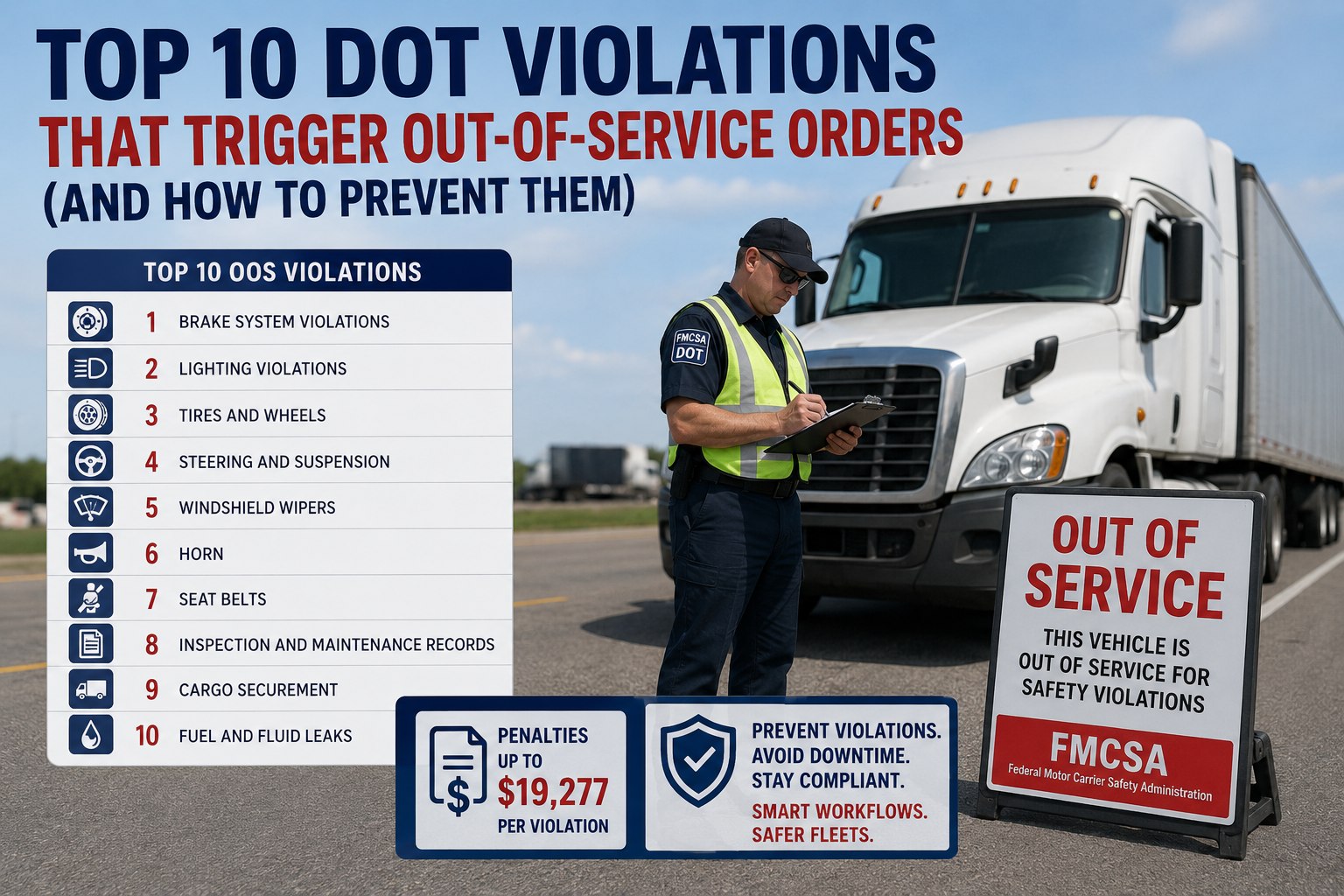
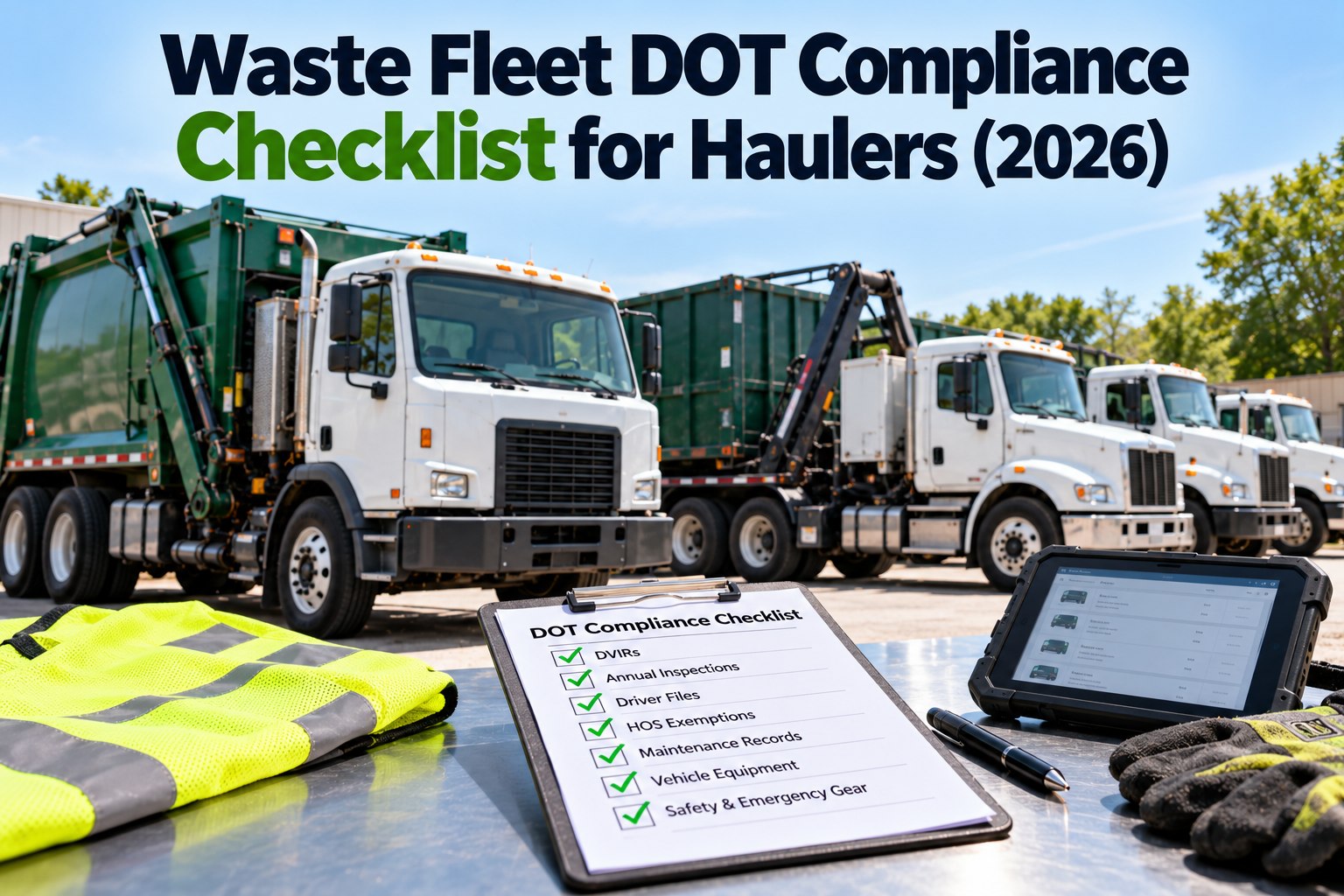
Every year, FMCSA issues hundreds of thousands of violations during roadside inspections — and a specific handful of them account for the overwhelming majority of vehicles pulled off the road. During the 2025 CVSA International Roadcheck, inspectors examined 56,178 commercial vehicles and placed 22.6% out of service, with brakes, tires, and lights alone driving more than 75% of those failures. The costly truth is that nearly every top out-of-service violation is a pre-trip inspection item — something that should have been caught in the yard before the truck ever rolled. This guide ranks the ten violations most likely to trigger an out-of-service order, the penalties each carries (up to $19,277 for operating an OOS vehicle), and the exact software workflow that prevents each one. Start free trial or book a demo to keep these violations off your record.
FMCSA OUT-OF-SERVICE VIOLATIONS · 2026
Nearly Every OOS Violation Is a Pre-Trip Item You Could Have Caught
Brakes, tires, lights, and inspection paperwork top the out-of-service list year after year. The vehicles that get parked are the ones with incomplete pre-trips — which means the fix is a workflow problem, not a mystery.
22.6%
Vehicle out-of-service rate at the 2025 CVSA Roadcheck
75%+
Of failures from brakes, tires, and lights alone
$19,277
Maximum fine for operating an out-of-service vehicle
7%
Of carriers pass a DOT audit with zero violations
The Top 10 Violations That Trigger Out-of-Service Orders
Ranked by how often they park a truck, here are the ten violations you most need to prevent. Each is a pre-trip inspection item — which is exactly why a disciplined, documented inspection program is the single highest-leverage defense against every one of them.
01
Inoperative Lights & Lamps
§393.9
The single most-cited violation year after year. Headlights, brake lights, turn signals, and marker lights — any required lamp not working is a citation, and each dead light can be written as a separate violation. Completely preventable with a proper pre-trip.
02
Brake Adjustment (Pushrod Travel)
§393.47
Brake pushrod travel exceeding adjustment limits is one of the most common OOS conditions and requires physical measurement, not just a visual check. When 20% or more of a vehicle's brakes are defective, it is an automatic out-of-service.
03
Tread depth below minimum (4/32" steer, 2/32" others), flat tires, exposed cords, and sidewall damage. Tire violations are among the highest-weighted in the CSA scoring system because they correlate directly with crash risk.
04
Air Brake System Failures
§393.40
Audible air leaks, brake hose deterioration, and failed air pressure tests. Air brake issues can result in immediate OOS orders because brake failure on a heavy vehicle is catastrophic — the pressure drop test must stay under 3 PSI/min single, 4 PSI/min combination.
05
Missing Annual Inspection Proof
§396.17
Missing proof of a current annual inspection is an automatic out-of-service order. The sticker or a copy of the report must be on the vehicle — no exceptions and no grace period once the inspection has lapsed.
06
Cargo Securement Failures
§393.100
Degraded straps, insufficient tiedown counts, and inadequate working load limit. A strap with visible abrasion, a burn mark, or fraying at the hook is an OOS condition — and loose equipment on the truck counts too.
07
Hours-of-Service & False Logs
§395
Driving beyond the 11-hour, 14-hour, or 60/70-hour limits, or falsifying records of duty status. ELD tampering and false logs are treated as serious violations and can place a driver out of service on the spot.
08
Steering & Suspension Defects
§393.209
Excessive steering play, worn tie rods and ball joints, cracked or missing suspension components. These undercarriage defects are caught on Level I inspections and are frequently the difference between a pass and a park.
09
Expired Medical Certificate
§391.41
An expired or missing medical examiner's certificate places the driver out of service. With 2026 rules linking medical certs electronically to the CDL record, a lapse is easier than ever for an officer to catch instantly.
10
Missing or Incomplete DVIRs
§396.11
Incomplete or missing inspection reports remain one of the most frequently cited violations nationwide. FMCSA estimates DVIRs help prevent roughly 14,000 accidents a year — and a missing one is a recordkeeping violation on top of any defect it would have caught.
Nine of these ten are caught in a five-minute walk-around.
Fleet Rabbit's guided pre-trip inspections cover every item on this list, route defects straight to a work order, and keep the documentation that proves it was done.
The 2026 Penalty Scale
FMCSA penalties adjust upward every January under the Federal Civil Penalties Inflation Adjustment Act, so last year's numbers are already outdated. Here is what the top violation categories can cost in 2026 — and the fine is often the smallest part of the total once CSA damage, insurance increases, and lost freight are counted. Swipe the table horizontally on mobile.
← Swipe to see all columns →
!
The fine is rarely the biggest cost. An out-of-service order stops the truck where it sits until the defect is repaired — losing the load, the revenue, and the delivery window. On top of that comes CSA score damage that raises insurance premiums, lost shipper contracts as brokers screen your safety record, and the downtime of the repair itself. For most violations, the total cost runs several times the headline fine.
Book a demo to prevent the violation and everything downstream of it.
Prevent Every Violation on This List From One Inspection Workflow
Fleet Rabbit's guided pre-trip inspections, photo-verified DVIRs, defect-to-work-order routing, and annual-inspection tracking cover every top OOS violation — catching them in the yard instead of at the roadside. Deploy at $5/vehicle/month, no hardware, live within 72 hours.
Guided pre-trip inspections
Defect-to-work-order routing
Annual-inspection tracking
Photo-verified DVIRs
The Software Workflow That Prevents Each One
Every violation on the top-10 list maps to a specific preventive workflow. Here is exactly which Fleet Rabbit capability stops each category before it becomes a roadside citation. Swipe the table horizontally on mobile.
← Swipe to see all columns →
Frequently Asked Questions
What is the single most common DOT violation?
Inoperative lights and lamps are the most-cited violation year after year. Any required light not working — headlight, brake light, turn signal, marker light — is a citation, and each dead light can be written as a separate violation on one inspection. It is also among the easiest to prevent: a proper daily pre-trip catches every one in the yard. Brakes, tires, and lights together account for over 75% of all out-of-service failures.
Book a demo.
How much does it cost to operate an out-of-service vehicle?
Operating a vehicle under an out-of-service order carries a fine of up to $19,277 per occurrence, and it compounds with whatever violation caused the OOS order in the first place. But the fine is rarely the biggest cost — the OOS order stops the truck where it sits, losing the load and delivery window, and the resulting CSA damage raises insurance premiums and can cost you shipper contracts.
Book a demo.
Which violations automatically put a truck out of service?
Brake defects at or above the 20% threshold, air brake failures, missing annual inspection proof, critical tire defects like exposed cords, unsafe cargo securement, and certain steering or suspension failures all trigger immediate out-of-service orders. On the driver side, HOS violations beyond the limits, false logs, and an expired medical certificate can place the driver out of service. Nearly all of these are pre-trip inspection items.
Book a demo.
Why do FMCSA fines keep going up?
FMCSA penalties adjust upward automatically every January under the Federal Civil Penalties Inflation Adjustment Act, which Congress passed to keep fines meaningful against inflation over time. That is why the maximum for operating an OOS vehicle sits at $19,277 in 2026 and rises each year — the fine schedule you memorized last year is already outdated. Prevention is the only cost that does not inflate.
Book a demo.
Can software really prevent out-of-service violations?
It prevents them by changing the habits that produce them. Nearly every top OOS violation is a pre-trip inspection item, so a guided daily inspection that covers lights, brakes, tires, and securement catches the defect in the yard before an officer finds it at the roadside. Expiration tracking prevents lapsed inspections and medical cards, and real-time HOS monitoring keeps drivers inside the limits. The violation you prevent is the one that never touches your CSA score.
Book a demo.
What percentage of carriers pass a DOT audit cleanly?
Only about 7% of motor carriers pass a DOT compliance review without a single violation — the other 93% face fines, out-of-service orders, or worse. The most common findings are also the most preventable: brake defects, lighting failures, tire issues, and missing documentation that a proper pre-trip and disciplined recordkeeping would have caught. That gap between avoidable and cited is exactly what an inspection workflow closes.
Book a demo.
Catch Every Violation in the Yard, Not at the Weigh Station.
Fleet Rabbit's guided pre-trips, photo-verified DVIRs, defect-to-work-order routing, expiration tracking, and real-time HOS monitoring cover every violation on the top-10 out-of-service list — turning roadside risk into a five-minute daily habit. Integrated with your existing systems in 5–7 working days, at $5/vehicle/month, with no new hardware required.
Free tier for up to 3 vehicles · No credit card required · No hardware installation
July 18, 2026
By Emily Davis
All Articles