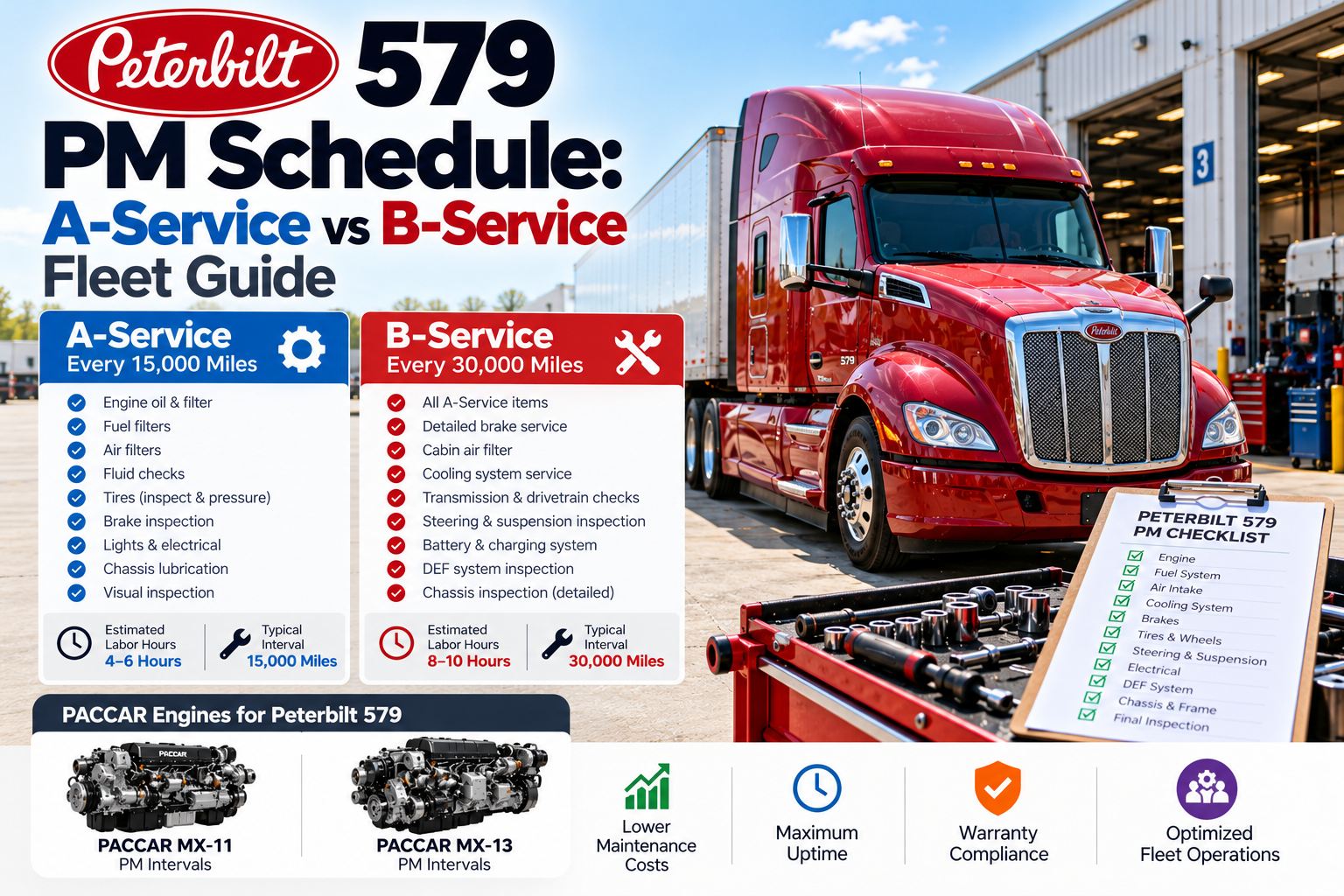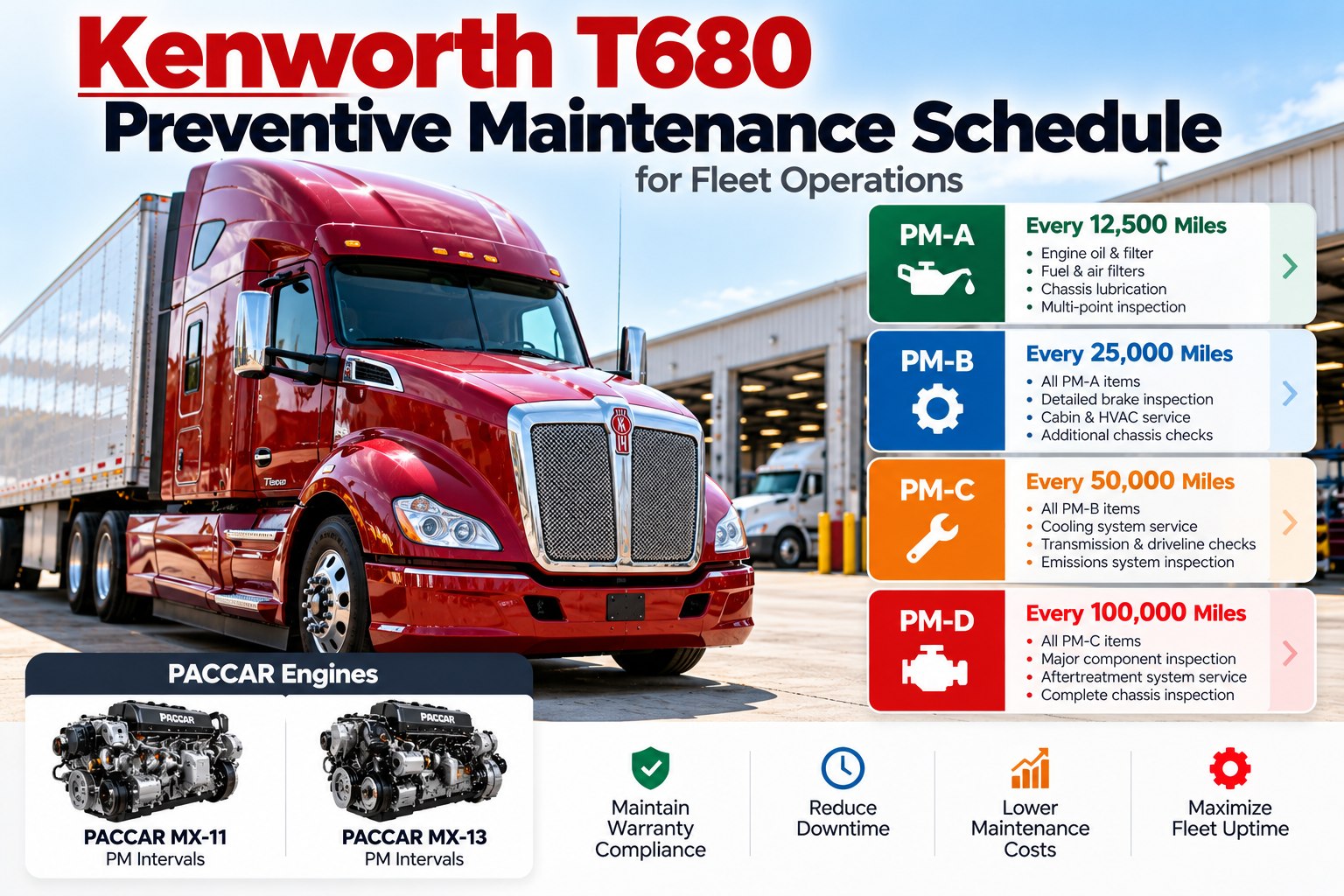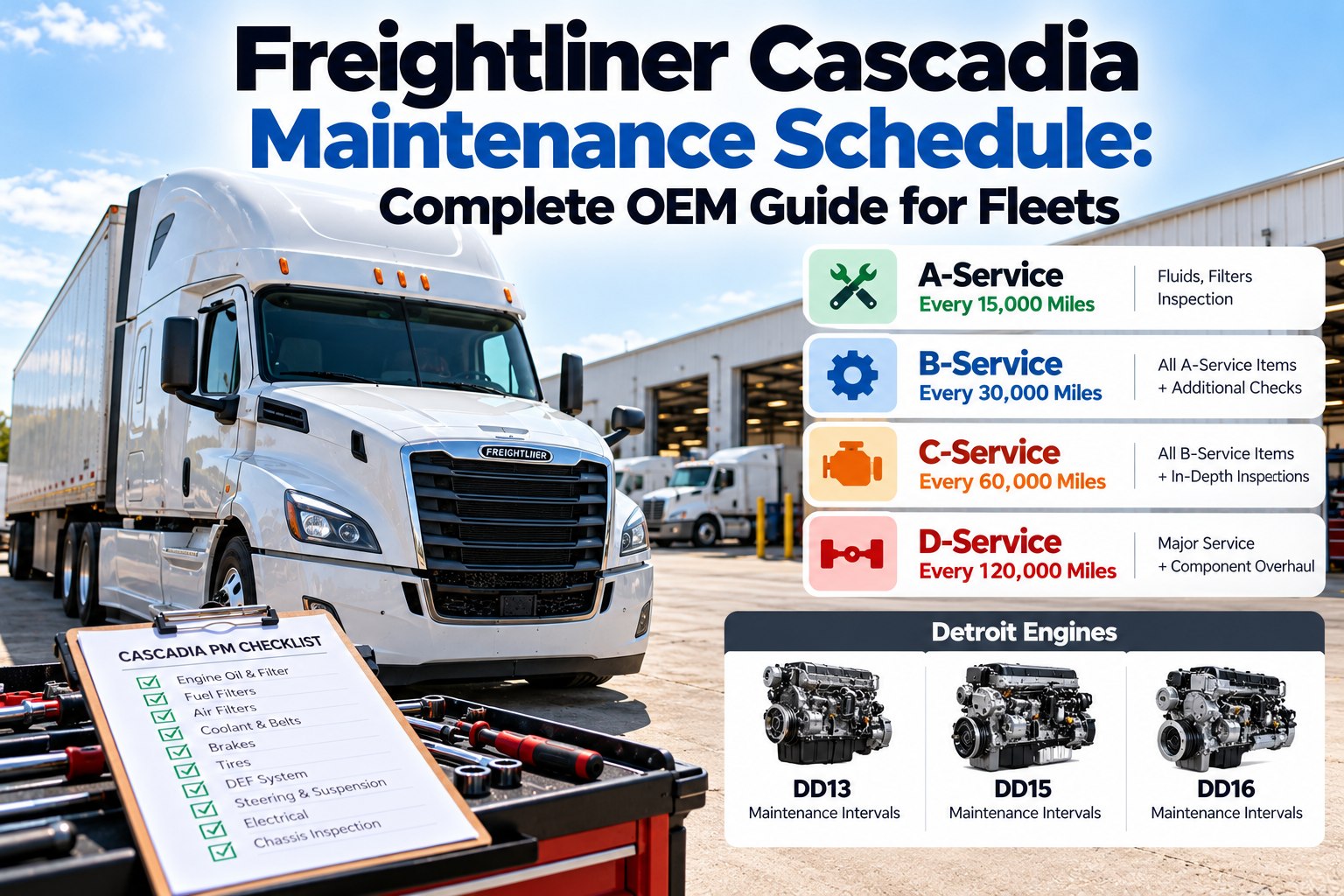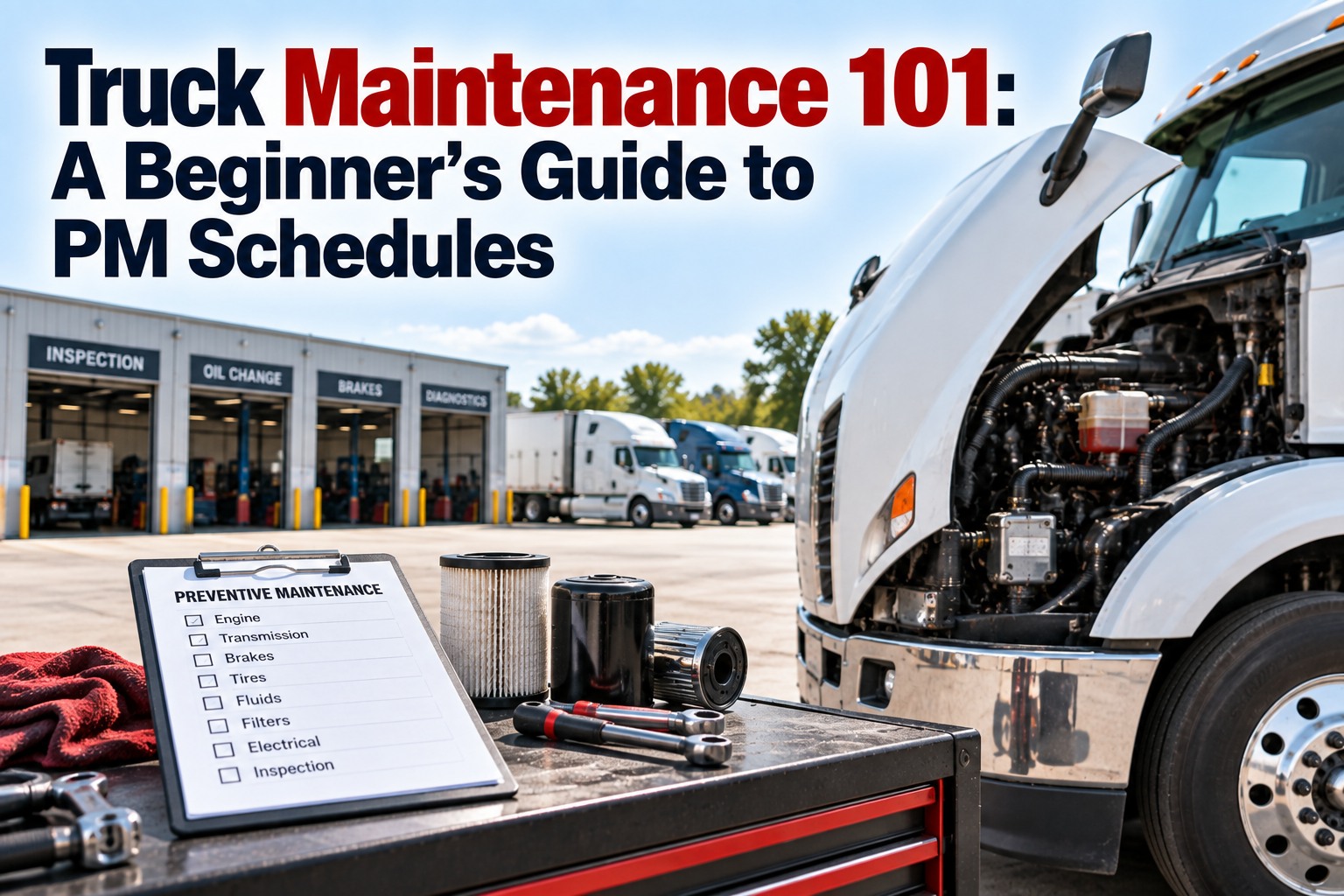
A truck preventive maintenance program is a written schedule that brings every vehicle into the shop before something breaks, built on four triggers — miles, engine hours, calendar time and condition data — and backed by records you can produce on request. It isn't optional: 49 CFR 396.3 requires every motor carrier to systematically inspect, repair and maintain the vehicles under its control, and to keep the records that prove it. This beginner's guide explains what to schedule, how to pick intervals for different trucks, what goes into each service level, how driver inspections feed the program, which records to keep and for how long, and a 30-day plan to get your first schedule running. Book a demo to see PM schedules running on your own units, or create a free account and set up your first three trucks.
Beginner's guide · Preventive maintenance
Every Truck Comes Into the Shop Eventually. A PM Schedule Decides Whether You Pick the Day.
For new fleet and maintenance managers, owner-operators and office staff taking on maintenance: how to build a PM program from scratch, from intervals to records.
What Preventive Maintenance Means for a Commercial Truck Fleet
Preventive maintenance is work done on a schedule to stop failures, rather than repairs made after one. For commercial fleets it is also a legal duty: federal rules require carriers to systematically inspect, repair and maintain every vehicle under their control, and to keep records showing it happened. A program has four parts — a schedule, a checklist for each service, a work order for what was found, and a record that survives the truck. You can set all four up on three vehicles with a free account.
When each truck is due, by miles, hours, date or condition.
What gets inspected and replaced at each service level.
What was found, what was repaired, which parts and labor.
Proof kept for the required period, ready to produce on request.
The Four Triggers That Decide When a Truck Is Due for Service
Most beginner programs use miles alone, which quietly over-services highway trucks and under-services vocational ones. Use whichever trigger arrives first for each unit, and let condition data catch what the calendar misses. We can set the right trigger per unit with you in a demo.
Mileage
Best for highway tractors that accumulate miles steadily and idle little.
Line-haul, regionalEngine hours
Best where the engine runs without the odometer moving: idling, PTO work, stop-start routes.
Vocational, refuse, utilityCalendar
A backstop for low-use trucks, and how seasonal work and annual inspections get scheduled.
Spare and seasonal unitsCondition and fault data
Fault codes, oil analysis and wear readings that pull a service forward when a truck needs it early.
Any unit with telematicsWhich trigger fits which kind of truck
Guidance, not a ruleRelative weighting, our assessment for a typical mixed fleet. Set your own mix from each unit's duty cycle.
How a Tiered PM Schedule Works, From Light Service to the Annual Inspection
Most fleets run a tiered schedule so that a light service happens often and a deep one happens rarely, with each tier including everything below it. When a higher tier comes due, do the lower ones in the same visit and reset all the clocks together. Set your tiers up free on 3 vehicles. Swipe the table on mobile.
| Tier | Typical scope | Notes |
|---|---|---|
| PM-A Light service | Oil and filter, fluid levels, tires, lights, brake visual, fault code read | Most frequent touchpoint |
| PM-B Intermediate | Everything in PM-A plus fuel and air filters, brake measurement, steering and suspension, battery and charging | Builds on the light service |
| PM-C Comprehensive | Everything above plus driveline fluids, chassis lubrication, cooling system service, wheel ends | Bigger shop block |
| PM-D Annual and major | Everything above plus the federal annual inspection, brake overhaul assessment, frame and structural checks | Plan it around the annual inspection |
Get your intervals from the engine and vehicle makers, not from a blog
Published interval ranges vary widely by engine, oil specification, duty cycle and climate, and a wrong number is expensive in both directions. Start from the manufacturer's service manual for each model you run, then tighten intervals for severe duty — heavy idling, stop-start work, dust, extreme temperatures — and adjust over time using your own findings and oil analysis.
What Actually Gets Inspected and Replaced at a Preventive Maintenance Service
Group the work so nothing gets skipped when a bay is busy. These six groups cover the systems that produce most roadside failures and most out-of-service violations. We can turn these into your PM checklist in a demo.
Lining thickness, drums and rotors, chambers, slack adjusters, air leaks, moisture in the tanks.
Pressure, tread depth, irregular wear, wheel seals, hub oil, torque on fasteners.
Engine oil and filter, fuel and air filters, coolant condition, DEF level and quality.
Play, bushings, springs, shocks, U-bolts, kingpins and tie rod ends.
All lamps and reflectors, connections, batteries, charging output, corrosion.
Read active and inactive fault codes, review regeneration history, check for leaks and crystals.
The third step is where most beginner programs stall
In 30 minutes we'll load your trucks, set mileage, hour and calendar triggers, and show what next month's PM board looks like.
How Driver Inspections Feed the Preventive Maintenance Program
Scheduled services catch wear; drivers catch what happened yesterday. A defect reported on a driver vehicle inspection report should open a work order the same day, and repeated defects on one unit should pull its next PM forward. Connect DVIRs to work orders free.
Which Maintenance Records You Must Keep, and for How Long
A program you can't prove is a program you don't have. These four retention periods come straight from the federal rules, and records generally must be produced within 48 hours of an official request. See retention tracked automatically in a demo. Swipe the table on mobile.
| Record | Keep it for | Rule |
|---|---|---|
| Driver vehicle inspection reports | 3 months from the date written | 49 CFR 396.11 |
| Maintenance and repair records | 1 year, plus 6 months after the vehicle leaves your control | 49 CFR 396.3(b) |
| Annual inspection report | 14 months from the report date | 49 CFR 396.21 |
| Roadside inspection reports | 12 months | 49 CFR 396.9 |
Retention periods from 49 CFR Part 396. Confirm against the current eCFR text for your operation.
A 30-Day Plan to Get Your First PM Schedule Running
You don't need a perfect program to start — you need every truck on a list with a due date. Work through these four weeks in order. Start the first week free on 3 vehicles.
Every unit with its class, duty cycle, current mileage or hours, and last service date.
Take the manufacturer's numbers, tighten for severe duty, and write them down per model rather than fleet-wide.
One checklist per tier, one path from defect to closed work order, one place records live.
Put the next 90 days of PMs on the board, book the bay time, and set your first KPI baseline.
Six Mistakes That Sink a New Preventive Maintenance Program
Every one of these is common, and every one is fixable in the first month. We can review your plan against these with you.
A delivery van and a Class 8 tractor don't wear alike. Set intervals per model and duty cycle.
High-idle trucks age far faster than their odometers suggest.
If nothing alerts, dates slip quietly until a breakdown reveals it.
A defect noted and not scheduled is a defect that reaches the roadside.
Without findings, you can't tighten intervals or prove the program exists.
A schedule with no capacity behind it becomes a backlog within a month.
The Five Numbers That Show Whether Your PM Program Is Working
Track these from month one and review them beside your preventive maintenance schedule. They tell you whether the schedule is being followed, whether it is catching anything, and whether it is changing what happens on the road. The cost side is what pays for it: industry benchmarking puts unplanned downtime at roughly $448 to $760 per truck per day before towing and repair, and ATRI puts average repair and maintenance cost at $0.215 per mile in 2025, up 8.6%. Start your baseline free.
Truck Preventive Maintenance Questions New Fleet Managers Ask
What is a truck preventive maintenance schedule?
A written plan that brings each vehicle in for service at set intervals — by miles, engine hours, calendar time or condition data — with a checklist for each service level and a record of what was found and repaired. See a schedule built on your units.
Is preventive maintenance legally required for commercial trucks?
Yes. Federal rules require carriers to systematically inspect, repair and maintain the vehicles under their control and to keep maintenance records, in addition to daily driver inspection reports and the annual inspection. Track compliance records free.
Should I schedule by miles or engine hours?
Use whichever comes first for that truck. Highway tractors track well on miles; vocational and high-idle units age on hours, and mileage alone under-services them. Set the right trigger per unit with us.
What are PM-A, PM-B, PM-C and PM-D?
Common names for a tiered schedule, from a light frequent service up to a major annual one, with each tier including the work below it. The intervals behind the names should come from your manufacturer's service information, not a generic figure. Set your tiers free.
How long do I need to keep maintenance records?
Maintenance records for one year plus six months after the vehicle leaves your control, DVIRs for three months, annual inspection reports for 14 months and roadside inspection reports for 12 months. Review retention with our team.
How do I start if everything is on paper today?
List every unit with its current mileage and last service, set intervals per model, build one checklist per tier and put the next 90 days on a schedule. Three trucks is enough to prove the process. Start with 3 vehicles free.
Put Every Truck on a Schedule Before the Road Picks the Date for You
FleetRabbit triggers each service by mileage, engine hours or calendar date, turns driver defects into work orders, and keeps the records with the retention period attached.