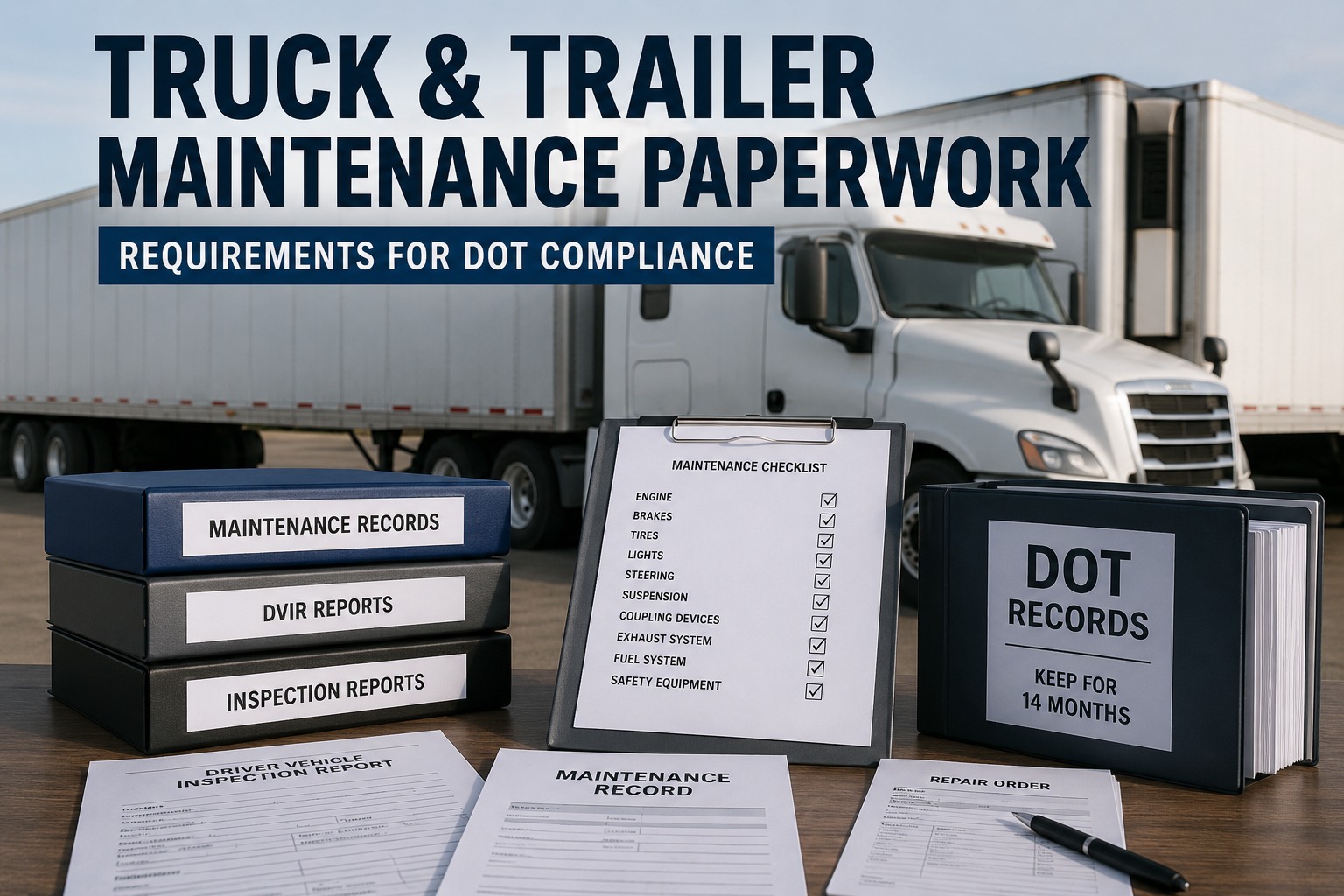
DOT compliance is not just about keeping your trucks in good repair — it is about proving you did. Under 49 CFR Part 396, motor carriers must document every inspection, repair, and maintenance action, and retain those records for specific periods that vary by document type. Miss the paperwork and it does not matter how well maintained the truck actually is: during a DOT audit, a missing record is treated the same as a missing repair. Vehicle maintenance files must be kept for one year in service plus six months after a vehicle leaves the fleet, annual inspection reports for 14 months, and DVIRs for three months — and every one must be produced on demand at the location where the vehicle is housed. This guide breaks down exactly what records to keep, for how long, and how digital recordkeeping eliminates the audit risk that trips up most fleets. Start free trial or book a demo to make your maintenance records audit-ready.
49 CFR PART 396 · RECORDKEEPING
During a DOT Audit, a Missing Record Counts the Same as a Missing Repair
FMCSA does not care whether the work was done if you cannot prove it. Vehicle maintenance files, DVIRs, and annual inspection reports each carry their own retention clock — and a gap in any one of them is a citable violation, regardless of how well the truck runs.
3 mo
DVIRs (Driver Vehicle Inspection Reports)
§396.11
1 yr
Vehicle maintenance files, in service
§396.3
14 mo
Annual periodic inspection reports
§396.17 / 396.21
+1 yr
Inspector qualification, after they leave
§396.19 / 396.25
Four different retention clocks. One place they all live.
Fleet Rabbit tracks every record's retention window automatically and flags a gap before an auditor does — no boxes, no spreadsheets, no lost weekend before a review.
The Complete DOT Maintenance Record Retention Table
The retention rules in Part 396 are spread across several sections, which is exactly why so many carriers get them wrong. Here is every maintenance-related record type, the regulation that governs it, how long you must keep it, and where it must be stored. Every one of these is subject to audit and can cost you if not properly maintained. Swipe the table horizontally on mobile to see all columns.
← Swipe to see all columns →
i
The rule most carriers get wrong: drivers are not required to submit a DVIR when they find no defects. FMCSA never required property-carrying CMV drivers to file "no-defect" reports — the obligation kicks in only when a driver discovers or is told about a problem. That said, individual carriers are free to require no-defect reports as company policy, and doing so builds a stronger documentation trail. Digital DVIR systems make no-defect logging effortless, so the record exists without adding paperwork burden.
See how digital DVIRs build the trail automatically.
What Actually Belongs in a Vehicle Maintenance File
Section §396.3 requires a maintenance file for every regulated vehicle under your control for 30 days or more. The regulation sets a bare minimum, but a defensible file — one that holds up in an audit and in accident litigation — goes further. Here is what each compliant file should contain.
Vehicle Identification
Company unit number, make, model, year, VIN, and tire size — the identifying details that tie every other record to the specific asset.
PM Schedule
A written preventive-maintenance schedule showing the frequency of inspections and services — following the manufacturer's recommended intervals is often the safest baseline.
Service & Repair Records
Repair orders, invoices, and work orders documenting every inspection, maintenance action, and repair actually performed on the vehicle.
Inspection Reports
Copies of the annual periodic inspection, plus DVIRs and their repair certifications — the proof that required inspections were completed and defects addressed.
Every Record, Every Retention Clock, One Audit-Ready System
Fleet Rabbit stores every DVIR, work order, annual inspection, and inspector file bound to the VIN, tracks each retention window automatically, and exports a complete, filtered audit package in one click. Deploy at $5/vehicle/month, no hardware, live within 72 hours.
Automatic retention tracking
VIN-bound digital records
One-click audit exports
Tamper-evident timestamps
Paper vs. Digital Recordkeeping
FMCSA explicitly allows carriers to maintain all maintenance records electronically, provided digital files meet the same standards as paper for integrity, accuracy, and accessibility. The regulation is format-neutral — but the two formats are not equal in practice. Recordkeeping violations remain among the most common and preventable audit failures, and almost all of them trace to the weaknesses of paper.
Paper & Spreadsheets
Records scattered across trucks, yards, and offices
Retention windows tracked by memory or a calendar
Audit prep means days of digging through boxes
A missing signature invalidates the whole record
No link between a defect and its repair proof
Lost or coffee-stained files can't be recovered
Digital Records
Every record centralized and bound to the VIN
Retention clocks tracked and flagged automatically
Audit package exports in a single filtered click
Required fields enforced at entry — nothing missing
Every defect links to its work order and sign-off
Tamper-evident, backed up, recoverable instantly
The Penalties for Getting It Wrong
Recordkeeping is not a soft compliance area. FMCSA treats missing and falsified records as citable violations with real financial teeth — and unlike a repair you can make on the spot, you cannot recreate a retention history that does not exist. Under regulation §390.31, carriers must maintain records at their principal place of business and produce them on demand.
$1,584
Per day for recordkeeping violations
$15,846
Maximum recordkeeping penalty per case
~22%
Of roadside-inspected vehicles placed OOS for maintenance defects
7%
Of carriers pass a DOT audit with zero violations
Frequently Asked Questions
How long do I have to keep DVIRs?
Driver Vehicle Inspection Reports must be retained for three months (90 days) from the date the report was prepared, under §396.11, along with any repair certification tied to them. They must be kept at the location where the vehicle is housed or maintained, or at the principal place of business. Note that drivers are only required to submit a DVIR when they find a defect — no-defect reports are optional unless your company policy requires them.
Book a demo.
Why is the annual inspection retention 14 months, not 12?
The annual periodic inspection itself is required every 12 months under §396.17, but the report must be retained for 14 months from the inspection date. The extra two months ensure that when the next annual inspection comes due, the previous report is still on file and available for an auditor to review the complete inspection history without a gap. Both the current and the immediately prior report should be retrievable.
Book a demo.
Can I keep all my maintenance records digitally?
Yes. FMCSA explicitly permits electronic recordkeeping for maintenance files, DVIRs, inspection reports, and more — provided the digital files meet the same standards as paper for integrity, accuracy, and accessibility. In practice, digital records are stronger: they enforce required fields at entry, track retention windows automatically, and export audit-ready in seconds. The key is a system that produces tamper-evident, timestamped records on demand.
Book a demo.
What happens to records when a vehicle leaves my fleet?
Under §396.3, the vehicle maintenance file must be retained for one year while the vehicle is in service, plus an additional six months after the vehicle leaves your control. That means selling or retiring a truck does not immediately clear your recordkeeping obligation — you must hold its file for six more months. Digital systems handle this automatically by retaining the record and flagging its final disposal date.
Book a demo.
Who is responsible if a third party did our annual inspection?
You are. Even if your carrier did not perform the vehicle's last annual inspection itself, you remain responsible for obtaining the original or a copy of that inspection report and producing it on demand to any authorized federal, state, or local official. Outsourcing the inspection does not outsource the recordkeeping obligation — the report must live in your maintenance file.
Book a demo.
What does a recordkeeping violation actually cost?
Recordkeeping violations can reach $1,584 per day up to a maximum of $15,846 per case. Beyond the direct fine, missing records damage your CSA score, can trigger a deeper compliance review, and create serious exposure in accident litigation where the absence of a maintenance record is treated as evidence of negligence. Given that only about 7% of carriers pass a DOT audit with zero violations, recordkeeping discipline is one of the highest-leverage investments a fleet can make.
Book a demo.
Make Every Maintenance Record Audit-Ready by Default.
Fleet Rabbit stores every DVIR, work order, annual inspection, and inspector file bound to the VIN, tracks each retention clock automatically, and exports a complete audit package in one click — so a DOT review becomes a filter-and-send task instead of a lost weekend. Integrated with your existing systems in 5–7 working days, at $5/vehicle/month, with no new hardware required.
Free tier for up to 3 vehicles · No credit card required · No hardware installation
July 18, 2026
By Emily Davis
All Articles