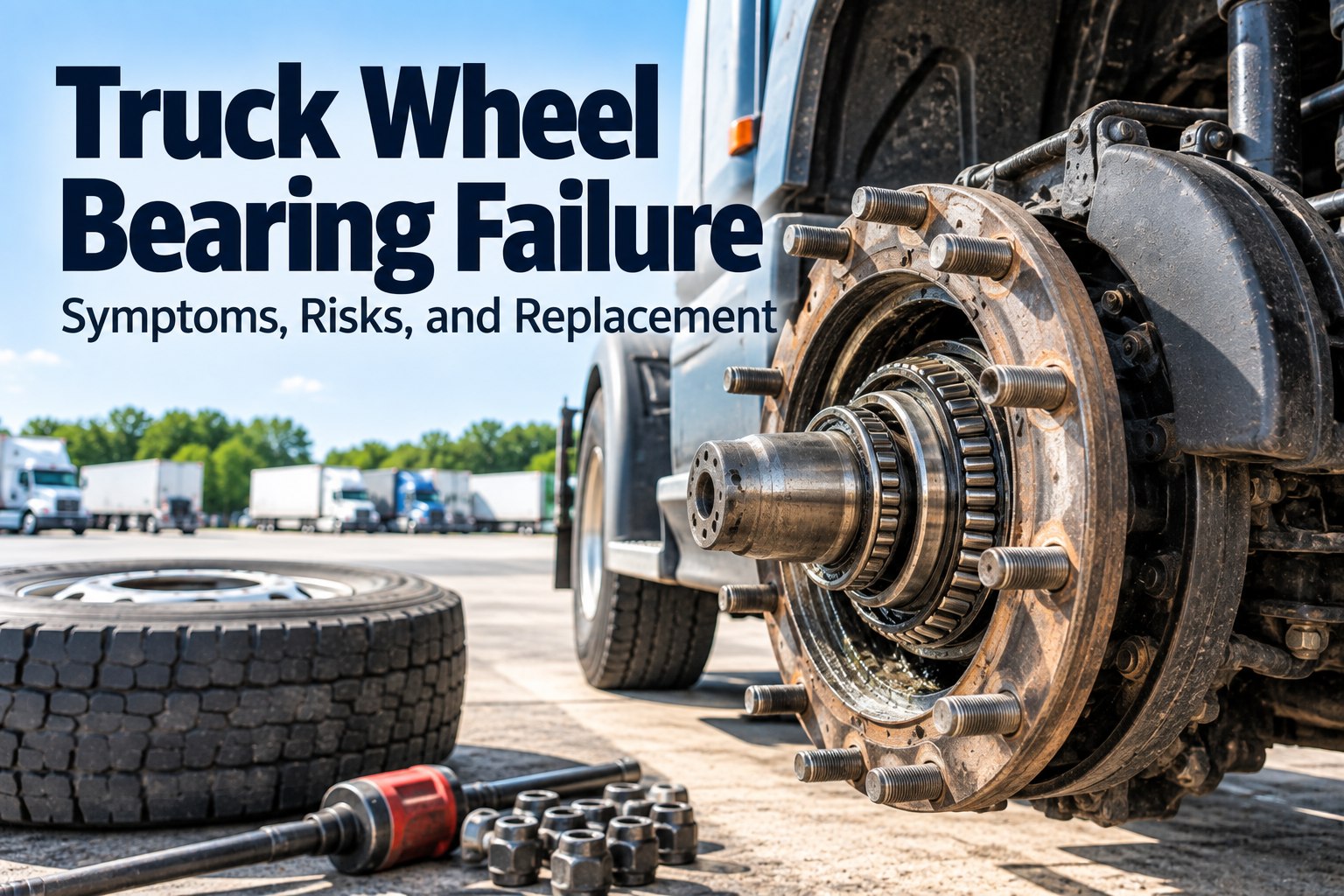
A heavy truck wheel bearing is set to a tolerance most people cannot picture: TMC Recommended Practice 618B puts acceptable wheel end play between 0.001 and 0.005 inches — a range narrower than a sheet of paper, which is about 0.004 inch thick. Outside that window in either direction, the wheel end starts consuming itself, and the failure path runs from a hum, through a leaking seal and a cycling ABS lamp, to spindle and hub damage, brake imbalance, and in the worst cases wheel separation while the vehicle is moving or a seal failure that ends in fire. The measurement that settles it is not a hand check: as TravelCenters of America's Homer Hogg puts it, the best way to check end play is with a dial indicator. This guide covers the symptoms in the order they appear, why the tolerance is so tight, manual versus pre-adjusted systems, the inspection routine, and what the repair costs before and after the wheel comes off. Book a 30-minute demo to see wheel-end findings tracked per position, or start free with 3 vehicles.
Five Thousandths of an Inch Separates a Wheel End That Lasts From One That Comes Apart.
For fleet mechanics, shop leads and maintenance managers: how to read the early symptoms, what end play actually has to be, and why a hand check has never been good enough.
No credit card required. Works alongside your existing PM routine.
Range per TMC Recommended Practice 618B, as reported by Trucks, Parts, Service. Verify with a dial indicator, not by feel.
SymptomsWhat a Failing Wheel Bearing Tells You, in the Order It Tells You
Wheel bearing failure is unusually generous with warning — it just gives those warnings to different people. The driver hears and feels the early ones; the technician sees the later ones on a wheel-end inspection. Catching the first group is the whole game. Record these findings by wheel position on a free account. Swipe the table on mobile.
| Symptom | What it means | How to confirm |
|---|---|---|
| Excessive wheel-end temperature | Friction from a bearing running tight, dry or loaded wrong | Hand or infrared check after a run — compare against the other side |
| A distinct humming noise | Classic bearing noise, most noticeable on front wheels | Road test, note whether it changes with speed or steering |
| Tire not spinning freely | Drag from a tight adjustment, or a brake not releasing | Jack and spin, compare both ends of the axle |
| Uneven tire wear | The wheel end is not tracking true, so the tread pays for it | Read the pattern before fitting a new tire |
| Leaking wheel seal | Seal damage from end play, heat or contamination | Look at the inner wheel face and the backing plate |
| ABS lamp coming on and off under braking | Sensor gap changing as the hub moves on a loose bearing | Read the codes, then check end play — not just the sensor |
| Vehicle handling changes | Play at the wheel end reaching the steering | Treat as urgent on a steer axle |
Symptom list drawn from Trucks, Parts, Service coverage of wheel end play and bearing adjustment, including guidance from TravelCenters of America and STEMCO.
The failure path, end to end
Consequence sequence as described in Trucks, Parts, Service. A wheel-end symptom on a steer axle is never a "next PM" item.
The toleranceWhy Wheel Bearings Are Set to a Range You Cannot Feel by Hand
Too loose and the hub moves — which chews seals, changes the ABS sensor gap and lets the bearing hammer itself. Too tight and there is no clearance for thermal expansion, so the bearing runs hot from the first mile. The correct answer is a narrow band with no margin for guessing, which is why the verification method matters as much as the adjustment. We'll add end play verification to your PM template in a demo.
- Wheel-end temperature climbs
- Tire will not spin freely
- Bearing life shortens fast
- Drag shows up as fuel burn
- Seal damage and lubricant loss
- ABS lamp cycling as the sensor gap changes
- Uneven tire wear and handling changes
- Progressive spindle and hub damage
"The best way to check it is with a dial indicator."
Homer Hogg, vice president of truck service operations at TravelCenters of America, on verifying wheel end play — Trucks, Parts, ServiceThe systemsManually Adjusted Versus Pre-Adjusted Wheel Ends
These two need different things from your shop, and confusing them produces wheel ends that look serviced but aren't. A manual system depends on the technician and has to be verified; a pre-adjusted system depends on torque and cannot be verified by measurement once it is together. Record which system each axle uses, free on 3 vehicles. Swipe the table on mobile.
| Manually adjusted | Pre-adjusted | |
|---|---|---|
| How the setting is achieved | Technician adjusts by feel, then verifies | Torqued to the manufacturer's specification |
| What it depends on | Technician skill and component quality | Following the torque spec correctly |
| How you verify it | A dial indicator, with the hub cap or axle removed | Torque value — preload is not measurable once installed |
| Typical outcome | Correct when done properly, variable when rushed | Consistent, neither too tight nor too loose |
| What to watch | Drift over time and after any wheel-end service | Correct torque and correct components at assembly |
On a pre-adjusted hub, the torque wrench is the measurement
Pre-adjusted wheel ends run in preload rather than end play, and as STEMCO's Chas Usé notes, that preload is not measurable when the wheel end is installed. There is no dial indicator check to fall back on, which makes torquing to the manufacturer's specification — with the right components, in the right order — the entire quality control step. Treat a missed torque spec on these as seriously as a missed measurement on a manual hub.
Which Wheel Positions Have Had a Seal or Bearing Twice in Two Years?
That list is where wheel-off risk lives, and almost no fleet can produce it on demand. Bring your last two years of wheel-end repairs and we'll group them by unit and position, show the repeats, and set up the checks so the next one is caught as a hum rather than a tow.
The routineWhat to Check Daily, at Every PM, and Whenever the Hub Comes Apart
Wheel ends reward routine more than almost any other component, because every failure mode above announces itself first. Put the daily items on the inspection report and the measured ones into preventive maintenance. Set the schedule free on 3 vehicles.
Oil level in the hub cap where fitted, any leak at the wheel face or backing plate, wheel-end temperature after a run, new noises or handling changes.
Seal condition, lubricant level and condition, hub cap gasket, fastener torque, and free rotation compared side to side.
Dial indicator with the hub cap or axle removed, on any wheel end showing heat, noise, a leaking seal or an ABS fault.
Anything that disturbs the hub — brake work, seal replacement, tire service — is a reason to confirm the setting before the truck leaves.
CostWhat This Repair Costs at Each Point on the Failure Path
The parts are modest at the start of the path and irrelevant at the end of it, because by then you are paying for a recovery and the damage the failure caused. Industry benchmarking puts unplanned downtime at roughly $448 to $760 per truck per day before towing and repair, and ATRI puts 2025 repair and maintenance cost at $0.215 per mile, up 8.6%. Estimate your own exposure with our team.
Relative cost by where on the failure path the problem is caught, illustrative — not prices. Downtime benchmark: FleetNet America and ATA's Technology & Maintenance Council via industry reporting; per-mile cost: ATRI.
MeasureFour Numbers That Predict a Wheel-End Failure Before It Happens
A single inspection tells you about today. These four turn wheel-end work into a pattern you can act on. Start tracking them free.
QuestionsTruck Wheel Bearing Questions Fleet Mechanics Ask Most
What are the first symptoms of a failing truck wheel bearing?
A distinct hum that changes with speed, excessive wheel-end temperature after a run, a tire that will not spin freely, a leaking wheel seal, uneven tire wear, an ABS lamp that comes on and off under braking, and changes in handling. See these tracked per position.
What is the correct wheel end play on a heavy truck?
TMC Recommended Practice 618B puts acceptable end play between 0.001 and 0.005 inches — for scale, a sheet of paper is roughly 0.004 inch. Verify it with a dial indicator rather than by hand. Record measured end play free.
Can I check a wheel bearing by rocking the wheel?
A hand check can find gross looseness, but it cannot resolve thousandths of an inch, which is the range that matters here. The industry guidance is explicit that a dial indicator is the way to verify end play. Review your verification steps with us.
What happens if a wheel bearing is adjusted too tight?
There is no clearance for thermal expansion, so the wheel end runs hot, the tire will not spin freely, drag shows up in fuel burn, and bearing life drops sharply. Too tight is as much a failure as too loose. Log wheel-end temperature checks free.
Do pre-adjusted hubs still need checking?
They need correct torque, correct components and correct assembly — but their preload is not measurable once the wheel end is installed, so there is no dial indicator check to fall back on. The torque specification is the quality control step. Set the procedure with our team.
How dangerous is it to keep running on a noisy wheel end?
The documented end point of an ignored wheel-end problem is spindle and hub damage, brake imbalance, and wheel or hub separation while moving or a seal failure that results in fire. Treat noise and heat as stop-and-inspect items, especially on a steer axle. Route these reports straight to the shop, free.
Catch the Wheel End While It's Still Making Noise
FleetRabbit keeps seal replacements, bearing work, measured end play and driver heat-and-noise reports against the wheel position they came from, flags the positions that repeat, and turns each report into a work order with that history attached.
No credit card required. Start with your next PM.