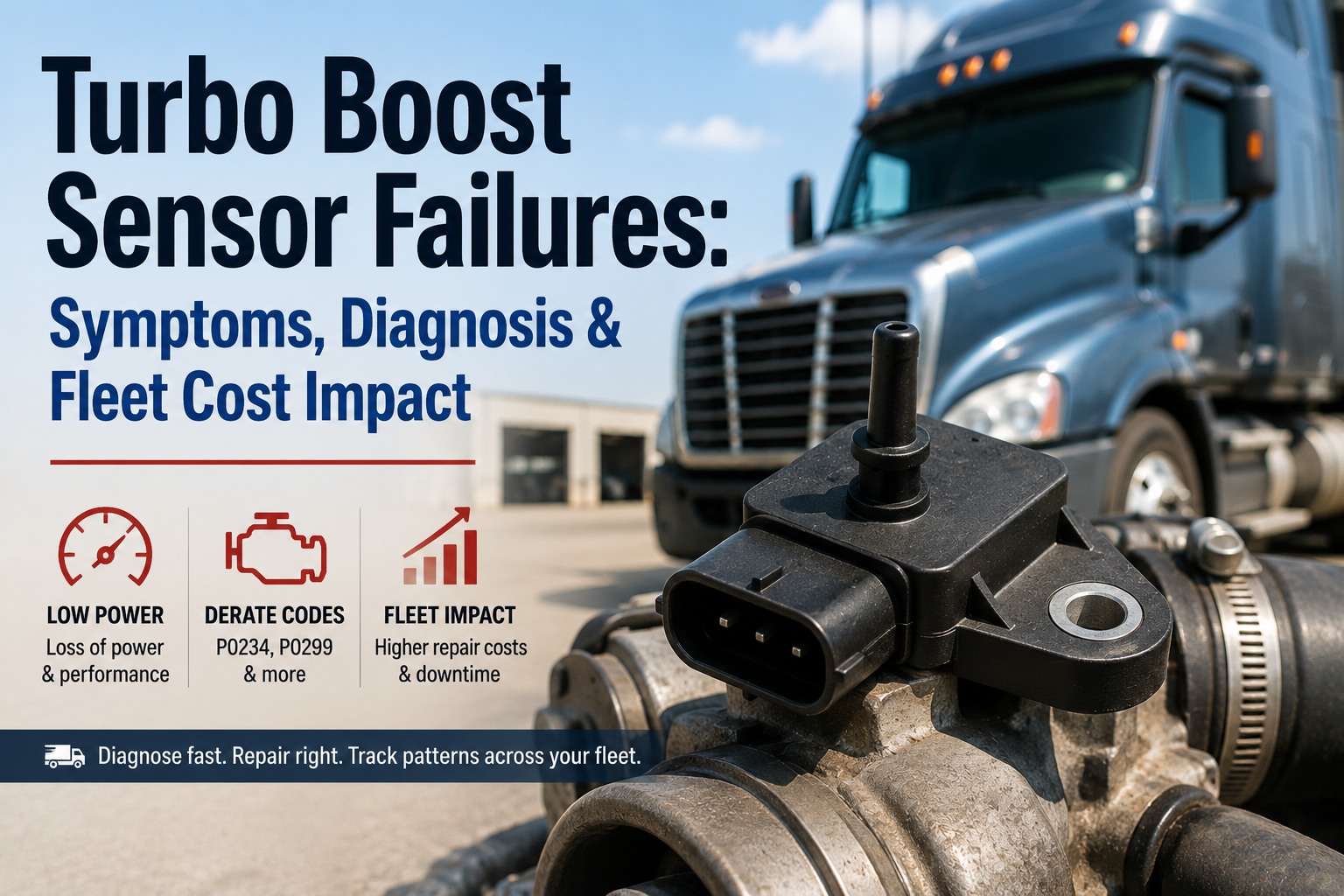
When a turbo-diesel loses power and drops into limp mode, the fault almost always traces back to one number the ECM watches constantly: the gap between the boost it commanded and the boost the engine actually made. Every turbo boost code is a statement about that gap. P0299 means actual came in under target; P0234 means it overshot. P0237 and P0238 mean the sensor reporting that number is electrically out of range and probably lying. The expensive mistake fleets make is treating all four as "the turbo" and replacing the turbocharger — a four-figure part — when the real cause is a split charge pipe, a soot-stuck VGT vane, a sticky solenoid, or a sensor reading high on a perfectly healthy turbo. The single test that prevents that mistake costs nothing: read requested boost against actual boost on a scan tool before touching a wrench. This guide walks fleet teams through what each code means, the requested-versus-actual test that splits a real boost problem from a lying sensor, the VGT and actuator faults behind most diesel cases, the repair costs, and how fleet software surfaces the pattern when the same boost fault starts spreading across trucks. Start free trial or book a demo to catch boost faults across the fleet before they become turbos.
DIAGNOSTICS & REPAIR · TURBO & BOOST
Every Boost Code Is One Number: Commanded vs. Actual
The ECM commands a boost target and watches what the engine delivers. Under target sets P0299, over target sets P0234, and a sensor reading outside its voltage range sets P0237 or P0238. Read that gap on a scan tool first and the diagnosis nearly makes itself.
P0299
UNDERBOOST
ACTUAL
TARGET
Actual came in below commanded
More common. Boost leak, stuck-open VGT vane, tired turbo, drifted sensor.
P0234
OVERBOOST
ACTUAL
TARGET
Actual overshot above commanded
Rarer but more urgent. Stuck-closed vane or wastegate, sensor reading high.
$45–$150
Boost pressure sensor — the cheap end of the range
$150–$500
VGT actuator replacement or recalibration
$1,500+
A full turbo — what you avoid by diagnosing first
250,000
RPM a turbo spins at full boost — zero room for error
System Code or Sensor Code? That Split Comes First
The four turbo codes fall into two groups that demand completely different responses. Two describe the boost the engine actually made; two describe the sensor's electrical signal. Knowing which group you're in tells you whether to chase mechanics or wiring.
SYSTEM CODES — actual boost is wrong
P0299P0234
The engine genuinely made too little or too much boost versus what the ECM commanded. The cause is mechanical or control-side: a boost leak, a sticking VGT vane, a wastegate problem, or a solenoid. This is where the real diagnostic work lives.
SENSOR CODES — the signal is out of range
P0237P0238
The boost sensor's voltage went below or above its valid window, so the ECM stops trusting it and substitutes a default — dropping the truck into limp mode. Usually a sensor, connector, or wiring fault, and usually the cheaper repair.
The One Test That Settles It: Requested vs. Actual
Before replacing any part, put a scan tool on live data and watch requested boost against actual boost during a loaded test drive. This single comparison separates a real boost problem from a sensor that's lying — and it's the difference between a $90 repair and a needless $1,500 turbo.
Actual boost genuinely undershoots or overshoots the requested target under load
↓
Real boost problem — chase the mechanics
Boost leak, VGT vane, wastegate, or solenoid
Actual boost tracks the target normally, yet a code is set and the truck is in limp mode
↓
The sensor is lying — chase wiring
Sensor, connector, or harness — usually under $300
i
The money-saving rule stated plainly: read live boost first. If actual boost is normal, you're chasing a sensor or wiring fault — usually a job under $300 — not an expensive turbo or wastegate repair. A boost code does not mean the turbo is bad; on many trucks it points to a boost leak, sticky vanes, a bad solenoid, or bad sensor information while the turbo itself is perfectly healthy. The scan-tool comparison takes minutes and routinely saves four figures.
See how logged live-data readings stay attached to the truck.
The VGT Problem Behind Most Diesel Cases
Most heavy diesels use a variable-geometry turbo whose vanes change angle to control boost. When those vanes stick — and on soot-heavy fleet duty cycles they do — the direction they stick in decides which code you get.
Vanes Stuck Open
The turbo can't build pressure, so actual boost falls short of target and you get a P0299 underboost. Sluggish, breathless power under load is the driver's complaint.
Vanes Stuck Closed
The turbo over-pressurizes, actual boost overshoots target, and you get a P0234 overboost — the more dangerous fault, since sustained overboost can damage the turbo and engine.
VGT Solenoid Failure
The solenoid uses oil pressure to move the vanes. When it sticks, fails, or has a wiring fault, the vanes don't move correctly — and a bad solenoid can make a perfectly good turbo look bad.
Why They Stick
Soot, rust, moisture, short-trip driving, extended idling, and age gum up the unison ring and vanes. Remove, inspect, clean, and service — if the ring or housing is worn, cleaning alone won't do it.
Sticky VGT vanes are a duty-cycle problem, and duty cycle is fleet-wide.
Fleet Rabbit surfaces boost codes across every truck, so a cluster of P0299s on your short-trip or high-idle units points at the operating pattern driving the soot — not four unlucky turbos.
The Four Codes, Decoded
Here's the full family with what each one actually means, its likely cause, and where to start. Swipe the table horizontally on mobile.
← Swipe to see all columns →
The Diagnostic Sequence
Work these in order, cheapest and most common first. The sequence is built to find a boost leak or a lying sensor before you ever consider pulling the turbo.
1
Read the Exact Code and Freeze-Frame
Identify whether you have a system code (P0234/P0299) or a sensor circuit code (P0237/P0238), and capture the freeze-frame conditions — the load and RPM where the fault set narrow the search immediately.
2
Watch Requested vs. Actual Boost
On a loaded test drive, compare the two on live data. Normal actual boost with a code means a sensor or wiring problem; a genuine shortfall or overshoot means a real mechanical or control fault.
3
Pressure-Test for Boost Leaks
The most common underboost cause. Check charge pipes, intercooler and its piping, hose clamps, and the diverter valve for splits and leaks — pressure escaping under load fails to reach the intake.
4
Inspect the VGT Vanes and Solenoid
Check the vane mechanism and unison ring for soot binding, and test the VGT solenoid — a bad solenoid or its wiring makes a healthy turbo behave like a failed one. Inspect the connector and pigtail.
5
Test the Wastegate Actuator
On wastegate turbos, apply a hand vacuum or pressure pump to the actuator. It should move smoothly and hold — if it sticks or leaks down, the actuator is suspect. Check the linkage for free movement.
6
Check the Boost Control Solenoid
Command it on and off with a scan tool and listen for the click; check resistance against spec and inspect its hoses for blockage or misrouting. A stuck solenoid mimics both over- and underboost.
7
Verify the Sensor and Its Wiring
Only after boost delivery checks out. Test sensor voltage against spec, clean corroded pins, dry moisture, and repair chafed wires. On some platforms a service bulletin ties these codes to the VGT actuator, not the sensor.
8
Replace — With the Cause Confirmed
Replace the sensor, solenoid, actuator, or turbo once testing has identified the failed part, and record what the live data and tests showed so a recurrence starts from evidence, not a fresh guess.
Diagnose the Boost Fault Before It Becomes a Turbo Bill
Fleet Rabbit logs every boost code against the specific truck with the live-data reading and repair that followed, flags parts replaced more than once, and surfaces the same code spreading across units — so you fix the boost leak or the sticky solenoid instead of buying a $1,500 turbo the truck never needed. Deploy at $5/vehicle/month, no hardware, live within 72 hours.
Requested-vs-actual logging
Repeat-failure flags
Fleet-wide boost patterns
Derate-risk alerts
Symptoms and What They Cost You
Boost faults rarely announce themselves dramatically — they creep in as lost power and worse economy before the limp-mode event that finally parks the truck. Here's what drivers report and what it means. Swipe the table horizontally on mobile.
← Swipe to see all columns →
How Fleet Software Catches the Pattern
A single boost code is a repair. The same code creeping across trucks, or returning after a part was already replaced, is information that changes what you fix. Here's how Fleet Rabbit surfaces it.
01
Requested-vs-Actual on Record
Log the live-data reading that split sensor from mechanical, so the next technician sees whether actual boost was normal or genuinely off — the finding that determines the whole repair path.
02
Repeat-Failure Flags
When a boost code returns after a sensor or actuator was already replaced, the system flags it — pointing you at the boost leak or solenoid the first repair missed rather than a second identical part.
03
Fleet-Wide Boost Patterns
The same underboost code across several trucks points at a shared cause — a soot-heavy duty cycle or a parts batch — instead of coincidental turbo wear on unrelated units.
04
Derate-Risk Prioritization
Boost codes that drop a truck into limp mode get flagged as urgent, so the unit is scheduled before a driver is crawling home with a load and an overboost condition risking the turbo.
05
Driver Symptom Capture
Sluggish power, black smoke, and turbo whine get logged the day they appear — weeks before the code sets, at the cheapest point in the failure curve.
06
Preventive Wiring & Actuator Checks
Schedule the recommended boost-sensor harness inspections and wastegate actuator servicing by interval, catching corrosion and soot binding before they set a code.
Frequently Asked Questions
What's the difference between P0234 and P0299?
They're mirror images. P0299 is an underboost condition — the turbo produced less pressure than the ECU commanded, usually from a boost leak, a sticking VGT vane, a stuck-open wastegate, a drifted sensor, or a tired turbo. P0234 is overboost — the turbo produced more than commanded, usually from a stuck-closed wastegate, a vane seized in the high-boost position, or a sensor reading high. They point in opposite directions and call for different repairs, so reading the stored code before doing anything else is essential — and logging that first read against the truck is exactly what you can
book a demo to see keep the diagnosis on track.
Does a turbo boost code mean my turbo is bad?
Usually not. A boost code tells you the system isn't matching what the PCM commanded, but that does not automatically mean the turbo is bad. These codes commonly come from a boost leak, sticky VGT vanes, a bad VGT solenoid, MAP or boost sensor issues, exhaust leaks, or EGR problems keeping the turbo from responding correctly — all far cheaper than a turbocharger. The way to know is to read live boost data before replacing anything, and keeping that reading on the truck's record is something you can
book a demo to see stop the reflexive turbo swap.
How do I know if it's the boost sensor or a real boost problem?
Read live boost first — requested against actual, on a loaded test drive. If actual boost is normal but a code is set and the truck is in limp mode, you're chasing a sensor or wiring fault, usually a repair under $300. If actual boost genuinely undershoots or overshoots the target, you have a real mechanical or control problem — a boost leak, VGT vane, wastegate, or solenoid. The sensor circuit codes P0237 and P0238 are electrical faults far more often than real overboost, so that live-data check, which you can
book a demo to see logged per truck, is what saves you from an expensive wrong turn.
Can I keep driving with a turbo boost code?
Carefully and briefly, but not for long. Most boost faults drop the truck into limp mode, limiting boost and fuel to protect the engine, so it's drivable to a safe location but severely down on power, often with black smoke, and towing rather than driving is the safer call for any distance. Overboost is the more urgent case — sustained overboost can damage the turbo and the engine, so a P0234 should come off the road promptly. Either way it's an efficiency and emissions problem every mile it runs, and catching it early is what you can
book a demo to see done through driver symptom reports.
Why do VGT turbo vanes stick, and what does it cause?
The variable-geometry vanes change angle to control boost, and they gum up over time from soot, rust, moisture, short-trip driving, extended idling, and age binding the unison ring. When the vanes stick open the turbo can't build pressure and you get a P0299 underboost; when they stick closed it over-pressurizes and you get a P0234 overboost. The fix is to remove, inspect, clean, and service the turbo — though if the vanes, ring, or housing are worn, cleaning won't be enough. Because sticking is driven by duty cycle, a cluster across similar trucks is a pattern you can
book a demo to see surface fleet-wide.
What does a turbo boost repair actually cost?
It spans an enormous range depending on which part actually failed, which is exactly why diagnosis matters. A boost pressure sensor runs roughly $45 to $150 and is often an easy replacement; wiring repair is in a similar band; a VGT actuator replacement or recalibration runs about $150 to $500; wastegate repair lands higher; and a full turbocharger is $1,500 or more. The gap between the cheap end and the turbo is the entire argument for reading live data before you order a part, and tracking what each repair actually cost per truck is something you can
book a demo to see build into your reporting.
Read the Gap First. Fix the Cause. Skip the Turbo You Didn't Need.
Fleet Rabbit logs every boost code with its requested-vs-actual reading against the truck, flags repeat failures, surfaces boost patterns spreading across the fleet, and prioritizes limp-mode faults — so turbo spend goes toward the boost leak or sticky solenoid that's actually the problem, not a turbocharger the truck never needed. Integrated with your existing systems in 5–7 working days, at $5/vehicle/month, with no new hardware required.
Free tier for up to 3 vehicles · No credit card required · No hardware installation
July 28, 2026
By Derek Goes
All Articles