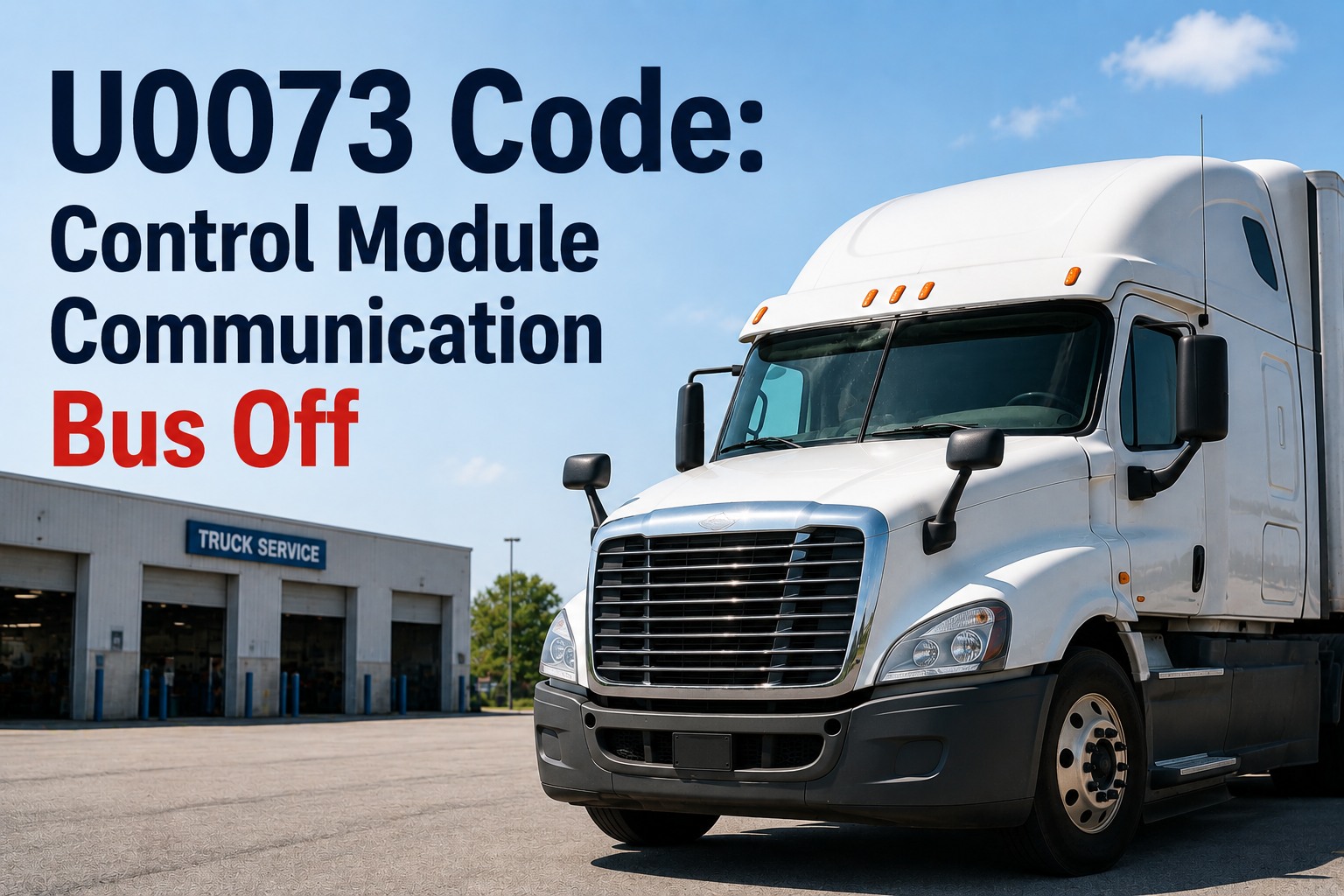
U0073 is one of the few codes with a single measurement that splits the entire diagnosis. It means the primary communication backbone — usually the high-speed network that carries powertrain, braking, steering and cluster traffic — has gone off from the perspective of one or more modules. That is a backbone-level fault rather than one module timing out, which is why it usually arrives with a crowd of other communication codes and a dashboard full of warnings. The useful part is that the network's electrical health can be checked with a multimeter across two pins of the diagnostic connector, and the number you get points in one of three completely different directions. Do that before anything else and the job stops being guesswork. Start free with three vehicles and keep the reading with the repair.
U0073
Control Module Communication Bus "A" Off
~0 ΩShort between the two lines
~60 ΩNetwork electrically healthy
~120 ΩOpen, or a terminator offline
Measured across pins 6 and 14 of the diagnostic connector with power off. One reading, three different jobs.
Why 60 Ohms Is the Number
Not arbitrary. It falls directly out of how the network is built, and understanding it makes the three readings self-explanatory.
Two resistors, in parallel
The network is terminated at each end by a 120-ohm resistor. Wired in parallel across the two data lines, they present roughly 60 ohms — which is what a healthy backbone measures. Tolerance is tight; readings much below about 57 or above 62 are worth investigating.
One of them lives inside a module
Typically one terminator sits inside the engine control module and the second inside another key module, or in a resistor pack elsewhere in the vehicle. That matters: losing a terminator can mean a module has dropped off rather than a resistor having failed.
The network needs both to work
With one terminator missing or a wire broken, resistance climbs toward 120 ohms and communication becomes unstable rather than simply absent — which is exactly the intermittent behaviour that makes these faults so frustrating to chase by symptom.
Do the measurement with the battery disconnected or power off — resistance readings taken on a live network are not meaningful. Use a wiring diagram to find an accessible access point if the diagnostic connector is not convenient, and leave the modules connected while you measure.
Three Readings, Three Jobs
What the number actually tells you to do next.
← Swipe to see all columns →
If the reading is good and the fault persists, move to a scope. At rest the two lines sit near a common voltage with small opposite deviations; a line stuck near zero or at supply voltage, no differential activity, or heavy ringing all indicate a hard fault or a termination problem that a static resistance check will not reveal.
Where the Corrosion Actually Is
The most useful section on this page, because these faults concentrate in specific physical places rather than distributing evenly along the harness.
01
The harness channel under the sill plate
Water intrusion leading to corrosion in the wiring channel beneath the driver's door sill is documented in manufacturer bulletins as producing a whole family of communication codes, alongside gauge fluctuation and shifting problems. Owners consistently report finding green-crusted data wires in exactly that spot.
02
Multi-wire connectors on the frame rail
A corroded connector on the frame rail under the driver's seat has been reported as resolving multiple communication codes once found and cleaned. Frame-mounted connectors sit in road spray and salt, and they fail accordingly.
03
After a jump start gone wrong
A blown high-amperage main fuse on the battery distribution block — from reversed polarity or a voltage spike during an improper jump start — has been reported as producing a completely dead truck with this code. Worth checking immediately on any unit that was jumped recently.
04
Anywhere someone has spliced in
Aftermarket devices tapped into the network are a recognised source of instability. If safe to do so, disconnect suspect devices one at a time and see whether the bus stabilises.
60
ohms
Two pins, two minutes
Record the reading, not just the repair.
A unit that measured 120 ohms last winter and measures it again this winter has a returning open, not a new fault. Fleet Rabbit keeps fault codes, test findings and repairs on one vehicle timeline — with telematics codes arriving as work orders that already carry the history.
Voltage and Grounds Can Fake This Entirely
A genuine trap, and the reason a resistance reading of 60 ohms does not end the job.
Poor grounds masquerade as bus failure
Low supply voltage and weak grounds can present exactly as a communication fault, and they make error counts worse rather than merely coexisting with them. Load-test supply and ground at the gateway module and at any heavily implicated module before condemning the network.
Manufacturer procedures pair the two
Service documentation routinely pairs this code with ground and connector checks rather than treating it purely as a wiring fault — which tells you how often the answer turns out to be electrical supply rather than data wiring.
Check bulletins before you start tracing
This code appears in published bulletin families covering loss of high-speed network communication across broad vehicle ranges, listing it alongside several other communication codes with symptoms including gauge fluctuation, intermittent no-crank and shifting problems, and pointing at wiring and connection issues. A known fault with a documented location saves hours of tracing, and on a fleet running one platform it may explain more than one truck.
Symptoms and Severity
The symptom list is long because the backbone carries everything. Severity scales with what stops talking.
Mild
Cluster anomalies and warning lightsGauge dropouts, chimes, multiple warning lamps and messages, loss of convenience functions such as door locks or interior lighting. Intermittent, and it worsens over time rather than settling.
Moderate
Driveline and braking affectedTransmission stuck or shifting incorrectly, loss of power features, intermittent no-crank or stalling. At this point the truck is unreliable rather than merely annoying.
Severe
Safety systems compromisedMissing safety-system warnings and unreliable driver assistance. Where stalling is occurring, recover the vehicle rather than driving it — and prompt diagnosis here is what avoids four-figure module repairs later.
Communication faults are the ones that return
Corrosion cleaned once comes back to the same connector; a splice that destabilised the bus destabilises it again. Fleet Rabbit records which connector was found, what the resistance read, and what was actually repaired — against the vehicle, so the second occurrence starts where the first one finished. Free for three vehicles, no credit card.
Frequently Asked Questions
What does U0073 mean?
The primary communication backbone — commonly the high-speed network carrying powertrain, braking, steering, cluster and gateway traffic — has gone off from the perspective of one or more modules. It is a backbone-level fault rather than a single module timing out, which is why it typically arrives with several other communication codes. Bus "B" faults carry a different code, and terminology varies slightly between manufacturers.
What is the first test?
Resistance across the two data pins of the diagnostic connector, with power off. A healthy network reads around 60 ohms, because it is terminated by two 120-ohm resistors in parallel. Roughly 120 ohms indicates an open — a broken wire, a failed terminator, or a module offline. Near zero indicates a short between the two lines. Readings much outside about 57 to 62 ohms are worth investigating.
Resistance is fine but the fault persists. Now what?
Two directions. First, check supply voltage and grounds under load at the gateway and at any implicated module — poor grounds and low voltage masquerade as bus failures and worsen error counts, which is why service procedures routinely pair this code with ground checks. Second, put a scope on the lines: a line stuck near zero or at supply voltage, absent differential activity, or heavy ringing all indicate a hard fault a static reading will not show.
Where should we look physically?
These faults concentrate. The wiring channel under the driver's door sill is documented as a water-intrusion and corrosion site producing whole families of communication codes; corroded multi-wire connectors on the frame rail under the driver's seat have been reported as resolving several codes once cleaned; and a blown high-amperage main fuse after an improper jump start has produced a dead truck with this code. Check any recent jump start immediately.
Could an aftermarket device be causing it?
Yes, and it is a recognised source of instability. Anything spliced into the network — added electronics, tracking or convenience devices — can destabilise it. Where it is safe per the service procedure, disconnect suspect devices one at a time and see whether the bus settles. An unexpected resistance reading that is not clearly an open or a short is also worth treating as a clue that something extra has been added.
Can we keep driving it?
Depends on what has stopped talking, and it deteriorates rather than stabilising. Mild cases show cluster anomalies and lost convenience functions; moderate cases disrupt transmission and braking systems; severe cases compromise safety systems. Where stalling is occurring, recover the vehicle rather than driving it. Prompt diagnosis is also what keeps this from becoming a four-figure module repair.
Should we check for bulletins?
Always, and before tracing. Published bulletin families cover loss of high-speed network communication across broad vehicle ranges, listing this code alongside several other communication codes with symptoms including gauge fluctuation, intermittent no-crank and shifting problems — and pointing at specific wiring and connection locations. That turns hours of harness tracing into a targeted inspection.
Start free with three vehicles and record what you find.
0 Ω60 Ω120 Ω
Measure First, Trace Second
Two pins and a multimeter narrow a whole-vehicle network fault to one of three jobs before anyone opens a harness — then check voltage and grounds, look where the corrosion is documented to be, and read the bulletins before tracing wire by wire.
Network architecture, pin assignments and expected values vary by manufacturer — follow the wiring diagram and procedure for your specific vehicle
September 2, 2026
By Sam Parker
All Articles