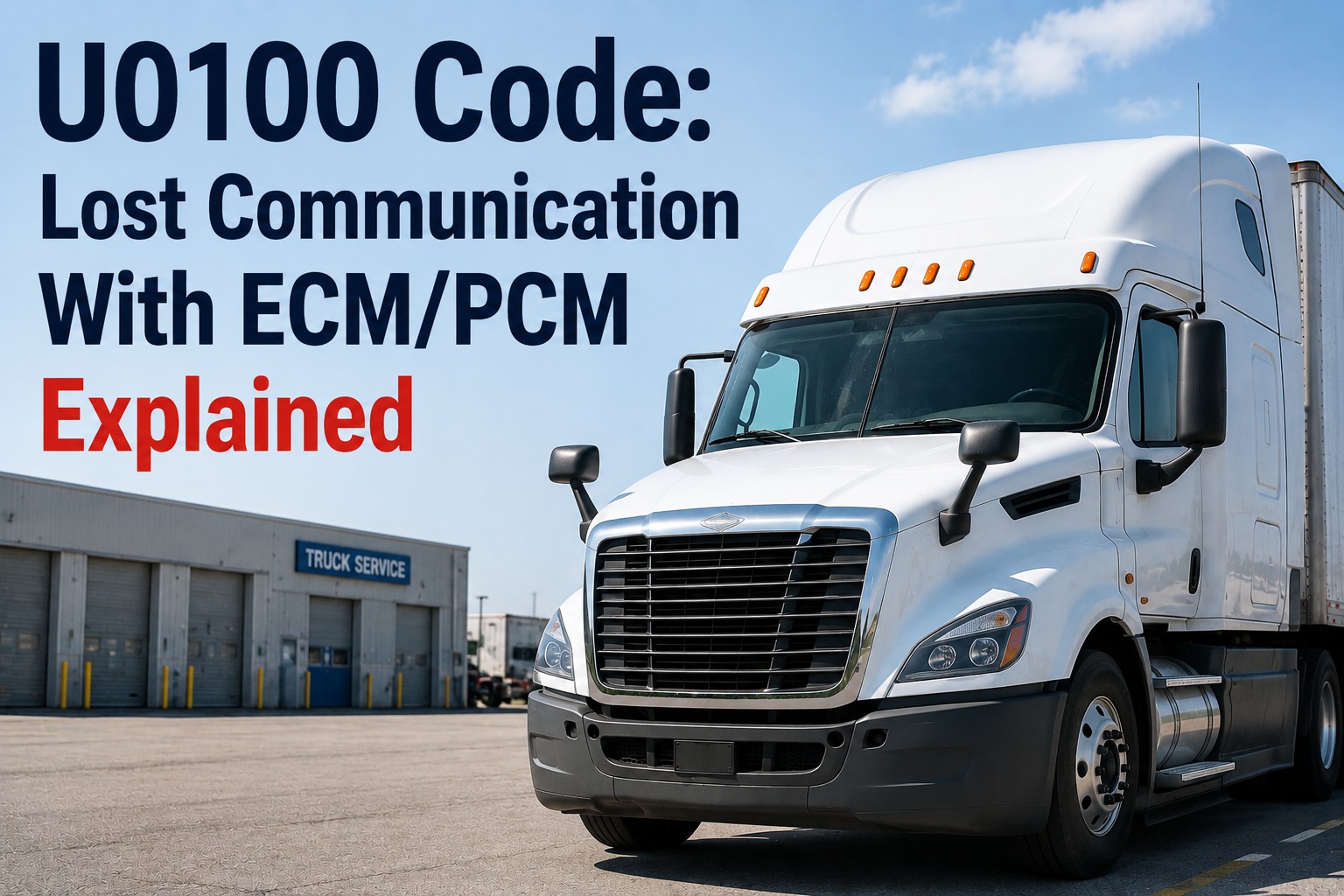
U0100 means other modules stopped receiving the messages they need from the engine control module. The module has gone dark on the network — and the most common reason is the least technical one available. Low system voltage is repeatedly identified as the number one cause of network drop-offs, ahead of wiring, ahead of connectors, and a very long way ahead of a failed computer. There is a specific mechanism behind that: the engine module runs on multiple power feeds and multiple grounds, and if a primary circuit fails it can still crank and run on what remains while losing the ability to transmit. The truck looks alive and is not talking. That distinction is worth knowing before anyone quotes for a replacement module and the programming that comes with it. Book a demo and keep the diagnosis with the vehicle.
U0100
Lost Communication With ECM / PCM "A"
Module supply
Power 1
Power 2
Ground 1
Ground 2
Still cranks · cannot transmit
Start With Voltage. Every Time.
Three checks before anything else, none of them expensive, and the first is described across sources as the single most common cause.
01
Battery, rested and under load
Around 12.6 volts at rest and a pass on a load test. Modern vehicles depend heavily on stable supply, and low voltage disrupts communication between modules directly. A weak battery is the simplest and most frequently cited cause of this code — check it before diving into anything complex.
02
Grounds, measured as voltage drop
Not continuity — drop under load, which should stay very small. A poor ground on the engine block can shut the module down entirely, and a marginal one degrades communication while leaving everything else apparently normal.
03
Module fuses and ignition relays
The supply path to the module, including its main fuses and ignition relays. A powered-down module produces this code everywhere at once, and correcting supply problems before touching the network is the correct order.
There is a diagnostic trick worth knowing for intermittents: tap lightly on the module and the main relay box while someone attempts to communicate with it. A connection that drops under vibration will often reveal itself immediately, and it costs nothing to try.
Why It Cranks But Cannot Talk
The mechanism that catches people out, and the reason a running engine does not rule this code out.
Multiple feeds, different jobs
The module typically has two or three power feeds and two or three separate grounds. They are not redundant copies of each other — different circuits support different functions inside the module.
Lose one and it half-works
If a primary power or ground circuit fails, the module may still crank and run on what remains while losing the ability to communicate on the network. It goes dark on the bus without going dark on the engine — which is precisely the confusing case where the truck runs and the scan tool cannot reach it.
Which is why symptoms vary so wildly
The same code produces anything from no symptoms at all through to a complete no-crank condition, depending on which circuit failed and how completely.
The Symptom Signature
Six, and two of them are distinctive enough to recognise across a yard.
No crank, no startOr an immediate stall. Where communication is lost entirely the vehicle may not start at all; where it is intermittent it runs poorly or drops into limp mode at random.
Cooling fans running at full speedA default fail-safe state, and one of the most recognisable signatures of this fault. Fans at maximum with a dead-feeling dashboard is a communication problem until proven otherwise.
The scan tool cannot reach the engine moduleNot a fault code from it — silence. Where a global scan shows several modules reporting this code and the engine module itself absent from the list, that absence is the finding.
A dashboard of unrelated warningsStability, traction, power steering, braking and airbag lamps together, plus reduced-power and service messages — because every one of those systems depends on data it is no longer receiving.
Feature losses that seem unconnectedCruise control, traction control, charging control and similar, varying by platform.
Or nothing at allGenuinely — the code can be present with no warning lights and no driveability symptom, which is why it sometimes only surfaces during an unrelated scan.
12.6
volts
Check this before anything else
The most expensive diagnosis on this code starts by skipping the cheapest test.
A replacement module runs into four figures once programming is included. A battery does not. Fleet Rabbit records battery and charging findings alongside fault codes on the same vehicle timeline — so a unit with a history of voltage complaints and a fresh communication code is an obvious sequence rather than two separate mysteries.
Water Is a Bigger Cause Than It Sounds
And on a fleet, one of the entry points is something your own operation does deliberately every week.
It causes two different faults
Water does more than corrode. It can create a direct short between the two data lines inside a connector, or raise the resistance of a ground circuit high enough that the module can no longer communicate properly. Same intrusion, two entirely different electrical symptoms.
Pressure washing forces it in
Engine-bay module connectors are a documented entry point specifically because rain or pressure washing can force water into them. If your wash routine includes the engine bay, that is a maintenance practice with an electrical consequence — and it is worth knowing before the third module goes on the same truck.
The other two entry points
Firewall grommets that have pulled loose, and underhood fuse and relay centres where the cover seal has deteriorated. Both are cheap to inspect and cheap to reseal, and both are ahead of any module in the diagnostic order.
Then there is whatever was added
Aftermarket electronics spliced into the network or into module power feeds are described as a major source of communication problems — remote starters, radios, alarms and trailer wiring kits among them. On a fleet, ask what was fitted and by whom before assuming a factory fault, particularly on units that have had accessories added since delivery.
Read the Scan Carefully
One interpretation trap that sends people to the wrong end of the vehicle.
Two networks, one gateway
Most vehicles run a high-speed network for powertrain modules and a slower one for body modules, bridged by a gateway — often the body control module itself. That architecture is the reason the code can mislead.
The module reporting it may not be near the fault
A fault on the high-speed powertrain network can show up as this code set by a body module sitting on the low-speed network entirely. The reporting module tells you who noticed, not where the problem is.
Run a global scan and read the pattern
Note which modules are offline and which are reporting the code, and use a topology or gateway view if the tool offers one. The shape of what is missing localises the fault far better than any single code does.
Cost, and the Programming Nobody Mentions
The range is enormous because the causes are, and there is one line item that surprises people at the far end.
Battery replacement or charging repair
The cheapest outcome, and a common one
Cleaning and resealing a wet connector
Labour, plus a seal
Ground repair or harness section
Modest, and permanent if done properly
Removing an aftermarket splice
Labour, and occasionally an argument
Module replacement
Commonly around $800–$1,200 for hardware, plus roughly $200–$300 labour
That last line carries a condition worth stating plainly: a replacement module will very likely need vehicle-specific programming before the engine will start at all. It is not a plug-in part, the programming is a separate cost, and it needs a properly equipped facility — which is why the module belongs at the end of the diagnostic order rather than the start of the parts list.
Do Not Drive It
The clearest advice on this page, and the least ambiguous across sources.
Behaviour becomes unpredictable
Loss of communication between the engine module and the rest of the network can produce unpredictable behaviour in the engine, the transmission and safety-critical systems including braking assistance and restraints. Driving with this code present is generally not considered safe.
Recover rather than drive
The advice is direct: have the vehicle towed where possible, because the small saving on recovery is not worth the safety risk or the potential for a more expensive failure. On a stalling truck this is not a judgement call.
Clearing it achieves nothing
The code returns if the underlying cause remains. Resetting without diagnosing simply removes the evidence and postpones the same conversation — usually to a less convenient location.
Voltage first, module last — and write down which it was
Fleet Rabbit brings telematics fault codes in as work orders with the vehicle's history attached, alongside driver inspection defects and preventive schedules in the same queue. Battery findings, connector repairs and module work all sit on one timeline, so a repeat communication fault starts from what the last one actually found. Free for three vehicles, no credit card.
Frequently Asked Questions
What does U0100 mean?
Modules on the network stopped receiving the messages they require from the engine or powertrain control module within the expected time. In plain terms, part of the vehicle can no longer talk to the engine computer. If communication is lost entirely the vehicle may not start; if it is intermittent, the truck may run poorly or drop into limp mode at random. A related code covers lost communication with the transmission module specifically.
What should we check first?
Battery and charging voltage. Low system voltage is repeatedly identified as the most common cause of network drop-offs, and it is the cheapest thing on the list to rule out — around 12.6 volts at rest with a pass on a load test. Then grounds, measured as voltage drop under load rather than continuity, since a poor ground on the engine block can shut the module down entirely. Then the module's fuses and ignition relays.
The engine runs. Can this still be the fault?
Yes, and it is the case that confuses people most. The module has two or three power feeds and two or three grounds, and if a primary circuit fails it can still crank and run on what remains while losing the ability to communicate on the network. It goes dark on the bus without going dark on the engine. That is why symptoms range from a complete no-start to no symptoms at all.
Is there a recognisable signature?
Two. Cooling fans running at maximum speed constantly is a default fail-safe state and one of the clearest indicators. And a scan tool that cannot connect to the engine module at all — where a global scan shows several modules reporting this code while the engine module itself is absent, that absence is the finding rather than an inconvenience. Add a dashboard of unrelated warnings across stability, steering, braking and restraints.
Could washing the truck have caused it?
Plausibly. Module connectors in the engine bay are a documented water entry point specifically because rain or pressure washing can force water in. Water then causes two distinct faults — a direct short between the data lines inside the connector, or a ground circuit resistance high enough to stop the module communicating. Firewall grommets that have pulled loose and underhood fuse centres with deteriorated seals are the other two entry points.
The code was set by the body module. Does that mean the fault is there?
Not necessarily, and this is a genuine trap. Most vehicles run a high-speed network for powertrain modules and a slower one for body modules, bridged by a gateway. A fault on the high-speed side can appear as this code set by a module sitting entirely on the low-speed network. The reporting module tells you who noticed, not where the problem is — run a global scan and read which modules are offline instead.
What does a replacement module cost?
Commonly around $800 to $1,200 for the hardware plus roughly $200 to $300 in labour, and there is a condition worth knowing: a replacement will very likely need vehicle-specific programming before the engine will start at all. It is not a plug-in part and the programming requires a properly equipped facility. Which is exactly why voltage, grounds, connectors and aftermarket wiring all come first.
Start free with three vehicles and record what the diagnosis actually found.
Tow it
Don't drive a truck whose engine module is off the network
Cheapest Cause, Most Expensive Assumption
Voltage before wiring, grounds before connectors, connectors before modules — and remember that a module which still cranks the engine can be completely absent from the network, so a running truck proves nothing here.
Architecture, supply circuits and programming requirements vary by manufacturer — follow the procedure for your specific vehicle
September 2, 2026
By Alex Rowan
All Articles